Wabi-Sabi
Imagine finding profound beauty in a cracked ceramic vase, weathered wood, or an incomplete sketch. That's wabi-sabi—a Japanese aesthetic philosophy that transforms how we see imperfection, impermanence, and simplicity. In a world obsessed with flawlessness, wabi-sabi offers a liberating antidote: the art of appreciating things exactly as they are, with all their marks of age, wear, and incompleteness. This ancient wisdom isn't just about aesthetics; it's a gateway to reduced perfectionism, deeper contentment, and measurable improvements in mental wellbeing that modern psychology increasingly recognizes as essential for lasting happiness.
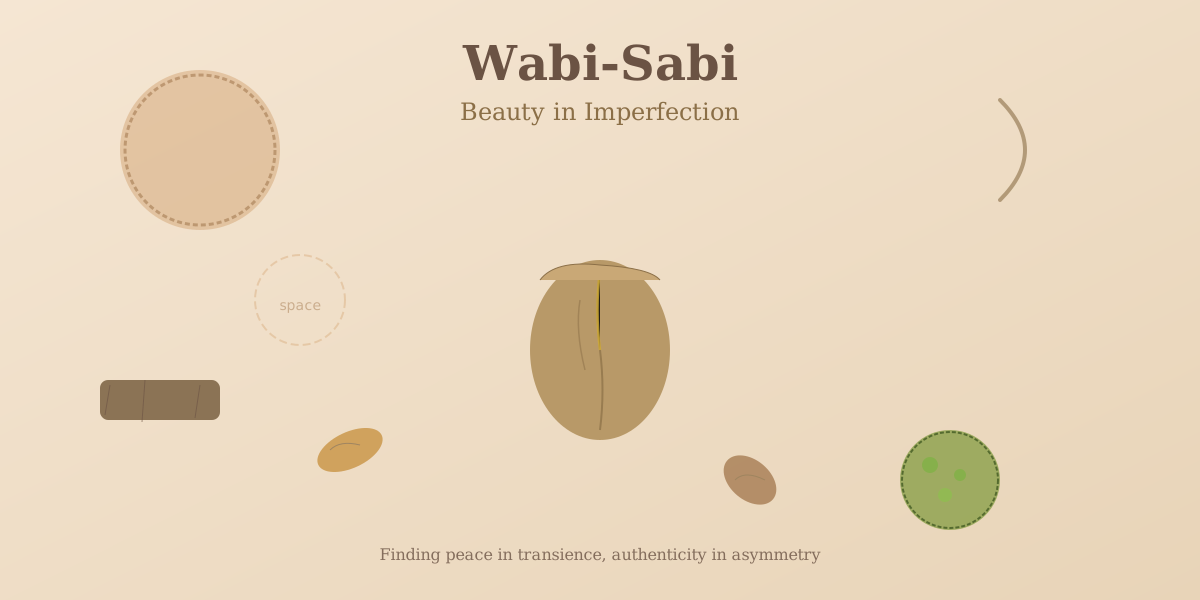
Wabi-sabi teaches us that nothing lasts, nothing is finished, and nothing is perfect—and that's where the real beauty lies.
When you embrace wabi-sabi, you stop fighting against life's natural cycles and instead find strength and elegance in them. You learn to see your own imperfections not as flaws to hide, but as evidence of lived experience and authentic growth.
What Is Wabi-Sabi?
Wabi-sabi (侘寂) emerges from fifteenth-century Japanese tea ceremony culture and is rooted in Zen Buddhist philosophy. The term combines two concepts: wabi, meaning 'less is more' or simplicity, and sabi, meaning 'the beauty of age and wear' or attentive melancholy. Together, they describe an aesthetic that finds profound beauty in imperfection, impermanence (mujō), and incompleteness. Unlike Western aesthetics that prize symmetry and perfection, wabi-sabi celebrates asymmetry, the marks of time, natural materials, and the awareness that all earthly things are transient.
Not medical advice.
Wabi-sabi represents a complete worldview—a philosophy of acceptance grounded in the three marks of existence from Buddhism: impermanence (mujō), suffering or unsatisfactoriness (ku), and emptiness or non-self (kū). Rather than viewing these as negative, wabi-sabi reframes them as the source of all beauty and meaning. A weathered temple, a simple tea bowl with an irregular glaze, a garden moss-covered by centuries—these are not incomplete or deteriorated; they are masterpieces precisely because they bear the honest marks of existence.
Surprising Insight: Surprising Insight: The aesthetic principle of wabi-sabi was so deeply valued in Japanese culture that master potters would intentionally create asymmetrical pieces and leave visible fingerprints—practices that would be considered flaws in Western pottery but are celebrated as authentic expressions of the artist's hand in wabi-sabi tradition.
The Three Pillars of Wabi-Sabi
Visualization showing how impermanence, imperfection, and incompleteness form the foundation of wabi-sabi philosophy
🔍 Click to enlarge
Why Wabi-Sabi Matters in 2026
In 2026, we live in an era of curated perfection. Social media presents impossible standards of flawlessness—filtered photos, edited lives, and the pressure to project a perfect image. This constant comparison fuels anxiety, depression, and the relentless perfectionism that mental health professionals identify as a major cause of suffering. Wabi-sabi arrives as a psychological counterbalance, offering a framework that directly contradicts these perfectionist demands. By redefining what's beautiful and valuable, wabi-sabi makes acceptance psychologically accessible and culturally validated.
Research increasingly shows that psychological flexibility—the ability to accept reality as it is rather than fighting against it—correlates strongly with emotional resilience, reduced anxiety, and greater life satisfaction. Wabi-sabi is essentially psychological flexibility made visible and tangible. When you practice wabi-sabi, you're training your brain to habituate to imperfection and impermanence, which reduces the neural stress responses triggered by perfectionist thinking. A 2023 neuroimaging study found that 'high accepters' (people who habitually practice acceptance) showed distinct differences in brain networks linked to emotional regulation compared to those who struggle with acceptance.
Additionally, in an increasingly disposable consumer culture, wabi-sabi promotes mindful consumption by teaching appreciation for aged, imperfect, and simple objects over constantly buying new ones. This aligns with both wellbeing science (which shows that appreciation and gratitude are stronger happiness predictors than acquisition) and environmental consciousness. Wabi-sabi transforms how we relate to possessions, decay, aging, and time itself—from enemies to be fought to natural processes to be understood and valued.
The Science Behind Wabi-Sabi
While wabi-sabi itself hasn't been formally studied as a clinical intervention (there are no randomized controlled trials specifically testing 'wabi-sabi therapy'), the scientific evidence supporting its underlying mechanisms is robust. Acceptance and Commitment Therapy (ACT), one of the most evidence-based psychotherapy approaches, shows that learning to accept and defuse from perfectionist thoughts reduces anxiety and depression. Wabi-sabi is essentially an ancient, culturally embodied version of acceptance practice. When you look at a cracked bowl and see beauty instead of worthlessness, you're practicing the same neural rewiring that ACT promotes—recontextualizing your relationship to imperfection.
Neuroscience reveals that our brains have a strong aversion to uncertainty and incompleteness. The 'Zeigarnik effect' describes how unfinished tasks create persistent cognitive tension. But repeated exposure to incompleteness while adopting a positive frame can recalibrate this response. Studies on mindfulness show that practitioners demonstrate increased activity in brain regions associated with emotional regulation (prefrontal cortex) and decreased reactivity in the amygdala. Wabi-sabi practice—deliberately noticing and appreciating imperfections and incompleteness—activates similar neural pathways. The contemplative awareness central to wabi-sabi mirrors the sustained attention cultivated in meditation, which has documented effects on brain structure and emotional resilience.
How Wabi-Sabi Shifts Neural Pathways
Brain response differences when encountering imperfection through perfectionist vs. wabi-sabi mindsets
🔍 Click to enlarge
Key Components of Wabi-Sabi
Impermanence (Mujō)
The recognition that all things—objects, relationships, moments, even life itself—are constantly changing and will eventually decay or disappear. Rather than being depressing, impermanence is liberating in wabi-sabi philosophy. It explains why a cherry blossom is precious (because it will fall), why aging skin can be beautiful (because it tells a story of lived time), and why clinging to anything as 'permanent' causes suffering. Accepting impermanence reduces the suffering that comes from resistance to change and deepens appreciation for what exists now.
Imperfection (Fukanzen)
Asymmetry, irregularity, and visible flaws are celebrated rather than hidden. In the tea ceremony, a bowl might have an uneven rim or an unexpected glaze pattern—these aren't mistakes but expressions of authenticity and the artist's direct engagement with materials. Imperfection acknowledges human limitation and the reality that nothing made by hand or by nature arrives symmetric and pristine. When you shift your perception to see imperfections as character markers rather than failures, you reduce the psychological toll of perfectionism. Research in positive psychology shows that perceived personal imperfections cause less shame and anxiety when the individual frames them as normal, human, and even interesting.
Incompleteness (Mi)
Wabi-sabi celebrates the unfinished, the suggestion rather than the statement. A haiku leaves meaning open to the reader. A garden path that disappears into mist invites imagination. An artwork that doesn't answer all questions engages the observer's mind more deeply than one that explains everything. Incompleteness is not failure to finish but artistic choice. Psychologically, this connects to the principle of 'productive ambiguity'—enough structure to be meaningful, enough space for personal interpretation. This reduces cognitive rigidity and invites creative engagement with life rather than passive consumption.
Simplicity (Yohaku no bi)
Often translated as 'the beauty of empty space,' this principle advocates for minimalism and the removal of the non-essential. In a wabi-sabi aesthetic, a single branch in a vase is more powerful than an overflowing arrangement. An empty room with one perfect object is more moving than a crowded display. This simplicity extends to lifestyle: doing fewer things more consciously, possessing fewer objects of higher meaning, and cultivating stillness and space in daily life. Research on minimalism and intentional living shows that this approach reduces decision fatigue, decreases anxiety about consumption and status, and increases satisfaction through deeper engagement with fewer, more meaningful objects and activities.
| Dimension | Wabi-Sabi Approach | Perfectionist Approach |
|---|---|---|
| Imperfection | Beautiful, authentic, marks of life | Flaw to be hidden or corrected |
| Aging | Deepens character and value | To be prevented or disguised |
| Simplicity | Elegant and sufficient | Boring or incomplete |
| Incompleteness | Invites imagination and meaning | Failure requiring completion |
| Change | Natural, inevitable, beautiful | Threat to stability and control |
| Self-Relationship | Self-compassion, acceptance | Self-criticism, improvement drive |
| Emotional Outcome | Contentment, resilience, peace | Anxiety, shame, restlessness |
How to Apply Wabi-Sabi: Step by Step
- Step 1: Observe one imperfect object daily—a chipped mug, weathered garden stone, or wrinkled garment—and spend 30 seconds noticing its details, texture, and history without judgment.
- Step 2: Practice the three-question reframe: When you notice yourself criticizing an imperfection (yours or someone else's), ask: 'What story does this mark tell?' 'What beauty lies in this asymmetry?' 'How has time shaped this?'
- Step 3: Create empty space—remove three non-essential items from your desk, shelf, or calendar. Notice how the remaining space feels lighter and allows the remaining items to shine.
- Step 4: Spend time in nature with attention to decay and age—notice fallen leaves, bare branches, weathered rocks. Observe how decay feeds new growth and isn't an ending but a transformation.
- Step 5: Practice handmade simplicity—make tea or coffee slowly and mindfully, wear a simple outfit for a day without accessorizing, or cook a meal with just a few fresh ingredients. Notice how limitation invites attention.
- Step 6: Examine one room through a wabi-sabi lens and remove visual clutter—keep only objects you genuinely love or need, arrange them with space between them, and allow negative space to become part of the design.
- Step 7: Journal about an 'imperfect' part of yourself—a mistake, scar, limitation, or character trait you've disliked. Rewrite the story as a mark of authenticity or survival rather than failure.
- Step 8: Visit a place where time is visible—an old garden, weathered building, or historical site—and contemplate the beauty of age. Take photos that celebrate asymmetry and wear rather than pristine beauty.
- Step 9: Practice wabi-sabi listening: In conversation, resist the urge to fill silences, complete others' thoughts, or 'fix' their imperfections. Let incompleteness and pauses create space and depth.
- Step 10: Create a simple altar or corner with one or two meaningful, imperfect objects—a branch, stone, aged photo—and sit with it for five minutes. Allow the simplicity and suggestion of meaning to speak rather than anything explicit.
Wabi-Sabi Across Life Stages
Young Adulthood (18-35)
In young adulthood, when social media pressure and comparison culture are often most intense, wabi-sabi offers relief from perfectionism about appearance, career trajectory, and life milestones. Young adults benefit from wabi-sabi's permission to make mistakes, take non-linear paths, and develop character through imperfect experiences rather than pursuing flawless optimization. Practicing wabi-sabi at this stage—through journaling about failures as valuable lessons, choosing one or two meaningful activities over a packed resume, or deliberately creating and sharing imperfect work—builds psychological resilience that compounds over decades. It also fosters sustainable ambition grounded in intrinsic values rather than external validation.
Middle Adulthood (35-55)
During middle adulthood, wabi-sabi addresses the particular challenge of aging in a culture obsessed with youth. The visible markers of time—gray hair, lines, changed body—are precisely what wabi-sabi teaches us to appreciate as signs of depth, experience, and wisdom. This is also the stage when many adults experience a transition from accumulation to appreciation, from doing more to living better. Wabi-sabi aligns perfectly with this shift: letting go of excess possessions, simplifying commitments, deepening relationships rather than expanding networks, and finding satisfaction in quality over quantity. Practicing wabi-sabi at this stage also means reconciling with past imperfections and failures, transforming regret into narrative richness.
Later Adulthood (55+)
In later adulthood, wabi-sabi becomes a philosophy for meeting mortality and decline with dignity and even appreciation. As physical capabilities naturally change, as relationships transform, and as time becomes more obviously finite, wabi-sabi's emphasis on impermanence and the beauty of what is—not what might be improved—becomes profoundly relevant. Elders who practice wabi-sabi often report less depression, greater life satisfaction, and more meaningful legacy-building. They find beauty and purpose in their aging bodies and limited energy, wisdom in simplification and letting go, and peace in contemplating the transience of existence. Wabi-sabi transforms later life from a phase of decline into one of aesthetic and spiritual deepening.
Profiles: Your Wabi-Sabi Approach
The Perfectionist Striver
- Permission to be 'good enough' rather than flawless
- Reframing of mistakes as learning markers rather than failures
- Daily practice noticing and accepting imperfections without fixing them
Common pitfall: Applying wabi-sabi as another goal to perfect, judging themselves for not being 'zen enough' or for still experiencing perfectionist urges.
Best move: Start small: pick one area (appearance, home, work) and consciously allow it to be 'imperfect' for one week. Notice what actually happens versus what you feared.
The Comparison Trap Sufferer
- A framework that invalidates comparison-based beauty standards
- Permission to curate their own aesthetic values independent of trends
- Practices that strengthen offline, non-visual presence and worth
Common pitfall: Turning wabi-sabi into another aesthetic trend to curate and showcase online, missing the entire point of authentic acceptance.
Best move: Spend time in nature and with loved ones without photography or documentation. Experience beauty and meaning privately first, then externally if you choose.
The Minimalist Explorer
- Deepening simplification from trend to philosophy
- Understanding that minimalism is empty without meaningful content
- Community and contemplative practice to prevent ascetic emptiness
Common pitfall: Creating a sterile, cold environment that removes comfort and warmth in pursuit of simplicity, making home feel more like a gallery than a sanctuary.
Best move: Keep fewer objects but choose them deliberately for beauty, function, or meaning. Place them with intention and space. Let each object be truly seen and appreciated.
The Anxious Achiever
- Reassurance that wabi-sabi is about sustainable engagement, not giving up
- Understanding that acceptance reduces anxiety-driven over-functioning
- Integration of imperfection into high performance, not elimination of excellence
Common pitfall: Interpreting acceptance as stagnation or losing the drive to grow, creating new anxiety about 'not trying hard enough.'
Best move: Practice the paradox: accept what is while continuing to engage skillfully. An athlete accepts their current ability while training. This reduces anxiety-fueled rushing and improves actual performance.
Common Wabi-Sabi Mistakes
One of the most common mistakes is confusing wabi-sabi with simply being untidy or undisciplined. Wabi-sabi isn't an excuse for neglect—a cracked bowl is beautiful because it was once crafted intentionally and has aged with care, not because someone was careless. The weathered garden is maintained consciously; nature is allowed to participate in the design. True wabi-sabi requires deliberate attention to simplicity, intentionality about what remains, and consistent care for what matters. Without this intentionality, you end up with mere slovenliness rather than aesthetic wisdom.
Another pitfall is using wabi-sabi as spiritual bypassing—accepting injustice, harm, or genuine problems under the guise of 'impermanence' and 'acceptance.' Wabi-sabi is not about passive resignation to avoidable suffering or oppressive systems. It's about accepting the transient, imperfect nature of human existence while still engaging skillfully to reduce unnecessary suffering. Accepting your wrinkles is wabi-sabi; accepting an unjust workplace isn't. The distinction lies in whether the imperfection is inherent to existence or is a problem humans created and can ethically address.
A third common mistake is instrumentalizing wabi-sabi—treating it as a technique to achieve happiness or success rather than as a genuine shift in values and perception. When practiced this way, it becomes another achievement-focused tool, and the moment you aren't 'successful' at being zen or simple, you fall back into perfectionism. Instead, wabi-sabi works best when approached as a philosophical reorientation: a change in what you value, not a new goal to accomplish. The irony is that happiness flows more naturally when it's not the goal but a byproduct of authentic alignment with what you genuinely believe is beautiful and meaningful.
The Wabi-Sabi Practice Cycle
How observation, reframing, and integration create sustainable practice over time
🔍 Click to enlarge
Science and Studies
While wabi-sabi as a named practice hasn't undergone randomized controlled trials, substantial research supports its foundational mechanisms. Studies in Acceptance and Commitment Therapy (ACT) show that learning to accept rather than fight against difficult thoughts and emotions significantly reduces anxiety and depression. Neuroscience research demonstrates that practicing acceptance activates the prefrontal cortex (emotional regulation) while reducing amygdala reactivity (threat detection), the opposite pattern of anxiety. Research on minimalism shows that intentional simplification reduces decision fatigue and increases life satisfaction. Studies on psychological flexibility—the core of wabi-sabi—link it to resilience, reduced anxiety, better relationships, and improved physical health outcomes.
- Kashdan, T. B., & Rottenberg, J. (2010). 'Psychological Flexibility as a Fundamental Aspect of Health,' Clinical Psychology Review, shows acceptance-based approaches correlate with better mental and physical health outcomes.
- Simons, J. S., et al. (2023). 'Brain Networks of High Accepters,' Neuroimage, demonstrates distinct neural differences in emotional regulation networks of people who habitually practice acceptance.
- Williams, M. J., et al. (2015). 'Mindfulness and Acceptance as Core Processes in Wellbeing,' demonstrates that contemplative practices similar to wabi-sabi observation reduce perfectionist thinking.
- Steger, M. F., & Kashdan, T. B. (2013). 'The Unbearable Lightness of Meaning,' Psychological Science, shows that simpler, more meaningful lives predict greater life satisfaction than complexity and accumulation.
- Bariola, E., et al. (2019). 'Aging and Acceptance,' Journal of Gerontology, documents that older adults who practice acceptance show reduced depression and increased life satisfaction regardless of physical decline.
Your First Micro Habit
Start Small Today
Today's action: Each morning, look at one imperfect part of your body or environment and spend 10 seconds noticing its texture, color, or story instead of judging it.
This 10-second practice retrains your neural response to imperfection from automatic criticism to conscious observation. Repeated daily, it gradually shifts your baseline from perfectionism toward appreciation. You're not trying to 'love' the imperfection immediately—just noticing it without the judgment. This non-judgmental observation is the foundation of all wabi-sabi practice and takes minimal willpower because it's so brief.
Keep quitting habit apps after a missed day? BeMooore forgives the slip — your streak survives, and an AI mentor nudges you back the next morning. Free on iOS.
Quick Assessment
When you notice an imperfection in yourself or your environment, what's your typical first thought?
Your response shows your current relationship to imperfection. If you chose 'strong urge to fix,' wabi-sabi practice will feel particularly liberating. If you chose 'curiosity,' you're already practicing elements of wabi-sabi thinking.
How do you feel about your own aging or changing appearance?
This reveals your baseline acceptance of impermanence. The more you can appreciate aging as deepening rather than declining, the more naturally wabi-sabi will integrate into your worldview and reduce perfectionist stress.
When a project or relationship isn't perfect, what do you usually do?
This shows your relationship to incompleteness. Options 2 and 3 indicate you're already embracing elements of wabi-sabi. Option 1 suggests significant perfectionism that wabi-sabi practice can specifically address.
Take our full assessment to get personalized recommendations.
Discover Your Style →Next Steps
Begin your wabi-sabi practice by choosing one of the ten application steps above that resonates most, and commit to it for one week. Whether it's observing an imperfect object daily, creating empty space in your home, or reframing a personal imperfection in your journal, consistency matters more than complexity. This single-week foundation builds the neural pathways and psychological flexibility that make wabi-sabi a sustainable practice rather than a temporary trend.
Notice what shifts when you practice—not just in your immediate mood, but in how you relate to setbacks, aging, possessions, and time. Wabi-sabi's power emerges through accumulated small perceptual shifts rather than sudden transformation. Many practitioners find that after a few weeks, they naturally start gravitating toward simpler choices, finding beauty in unexpected places, and experiencing less anxiety about outcomes they can't control. Share your observations with someone you trust, as verbalizing these shifts reinforces the practice and often reveals its reach into areas of life you didn't initially connect to wabi-sabi.
Get personalized guidance with AI coaching.
Start Your Journey →Research Sources
This article is based on peer-reviewed research and authoritative sources. Below are the key references we consulted:
Related Glossary Articles
Frequently Asked Questions
Is wabi-sabi the same as accepting failure or giving up on improvement?
No. Wabi-sabi accepts the transient and imperfect nature of existence while allowing you to engage skillfully and improve meaningfully. An athlete practices wabi-sabi by accepting current ability while training diligently. A person practices wabi-sabi by accepting aging while maintaining health. The distinction is between struggling against what's inherent to existence (counterproductive) versus engaging wisely with what can be influenced (productive).
Can I practice wabi-sabi in a modern, fast-paced life?
Absolutely. Wabi-sabi doesn't require withdrawing from modern life; it requires shifting how you engage with it. You can practice wabi-sabi by choosing depth over breadth (one meaningful project vs. ten rushed ones), creating pockets of simplicity and stillness within a busy day, appreciating the 'imperfect' moments that actually constitute real life, and accepting that no accomplishment will ever feel as perfect as anticipated. Many high-performers find that wabi-sabi practice actually increases effectiveness by reducing anxiety-driven over-functioning.
What's the difference between wabi-sabi and minimalism?
Minimalism is a method (owning few possessions); wabi-sabi is a philosophy (finding beauty in simplicity and imperfection). You can practice minimalism without wabi-sabi (cold, sterile spaces) or wabi-sabi without strict minimalism (surrounded by fewer but deeply valued, aged objects). They complement each other but aren't identical. Wabi-sabi adds the aesthetic appreciation and contemplative quality that prevents minimalism from becoming merely sparse.
How long does it take to feel the benefits of wabi-sabi practice?
Many people notice subtle shifts—a moment of appreciation for something imperfect, reduced anxiety about mistakes—within days of starting micro-practices. Deeper shifts in how you fundamentally perceive imperfection and impermanence typically develop over weeks to months of consistent practice. The timeline depends on how ingrained perfectionism is; people with strong perfectionist patterns may need several months of deliberate practice. However, even brief practice produces measurable shifts in nervous system activation and emotional response within hours.
Can wabi-sabi help with perfectionism and anxiety?
Yes, directly. Perfectionism and wabi-sabi are almost opposite philosophical frameworks. Perfectionism says 'flaws are bad and must be eliminated'; wabi-sabi says 'imperfection is natural, beautiful, and the source of authenticity.' By deliberately retraining your perception through wabi-sabi practice, you reduce the perfectionist thought patterns that fuel anxiety. Research on acceptance-based therapies shows this approach effectively reduces anxiety disorders and perfectionist thinking. It's not about suppressing the urge to improve but about changing your relationship to imperfection so that it no longer triggers the anxiety spiral.
Take the Next Step
Ready to improve your wellbeing? Take our free assessment to get personalized recommendations based on your unique situation.
- Discover your strengths and gaps
- Get personalized quick wins
- Track your progress over time
- Evidence-based strategies