Ambition
Ambition is the internal drive and desire to achieve meaningful goals, pursue success, and make progress in areas that matter to you. It's the force that propels you forward toward your aspirations, whether they involve career advancement, personal growth, financial security, or making a positive impact on the world. Ambition becomes most powerful when it's aligned with your core values and combined with realistic planning. Research shows that people with healthy ambition experience higher levels of achievement, satisfaction, and resilience. However, ambition without balance can lead to burnout, anxiety, and damaged relationships. Understanding how to channel your ambition effectively is essential for sustainable success and genuine happiness.
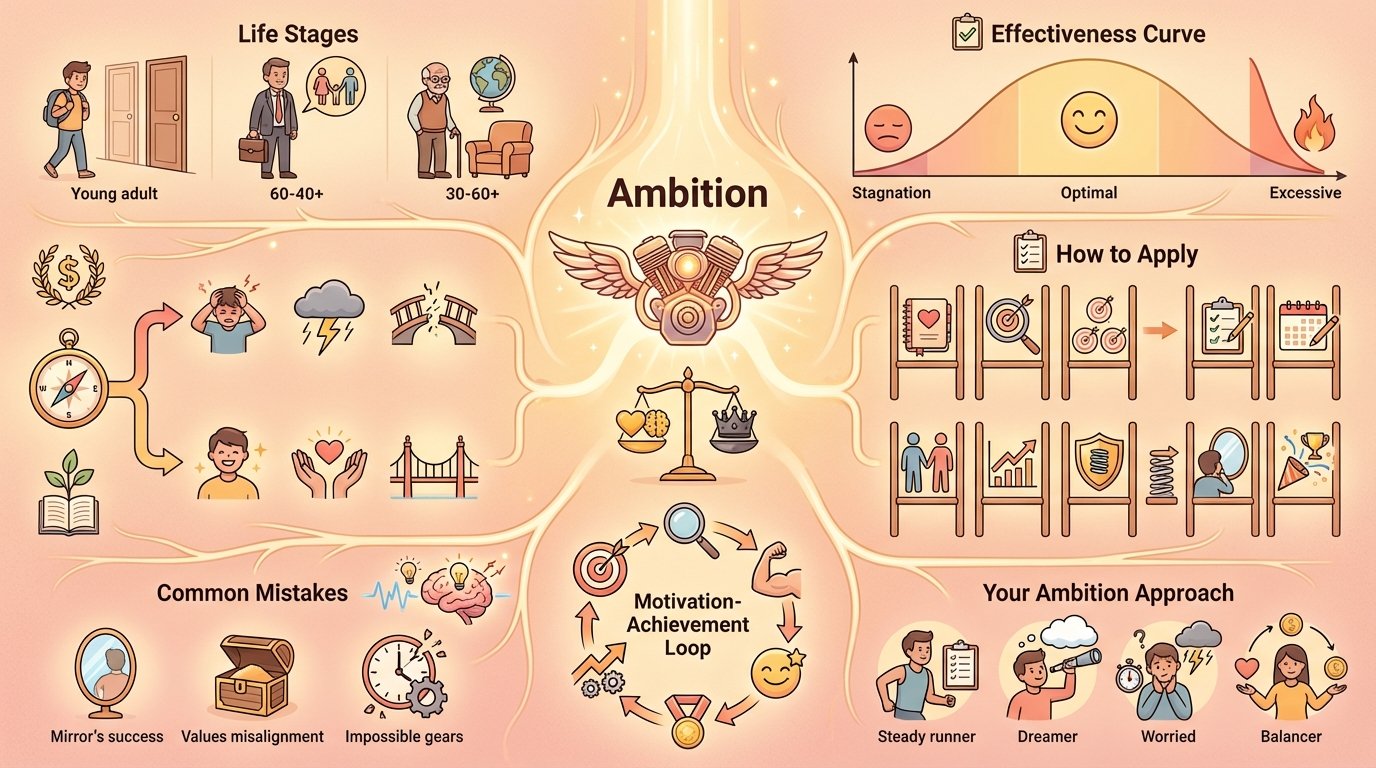
Think of ambition as fuel for your growth engine. Without it, you lack motivation. With too much, you burn out. The sweet spot is finding the right amount that propels you forward while protecting your well-being.
This guide explores what ambition really means, why it matters, and how to use it wisely to create lasting success without sacrificing your health, relationships, or sense of purpose.
What Is Ambition?
Ambition is fundamentally the desire for achievement and advancement. It's a psychological state where you set your sights on a goal and feel motivated to pursue it. Psychologists define ambition as having two primary dimensions: extrinsic ambition (driven by external rewards like money, status, and power) and intrinsic ambition (driven by internal satisfaction, mastery, learning, and personal growth).
Not medical advice.
Most people experience both types. A healthy approach integrates elements of both, where you pursue achievement in ways that align with your values. Ambition is different from mere goals—it's the emotional energy and persistence behind those goals. Someone with ambition doesn't just want something; they feel genuinely driven to get it and are willing to work consistently toward it.
Surprising Insight: Surprising Insight: Research from 2024 shows that ambition is a double-edged sword. Extrinsic ambition (focused on power and status) is more likely to lead to unethical behavior, while intrinsic ambition (focused on growth and learning) correlates strongly with sustainable success and well-being.
Types of Ambition and Their Outcomes
A comparison of how intrinsic and extrinsic ambition influence behavior, achievement, and well-being
🔍 Click to enlarge
Why Ambition Matters in 2026
In our rapidly changing world, ambition has become more important than ever. The job market, technological landscape, and personal opportunities shift constantly. Having ambition—the drive to learn, grow, and adapt—gives you the resilience to navigate these changes successfully. People with healthy ambition are more likely to pursue continuous learning, take calculated risks, and recover from setbacks.
Ambition also protects against stagnation and depression. Research shows that people without meaningful goals experience higher rates of anxiety and depression. Ambition provides direction, purpose, and a sense of progress. It motivates you to invest in yourself, develop new skills, and build capabilities that increase your confidence and effectiveness in life.
Beyond individual benefits, ambition drives innovation and positive change in society. Ambitious entrepreneurs create businesses that solve problems. Ambitious teachers inspire students. Ambitious parents model growth for their children. The key is channeling ambition in ways that benefit not just yourself, but also those around you and your larger community.
The Science Behind Ambition
Neuroscience research reveals that when you set ambitious goals, your brain literally rewires itself. Goal-setting activates the brain's reward centers and creates new neural pathways that support persistent behavior. When you focus on a goal, your brain directs attention and energy toward goal-relevant information while filtering out distractions. This is called the reticular activating system at work.
Psychologists Locke and Latham have conducted over 1,000 studies spanning 35 years on goal-setting. Their research consistently shows that setting high and specific goals is associated with increased motivation, performance, and persistence compared to vague or easy goals. However, the critical factor is achievability. When ambitious goals feel attainable with effort, they motivate. When they feel impossible, they demoralize.
The Motivation-Achievement Loop
How ambition, action, and achievement create positive feedback that sustains motivation
🔍 Click to enlarge
Key Components of Ambition
Clear Vision and Goals
Ambition requires knowing what you want. Vague wishes like 'be successful' don't work as well as specific goals like 'complete my certification by June' or 'increase monthly income by 30%' or 'run a marathon under 4 hours.' A clear vision gives ambition direction and makes it measurable. Write your goals down, break them into milestones, and review them regularly.
Self-Belief and Confidence
You can't sustain ambition without believing that progress is possible. Self-belief doesn't mean arrogance; it means having realistic confidence in your ability to learn, adapt, and improve. Building self-belief requires small wins. Start with achievable goals, accomplish them, and use those successes as evidence that larger goals are within reach. Your past performance is the strongest predictor of future belief.
Persistence and Resilience
Ambition without persistence is just fantasy. Every meaningful goal involves setbacks, failures, and obstacles. People with healthy ambition develop resilience—the ability to bounce back from disappointment and keep going. They view failures as data, not disaster. They ask 'what can I learn?' instead of 'why can't I succeed?' Resilience can be built through practice, reflection, and support systems.
Value Alignment
The most sustainable ambition aligns with your core values. If you're ambitious about becoming a top earner but you value family time above all else, you'll eventually experience conflict. Take time to identify your top 5-7 values. Then examine your goals. Do they reflect what truly matters to you? If they don't, adjust either the goals or your values understanding. This alignment is what separates hollow ambition from meaningful drive.
| Dimension | Healthy Ambition | Unhealthy Ambition |
|---|---|---|
| Source of Drive | Internal (growth, mastery, purpose) | External (approval, status, comparison) |
| Work-Life Balance | Integrated; includes rest and relationships | Sacrifices health, sleep, relationships |
| Self-Worth Connection | Separate from outcomes | Rises/falls with success/failure |
| Ethical Approach | Values-aligned; ethical means | Any means to achieve ends |
| Response to Setbacks | Learning; course correction | Shame; discouragement |
| Sustainability | Long-term; energizing | Exhausting; leads to burnout |
How to Apply Ambition: Step by Step
- Step 1: Clarify Your Values: Spend 30 minutes writing about what matters most to you—family, growth, impact, security, creativity, health. These are your north star. Your ambitions should serve these values.
- Step 2: Define Specific Goals: Replace vague aspirations with SMART goals (Specific, Measurable, Achievable, Relevant, Time-bound). Instead of 'get healthier,' write 'exercise 30 minutes, 5 days per week for 3 months, focusing on strength training.'
- Step 3: Break Goals Into Milestones: Large ambitions feel overwhelming. Divide them into quarterly or monthly milestones. Each milestone should be achievable within a specific timeframe, giving you regular wins.
- Step 4: Assess Current Reality: Honestly evaluate where you stand now relative to each goal. What skills do you have? What do you need to develop? What resources are available? This gap analysis drives your action plan.
- Step 5: Create an Action Plan: For each milestone, list the specific actions required. By when? Who can help? What obstacles might arise and how will you address them? Write this down.
- Step 6: Build Your Support System: Ambition pursued in isolation is harder. Find accountability partners, mentors, coaches, or communities aligned with your goals. Share your ambitions and progress with them.
- Step 7: Track Progress Weekly: Review your goals and actions weekly. Celebrate wins, however small. Adjust plans based on what's working. Tracking creates visibility and momentum.
- Step 8: Build Resilience Practices: Expect setbacks. Develop practices that help you bounce back: journaling, talking with mentors, exercise, meditation, or simply allowing yourself rest. Resilience is a skill.
- Step 9: Practice Regular Reflection: Monthly, review what you've learned. What obstacles surprised you? What capabilities did you discover? How are your goals still aligned with your values? Adjust as needed.
- Step 10: Celebrate Milestones: When you hit milestones, actually celebrate them. Share the win. Let yourself feel the accomplishment. This reinforces your confidence and motivation for the next phase.
Ambition Across Life Stages
Young Adulthood (18-35)
During young adulthood, ambition often focuses on establishing a career, gaining independence, and exploring possibilities. You're building your foundation. The key advantage is time—you have decades ahead to learn and grow. Focus on building diverse skills, trying different paths, and developing self-knowledge. Be ambitious about learning rather than just titles or income. This phase is the best time to invest in education, relationships, and foundational capabilities that will compound over time.
Middle Adulthood (35-55)
In middle adulthood, ambition often becomes more targeted. You likely have clarity about what matters and what doesn't. This is the period of maximum earning potential and influence. The challenge is balancing high ambition with family responsibilities. Many experience tension between career advancement and quality time with children or aging parents. The most satisfied people at this stage have integrated their ambitions—they're ambitious about meaningful work and about being present with loved ones. This is when mentoring younger colleagues becomes rewarding, expanding your impact beyond your own achievements.
Later Adulthood (55+)
Later adulthood offers the freedom to redirect ambition toward legacy, mastery, and generosity. Some people retire from paid work but remain deeply ambitious about volunteer work, creative pursuits, grandparenting, or community impact. Many report this phase as deeply fulfilling because ambition aligns fully with intrinsic values. The wisdom and experience you've accumulated becomes your asset. Ambitious goals might include 'write a book sharing my expertise,' 'build a scholarship fund,' or 'master a skill I never had time for.' Later adulthood ambition is often about depth and meaning rather than advancement.
Profiles: Your Ambition Approach
The Steady Achiever
- Clear milestones and regular progress tracking
- Recognition for incremental wins
- Structured plans with defined endpoints
Common pitfall: Can become so focused on the plan that you miss opportunities or fail to adapt when circumstances change
Best move: Build in quarterly reviews where you explicitly reassess and adjust your approach. Stay ambitious but stay flexible.
The Big Picture Visionary
- Permission to dream bold goals
- Help with implementation details and execution
- Reminders to celebrate small progress
Common pitfall: Big visions without execution become frustration. You dream ambitiously but struggle with the daily work required
Best move: Partner with someone who enjoys implementation. Use their strength to turn your vision into reality. Break visions into smaller phases.
The Anxious Ambitious
- Realistic timelines that reduce pressure
- Regular reassurance that progress is happening
- Focus on growth rather than comparison
Common pitfall: Ambition gets twisted into anxiety. You set impossible standards, judge yourself harshly, and experience constant stress
Best move: Separate your self-worth from your outcomes. Practice self-compassion. Set ambitious but achievable goals. Meditate or journal to calm the nervous system.
The Balanced Pragmatist
- Acknowledgment that ambition is healthy and good
- Permission to not be the very best, just very good
- Integration of ambition with other life priorities
Common pitfall: Can under-reach your potential because you're so focused on balance that you don't push yourself enough
Best move: Be more ambitious about specific areas. You don't need to be maximally ambitious about everything—choose 2-3 domains where you'll push hard.
Common Ambition Mistakes
The first major mistake is confusing ambition with comparison. Social media has made it easy to adopt other people's ambitions rather than discovering your own. You see someone else's success and decide that's what you want, without checking if it aligns with your values or interests. Comparison-based ambition feels hollow because it's not truly yours. The antidote: get quiet, reflect deeply on what you actually care about, and pursue that rather than what looks impressive on Instagram.
The second mistake is ambition without values—pursuit of achievement for its own sake. You might become ambitious about earning a high income, reaching a title, or accumulating possessions, only to achieve those things and feel surprisingly empty. This happens because extrinsic ambition doesn't satisfy the human need for purpose and meaning. Solution: regularly check in with your values. Does this goal serve something that truly matters to you?
The third mistake is unrealistic timelines. You set ambitious goals with impossible deadlines, guarantee failure, and then interpret that failure as proof you're not capable. Ambitious and realistic are not opposites. Set ambitious goals with reasonable timelines. A marathon takes months of training, not weeks. A career change takes planning and skill-building. High ambition with realistic pacing is far more effective than ambitious goals with delusional timelines.
The Ambition Effectiveness Curve
Shows how too little and too much ambition reduce effectiveness, while moderate, realistic ambition optimizes achievement and well-being
🔍 Click to enlarge
Science and Studies
The research on ambition is extensive and consistent. Below are key studies and findings that inform our understanding of healthy ambition and achievement.
- Locke & Latham (1990s-2020s): Over 1,000 studies confirm that specific, ambitious goals increase motivation and performance when they're achievable
- ScienceDirect (2024): Research on ambition as a double-edged sword shows extrinsic ambition correlates with unethical behavior while intrinsic ambition supports sustainable success
- Frontiers in Psychology (2025): Study examining how ambition relates to psychological well-being and substance use, highlighting importance of healthy channeling
- Bayside Online & Neuroscience Research: Work-life imbalance and self-worth tied to outcomes are key markers of unhealthy ambition requiring intervention
- PMC/NIH Studies: Goal-setting activates neural pathways and reward centers; goal failure decreases motivation, self-esteem, and affect if goals were too ambitious for actual capability
Your First Micro Habit
Start Small Today
Today's action: Spend 5 minutes tonight writing down one meaningful goal you want to pursue in the next 90 days. Make it specific and ambitious but achievable. Then, write one action you can take tomorrow toward that goal.
This micro habit breaks ambition into actionable pieces. Writing activates intention. Specificity builds momentum. Tomorrow's action makes the goal real.
Keep quitting habit apps after a missed day? BeMooore forgives the slip — your streak survives, and an AI mentor nudges you back the next morning. Free on iOS.
Quick Assessment
When you think about your biggest goals right now, how do you feel?
Your emotional response to your goals reveals whether your ambition is healthy. Excitement with some healthy anxiety is ideal. Unclear or overwhelmed suggests your goals need clarification or your approach needs adjustment.
How connected are your current goals to your core values?
Value alignment is crucial for sustainable ambition. If you're pursuing goals that don't connect to your values, you'll eventually feel empty even when you achieve them. Realign or reframe.
When you face setbacks or failures, what's your typical response?
Your response to setbacks determines whether ambition becomes healthy persistence or unhealthy obsession. Learning-oriented responses build resilience. Self-doubt or blame requires mindset work.
Take our full assessment to get personalized recommendations.
Discover Your Style →Next Steps
Ambition is one of humanity's most powerful forces. It drives innovation, builds character, and creates meaningful lives. The work now is channeling yours in ways that serve both your success and your well-being. Start with clarity about your values. Build from there.
Remember: You don't need to be ambitious about everything. Choose your arenas carefully. Be ambitious about what matters. Build sustainable practices around those ambitions. And maintain relationships and self-care alongside your pursuits. This balance is what transforms ambition from something that consumes you into something that fulfills you.
Get personalized guidance with AI coaching.
Start Your Journey →A goal you see every morning gets acted on more often than one that lives in a note app. Build a vision board free in your browser, no account, and export a phone wallpaper you can set tonight.
Build a free vision board →Research Sources
This article is based on peer-reviewed research and authoritative sources. Below are the key references we consulted:
Related Glossary Articles
Frequently Asked Questions
Is ambition selfish?
Not necessarily. Ambition becomes selfish when it's purely extrinsic (status, money, power) and involves harming others. Ambition is healthy when it's intrinsic (growth, learning, impact) and creates value for others. Many ambitious people make significant positive contributions to their families, communities, and society.
How do I balance ambition with contentment?
They're not opposites. Healthy ambition includes contentment with who you are right now, plus drive to grow. You can be satisfied with your life while being ambitious about the next chapter. This combination is more sustainable than perpetual dissatisfaction.
What if I don't have ambition?
Not everyone has high ambition, and that's fine. But usually, people without ambition are either depressed, lacking clarity about what they want, or focused on survival rather than growth. If you want more ambition, start by clarifying values and setting small achievable goals. Momentum builds motivation.
Can ambition cause burnout?
Yes, when ambition is excessive and paired with unrealistic timelines or external pressure. Ambition itself isn't the problem—misalignment between ambition and resources/time is. Build rest and relationships into your ambitious pursuits.
How do I know if my ambition is healthy or unhealthy?
Healthy ambition energizes you, connects to your values, improves your relationships, and motivates without crushing you. Unhealthy ambition exhausts you, isolates you from loved ones, ties your self-worth to outcomes, and involves ethical compromises. Honest self-assessment is key.
Take the Next Step
Ready to improve your wellbeing? Take our free assessment to get personalized recommendations based on your unique situation.
- Discover your strengths and gaps
- Get personalized quick wins
- Track your progress over time
- Evidence-based strategies