Minimalism
Imagine waking up in a space that brings you peace instead of stress, where every item has a purpose and every corner invites calm. That's the promise of minimalism. In our world of endless consumption and digital overwhelm, minimalism offers a radical alternative: intentional living with less. But this isn't about deprivation or bare walls. It's about freedom. Research shows that over 80% of people who embrace minimalism report higher life satisfaction, reduced anxiety, and greater mental clarity. Whether you're drowning in possessions, struggling with decision fatigue, or simply seeking more meaning in life, minimalism offers a proven path to contentment and genuine happiness. This guide explores how simple living transforms not just your space, but your entire relationship with what matters most.
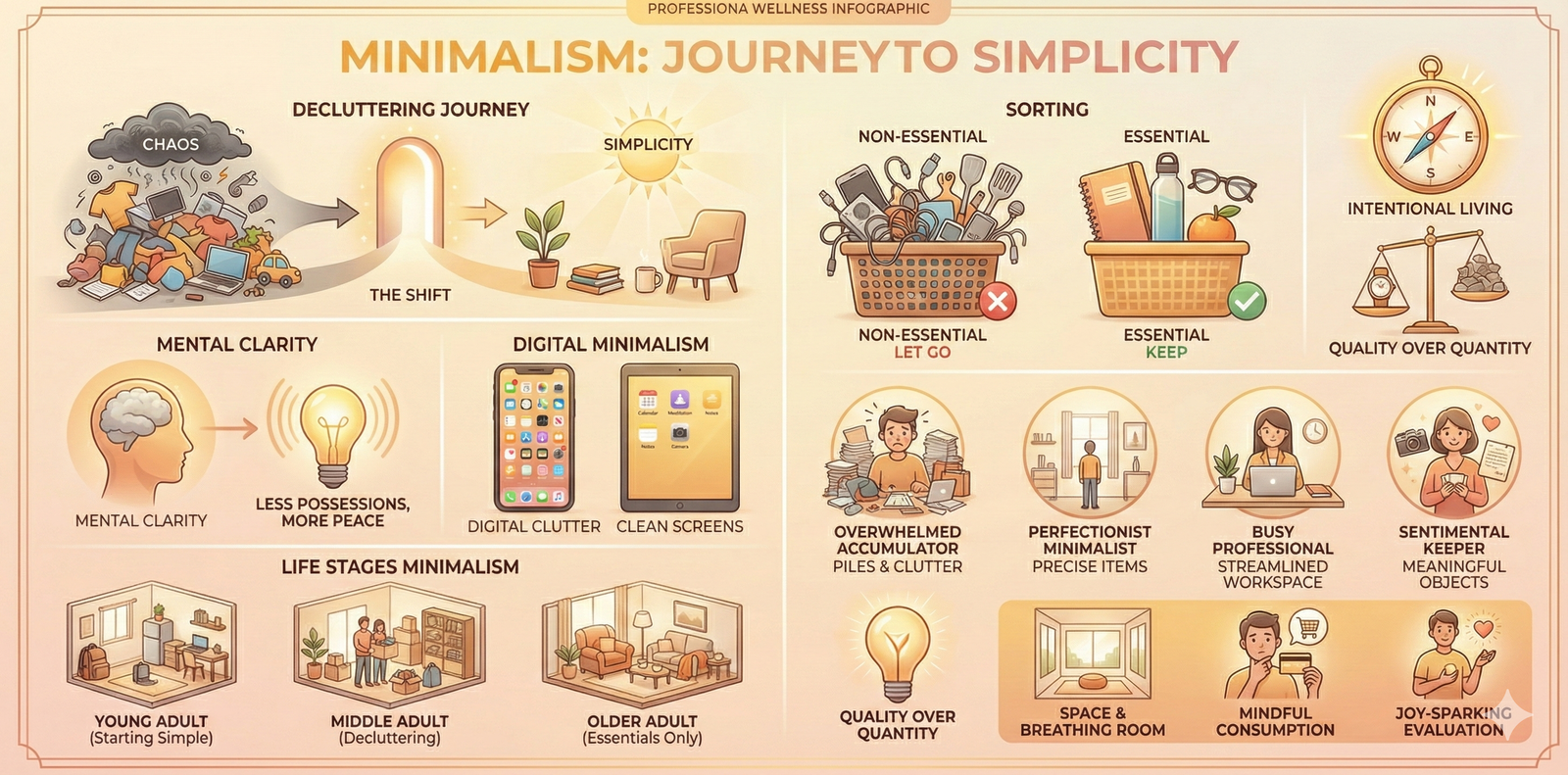
Minimalism works differently for everyone. Some people reduce possessions dramatically; others focus on minimizing digital distractions or commitments. The common thread: intentional choice.
The benefits compound over time as you align your surroundings, schedule, and spending with your deepest values and what truly brings you joy.
What Is Minimalism?
Minimalism is the intentional practice of living with less—fewer possessions, fewer commitments, and fewer mental burdens—to make room for what truly matters. It's not an extreme lifestyle choice; it's a mindful approach to deciding what deserves your time, energy, and resources. At its core, minimalism answers a simple question: What adds value to my life, and what doesn't? The practice recognizes that our brains, our homes, and our hearts have limited capacity. When we eliminate unnecessary clutter and distractions, we create space—both literally and mentally—for authentic joy, meaningful relationships, and purposeful work.
Not medical advice.
Minimalism emerged as a lifestyle philosophy in the early 2000s through books and documentaries, but its roots trace back to ancient wisdom traditions including Zen Buddhism, Stoicism, and ascetic practices. Today, minimalism intersects with mental health, environmental sustainability, and financial wellbeing. It's not about judgment; it's about freedom. A minimalist might own one elegant suit or fifty vintage dresses—what matters is that each item reflects a conscious choice and serves a genuine purpose.
Surprising Insight: Surprising Insight: A 2020 study found that adopting minimalism could decrease stress levels by up to 75% and improve life satisfaction by 80%. Visual clutter literally spikes cortisol production, the hormone responsible for chronic stress.
The Minimalism Spectrum
Minimalism isn't binary—it exists on a spectrum from extreme reduction to intentional simplification. Where people fall depends on their values, life stage, and what brings them happiness.
🔍 Click to enlarge
Why Minimalism Matters in 2026
We live in an era of unprecedented abundance and unprecedented overwhelm. The average person now owns over 10,000 items compared to 180 items in 1950. We're exposed to 5,000 marketing messages daily and consume four times more data than we did just fifteen years ago. This constant input exhausts our decision-making capacity, triggers anxiety, and disconnects us from what matters. Minimalism has become essential because our brains and wellbeing are suffering from cognitive overload. In 2026, minimalism isn't a luxury—it's a survival skill.
Beyond personal benefit, minimalism addresses collective crises. Environmental degradation stems largely from overconsumption. Financial stress often comes from buying more than we need. Loneliness increases when we prioritize things over relationships. Minimalism offers a solution that heals all three: by consuming less, we reduce environmental impact, free up financial resources, and create space for connection with people and ourselves.
The 2025 research shows that minimalist practices directly influence younger generations' wellbeing. Generation Z and Millennials increasingly reject consumerism not from deprivation but from recognizing its true cost to mental health and environmental future. Minimalism represents a values shift from 'having more' to 'living better.'
The Science Behind Minimalism
The neuroscience is clear: clutter overwhelms your brain. When your visual field contains disorganized items, your brain treats each one as an incomplete task, sending constant 'finish this' signals. This triggers the release of stress hormones, particularly cortisol. Multiple studies confirm that cluttered environments correlate with elevated cortisol levels, anxiety, depression, and difficulty concentrating. When you remove that visual burden, your brain relaxes, creativity increases, and focus deepens. One study found that people in organized spaces showed a 70% increase in focus and 75% increase in productivity. The mechanism is simple: fewer decisions about your environment mean more mental energy for what matters.
Research from the University of North Texas examined 23 peer-reviewed studies on minimalism and happiness. They found that over 80% of quantitative studies reported a direct connection between voluntary simplicity and enhanced wellbeing. The research identifies several psychological mechanisms: minimalism reduces decision fatigue (we make over 35,000 decisions daily; reducing unnecessary choices preserves mental energy), increases autonomy (when we consciously choose what stays, we feel more in control), and promotes mindfulness (the act of deciding what to keep forces intentional awareness). Additionally, minimalists report enhanced life satisfaction, better sleep, improved relationships, and greater self-acceptance. The benefits extend beyond the individual to collective environmental and financial wellbeing.
How Minimalism Transforms Your Brain
When you reduce physical and mental clutter, your nervous system shifts from stress mode to calm mode, unlocking cognitive and emotional benefits.
🔍 Click to enlarge
Key Components of Minimalism
1. Physical Decluttering
The most visible aspect of minimalism is removing possessions you no longer use, need, or love. This isn't about living with almost nothing; it's about conscious curation. The process typically involves examining each item and asking: Does this serve a purpose? Does it bring me joy? Would I buy it again today? Physical decluttering provides immediate psychological relief and signals to your brain that you have control over your environment. The act itself builds momentum and reinforces the practice.
2. Mental Minimalism
Beyond possessions, minimalism addresses mental burden. This includes clearing limiting beliefs, letting go of judgment from others, releasing perfectionism, and simplifying your mental narratives about what you 'should' be doing. Mental minimalism recognizes that anxiety often stems not from what we own but from what we're carrying psychologically. Practices like journaling, meditation, and therapy help identify and release mental clutter. As you clear your physical space, you often discover mental patterns to address too.
3. Digital Minimalism
In our 2026 world, digital clutter may cause more stress than physical possessions. Digital minimalism means curating your apps, notifications, social media accounts, and email to support rather than drain you. It includes reducing screen time, unfollowing accounts that trigger comparison or negativity, deleting unused apps, and creating phone-free spaces and times. The goal isn't rejecting technology but using it intentionally. Digital minimalism directly improves sleep quality, reduces anxiety, and increases time for face-to-face connection.
4. Time and Commitment Minimalism
Many people struggle because they own fewer things but say 'yes' to everything: every invitation, every project, every obligation. Time minimalism means protecting your calendar as fiercely as your closet. It involves identifying your genuine priorities, learning to decline requests that don't align with those priorities, and creating protected time for rest and relationships. This component often brings the most immediate happiness boost because it directly increases your free time.
| Pillar | Main Focus | Starting Point |
|---|---|---|
| Physical | Possessions and environment | Declutter one drawer or closet |
| Mental | Thoughts, beliefs, self-judgment | Identify one limiting belief to release |
| Digital | Apps, notifications, accounts | Unfollow five accounts that drain you |
| Time | Schedule, commitments, boundaries | Decline one non-essential commitment |
How to Apply Minimalism: Step by Step
- Step 1: Start with your mindset: Before decluttering, clarify why you want to simplify. Is it to reduce stress? Create space for what matters? Improve finances? Save time? Having a clear 'why' keeps you motivated when the process gets emotional.
- Step 2: Choose one small area: Don't start with your entire bedroom. Begin with one drawer, one shelf, or one small category. This builds momentum and proves you can do it. Success breeds commitment.
- Step 3: Apply the intentional choice framework: For each item, ask three questions: (1) Do I use this? (2) Do I love this? (3) Would I buy this again today? If the answer is no to two or more questions, it's a candidate for removal.
- Step 4: Address emotional attachments: Many items carry guilt (expensive gifts, inherited items), fear (might need it someday), or identity (I might wear that style again). Acknowledge the emotion, thank the item for its purpose, and let it go. This transforms decluttering from loss to gratitude.
- Step 5: Create zones for different categories: Group similar items together so you can see how many you actually own. Seeing seven pairs of black jeans might surprise you. This builds awareness and makes prioritization easier.
- Step 6: Establish a 'maybe' box: Items you're unsure about go in a temporary box. Set it aside for 30 days. If you haven't needed or thought about anything inside, it's truly not necessary. This removes decision paralysis.
- Step 7: Organize what remains by accessibility: Keep frequently used items easily accessible; store occasional-use items appropriately; donate or sell the rest. Organization follows decluttering, not before.
- Step 8: Extend to other areas: After succeeding with physical spaces, apply minimalism to digital devices (uninstall unused apps, organize folders), time (create a weekly calendar audit), and mental burdens (identify one limiting belief to challenge).
- Step 9: Establish a 'one in, one out' rule: For every new item you bring home, remove something similar. This maintains the minimalist baseline you've created and prevents re-accumulation.
- Step 10: Review and adjust quarterly: Your minimalism should evolve with life changes. What serves you at 25 differs from what serves you at 45. Quarterly reviews ensure your space, schedule, and commitments remain aligned with your current values.
Minimalism Across Life Stages
Young Adulthood (18-35)
During young adulthood, minimalism often focuses on preventing accumulation rather than clearing decades of clutter. This is the ideal time to develop intentional consumption habits before they become entrenched patterns. Young adults benefit tremendously from digital and time minimalism—creating a healthy relationship with social media, establishing boundaries around notifications, and building a work-life rhythm before career acceleration takes over. Physical minimalism during this stage might mean choosing quality basics over fast fashion, resisting the urge to furnish entire apartments, and recognizing that life's transitions (moving jobs, relationships shifting) mean your needs change frequently. The contentment gained from minimalism in these years compounds: less spending means financial flexibility for future choices.
Middle Adulthood (35-55)
Middle adulthood often involves more accumulated possessions: decades of items, family inheritance, children's belongings, and career-related accumulation. Minimalism here becomes powerful because it directly addresses burnout. Mid-life stress often combines overflowing homes, over-committed calendars, and identity confusion (who am I beyond my roles?). Clearing physical space sparks clarity about what matters. Many people in this stage report that minimalism helps them reimagine their lives: Does this career path still align with my values? Do these friendships energize me? The decluttering process becomes a mirror for examining every life domain. Additionally, this stage benefits from financial minimalism—simplifying expenses to fund freedom (early retirement, sabbaticals, career changes).
Later Adulthood (55+)
Later adulthood brings mortality awareness, which paradoxically clarifies priorities beautifully. Minimalism in these years often feels liberating rather than restrictive because the 'why' is undeniable: every moment and possession should reflect what genuinely enriches life. Many people in this stage discover that minimalism reduces anxiety about legacy and burden on children. Instead of leaving behind decades of accumulated items, you're curating meaningful objects and information. Minimalism also supports physical aging—simplified living reduces the physical demands of maintaining a home. The emotional work is lightened too: fewer possessions mean less decision-making and mental load, allowing more energy for relationships, travel, or creative pursuits. Research shows minimalists in later adulthood report higher life satisfaction and greater engagement with purpose-driven activities.
Profiles: Your Minimalism Approach
The Overwhelmed Accumulator
- Permission to let go without guilt
- A gradual, compassionate approach
- Help addressing emotional attachments to possessions
Common pitfall: Feeling paralyzed by how much there is to sort through and giving up before starting
Best move: Start with small wins—one drawer, one category. Don't try to transform everything at once. Build momentum with success.
The Perfectionist Minimalist
- Flexibility about what minimalism looks like
- Permission for 'good enough' rather than perfect
- Recognition that your version might include more items than others
Common pitfall: Becoming rigid about rules, judging yourself for owning 'too much,' or obsessing over organizing systems
Best move: Remember: minimalism serves you, not the reverse. If owning 500 books brings you genuine joy and you're not drowning in clutter, that's perfect minimalism for you.
The Busy Professional
- Focus on time and mental minimalism first
- Batch decluttering into weekend projects
- Digital minimalism to reclaim mental space during work stress
Common pitfall: Knowing they should declutter but not having bandwidth to start, then feeling guilty about the clutter
Best move: Prioritize digital and time minimalism—they deliver immediate relief. Do one small physical decluttering project monthly. Small, consistent progress beats procrastination.
The Sentimental Keeper
- Photography of meaningful items before releasing them
- Ritualistic ways to honor and release possessions
- A box for truly meaningful items to preserve
Common pitfall: Keeping everything because 'memories matter' and ending up in exactly the same overwhelmed state
Best move: Photograph items for memory preservation, then let them go physically. Keep a small 'meaningful memories box' with the most precious items, but embrace that memories live in you, not in objects.
Common Minimalism Mistakes
The first major mistake is confusing minimalism with deprivation. Minimalism isn't about suffering or living uncomfortably; it's about living well with intention. People sometimes throw away items they actually need or love, thinking that 'more minimal' is inherently better. This mindset misses the point entirely. Your minimalism should increase happiness and functionality, not decrease it. If you love cooking and own twelve skillets, that's fine—keep them. If you have no kitchen tools but hate cooking, minimalism hasn't served you.
The second mistake is starting too big and burning out. Attempting to declutter your entire house in one weekend often leads to decision fatigue, emotional exhaustion, and giving up. Minimalism succeeds through consistency and momentum, not heroic efforts. One small area thoroughly completed creates motivation and proof that change is possible. Three months of small consistent choices transform your life far more than one overwhelmed weekend.
The third mistake is ignoring the rebound effect—surrounding yourself with new clutter after clearing. Without establishing new habits and awareness, your space refills within months. Pair minimalism with intentional consumption: before buying anything, ask 'Would I buy this if I already owned it?' Create friction around purchases. Unsubscribe from marketing emails. Use the 30-day rule for non-essential purchases. This prevents the rebound and keeps your minimalist gains.
The Minimalism Journey: Common Obstacles & Solutions
Minimalism success depends on understanding where most people get stuck and planning for those moments.
🔍 Click to enlarge
Science and Studies
Research consistently confirms that minimalism and simple living significantly enhance wellbeing. Multiple peer-reviewed studies document the psychological benefits: reduced anxiety, improved focus, enhanced life satisfaction, and greater sense of control. The research also shows important nuances—minimalism benefits people differently depending on income level (showing greater effect for lower-income individuals who gain financial relief), age (showing consistent benefits across all life stages), and the specific domain minimized (physical, digital, time, or mental).
- University of North Texas (2020): Meta-analysis of 23 peer-reviewed studies found that 80% of quantitative research confirmed a positive connection between voluntary simplicity and psychological wellbeing.
- 2024 Study on Digital Minimalism: Participants who reduced daily social media use by just 30 minutes reported 27% reduction in anxiety and improved sleep quality within 30 days.
- Research on Cortisol and Clutter (2009): Studies show that cluttered home environments spike cortisol production, the stress hormone, while organized spaces correlate with lower baseline stress levels.
- Generation Z and Minimalism (2024): 73% of Gen Z respondents report rejecting consumerism for environmental and mental health reasons, with minimalism cited as a primary lifestyle approach.
- Life Satisfaction Research (2023): Studies examining minimalism and happiness found that experiential consumption and mindfulness practices mediate the relationship—minimalists spend freed resources on experiences and relationships rather than things.
Your First Micro Habit
Start Small Today
Today's action: Choose one small area in your home (a drawer, shelf, or corner) and spend 20 minutes identifying three items you no longer need. Donate, sell, or discard them. Notice how that small cleared space feels.
This micro habit proves you can make a change without overwhelming effort. The cleared space provides immediate visual relief, your brain releases a small hit of accomplishment, and you build momentum for the next area. Twenty minutes is achievable even on a busy day, making success likely and motivation strong.
Keep quitting habit apps after a missed day? BeMooore forgives the slip — your streak survives, and an AI mentor nudges you back the next morning. Free on iOS.
Quick Assessment
How does your current living environment affect your mood and focus?
People who feel energized by their environment typically find contentment easier. If your space drains you, even small decluttering changes could significantly boost happiness and mental clarity.
What area of your life feels most cluttered right now?
Everyone's minimalism starting point differs. Identifying your primary source of overwhelm helps you focus your minimalism efforts where they'll provide the most relief.
What outcome would matter most to you from a simpler life?
Your 'why' fuels sustainable change. Connecting minimalism to what truly matters for you—whether that's peace, connection, freedom, or authenticity—transforms it from a chore into a joyful practice.
Take our full assessment to get personalized recommendations.
Discover Your Style →Next Steps
Start where you are, with what overwhelms you most. If your physical space causes daily stress, begin with one small decluttering project. If your schedule is the main source of burnout, start by declining one non-essential commitment and protecting that reclaimed time. If digital notifications interrupt your peace, spend 30 minutes unfollowing draining accounts and turning off non-essential notifications. Small, aligned actions create momentum faster than perfect plans.
Remember: minimalism isn't about deprivation or judgment. It's a personal practice, not a competition or moral statement. Some people thrive with 200 possessions; others with 5,000. What matters is that your choices reflect your values, reduce stress, and create space—literal or mental—for what brings genuine contentment. As you simplify, you'll likely notice unexpected shifts: better sleep, easier decision-making, improved relationships, and a clearer sense of who you are beyond your roles and possessions. That's the real power of minimalism.
Get personalized guidance with AI coaching.
Start Your Journey →Research Sources
This article is based on peer-reviewed research and authoritative sources. Below are the key references we consulted:
Related Glossary Articles
Frequently Asked Questions
Is minimalism extreme? Do I have to own almost nothing?
Minimalism exists on a spectrum. Some people own 300 items; others own 3,000. The key is intentionality—every possession should serve a purpose or bring joy. Minimalism means fewer things you don't need, not living uncomfortably. It's about alignment between your possessions and your values, not achieving a specific number.
Isn't minimalism just another form of consumerism or status symbol?
This is a fair critique. Minimalism can become status-oriented when people focus on looking minimal or judging others for owning more. True minimalism is internal—about your own alignment and peace. If someone owns more but feels intentional and happy, that's valid minimalism. The philosophy is about consciousness, not judgment.
How do I handle guilt about throwing away things I spent money on?
The money is already spent; sunk cost fallacy means the guilt doesn't recover the money. Instead, recognize that keeping something you don't use actually costs more: mental burden, storage space, decision-making energy. Letting it go is the final gift you can give yourself and the money. Thank the item for its purpose and release it with gratitude rather than guilt.
What's the difference between minimalism and Marie Kondo's KonMari method?
KonMari focuses specifically on keeping items that 'spark joy' and is a complete overhaul methodology. Minimalism is broader: it includes physical, digital, time, and mental decluttering, and it's less about joy and more about intention and utility. KonMari is one specific approach to minimalism; minimalism is the larger philosophy. Many people find KonMari helpful as a starting framework.
After I declutter, how do I prevent re-accumulation?
Establish new habits: (1) The one-in-one-out rule—for every new item, remove something similar. (2) Intentional consumption—pause before purchasing; use the 30-day rule for wants. (3) Unsubscribe from marketing to reduce exposure to promotional messages. (4) Quarterly reviews of your space to catch early re-accumulation. (5) Mindfulness about why you're buying—are you addressing an actual need or an emotional one?
Take the Next Step
Ready to improve your wellbeing? Take our free assessment to get personalized recommendations based on your unique situation.
- Discover your strengths and gaps
- Get personalized quick wins
- Track your progress over time
- Evidence-based strategies