Digital Minimalism
Digital minimalism is a philosophy of intentional technology use that transforms your relationship with devices and apps. Instead of allowing endless notifications, scrolling, and digital clutter to fragment your attention, digital minimalism asks you to carefully select which technologies truly serve your values and ruthlessly eliminate the rest. This approach has proven to reduce stress, improve focus, enhance sleep quality, and restore the mental clarity we lose in our hyperconnected world. By reclaiming your digital space, you reclaim your life.
In 2026, digital minimalism is no longer a niche wellness trend—it's an essential component of psychological wellbeing for millions of people overwhelmed by screen time and digital distraction.
The surprising insight: you don't need to quit technology entirely to feel its transformative benefits, just become deliberate about how you use it.
What Is Digital Minimalism?
Digital minimalism is a philosophy of technology use in which you focus your online time on a small number of carefully selected and optimized activities that strongly support things you value, and then happily miss out on everything else. Popularized by computer scientist Cal Newport in his 2019 bestselling book, this approach directly challenges the default mode of technology consumption where we passively accumulate apps, accounts, and notifications without questioning their value. Digital minimalism rests on three foundational principles: clutter is costly (multiple competing digital demands drain your attention and wellbeing), optimization matters (using chosen technology intentionally to maximize its benefits), and intentionality is satisfying (the act of being deliberate itself creates deep satisfaction and meaning).
Not medical advice.
Unlike a digital detox—which is temporary abstinence from technology—digital minimalism is a permanent philosophy shift toward sustainable, intentional technology use. It's not about rejecting all technology, but about being ruthless in choosing which tools genuinely enhance your life while eliminating those that undermine your focus, sleep, relationships, or mental health. Research shows that individuals practicing digital minimalism report reduced anxiety, improved cognitive function, stronger real-world relationships, and a greater sense of life satisfaction compared to those engaging in unrestricted technology consumption.
Surprising Insight: Surprising Insight: A 2024 study from the International Journal of Consumer Studies found that people practicing digital minimalism showed significantly higher life satisfaction scores—not because they used less technology overall, but because they used it more intentionally and purposefully.
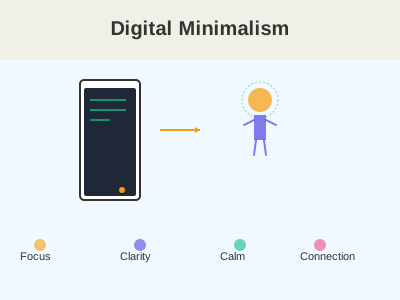
The Digital Minimalism Mindset Shift
Visualizing the transformation from passive technology consumption to intentional digital choice
🔍 Click to enlarge
Why Digital Minimalism Matters in 2026
In 2026, we face an unprecedented attention crisis. The average person checks their phone 150+ times daily, and studies show that excessive screen time correlates with rising rates of anxiety, depression, sleep disorders, and attention deficits. Social media platforms employ sophisticated algorithms designed to maximize engagement—essentially weaponizing psychological principles to keep you scrolling. Digital minimalism matters because it restores your autonomy: you decide how technology serves you, not the other way around. This is fundamentally about reclaiming your mental sovereignty.
The mental health implications are significant. Research from 2024-2025 demonstrates that digital minimalism practitioners experience measurably lower stress levels, improved sleep quality, enhanced ability to concentrate, and stronger face-to-face relationships. For young adults navigating their careers, digital minimalism enables the deep work and single-tasking that drives professional excellence. For middle-aged professionals, it provides the mental space needed for leadership, creativity, and meaningful family time. For anyone feeling overwhelmed by constant connectivity, digital minimalism offers a pathway back to presence and calm.
Beyond individual benefits, digital minimalism addresses societal issues: it reduces the behavioral manipulation engineered into apps, protects your personal data from overexploitation, and creates space for the kind of sustained attention required for complex thinking, learning, and genuine human connection. As technology becomes increasingly invasive—from wearables to home devices to workplace surveillance—digital minimalism becomes a form of digital citizenship and personal integrity.
The Science Behind Digital Minimalism
The neuroscience supporting digital minimalism is compelling. When you're constantly switching between apps, messages, and notifications, your brain activates the anterior cingulate cortex and prefrontal cortex repeatedly—the regions responsible for attention control and decision-making. This constant task-switching depletes your cognitive resources, a phenomenon called "attention residue." Research shows it takes approximately 23 minutes to fully refocus after a distraction. If you're interrupted every few minutes, you never achieve the neural state required for deep work or complex thinking. Digital minimalism works because it eliminates these interruptions, allowing your brain to enter flow state—where optimal performance, creativity, and satisfaction occur.
Sleep science also supports digital minimalism. The blue light emitted by screens suppresses melatonin production, your body's sleep-onset hormone. Regular evening screen time disrupts circadian rhythms, leading to insomnia and poor sleep quality. Sleep deprivation then impairs prefrontal cortex function, increasing emotional reactivity and decision-making deficits. By minimizing evening screen time, digital minimalists restore natural sleep-wake cycles and the restorative sleep essential for emotional regulation, memory consolidation, and immune function. Furthermore, research from the Springer Nature journal 'Current Psychology' shows that digital minimalism correlates strongly with reduced anxiety and depression symptoms—likely because reduced screen time decreases both the psychological comparison trap of social media and the cortisol spike triggered by constant notifications.
How Digital Minimalism Improves Brain Function
The neuroscience pathway: fewer digital interruptions leading to better focus, sleep, and mental health
🔍 Click to enlarge
Key Components of Digital Minimalism
Intentional Selection of Tools
The first component is deliberately choosing which technologies serve your core values. This isn't about using less technology—it's about using only technology that aligns with what matters most to you. If you value deep friendships, keep communication tools that enable meaningful conversation. If you value creative work, maintain tools that support that. If you don't genuinely value endless entertainment consumption, eliminate platforms that trap your time. The key is conscious decision-making: for each app, service, and device, ask explicitly: 'Does this help me become the person I want to be?' and 'Does this align with my stated values?' This prevents default technology accumulation and the digital debt that clutters your mental space.
Optimization of Chosen Technologies
Once you've decided which technologies to keep, optimize how you use them. This might mean disabling all notifications except those truly urgent, setting specific time windows for checking email rather than constant monitoring, using app blockers during focus work, or deleting social media apps from your phone while maintaining a desktop version for limited use. Optimization recognizes that even valuable tools can become destructive if used without boundaries. The goal is extracting maximum benefit from chosen technology while minimizing its capacity for distraction. This might involve using focus applications like Forest or Freedom, setting your phone to grayscale to reduce engagement appeal, or scheduling specific times for social media checking rather than constant scrolling.
Dedicated Solitude and Offline Time
Digital minimalism requires protecting substantial blocks of offline time—time without any device access or digital engagement. This isn't antisocial; it's essential for the thinking, creativity, and self-reflection that drive personal growth. Research shows that solitude enhances cognitive function, enables emotional processing, and allows the mind to consolidate learning. Without this offline time, you're essentially always in interrupt mode, never reaching the neurological states required for creative breakthrough or genuine self-understanding. Many digital minimalists protect their mornings for offline routines, maintain device-free meals, and establish tech-free hours before bed. This creates rhythms of digital and offline engagement rather than constant saturation.
Cultivation of Real-World Leisure and Attention
The fourth component is actively cultivating high-quality offline activities that genuinely engage your attention and bring satisfaction. Rather than filling freed time with more digital consumption, digital minimalists invest in activities like reading books, exercise, face-to-face socializing, creative hobbies, learning, gardening, or outdoor recreation. These activities improve wellbeing and provide genuine rest and rejuvenation—unlike the pseudo-relaxation of mindless scrolling, which leaves you more depleted. This component transforms digital minimalism from subtraction (what you're removing) into addition (what you're gaining), making the practice sustainable and deeply satisfying.
| Dimension | Unrestricted Use | Digital Minimalism |
|---|---|---|
| Device Relationship | Reactive & automatic | Intentional & deliberate |
| Daily Screen Time | 5-8+ hours average | 2-3 hours average |
| Notifications | Constant (100+ per day) | Minimized (10-20 per day) |
| Attention Quality | Fragmented across tasks | Deep, sustained focus |
| Sleep Quality | Often disrupted | Restored to baseline |
| Social Connection | Superficial online ties | Deeper real-world bonds |
| Stress Level | Elevated & chronic | Reduced & managed |
| Mental Clarity | Foggy, information-overloaded | Clear & focused |
| Life Satisfaction | Lower reported levels | Significantly higher |
How to Apply Digital Minimalism: Step by Step
- Step 1: Conduct a technology audit: list every app, device, subscription, and digital service you currently use regularly. Be thorough—this includes social media, streaming, email, work tools, games, shopping apps, news apps, and every notification you receive.
- Step 2: Define your core values: write down what actually matters to you in life. Examples: deep relationships, creative work, learning, health, career advancement, spirituality, adventure, family time. Be specific and honest about your genuine priorities, not idealized versions of yourself.
- Step 3: Evaluate each technology against your values: for each app or service, ask: 'Does this directly support one of my core values? Is it the only or best tool for that?' Rate each as 'Keep,' 'Remove,' or 'Optimize.' Be ruthless with the Remove category—if there's doubt, remove it. You can always re-add tools later.
- Step 4: Design your digital minimalism setup: keep only the tools you decided to maintain, then configure them for minimal distraction. Turn off all non-essential notifications, delete apps from your phone while keeping desktop versions, set specific usage windows, and remove temptation.
- Step 5: Establish notification rules: set a firm policy that only truly urgent communication triggers notifications. Everything else gets checked on your schedule, not at the app's demand. Most notifications can be disabled entirely without meaningful consequences.
- Step 6: Create offline rituals: establish specific times or activities that are completely device-free. Examples: first hour after waking, mealtimes, one-hour wind-down before bed, weekend mornings, or exercise time. Protect these times fiercely.
- Step 7: Replace freed time intentionally: when you cut out digital time-wasters, fill the space with activities you actually value—not just different screen time. Physical activity, face-to-face socializing, creative pursuits, learning, or quiet reflection all restore wellbeing better than passive entertainment.
- Step 8: Implement focus work practices: during important work or thinking, use techniques like the Pomodoro method or time-blocking. Set your phone to do-not-disturb mode, close unnecessary browser tabs, and protect your cognitive resources from interruption.
- Step 9: Manage social pressure and FOMO: you'll likely face social friction from people expecting constant availability. Communicate your boundaries clearly: 'I'm not constantly checking messages, but I respond by evening' or 'I don't do social media, but here's my email.' Set expectations proactively.
- Step 10: Review and adjust weekly: digital minimalism is not a one-time reset but an ongoing practice. Weekly, review what's working, what's leaking back into your digital life, and what needs adjustment. Course-correct before old patterns reassert themselves.
Digital Minimalism Across Life Stages
Young Adulthood (18-35)
Young adults often face particular digital pressure: social media is foundational to peer connection and social status, career development increasingly involves digital presence, and constant connectivity is normalized. For this group, digital minimalism means being selective about which platforms genuinely serve your social or professional goals while ruthlessly eliminating those that don't. Young adults practicing digital minimalism report better academic/professional focus, less anxiety, more authentic relationships, and clearer sense of identity—because they're not constantly comparing themselves to curated online personas. The key is implementing digital minimalism early, before digital habits calcify. Young adults have the greatest opportunity to shape their relationship with technology before it shapes them.
Middle Adulthood (35-55)
Middle-aged adults often struggle with digital distraction combined with high work demands, family responsibilities, and the sense of 'never enough time.' Digital minimalism addresses this by restoring the focus required for meaningful work, the presence required for family connection, and the sleep required for health maintenance. Many middle-aged adults report that digital minimalism feels like reclaiming their life—suddenly they have mental bandwidth for their actual priorities. This group often finds that limiting technology is easier than younger adults because they remember pre-digital life and consciously choose to restore elements of it. Digital minimalism in this stage is often about reclaiming time for partnership, parenting presence, and career excellence.
Later Adulthood (55+)
Older adults may initially resist digital minimalism, fearing social isolation or that they'll 'miss out.' However, research shows that older adults practicing intentional technology use report better wellbeing, stronger family connections, and more satisfying social lives—because they use technology deliberately rather than becoming trapped by it. Digital minimalism allows older adults to leverage technology's genuine benefits (video calls with distant grandchildren, maintaining friendships, accessing information and entertainment) while avoiding technology-related isolation and overwhelm. Later adulthood is often the stage where life clarity is highest—you know what matters, and digital minimalism powerfully aligns technology with those genuine priorities.
Profiles: Your Digital Minimalism Approach
The Overwhelmed Professional
- Clear boundaries between work and personal time
- Control over notification and communication volume
- Time and mental space for strategic thinking and creativity
Common pitfall: Trying to maintain digital minimalism while keeping work email on phone with notifications enabled, which defeats the purpose
Best move: Set specific times for email checking rather than constant monitoring; use separate devices for work and personal; establish email boundaries with colleagues
The Social Connector
- Intentional platform choice that genuinely serves real relationships
- Balance between online connection and face-to-face depth
- Protection from comparison and FOMO-driven compulsive checking
Common pitfall: Keeping all platforms 'just to stay connected' without realizing most drain more energy than they provide
Best move: Choose one or two platforms that genuinely serve your real social goals; delete apps from phone to reduce habitual checking; replace some online time with direct conversation
The Information Junkie
- Satisfying legitimate curiosity without information overload
- Deep learning and reading time rather than surface-level scrolling
- Protection from news and data anxiety
Common pitfall: Reading endless articles and newsletters while never going deep enough to learn anything meaningful; staying constantly updated but never satisfied
Best move: Use RSS feeds or curated sources instead of algorithmic feeds; set specific times for information consumption; replace news apps with books and long-form articles
The Creative or Knowledge Worker
- Uninterrupted focus blocks for deep work
- Protection from context-switching and attention fragmentation
- Mental bandwidth for creative problem-solving
Common pitfall: Believing you need constant connectivity to be responsive, when in reality deep work requires focus time to generate value
Best move: Establish focus time blocks with all notifications off; use focus applications; batch communication checking into specific windows; protect your best thinking hours
Common Digital Minimalism Mistakes
The first mistake is going too extreme too fast. If you suddenly quit all social media, email, and messaging in one move, you create dramatic disruption to your social life and professional relationships. Better approach: thoughtfully remove clearly low-value technologies, optimize the ones you keep, and allow systems to adjust gradually. This creates sustainable change rather than dramatic swing-back to old habits. The goal is a sustainable new baseline, not a heroic temporary sacrifice.
The second mistake is replacing digital time-wasting with different time-wasting. If you delete your social media app but then spend the freed time watching streaming content or gaming mindlessly, you haven't actually addressed the underlying issue: lack of intentionality about how you spend attention. Digital minimalism requires filling freed time with activities that genuinely serve your values—that restore energy, build skills, or deepen relationships. Otherwise freed time just gets recaptured by other digital distractions.
The third mistake is trying to maintain digital minimalism while keeping your phone accessible during focus work. If your phone is in sight, your brain continuously allocates resources to resisting the urge to check it—a phenomenon called ego depletion. The solution: physical separation during focus time. Put your phone in another room, not just on silent. The psychological barrier of physical distance is vastly more effective than the fragile reliance on willpower.
Digital Minimalism Mistakes and Solutions
Three common pitfalls and how to avoid them
🔍 Click to enlarge
Science and Studies
The scientific support for digital minimalism has grown substantially from 2024-2025. Multiple peer-reviewed studies demonstrate measurable psychological and neurological benefits of intentional technology use. Research published in peer-reviewed journals consistently shows that digital minimalism practitioners experience significant reductions in anxiety and depression, improved sleep quality, better academic and work performance, and stronger real-world relationships compared to those practicing unrestricted technology use.
- A 2024 study in the International Journal of Consumer Studies found that people practicing digital minimalism showed significantly higher life satisfaction scores, with digital minimalism positively predicting wellbeing among young adults.
- Research from Current Psychology (Springer Nature, 2025) examining systemic aspects of digital minimalism showed strong correlations between intentional technology reduction and improved emotional regulation, reduced anxiety symptoms, and enhanced sense of control over one's digital environment.
- A validation study developing the Digital Minimalism Scale found that the measure was psychometrically sound, with good correlation between digital minimalism practice and life satisfaction, suggesting the construct has solid psychological validity.
- Intervention studies using the MinimalistPhone app demonstrated that guided digital detox through minimalist design principles resulted in measurably reduced screen time, decreased habitual phone checking behavior, and improved emotional experiences among young users.
- Stanford neuroscience research measuring brain activity before and after digital minimalism implementation showed improvements in prefrontal cortex function—the region responsible for focus, decision-making, and emotional regulation.
Your First Micro Habit
Start Small Today
Today's action: Turn off all notifications on your phone except for calls and texts from contact favorites. This takes 10 minutes and immediately reduces digital intrusions by up to 90% without requiring any major life changes.
Notifications trigger constant context-switching and attention fragmentation. By disabling them, you transform your phone from a master controlling your attention to a tool you control. This single change allows your brain to maintain focus for longer periods, immediately reducing stress and improving cognitive performance. You can check important apps on your own schedule rather than at the app's demand.
Keep quitting habit apps after a missed day? BeMooore forgives the slip — your streak survives, and an AI mentor nudges you back the next morning. Free on iOS.
Quick Assessment
How much do you currently feel controlled by your devices and notifications?
Your response indicates your current relationship with technology. Digital minimalism most benefits those who feel somewhat or significantly controlled by devices. If you feel compulsive about checking, this is your signal that intentional change would create noticeable wellbeing improvement.
What is your primary goal for digital minimalism?
Your goal shapes which digital minimalism strategies will most benefit you. If focus is priority, protect work time and disable notifications. If sleep is priority, establish evening screen-free time. If relationships matter most, reduce phone presence during social time. Aligning your approach with your specific goal increases success.
Which technology platform currently drains your energy or time most significantly?
Your answer reveals your primary digital challenge. For most people, removing or minimizing this single platform creates the biggest immediate wellbeing gain. Start by addressing your biggest energy drain first—this builds momentum for additional changes.
Take our full assessment to get personalized recommendations.
Discover Your Style →Next Steps
Your first practical next step is simple: conduct the technology audit described in our How to Apply section. Spend 15 minutes listing every app, notification, subscription, and device you currently use. This creates clarity on your actual technology landscape, which is essential before making intentional changes. Most people are shocked at the true extent of their digital environment when they actually write it down.
Your second step is defining your core values—not what you think you should value, but what you actually care about. This becomes the decision-making framework for every technology choice you make. With these two elements in place, you're ready to begin the digital minimalism journey. The transformation from reactive technology use to intentional choice is one of the most impactful changes you can make for your wellbeing, focus, relationships, and sense of life control. Start today with one change—disable notifications, delete one app, or establish one phone-free hour. Small steps create momentum.
Get personalized guidance with AI coaching.
Start Your Journey →Research Sources
This article is based on peer-reviewed research and authoritative sources. Below are the key references we consulted:
Related Glossary Articles
Frequently Asked Questions
Isn't digital minimalism just another name for using less technology?
Not exactly. Using less technology is just reduction; digital minimalism is intentional curation. You might maintain significant technology use—just only of tools you've consciously chosen because they serve your values. The difference is philosophy: going from reactive consumption to active choice. Many digital minimalists use substantial technology; they just use it deliberately rather than defaulting to whatever the latest app demands.
Won't digital minimalism make me less professionally successful?
Research suggests the opposite. Deep work—sustained, focused attention on complex problems—is increasingly valuable professionally. Digital minimalism enables deep work by protecting focus time from constant interruption. Many high-performing professionals practice digital minimalism specifically to maintain the cognitive bandwidth required for excellent work. Constant connectivity often reduces professional performance, not improves it.
How do I explain to friends/family/colleagues why I'm not responding constantly?
Set clear expectations proactively. Communicate: 'I'm not constantly checking messages, but I respond to important communications by evening' or 'I check email at 9am, 1pm, and 4pm—if something's urgent, call me.' Most people respect this clarity more than unreliable responsiveness. Being unavailable by choice is actually more sustainable than being constantly on-call but erratically responsive.
What if I genuinely need to be constantly available for work?
Even those with genuine on-call requirements can practice digital minimalism in other areas. Keep work communication tools if required, but apply minimalism to social media, entertainment apps, and unnecessary notifications. You can also establish boundaries like 'on-call only during work hours, completely offline after 6pm.' Few jobs require true 24/7 availability despite feeling that way.
How long until I see the benefits of digital minimalism?
Many people notice improved focus and reduced stress within 3-7 days of making changes. Sleep improvement often takes 1-2 weeks as sleep rhythms reset. Relationship improvements and deeper life satisfaction typically develop over weeks and months as freed mental and temporal space gets filled with meaningful activities. Start with small changes and notice the immediate shifts in your attention and stress level.
Take the Next Step
Ready to improve your wellbeing? Take our free assessment to get personalized recommendations based on your unique situation.
- Discover your strengths and gaps
- Get personalized quick wins
- Track your progress over time
- Evidence-based strategies