Leadership
Leadership is the ability to inspire, guide, and influence others toward a shared vision while building trust and creating meaning. Great leaders don't command through authority alone—they lead through authenticity, vision, and genuine care for their team's wellbeing. In 2026, the most valued leaders are those who combine emotional intelligence with clear communication, adapt to change rapidly, and prioritize the growth and happiness of those they lead.
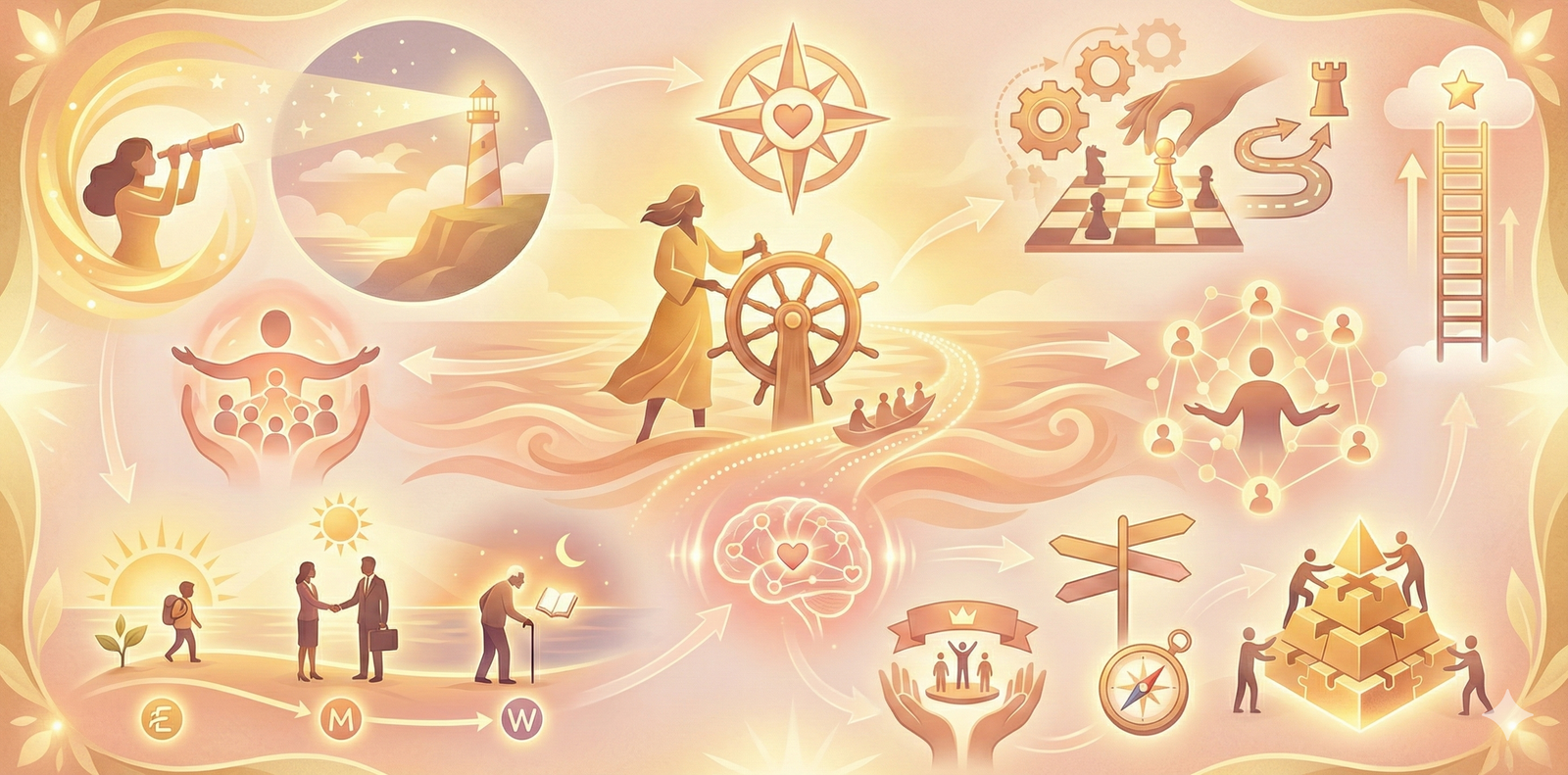
Want to know the one skill that separates exceptional leaders from average managers? It's vulnerability.
Leaders who admit mistakes, ask for help, and share their struggles create psychological safety—the foundation where innovation, collaboration, and loyalty flourish.
What Is Leadership?
Leadership is the practice of guiding, inspiring, and influencing a group of people toward achieving common goals. It's not about having the loudest voice or the most power—it's about creating an environment where others feel safe, valued, and motivated to do their best work. Leadership encompasses setting direction, making decisions, communicating vision, and modeling the values and behaviors you expect from others.
Not medical advice.
Leadership appears in many contexts: at home with family, in teams at work, in community organizations, and in personal projects. Whether you're leading a multinational company, a team of three people, or just yourself toward your goals, the core principles remain the same. Effective leadership requires self-awareness, emotional intelligence, clear communication, and a genuine commitment to the success of those you lead.
Surprising Insight: Surprising Insight: Leaders who focus on their team's wellbeing report 2.5x higher employee engagement, 3x greater innovation, and significantly lower turnover rates than leaders who focus only on output metrics.
The Leadership Influence Model
Shows how authentic leadership creates a ripple effect through trust, safety, and team performance
🔍 Click to enlarge
Why Leadership Matters in 2026
In 2026, leadership skills are no longer optional—they're essential. The workplace has fundamentally changed. Remote teams span time zones. Change happens constantly. Employees increasingly demand meaning, purpose, and connection from their work. Leaders who can navigate complexity, build remote connections, and inspire without direct oversight create organizations that thrive. The old command-and-control model is dead.
Leadership directly impacts happiness, both for the people you lead and for yourself. Leaders who master emotional intelligence and authentic communication report higher personal satisfaction, better relationships, and deeper fulfillment. Research shows that teams led by emotionally intelligent leaders experience less stress, less burnout, and significantly higher job satisfaction.
Beyond the workplace, leadership skills transform personal life. Parents lead families. Friends lead circles. Individuals lead themselves. The ability to inspire, communicate clearly, make sound decisions under pressure, and build meaningful connections—these are leadership skills that enhance every relationship and every challenge you face.
The Science Behind Leadership
Neuroscience reveals fascinating truths about how leadership affects the brain. When leaders create psychological safety through authentic communication and vulnerability, the team's brains release oxytocin—the bonding hormone that builds trust. When leaders threaten, shame, or create uncertainty, the brain releases cortisol, triggering the threat response. Suddenly, people focus on self-protection, not creativity or collaboration.
Research from Harvard, Stanford, and MIT shows that transformational leadership—where leaders inspire through vision, model desired behavior, and provide individualized support—directly improves team performance, innovation, and wellbeing. Coaching-oriented leadership, where leaders ask questions and support growth rather than dictate answers, increases psychological entitlement and resilience in team members, making them more adaptable to change.
Leadership Impact on Team Neurobiology
Illustrates how different leadership styles trigger different neurochemical responses in teams
🔍 Click to enlarge
Key Components of Leadership
Vision & Direction
Great leaders articulate a clear, compelling vision of what they're building and why it matters. This vision gives meaning to daily work and helps teams navigate ambiguity. Vision isn't just about business outcomes—it's about the impact you're creating, the problems you're solving, and the values that guide your decisions. People don't follow because they must; they follow because they believe in where you're going.
Trust & Psychological Safety
Trust is the currency of leadership. When team members trust you, they speak up about problems before they become crises. They share ideas. They take smart risks. They stay longer. Psychological safety—the belief that you won't be punished or humiliated for speaking your mind—is built through consistent, authentic behavior. It grows when leaders admit mistakes, ask for feedback, and respond to concerns with curiosity rather than defensiveness.
Emotional Intelligence
Emotional intelligence—the ability to recognize, understand, and manage your own emotions and those of others—is twice as predictive of leadership success as IQ. It encompasses self-awareness (knowing your triggers, strengths, and blind spots), empathy (understanding others' perspectives and feelings), and relationship management (navigating interpersonal dynamics skillfully). Leaders with high EQ create environments where people feel understood and valued.
Communication & Influence
Leadership is fundamentally about communication—not just speaking, but truly listening. Exceptional leaders ask powerful questions, listen without judgment, and communicate with clarity and warmth. They adjust their message for their audience. They explain the 'why' behind decisions. They give feedback that helps people grow. Communication is how vision becomes shared understanding, how trust gets built, and how teams coordinate action.
| Competency | What It Means | Impact on Team |
|---|---|---|
| Vision Setting | Articulating where you're going and why | Team feels purpose and direction |
| Emotional Intelligence | Understanding self and others' emotions | Stronger relationships and trust |
| Communication | Clear, authentic, listening-focused interaction | Better alignment and collaboration |
| Decision Making | Making choices with available information under uncertainty | Faster progress and confidence |
| Adaptability | Flexing approach as circumstances change | Team feels safe with change |
| Vulnerability | Admitting mistakes and limitations authentically | Psychological safety and trust |
How to Apply Leadership: Step by Step
- Step 1: Start with self-awareness: Reflect on your current leadership style. What are your natural strengths? When do you feel most confident leading? Where do you struggle? Ask trusted colleagues for honest feedback about how you show up as a leader.
- Step 2: Define your personal vision: What impact do you want to create? Not just at work, but in all the places you lead—your family, your community, your own life. Write this down in simple, personal language. Your vision should inspire you.
- Step 3: Practice active listening: In your next team meeting or conversation, commit to truly listening instead of planning your response. Ask questions to understand the other person's perspective. Notice what shifts in the conversation.
- Step 4: Build psychological safety: Share something vulnerable. Admit a mistake. Ask for help. Model the openness you want from your team. Notice how people respond when you're authentic rather than invincible.
- Step 5: Give feedback with growth mindset: When someone struggles, frame it as a learning opportunity, not a failure. Use the formula: 'I noticed [behavior]. Here's the impact: [effect]. What could you try differently next time?' Then listen.
- Step 6: Create space for input: Before making decisions, ask your team for their perspective. Show how their input influenced your decision. When people feel heard, they're more committed to the outcome.
- Step 7: Celebrate effort and growth: Don't wait until you've hit the big goal. Recognize when someone works hard, tries something new, or helps a teammate. This builds momentum and reinforces desired behaviors.
- Step 8: Develop emotional awareness: Notice your emotional reactions throughout the day. When you feel frustrated, defensive, or anxious, pause and breathe. What's really driving this feeling? How can you respond thoughtfully rather than react?
- Step 9: Learn continuously: Read books on leadership. Take courses. Find a mentor or coach. Ask your team what you could improve. Great leaders are perpetual learners who model growth for their teams.
- Step 10: Reflect weekly: Every week, ask yourself: Did I lead with authenticity? Did my team feel safe? Did I move toward my vision? What's one thing I'll do differently next week?
Leadership Across Life Stages
Adultez joven (18-35)
In early adulthood, leadership often emerges in small ways: on project teams, in friendships, or in volunteer contexts. The focus is on building credibility through competence and reliability. Young leaders are developing their leadership voice and learning from mentors. This is the time to seek feedback aggressively, take on leadership opportunities even when uncertain, and learn from diverse role models. The goal isn't to have all the answers—it's to build a foundation of self-awareness and skill.
Edad media (35-55)
Middle adulthood is when many people step into formal leadership roles. You have experience, credibility, and often manage teams or significant projects. The challenge here is staying authentic rather than adopting a 'leadership persona.' Middle-aged leaders often have the wisdom to mentor younger colleagues while still having the energy and influence to drive change. This is also when burnout risk peaks if leaders don't balance leadership demands with self-care and personal relationships.
Adultez tardía (55+)
Later-adulthood leaders often shift toward legacy-building and mentorship. You have deep wisdom to share. Your leadership can focus on developing the next generation, shaping organizational culture, and ensuring your influence extends beyond your direct tenure. Many find this phase most fulfilling because leadership becomes less about proving yourself and more about contributing meaningfully to something larger than yourself.
Profiles: Your Leadership Approach
The Visionary Leader
- Clear big-picture thinking
- Ability to inspire through purpose
- Confidence in uncertain situations
Common pitfall: Gets so focused on the vision that they overlook the people and processes needed to execute it. Can seem disconnected from day-to-day reality.
Best move: Partner with detail-oriented people who can translate your vision into concrete steps. Check in regularly with your team about what they actually need, not just the end goal.
The Compassionate Leader
- Strong emotional intelligence
- Genuine care for team wellbeing
- Ability to create safe spaces
Common pitfall: Sometimes avoids difficult conversations or necessary feedback because they don't want to hurt feelings. Can inadvertently allow underperformance to continue.
Best move: Remember that real care means honest feedback. Frame growth conversations as genuine investment in someone's development. Combine warmth with clarity about expectations.
The Strategic Leader
- Systems thinking
- Analytical problem-solving
- Long-term planning capability
Common pitfall: Can come across as cold or detached. May overlook the human impact of strategic decisions. Teams might feel like they're being optimized rather than led.
Best move: Deliberately communicate the 'why' behind your strategies in human terms. Show how your decisions serve people, not just metrics. Ask about impact on individuals, not just numbers.
The Collaborative Leader
- Strong communication skills
- Genuine interest in others' input
- Ability to synthesize diverse perspectives
Common pitfall: Can over-process decisions by seeking input from too many people. Might struggle with needed decisiveness or clarity. Can be seen as lacking conviction.
Best move: Set clear boundaries on consultation. Decide which decisions require input and which you'll make independently. Be decisive when it's your call, while maintaining openness to feedback.
Common Leadership Mistakes
One of the biggest leadership mistakes is assuming that your way is the right way. Great leaders are curious about different perspectives, different working styles, and different cultural backgrounds. They ask 'Why do you approach it that way?' instead of assuming someone is wrong. This curiosity builds trust and often leads to better solutions.
Another critical mistake is failing to manage your own stress and emotions. When you're burned out, anxious, or overwhelmed, everyone feels it. You snap at people. You make reactive decisions. Your team loses confidence. Taking care of your own mental health isn't selfish—it's essential leadership work. When you manage your stress well, you bring your best self to every interaction.
Finally, many leaders focus so hard on being strong and having answers that they never show vulnerability. They hide their struggles, their uncertainties, their learning edges. This creates distance and kills psychological safety. The paradox of modern leadership is that vulnerability—not invincibility—is what creates the deepest trust and the most engaged teams.
From Leadership Mistakes to Leadership Mastery
Shows how common mistakes transform into leadership strengths through awareness and practice
🔍 Click to enlarge
Ciencia y estudios
Recent research from 2023-2025 reveals critical insights about what makes leaders effective. Studies consistently show that transformational leadership—where leaders inspire through vision, model desired behavior, and provide individualized support—directly improves team performance, engagement, and psychological wellbeing. Coaching-oriented leadership increases team members' resilience and their motivation to adapt to change. Leaders who prioritize team wellbeing report happy teams that are 28% more productive, 3x more innovative, and significantly more loyal.
- Harvard Business Review (2024): Transformational leadership directly influences university faculty research performance by increasing proactive work behaviors and intrinsic motivation.
- King's College London (2025): Leadership skills including conflict resolution, feedback, and vision-setting are now considered as important as technical expertise in research and scientific careers.
- Center for Creative Leadership (2024): Emotional intelligence is twice as predictive of leadership success as IQ and accounts for up to 90% of the competencies that separate top-performing leaders.
- Frontiers in Psychology (2025): Positive leadership and worker well-being are interconnected; leaders who foster psychological safety create teams with higher engagement, innovation, and retention.
- MIT Sloan (2024): Leaders who create environments of psychological safety and authentic communication develop teams with stronger problem-solving capacity and faster adaptation to change.
Tu primer micro hábito
Comienza pequeño hoy
Today's action: In your next conversation—whether with your boss, your team, or your family—ask one genuine question and then truly listen to the answer without planning your response. Notice what changes in how the person responds to you.
This tiny habit rewires your listening muscle. Most of us listen while planning what we'll say next. True listening creates immediate connection and gives you information you couldn't get while talking. When people feel genuinely heard, they trust you more and open up more.
Track your listening practice and get insights into your leadership growth patterns with our AI mentor app. The more you practice intentional listening, the stronger your leadership foundation becomes.
Evaluación rápida
How would you currently describe your leadership approach?
Your current self-assessment reveals where you are on your leadership journey. Leaders grow through self-awareness and intentional practice.
What's your biggest challenge when leading others?
Your challenge area points to your greatest growth opportunity. The most effective leaders invest in their weakest link.
Which aspect of leadership matters most to you personally?
What matters to you reveals your leadership values and where your natural strengths likely exist. The best leaders lead from their values.
Take our full assessment to get personalized recommendations for your leadership growth.
Discover Your Style →Preguntas frecuentes
Próximos pasos
Your leadership journey is unique. Maybe you're just discovering that you want to lead. Maybe you're already in a leadership role and feeling the weight of that responsibility. Maybe you're shifting into a new phase of your life and wondering what leadership looks like for you. Wherever you are, you have the potential to grow.
Start with one small practice. Listen more deeply in one conversation. Ask for feedback on something specific. Admit a mistake to your team. Create one moment of psychological safety. These tiny actions compound. Over weeks and months, they transform how you show up as a leader. And as you transform, everyone around you transforms too.
Get personalized guidance for developing your unique leadership style with AI coaching.
Start Your Journey →Research Sources
This article is based on peer-reviewed research and authoritative sources. Below are the key references we consulted:
Related Glossary Articles
Frequently Asked Questions
Do you have to be naturally confident to be a good leader?
No. Many of the best leaders struggle with self-doubt internally. What matters is acting with conviction despite uncertainty and showing up authentically. Confidence is built through small wins and practice, not something you're born with. Leaders who admit their doubts while still taking action often create more trust than those who appear invincible.
Can you develop leadership skills if you're introverted?
Absolutely. Some of the most effective leaders are introverts. Introverted leaders often listen deeply, think before speaking, and build one-on-one relationships effectively. You don't need to be the loudest person in the room to be a great leader. You need to be authentic, clear, and committed to your people's success.
What's the difference between leadership and management?
Management is about coordinating tasks and ensuring execution. Leadership is about inspiring vision and building trust. You can be a great manager without being a leader, but great leaders usually develop good management skills too. The most effective people do both: they get things done AND they build culture.
How do I develop leadership skills if I'm not in a formal leadership position?
Leadership opportunities exist everywhere. Lead projects. Mentor a colleague. Take initiative at home with family. Lead yourself toward your goals with discipline and authenticity. Lead in volunteer contexts. Every situation where you influence, guide, or inspire is leadership practice.
Is it ever too late to develop leadership skills?
It's never too late. Research on leadership development shows that people at every life stage can significantly improve their leadership effectiveness. The benefits compound—a leader at 60 who suddenly develops emotional intelligence doesn't just improve their remaining years, they often create meaningful legacy through mentoring others.
Take the Next Step
Ready to improve your wellbeing? Take our free assessment to get personalized recommendations based on your unique situation.
- Discover your strengths and gaps
- Get personalized quick wins
- Track your progress over time
- Evidence-based strategies