Boundary Setting
Imagine reaching the end of each day feeling drained, your energy depleted by endless demands from work, family, and friends. You say yes to everything, help everyone, and prioritize others' needs over your own. This exhaustion isn't a personal failing—it's a sign that your boundaries need attention. Boundary setting is the practice of establishing clear limits on what you will and won't do, creating psychological and emotional protection for your wellbeing. In 2026, as remote work blurs the lines between professional and personal time, as social media demands constant availability, and as compassion fatigue spreads across caring professions, healthy boundaries have become essential to happiness and mental health. This guide explores what boundaries are, why they matter, and how to establish them in every area of your life.
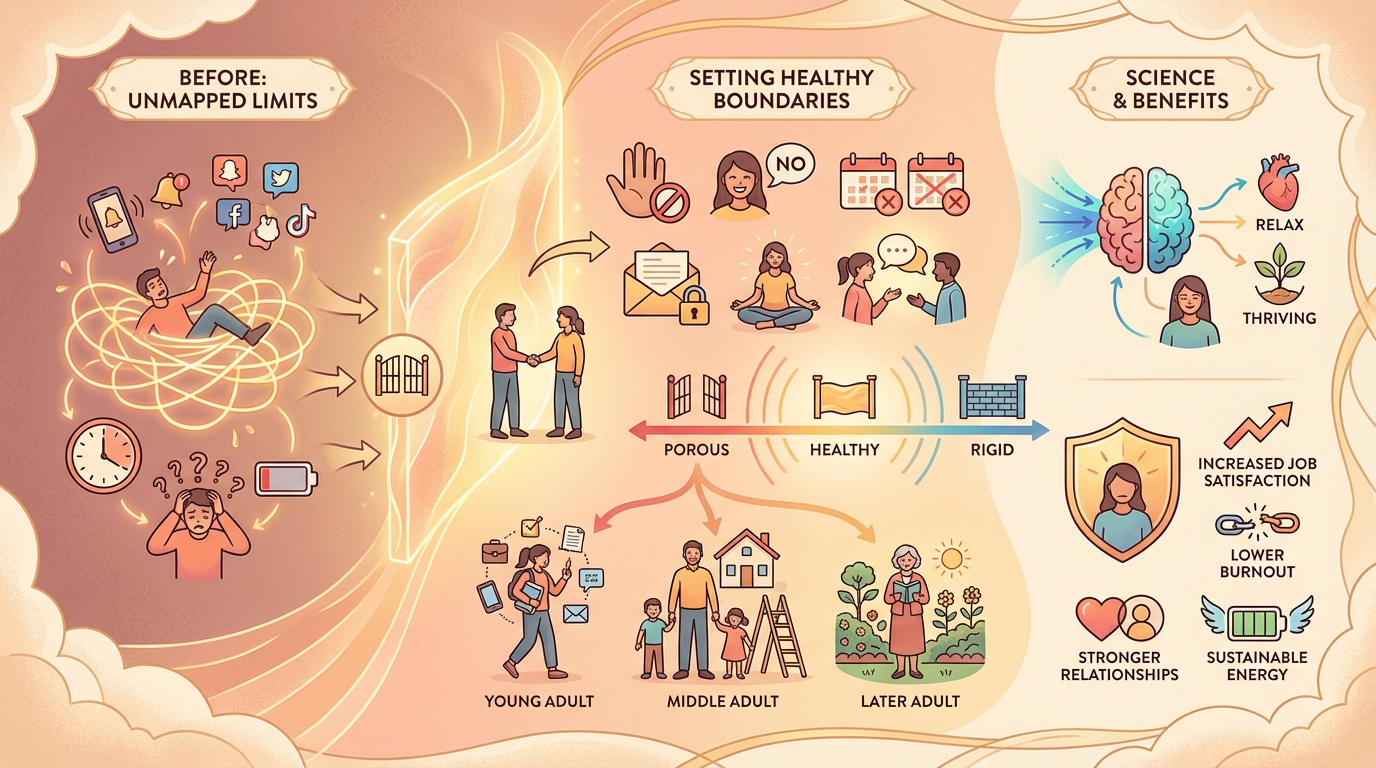
Strong boundaries don't make you selfish—they make you sustainable. They protect your mental health, reduce stress, and actually improve your relationships by creating clarity and respect.
Whether you're struggling with work demands that follow you home, relationships that drain your energy, or guilt around saying no, you'll learn practical strategies from therapeutic research and psychology to reclaim your peace.
What Is Boundary Setting?
Boundary setting is the process of clearly identifying and communicating your limits, values, and needs to others. It's a psychological demarcation that protects the integrity of your individual space—physical, emotional, mental, and digital. A boundary is not a wall; it's a permeable barrier that allows healthy connection while preventing exploitation, resentment, and burnout. When you set a boundary, you're saying 'I matter' and 'my wellbeing is important.' Boundaries come in many forms: saying no to extra work, limiting contact with someone who triggers anxiety, keeping your evenings free from work emails, or refusing to engage in conversations that violate your values.
Not medical advice.
The research is clear: boundaries are foundational to mental health. Psychology Today reports that healthy boundaries are independent predictors of self-esteem and wellbeing. When boundaries are blurred or constantly crossed, chronic stress develops, emotional exhaustion increases, and burnout becomes inevitable. Conversely, individuals who establish and maintain clear boundaries experience lower anxiety, greater job satisfaction, improved relationships, and higher life satisfaction. Setting boundaries is not selfish; it's self-preservation and a prerequisite for sustainable happiness.
At its core, boundary setting is about recognizing that you are a separate person from others, with your own needs, values, and emotional experience. This fundamental truth is often overlooked in cultures that emphasize caregiving, people-pleasing, or service to others. Yet understanding this separation is not cold or isolating; it's the foundation of genuine connection. When you understand that your emotional wellbeing is your responsibility, not dependent on others' approval, you paradoxically become more capable of authentic care for others. You give from fullness rather than depletion. Your boundaries create space for relationships based on mutual respect rather than obligation.
Surprising Insight: Surprising Insight: A 2022 study in Psychological Health found that individuals who regularly enforced boundaries were significantly less likely to experience burnout, even in high-stress professions. The effect was stronger than many stress-reduction interventions.
The Boundary Spectrum
A visual showing the spectrum from no boundaries to rigid boundaries, with healthy boundaries in the middle
🔍 Click to enlarge
Why Boundary Setting Matters in 2026
The workplace landscape has fundamentally changed. Remote work has eliminated the physical boundary between home and office. Slack, email, and text messages mean work can reach you at 11 PM. Social media platforms encourage constant availability. Meanwhile, caregiving responsibilities—childcare, elder care, supporting anxious friends—create emotional demands that can become overwhelming. In this environment, boundaries are no longer optional; they're essential infrastructure for mental health. Research from UC Davis Health and Vanderbilt University confirms that intentional boundary setting directly improves work-life balance, reduces emotional exhaustion, and boosts overall wellbeing.
The statistics are sobering: 'work-life blending' is linked to increased stress levels, decreased job satisfaction, and higher burnout rates. Yet the solution is within your control. When you set clear boundaries—on work hours, email checking, personal requests, and emotional labor—you create protected time for recovery, relationships, hobbies, and self-care. This isn't laziness; it's the foundation of sustainable productivity and happiness.
Additionally, setting boundaries improves your relationships. Paradoxically, saying no more often strengthens connection because your yes becomes more meaningful. When you're not resentful about overcommitment, you show up more fully in the relationships that matter. Clear expectations reduce conflict. Respecting your own limits teaches others to respect them too.
Consider the cumulative impact of boundary violations. Each small yes—answering a text during dinner, taking on one more project, listening to a friend's crisis when you're depleted—seems insignificant alone. But collectively, they erode your wellbeing like water wearing down stone. You don't wake up burned out; you arrive there through a thousand small boundary violations. Conversely, each time you maintain a boundary, you send a powerful message to your nervous system: I'm safe, I'm in control, I matter. These small acts compound into profound shifts in how you experience your life, your energy levels, and your capacity for genuine connection.
The Science Behind Boundary Setting
Neuroscience reveals why boundaries are so powerful. When you say yes to something you don't want, your nervous system registers a threat. You're overriding your own needs, which activates the stress response even if there's no external danger. Chronic boundary violations keep your nervous system in a state of low-level alert, depleting your resources. Conversely, when you honor your own boundaries, your nervous system receives the message: 'I'm safe, I'm in control, I matter.' This activates the parasympathetic nervous system—the rest-and-digest response—allowing your body to recover, heal, and restore itself.
Research on boundary theory, published in the Journal of Occupational and Organizational Psychology, shows that individuals who actively manage boundaries between work and personal life experience better mental health, higher job satisfaction, and greater overall wellbeing. The study found that the combination of boundary control, organizational support for boundaries, and personal boundary preferences creates the strongest predictor of work-life balance. In other words, actively managing your boundaries—not just hoping they'll happen naturally—is key to success.
How Boundaries Protect Your Nervous System
Shows the relationship between boundary violations and nervous system activation
🔍 Click to enlarge
Key Components of Boundary Setting
Identifying Your Values and Needs
Before you can set boundaries, you must know what you value and what you need. This requires self-awareness and honesty. What brings you fulfillment? What depletes you? What matters most to you? Some people value creative time alone; others thrive on social connection. Some need 9 hours of sleep; others function well on less. Some can't work weekends; others prefer it to weekday structure. Your boundaries must reflect your authentic needs, not someone else's expectations. Spend time journaling, meditating, or working with a therapist to clarify your values. This clarity becomes the foundation for all boundary conversations.
Clear Communication and Assertiveness
Once you know your limits, you must communicate them clearly and respectfully. This is where many people stumble. They hint, apologize, over-explain, or soften their message so much that it becomes unclear. Instead, use 'I' statements: 'I work best when I'm not checking emails after 6 PM' rather than 'You're disrespectful if you email me late.' Be direct and specific. 'I can't take on new projects this quarter' is clearer than 'I'm pretty busy right now.' Practice saying no without explanation or guilt. Research on assertiveness shows that clear, respectful boundary statements reduce misunderstandings and actually increase respect from others.
Consistency and Follow-Through
A boundary that isn't enforced isn't a boundary; it's a suggestion. If you say you won't check work emails after 6 PM but then respond to every message at 10 PM, people will test your boundary again and again. Consistency teaches others what you're serious about. This doesn't mean being rigid or punitive. If someone violates your boundary, address it calmly and clearly: 'We agreed I wouldn't take calls during dinner. I'd appreciate it if you'd text instead.' When you consistently maintain your boundary, respect follows.
Flexibility and Compassion
Healthy boundaries aren't walls; they're permeable. Sometimes you'll make exceptions. The key is choosing consciously, not just defaulting to others' demands. You might say yes to extra work on a specific project because you believe in it, but then restore your boundary when it's complete. You might stay late to support a colleague in crisis, but you make sure this isn't your new normal. Healthy boundaries also acknowledge human needs and limitations. Life happens. Emergencies occur. Children get sick. The goal isn't perfection; it's intention and consistency.
This component also involves self-compassion. You won't maintain every boundary perfectly. You'll find yourself saying yes when you meant to say no. You'll get pulled back into old patterns. Rather than spiraling into shame, treat this as data: 'In this situation, I couldn't maintain my boundary. What made that hard? What support do I need?' Self-compassion paradoxically strengthens boundaries because it removes the punishment-based motivation that often collapses. Instead of 'I'm weak for saying yes,' you think 'I'm learning to say no more consistently.' This mindset sustains change.
| Type of Boundary | Description | Example |
|---|---|---|
| Physical Boundaries | Limits on touch, space, and bodily autonomy | Not comfortable with hugging; prefer handshakes |
| Emotional Boundaries | Responsibility for own emotions; not absorbing others' feelings | You're upset, but that's not my responsibility to fix |
| Mental Boundaries | Your thoughts and ideas are your own | I disagree respectfully; you can have a different opinion |
| Time Boundaries | Control over your schedule and availability | I work 9-5; evenings are for family |
| Material Boundaries | Control over your possessions and money | I lend books, not money, to friends |
| Sexual Boundaries | Consent and comfort with physical intimacy | I'm not ready for that; please ask first |
| Digital Boundaries | Control over online presence and communication | I don't text work issues on weekends |
| Professional Boundaries | Clear roles and expectations at work | I'm your colleague, not your therapist |
How to Apply Boundary Setting: Step by Step
- Step 1: Identify where your boundaries are unclear or missing. Notice situations that trigger resentment, guilt, or exhaustion. These are signals that a boundary needs attention. Write down 3-5 areas in your life where boundaries are weak.
- Step 2: Clarify your values and non-negotiables. What do you need to thrive? What violates your core values? Be specific. Instead of 'I need more balance,' try 'I need three evenings per week without work contact and weekends completely free.'
- Step 3: Practice saying no to small requests first. Don't start with the biggest, scariest boundary. Say no to a casual invitation, decline adding to a project, or set a small time boundary. Build confidence with low-stakes practice.
- Step 4: Communicate your boundary clearly and specifically to the relevant person. Use an 'I' statement. Be direct. Avoid apologies or over-explaining. Example: 'I've realized I work best when I'm not managing emails after 6 PM. I'll respond first thing in the morning.'
- Step 5: Prepare for pushback and stay calm. Some people will test your boundary or try to convince you it's unreasonable. This is normal. Stay firm and compassionate. You might say, 'I understand this might be inconvenient. My boundary is firm. Let's figure out how to make this work.'
- Step 6: Establish specific practices to enforce your boundary. Turn off email notifications after 6 PM. Don't answer your phone during meals. Close your office door during focus time. The specific practice makes it real and sustainable.
- Step 7: Use the 'broken record' technique if needed. If someone repeatedly violates your boundary, calmly repeat it without getting pulled into debate: 'Like I mentioned, I'm not available after 6 PM. I'm happy to help first thing tomorrow.'
- Step 8: Expect discomfort in yourself. Setting boundaries can trigger guilt, especially if you've been a people-pleaser. Remind yourself: 'My boundary protects my mental health. I'm allowed to have limits. This is healthy.'
- Step 9: Monitor your energy and mood. After setting a boundary, notice if you have more energy, less resentment, better focus. These positive changes reinforce that your boundary is working and worth maintaining.
- Step 10: Celebrate your progress and be patient with imperfection. You didn't develop boundary-less patterns overnight; they won't change overnight either. Small, consistent wins compound into transformation.
Boundary Setting Across Life Stages
Young Adulthood (18-35)
Young adults often struggle with boundaries because they're establishing independence while managing family expectations, new relationships, and career pressures. You might be the first to leave home, the first to earn significant money, or the first to move away. Family members may expect you to maintain old patterns—being available for every family event, lending money, or tolerating criticism. Simultaneously, new romantic relationships require boundary conversations about exclusivity, emotional labor, and time commitment. Career demands can feel non-negotiable when you're establishing yourself. The key in this stage is recognizing that setting boundaries is part of healthy maturation. It's not rejection of family or friends; it's defining yourself as an independent adult. Clear boundaries actually strengthen relationships because they're based on choice, not obligation. Young adults who establish boundaries early create healthier templates for all their future relationships and avoid accumulating resentment that can poison family dynamics for years.
Middle Adulthood (35-55)
Middle adulthood brings a unique boundary challenge: the 'sandwich generation' squeeze. You're managing responsibilities to aging parents while supporting teenage or adult children, building careers, and maintaining partnerships. Emotional demands skyrocket. Everyone needs something, and saying no feels cruel when parents are aging or children are struggling. Work responsibilities often peak during these years, with expectations for leadership and longer hours. Financial pressures intensify. The most important boundary work in this stage is protecting time for your marriage or partnership, ensuring you're not burning out as a caregiver, and maintaining work-life separation. Many people in this stage benefit from explicit family conversations: 'I want to support Mom, and I can visit twice a week. I can't help with daily caregiving.' Clear boundaries prevent resentment from accumulating and actually allow you to be more present and helpful. Without boundaries in this stage, many people experience what's called 'invisible illness'—chronic stress, depression, and anxiety that goes unrecognized because it's attributed to 'just being busy.'
Later Adulthood (55+)
Later adulthood brings the opportunity to prioritize yourself in ways earlier stages didn't allow. Children are launching (hopefully). Career pressures may ease as retirement approaches. The boundary work shifts to protecting your agency and autonomy. Some older adults struggle with role reversal, where adult children start managing their healthcare, finances, or living decisions. Setting firm boundaries about your independence is crucial: 'I appreciate your concern, and I'm making my own choices about my living situation.' Additionally, this stage offers the gift of time—time to pursue interests, invest in friendships, and focus on what actually matters to you. Boundaries around health, activities, and relationships become easier because your values are clear. Use this freedom to design your life intentionally. Older adults who set boundaries report greater satisfaction with their relationships because they've eliminated obligation-based connections and can invest fully in relationships they genuinely choose.
Profiles: Your Boundary Setting Approach
The People-Pleaser
- Permission to prioritize yourself without guilt
- Practice saying no to small requests first
- Understanding that healthy boundaries strengthen relationships
Common pitfall: Over-explaining and apologizing for boundaries, which sends the message that boundaries are negotiable or shameful.
Best move: Use simple, confident language without apology: 'That doesn't work for me.' Notice the guilt that arises—it's temporary. Maintain the boundary anyway. Guilt decreases with repetition.
The Boundary Avoider
- Recognition that unstated boundaries create resentment
- Practice with low-stakes boundary conversations
- Support from trusted friends or a therapist
Common pitfall: Assuming that being nice and accommodating will prevent conflict, when in fact it often creates frustration and misunderstanding.
Best move:
The Rigid Boundary Setter
- Permission to be flexible when it serves you
- Understanding that boundaries serve connection, not disconnection
- Practice distinguishing between firmness and harshness
Common pitfall: Erecting walls that prevent genuine intimacy and connection, turning boundaries into isolation.
Best move:
The Recovering Boundary Crosser
- Acknowledgment of past boundary violations you've committed
- Understanding that awareness creates change
- Practices to honor others' boundaries as well as your own
Common pitfall: Shame and self-punishment, which actually don't change behavior. Instead, focus on forward-moving practices.
Best move:
Common Boundary Setting Mistakes
The first major mistake is making boundaries that don't reflect your authentic needs. You set a boundary because you think you 'should' or because someone else told you to, rather than because it serves your wellbeing. This leads to inconsistency and eventual collapse. Example: You set a boundary about not checking work emails on weekends, but you don't actually value that boundary—you work on weekends anyway. Authentic boundaries are rooted in your genuine values and needs. Ask yourself: 'Does this boundary serve my wellbeing?' If not, adjust it to something that actually matters to you. Many people adopt boundaries from self-help books or therapists' recommendations without examining whether those boundaries align with their actual values. The boundary that works for your friend might be wrong for you. Your boundaries must come from your internal compass, not external shoulds.
The second mistake is communicating boundaries in anger or resentment. When you've let resentment build for weeks, your boundary conversation becomes an accusation: 'You're always asking me for money!' or 'You never respect my time!' This triggers defensiveness and conflict. Instead, set boundaries proactively, before resentment accumulates. Communicate calmly and clearly, from a place of self-care rather than anger. Use 'I need' and 'I work best when' language rather than blame. The tone of your boundary communication matters enormously. If you deliver it with contempt or fury, even valid boundaries will damage relationships. If you deliver it calmly and clearly, even firm boundaries can strengthen connections.
The third mistake is inconsistency. You set a boundary on Monday and violate it by Wednesday. You say you don't work weekends, then respond to emails Saturday afternoon. Inconsistency teaches others that your boundary isn't real. It also creates confusion in your own mind about what you actually value. Choose boundaries you can consistently maintain, and protect them with specific practices. This is why implementation matters: don't just decide 'I won't check work emails after 6 PM'—actually turn off notifications, delete the app from your home screen, or whatever it takes to make the boundary real.
A fourth mistake is rigid, punitive boundaries that stem from anger or past hurt. These are walls masquerading as boundaries. You might say 'I never lend money' because you've been burned, rather than 'I thoughtfully evaluate financial requests based on my ability.' Rigid boundaries prevent connection and often backfire when you decide to make an exception, triggering guilt or inconsistency. Healthy boundaries are firm about what you need while remaining open to connection.
The Boundary Violation Cycle
Shows how weak boundaries lead to resentment, which leads to explosive conversations, which damages relationships
🔍 Click to enlarge
Science and Studies
Recent research confirms what many have experienced: setting boundaries is one of the most effective interventions for preventing burnout, improving mental health, and strengthening relationships. A comprehensive review of boundary research shows consistent patterns across demographics and professions. Neuroscience research reveals that boundary violations activate the stress response in your nervous system, even when there's no obvious external threat. This chronic activation depletes your mental and physical resources. Setting and maintaining boundaries, by contrast, sends safety signals to your brain, activating the parasympathetic nervous system and allowing for recovery and healing.
The research across therapeutic disciplines—cognitive behavioral therapy, dialectical behavior therapy, interpersonal therapy—all emphasize boundary setting as a core skill for managing stress, relationships, and mental health. Therapists recognize that boundary work is often the first step in recovery from anxiety, depression, and relational trauma. Without clear boundaries, other therapeutic interventions have limited effectiveness because the person continues experiencing violation and resentment.
- Journal of Occupational and Organizational Psychology (2024): Research on boundary preference and behavior shows that individuals who actively manage boundaries experience greater work-life balance and job satisfaction than those who don't set boundaries, even in identical job conditions.
- UC Davis Health (2024): Their comprehensive guide on setting boundaries emphasizes that boundary setting is a skill that can be learned and that early adoption prevents the accumulation of resentment and chronic stress.
- Vanderbilt University (2025): Recent studies demonstrate that setting boundaries at work is 'a key to well-being,' with clear boundaries predicting both improved mental health and better workplace relationships.
- Psychology Today (2025): A guide to healthy boundaries confirms that healthy personal boundaries are independent predictors of self-esteem, lower anxiety, and overall life satisfaction across diverse populations.
- Psychological Health (2022): A landmark study found that individuals who regularly enforced boundaries were significantly less likely to experience burnout compared to those with weak or unclear boundaries, regardless of job stress level.
Your First Micro Habit
Start Small Today
Today's action: Choose one small boundary to test today. Pick something low-stakes: don't check your phone for the first hour after waking, don't answer non-urgent texts after 8 PM, or decline one request that doesn't align with your priorities. Notice how it feels. Notice any guilt or resistance. Maintain it for one day, then celebrate.
Small boundary successes build confidence and prove to your nervous system that boundaries are safe. You're not asking for permission from others; you're claiming authority over your own time and energy. This tiny practice, repeated, compounds into a profound shift in how you relate to yourself and others.
Keep quitting habit apps after a missed day? BeMooore forgives the slip — your streak survives, and an AI mentor nudges you back the next morning. Free on iOS.
Quick Assessment
When someone asks you to do something that doesn't fit your schedule, what do you typically experience?
Your answer reveals your boundary relationship. If you chose the first two, building boundary-setting skills could dramatically reduce your stress. If you chose the third, you likely have strong boundaries already. If you chose the fourth, you may be communicating boundaries unclearly, or people don't believe they're real.
How often do you feel resentment toward people you've helped or commitments you've made?
Frequent resentment is a major signal of weak boundaries. Boundaries aren't just about saying no; they're about ensuring your yes is genuine and sustainable. If resentment is regular, exploring where your boundaries need work will transform your relationships and energy.
If you set a boundary and someone reacted negatively, how would you likely respond?
The healthiest response is the third: holding boundaries calmly while staying connected. If you chose the first, you're prioritizing others' comfort over your own needs. If you chose the second, you're on the right track but could strengthen your conviction. If you chose the fourth, you may be setting boundaries from a place of anger rather than self-care.
Take our full assessment to get personalized recommendations.
Discover Your Style →Next Steps
Setting boundaries is a profound act of self-respect. You're claiming that your time, energy, emotions, and needs matter. This isn't arrogance; it's sanity. The world will have endless demands. Your body and mind need rest and protection. Boundaries are how you provide that to yourself. Start small, stay consistent, and expect improvement in your energy, relationships, and overall happiness within weeks. Every time you maintain a boundary, you're strengthening your nervous system, proving to yourself that you're safe and in control, and teaching others how to treat you.
Remember: boundaries are an act of love—love for yourself and ultimately for everyone around you. When you're not depleted, not resentful, not stretched thin, you show up more fully. You're more patient, more generous, more present. Your boundaries create space for genuine connection rather than obligatory interaction. They're not selfish; they're the foundation of sustainable happiness and healthy relationships.
Get personalized guidance with AI coaching.
Start Your Journey →Research Sources
This article is based on peer-reviewed research and authoritative sources. Below are the key references we consulted:
Related Glossary Articles
Frequently Asked Questions
Isn't setting boundaries selfish?
No. Selfishness is taking at others' expense. Boundaries are about protecting your own wellbeing so you can show up fully for those you care about. In fact, people who set healthy boundaries often give more generously because they're not resentful or depleted. Think of it like oxygen masks on an airplane: you put yours on first so you can help others. Boundaries are not selfish; they're sustainable. Consider the alternative: people who constantly exceed their limits become exhausted, resentful, and eventually unable to help anyone, including themselves. Your boundary protects your capacity to give.
How do I set boundaries with people I'm dependent on (boss, parent, partner)?
Start by being clear about what you need, not what they're doing wrong. Instead of 'You're always interrupting me,' try 'I work best with uninterrupted focus time from 9-11 AM. Can we schedule check-ins outside those hours?' Use calm, specific language. Acknowledge power dynamics: 'I know you're my manager, and I'd like to discuss my availability for after-hours work.' Clear, respectful communication often works because it reduces defensiveness. If it doesn't, you may need support from HR, a therapist, or other resources. Remember that some people, particularly those with power over you, may resist your boundaries. That's their choice, and it doesn't make your boundary invalid.
What if my boundary makes someone really upset?
Their upset is information about them, not about you. You can be compassionate about their feelings while maintaining your boundary. 'I understand you're disappointed, and my boundary stands.' Remember: setting a boundary doesn't require their agreement or comfort. It's your decision. Some people will adjust over time; others may choose to reduce contact. Both are acceptable outcomes. Your mental health is more important than someone else's comfort with your boundaries. People often react strongly to boundaries because they've become accustomed to you accommodating them. That reaction will diminish if you remain consistent.
How long does it take to get comfortable with boundary setting?
Most people feel more confident within 2-4 weeks of consistent practice. The discomfort you initially feel (guilt, anxiety) will decrease significantly once you see that boundaries don't destroy relationships—they actually improve them. You'll notice more energy, less resentment, and better focus. Give yourself grace; this is a skill, and skills improve with practice. Consider working with a therapist if you have deep patterns around boundaries. Some patterns take longer to shift, especially if you grew up in environments where boundaries were punished or where people-pleasing was rewarded.
Can you have too many boundaries?
Yes, though this is less common. Boundaries can become walls if they're so rigid that they prevent connection and intimacy. Healthy boundaries are flexible. You might say no to most requests but yes to specific ones that matter. You might protect your mornings for focus but be available in afternoons. The goal is sustainable access to yourself and others—not total isolation or total availability. If your boundaries feel isolating rather than protective, that's worth exploring with a trusted person or therapist. The best boundaries create more intimacy, not less, because they remove resentment and allow genuine choice in your connections.
Take the Next Step
Ready to improve your wellbeing? Take our free assessment to get personalized recommendations based on your unique situation.
- Discover your strengths and gaps
- Get personalized quick wins
- Track your progress over time
- Evidence-based strategies