How to Build Stamina
Your body feels heavy during that final sprint, your mind starts questioning whether you can keep going, and doubt creeps in. This moment reveals the true power of stamina—the remarkable ability to sustain physical and mental effort over extended periods. Whether you're climbing stairs without breathlessness, finishing a demanding workday with energy intact, or completing an athletic challenge, stamina determines your capacity to endure. In our high-demand world, stamina has become one of the most valuable human capabilities. Athletes build it through systematic training, office workers develop it to combat fatigue, and individuals across all walks of life strengthen it to maintain their best performance. The science shows that stamina is not fixed—it's trainable, measurable, and profoundly connected to your cardiovascular health, mental resilience, and overall quality of life. This guide reveals how to build the stamina that transforms your capabilities and unlocks new levels of achievement.
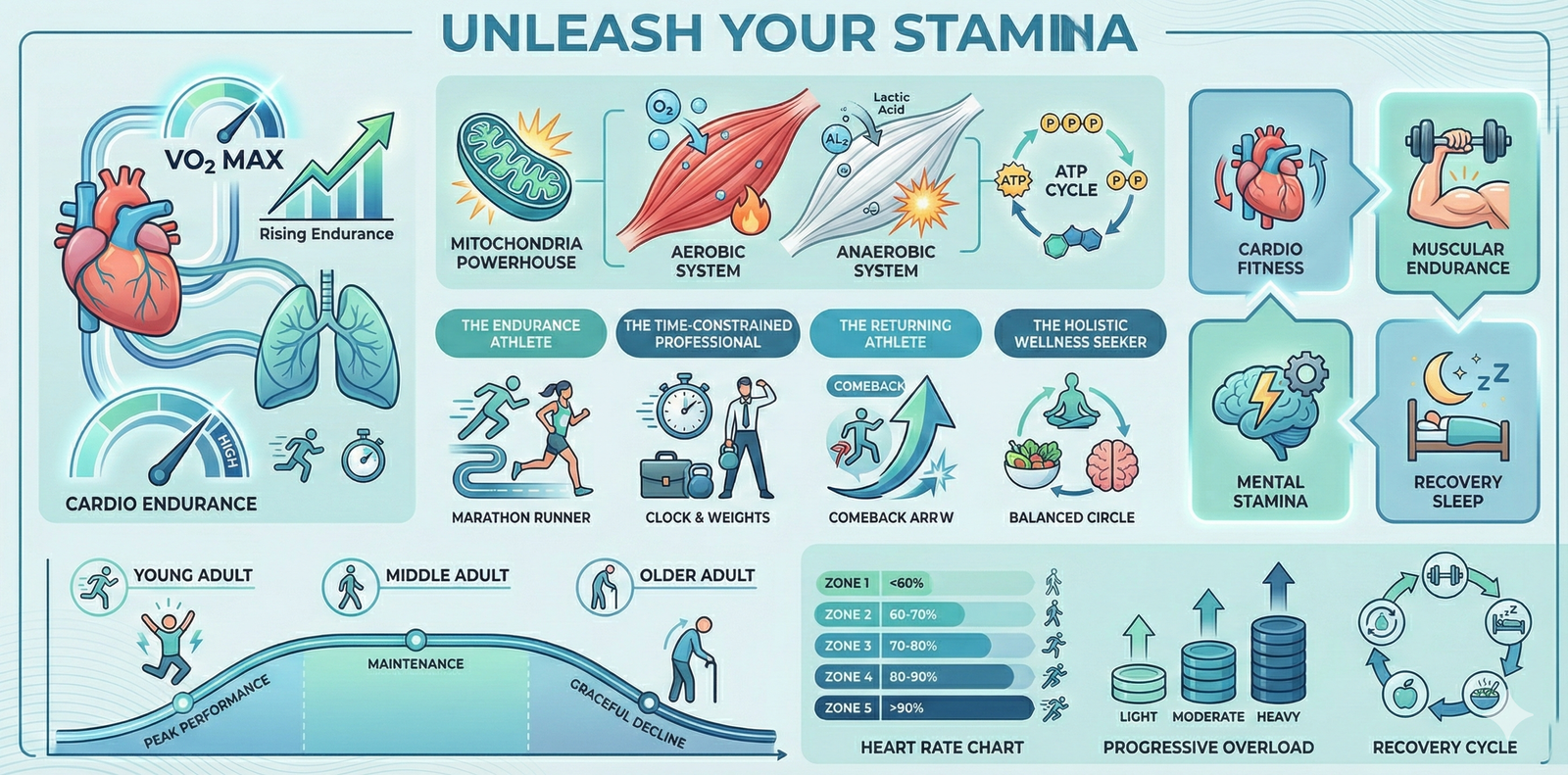
Discover the four energy systems your body uses and how to optimize each one for maximum endurance performance.
Learn the specific training methods that increase VO2 max, improve lactate clearance, and build mental toughness for sustained performance.
What Is Stamina?
Stamina is your body's ability to sustain physical and mental effort over extended periods without excessive fatigue. It combines cardiovascular endurance, muscular endurance, and mental resilience into a single capacity for sustained performance. Stamina represents the intersection of how efficiently your heart pumps oxygenated blood, how effectively your muscles utilize that oxygen, how well your energy systems work together, and how mentally tough you are when fatigue sets in. Physical stamina allows you to run for distance without collapse, climb stairs without breathlessness, or work through a demanding day with consistent energy. Mental stamina enables you to maintain focus during complex tasks, stay motivated through challenges, and persist when willpower wavers. The two are deeply interconnected—physical training strengthens mental resilience, while mental strength allows you to push through physical fatigue.
Not medical advice.
Stamina differs from strength, which is about maximum force production in a single effort. A powerlifter can produce enormous force for seconds. A marathoner with exceptional stamina produces moderate force continuously for hours. Both are valuable, but they develop through different training mechanisms. Stamina also differs from speed, which focuses on moving quickly for short distances. A sprinter explosively covers 100 meters in seconds. An endurance athlete with high stamina covers long distances at sustainable paces. Your stamina profile depends on your goals, training history, genetics, and the specific demands you want to meet.
Surprising Insight: Surprising Insight: People who completed eight weeks of brain endurance training—combining physical exercise with mentally demanding cognitive tasks—showed significantly improved athletic performance and delayed fatigue compared to those doing physical training alone. Mental fatigue can limit physical performance even when your muscles have capacity remaining.
The Stamina System: Physical and Mental Integration
Shows how cardiovascular function, energy systems, muscular efficiency, and mental resilience work together to create overall stamina capacity.
🔍 Click to enlarge
Why Stamina Matters in 2026
In 2026, the demands on your endurance have expanded beyond traditional athletics into every domain of life. The average knowledge worker faces eight to ten hours of focused concentration daily, requiring mental stamina that previous generations rarely developed. Remote work eliminates commutes but increases the psychological demand for sustained attention across video calls, complex projects, and decision-making. Climate-related environmental stresses—heat waves, air quality challenges, altitude variations—increasingly demand that your body maintain performance under variable conditions. The rise of personalized health monitoring through wearables and apps means stamina is now quantifiable and trackable in real time, allowing for data-driven training optimization previously available only to elite athletes.
Physical stamina directly impacts longevity and disease prevention in ways science continues to validate. Research shows that cardiorespiratory fitness is inversely related to all-cause mortality risk across all age groups and demographics. People with higher stamina demonstrate lower rates of cardiovascular disease, type 2 diabetes, certain cancers, and cognitive decline. Beyond disease prevention, stamina determines your functional independence as you age. The ability to climb stairs, carry groceries, play with grandchildren, and maintain active hobbies in later life depends on the stamina foundation you build now. In professional contexts, stamina separates high performers from adequate performers. Executives and leaders with greater endurance navigate crisis situations more effectively, maintain focus during marathon negotiations, and demonstrate the resilience that accelerates advancement.
Mental stamina has become equally critical in our information-dense world. Your ability to maintain focus despite infinite digital distractions, persist through setbacks without emotional dysregulation, and sustain motivation toward long-term goals determines your success more than raw intelligence or talent. Cognitive endurance allows you to engage in deep work that produces meaningful results rather than fragmented attention that produces surface-level outputs. The convergence of physical and mental stamina creates a compound advantage—better cardiovascular fitness enhances cognitive performance through improved brain blood flow and neurogenesis, while mental resilience enables you to push through physical discomfort during training, creating a virtuous cycle of improvement.
The Science Behind Stamina
Stamina emerges from your body's capacity to continuously deliver energy to working muscles while managing metabolic byproducts and maintaining neural drive. The human body operates three primary energy systems simultaneously, each with different capacity and duration characteristics. The phosphocreatine system provides immediate energy for the first 10-15 seconds of intense effort through rapid ATP replenishment, but exhausts quickly. The glycolytic system produces energy from glucose and glycogen through anaerobic metabolism without requiring oxygen, powering efforts from 15 seconds to about three minutes, but accumulating lactate that increases fatigue. The aerobic system oxidizes carbohydrates and fats in the presence of oxygen, providing sustainable energy for efforts lasting more than three minutes and continuing for hours or days. Your stamina depends on optimizing all three systems while efficiently transitioning between them based on task demands.
At the cardiovascular level, stamina depends on your heart's ability to pump oxygenated blood to working muscles efficiently, measured as VO2 max—the maximum amount of oxygen your body can utilize per minute per kilogram of body weight. Higher VO2 max directly correlates with greater aerobic stamina because your muscles have access to more oxygen for continuous energy production. Endurance training increases VO2 max through cardiac adaptations (stronger heart muscle, larger stroke volume) and muscular adaptations (increased capillary density, more mitochondria). Research shows that high-intensity interval training with work intervals of 30 seconds to four minutes produces superior VO2 max improvements compared to steady-state endurance work, though maintaining a base of lower-intensity aerobic work remains essential for building overall endurance capacity. Your lactate threshold—the exercise intensity where lactate production exceeds clearance—represents another critical stamina determinant. Training above your lactate threshold improves your ability to clear lactate, sustain higher intensities longer, and delay fatigue onset.
Energy Systems and Stamina Capacity
Illustrates how the three energy systems (phosphocreatine, glycolytic, aerobic) interact across different exercise durations and intensities.
🔍 Click to enlarge
Key Components of Stamina
Cardiovascular Capacity
Your cardiovascular system forms the foundation of physical stamina. A strong heart pumps more blood with each beat (greater stroke volume), maintaining oxygen delivery even as exercise intensity increases. Larger, more efficient arteries and capillaries deliver oxygen-rich blood to muscles while removing metabolic waste. Regular aerobic training strengthens the heart muscle itself, enlarges the left ventricle (the main pumping chamber), and improves cardiac output. Runners, cyclists, and swimmers typically develop exceptional cardiovascular capacity because their training directly challenges the heart to pump maximum blood while sustaining that effort. Even moderate-intensity aerobic exercise for 150 minutes weekly produces measurable cardiovascular improvements within 4-6 weeks. Higher cardiovascular capacity directly translates to greater stamina because your muscles receive consistent oxygen supply even during extended efforts.
Muscular Endurance
Beyond cardiovascular function, your muscles must have the capacity to sustain contractions without excessive fatigue. Muscular endurance depends on mitochondrial density (the energy-producing structures within cells), capillary density within muscle tissue, myoglobin concentration (oxygen-storing protein), and muscle fiber type composition. Slow-twitch muscle fibers (Type I) excel at sustained contractions and fatigue resistance because they have high oxidative capacity and excellent capillary supply. Fast-twitch fibers (Type II) produce greater force but fatigue quickly, though they can be trained toward greater endurance capacity. Endurance training increases mitochondrial density within muscle cells, essentially creating more power plants to produce energy continuously. Resistance training paradoxically improves muscular endurance when performed at moderate loads with higher repetitions, increasing slow-twitch fiber activation and improving metabolic capacity. A runner with exceptional cardiovascular fitness but weak leg muscles will still hit a performance ceiling because muscles cannot sustain the required contractions.
Energy System Optimization
Stamina requires your body to efficiently utilize all three energy systems and transition between them based on intensity and duration. High-intensity interval training optimizes the phosphocreatine and glycolytic systems by forcing rapid ATP regeneration and lactate management under intense conditions. Threshold training at 85-90% maximum heart rate improves your lactate threshold, allowing sustainable efforts at higher intensities before fatigue accelerates. Steady-state aerobic training builds aerobic capacity and teaches your body to burn fat efficiently at moderate intensities, sparing precious glycogen for higher-intensity efforts. The most effective stamina training incorporates all three approaches throughout the week rather than specializing exclusively in one. A runner might do one high-intensity interval session, one threshold session, and multiple lower-intensity aerobic runs weekly. This comprehensive approach develops capacity across the intensity spectrum while preventing overtraining and injury.
Mental Resilience and Cognitive Endurance
Stamina cannot be understood as purely physiological because mental factors significantly impact sustained performance. Mental stamina—your ability to maintain focus, persist through discomfort, and sustain motivation—involves prefrontal cortex function, neurotransmitter regulation, and psychological resilience. When physical fatigue intensifies, your brain receives signals indicating danger and exhaustion, naturally motivating you to slow down or stop. Athletes with superior mental stamina recognize these signals but choose to continue, understanding they can endure the discomfort. Research on brain endurance training shows that combining physical training with mentally demanding cognitive tasks significantly improves both mental and physical performance compared to physical training alone. Meditation and mindfulness practices increase gray matter volume in regions associated with attention and emotional regulation, directly supporting mental stamina. Goal clarity, purpose connection, and intrinsic motivation all enhance your ability to push through fatigue. Conversely, low self-confidence, negative self-talk, and unclear purpose create mental barriers that limit performance even when physical capacity remains available.
| Training Phase | Timeline | Primary Adaptations | Performance Changes | |
|---|---|---|---|---|
| Foundation Phase | Weeks 1-4 | Cardiovascular system begins adapting, mitochondrial biogenesis initiates, nervous system learns movement patterns | 10-15% improvements in aerobic capacity, noticeably easier breathing at previous intensities | |
| Build Phase | Weeks 5-12 | Capillary density increases, hemoglobin rises, lactate threshold improves, muscle oxidative enzymes increase | 20-30% improvements in sustained performance, ability to exercise at higher intensities | Strength gains in specific movements |
| Peak Phase | Weeks 13-16 | VO2 max plateaus at new higher level, lactate clearance significantly improved, psychological confidence elevated | 30-50% total improvements from baseline, subjective effort decreases significantly for same workloads | |
| Maintenance Phase | Week 17+ | Adaptations plateau unless training stimulus increases, continued functional improvements in daily life | Performance stabilizes at new level, requires ongoing training to prevent deconditioning |
How to Apply Stamina: Step by Step
- Step 1: Assess Your Current Baseline: Establish where you're starting by measuring resting heart rate, testing how long you can sustain moderate-intensity exercise without stopping, timing a one-mile run or comparable distance, and noting your mental endurance during focused work. These baseline measurements allow you to track progress and adjust training appropriately.
- Step 2: Establish Your Training Zone: Calculate your maximum heart rate (220 minus your age for rough estimates, or through actual testing), then identify your training zones: Zone 1 (50-60% max HR, easy conversational pace), Zone 2 (60-70%, moderate effort), Zone 3 (70-80%, harder breathing), Zone 4 (80-90%, high intensity), and Zone 5 (90-100%, maximum effort). Most stamina training happens in Zones 1-3, with occasional work in Zone 4-5.
- Step 3: Build Your Aerobic Base: Spend 4-6 weeks doing primarily Zone 1-2 training, accumulating 150-300 minutes weekly depending on your goal. This low-intensity foundation increases mitochondrial density, improves fat utilization, and prepares your system for harder training without injury. Walk, cycle, swim, or run at comfortable paces where you can hold a conversation.
- Step 4: Introduce Threshold Training: Once your aerobic base is established, add one weekly session of threshold training—sustained efforts at 85-90% maximum heart rate for 20-40 minutes. This trains your lactate threshold and teaches your body to sustain higher intensities. Start with just 15-20 minutes of threshold work and extend progressively.
- Step 5: Implement High-Intensity Intervals: Add one or two weekly sessions of high-intensity interval training with work intervals ranging from 30 seconds to four minutes at 90-100% max HR, followed by recovery periods. Start with shorter intervals (30-90 seconds) and progress toward longer work-rest ratios as fitness improves. HIIT sessions dramatically improve VO2 max efficiency.
- Step 6: Manage Recovery Deliberately: Structure your training so that hard sessions are separated by 48 hours of easy training or rest. Recovery allows physiological adaptations to occur—muscle rebuilding, mitochondrial expansion, and neural reorganization happen during rest, not during training. Sleep quality becomes critical; aim for 7-9 hours nightly and prioritize consistent sleep schedules.
- Step 7: Track and Adjust Progressively: Monitor key metrics including average heart rate at given paces (should decrease weekly), resting heart rate (should decrease over weeks), subjective effort perception (same pace feels easier), and duration capacity (can sustain efforts longer). Increase training volume or intensity by no more than 10% weekly to prevent injury and overtraining.
- Step 8: Strengthen Supporting Systems: Incorporate resistance training 2-3 weekly sessions emphasizing legs, core, and movement-specific muscles. Improve flexibility through dynamic stretching before workouts and static stretching after. Address nutritional status with adequate protein (1.2-1.6g per kg bodyweight for training individuals), carbohydrate availability, and consistent hydration. These factors prevent injury and optimize adaptation.
- Step 9: Build Mental Stamina Through Challenge: Regularly expose yourself to uncomfortable training that requires mental persistence. This teaches your nervous system that discomfort is tolerable and strengthens your ability to override fatigue signals. Also practice meditation or mindfulness for 10-20 minutes daily to improve attentional stamina for mental work.
- Step 10: Periodize for Long-Term Progress: Organize your training into cycles: 4 weeks of aerobic base building, 4 weeks of threshold and tempo work, 4 weeks of high-intensity work, then 1 week of active recovery. This periodization prevents adaptation plateaus, reduces injury risk, and allows systematic peak performance when needed. Repeat cycles with gradually increasing difficulty.
Stamina Across Life Stages
Young Adulthood (18-35)
Young adults possess the physiological potential for exceptional stamina development because hormonal profiles favor muscle building and fat oxidation, recovery capacity is typically excellent, and cardiovascular systems respond dramatically to training stimulus. This life stage is optimal for establishing the aerobic base and training habits that pay dividends across decades. Young adults can tolerate higher training volumes, recover quickly from intense sessions, and adapt rapidly to training stress. The mistakes often made during this phase include neglecting resistance training while focusing exclusively on endurance activities, which can lead to muscle imbalances and injury vulnerability. Other young adults start too intensely, burning out or injuring themselves before developing sustainable training habits. The wisest approach involves building training consistency, developing movement competency across different modalities, establishing sleep and recovery prioritization, and understanding that slow, sustainable progress accumulates into exceptional fitness by age 35-40.
Middle Adulthood (35-55)
Middle-aged adults face several stamina-relevant changes: slight yearly declines in VO2 max capacity, slower recovery compared to younger years, increased injury recovery time, and competing demands from work and family limiting training time. However, middle-aged individuals bring significant advantages including greater training discipline, better understanding of their bodies and responses, higher intrinsic motivation, and psychological resilience developed through life experience. The key to maintaining or improving stamina during this phase involves prioritizing quality over quantity (fewer high-quality training sessions rather than high volume), emphasizing resistance training to preserve muscle mass and prevent the age-related decline, and increasing recovery focus through sleep, nutrition, and stress management. Many middle-aged individuals achieve their best endurance performances during this life stage despite slight physiological declines, because strategic training, consistency, and experience combine to unlock peak performance. This phase also becomes critical for establishing long-term sustainable training that maintains stamina and health into later adulthood.
Later Adulthood (55+)
Older adults experience more significant VO2 max decline (approximately 10% per decade without intervention), reduced muscle protein synthesis and muscle mass loss (sarcopenia), slower recovery, and higher injury recovery times. Simultaneously, regular endurance training in older adults produces remarkable adaptations—reversal of age-related decline, maintained cardiovascular function, preserved muscle mass and strength, and significant improvements in quality of life and functional independence. Older adults become particularly responsive to resistance training combined with endurance work, making a hybrid approach especially valuable. Younger-old adults (55-70) can often maintain competitive-level endurance performance with consistent training. Older-old adults (70+) benefit enormously from moderate stamina training that maintains functional capacity for daily activities and independence. The opportunity to begin or intensify training at any age in this category produces meaningful adaptations—studies show that sedentary 70-year-olds beginning endurance training improve cardiovascular function and work capacity substantially within months.
Profiles: Your Stamina Approach
The Endurance Athlete
- Structured progressive training with periodized peaks
- Scientific monitoring of VO2 max, lactate threshold, and training zones
- Balance between high-intensity work and aerobic base development
Common pitfall: Overtraining and ignoring recovery, leading to burnout and injury despite high fitness
Best move: Implement strict periodization with planned recovery phases and emphasize 80% of training at easy, aerobic-building intensity
The Time-Constrained Professional
- High-intensity interval training to maximize adaptation from limited training time
- Efficient, compound exercises that develop stamina while building strength
- Integration of movement into daily routines rather than depending on separate gym sessions
Common pitfall: Skipping recovery and sleep due to busy schedules, which eliminates adaptation despite good training quality
Best move: Prioritize non-negotiable sleep and recovery even if it means fewer training sessions; emphasize consistency over volume
The Returning Athlete
- Gradual progression to rebuild cardiovascular fitness and prevent re-injury
- Specific attention to weak points or injuries from previous athletic history
- Patience with the return process even though previous fitness memories create frustration
Common pitfall: Attempting to return to previous fitness levels too quickly, causing re-injury or overtraining illness
Best move: Start conservatively with low-intensity aerobic work for 4 weeks before introducing threshold or high-intensity sessions
The Holistic Wellness Seeker
- Integration of physical stamina with mental resilience and emotional sustainability
- Mindfulness and brain endurance training alongside cardiovascular work
- Connection between stamina building and larger life purpose
Common pitfall: Separating physical training from mental-emotional work, creating incomplete stamina development
Best move: Combine deliberate physical training with meditation, breathwork, or mental challenge practices; track energy and mood alongside performance metrics
Common Stamina Mistakes
The most prevalent stamina-building mistake is excessive intensity without adequate aerobic base. Enthusiastic newcomers often begin stamina training by doing high-intensity interval work multiple times weekly, mistakenly believing harder training always produces faster results. In reality, excessive intensity without foundational aerobic development leads to rapid fatigue, poor adaptation, overtraining syndrome, and injury. The correct approach involves 4-6 weeks of primarily easy, aerobic-zone training before introducing harder work. Research shows that elite endurance athletes spend approximately 80% of training time in easy zones, 10% at threshold intensity, and just 10% at high intensity. This distribution seems counterintuitive to beginners but produces superior long-term results because it builds the physiological foundation necessary for tolerating and adapting to harder work.
A second critical mistake is neglecting resistance training while pursuing stamina development. Many endurance athletes focus exclusively on running, cycling, or swimming, believing these activities are sufficient. However, resistance training prevents age-related muscle loss, improves movement economy (muscles become more efficient), enhances injury resilience, and paradoxically improves aerobic performance. Runners who incorporate strength training run faster at the same effort levels. Cyclists who do resistance work produce greater power at the same body weight. The mechanism involves improved neural efficiency, increased muscle fiber recruitment, and better muscular stability. Adding just 2-3 resistance sessions weekly dramatically improves stamina outcomes across all populations.
The third mistake involves inadequate recovery and sleep, which eliminates adaptation despite sound training. Your body doesn't adapt during training—it adapts during recovery when muscles rebuild, mitochondria multiply, and neural patterns reorganize. Individuals who maintain irregular sleep schedules, stress without management, or high training volume without sufficient rest stall their progress despite correct training methodology. Sleep deprivation directly impairs aerobic performance, increases injury risk, and eliminates the hormonal milieu necessary for physical adaptation. Additionally, chronic stress without recovery produces elevated cortisol that suppresses testosterone and promotes catabolic (breakdown) processes. The most simple but powerful improvement many stamina builders can implement is consistent 7-9 hour sleep and basic stress management.
The Recovery-Adaptation Cycle: Why Rest Matters
Illustrates how training stimulus triggers adaptation only when combined with adequate recovery, sleep, nutrition, and stress management.
🔍 Click to enlarge
Science and Studies
The scientific foundation for stamina training is exceptionally robust, with decades of research from sports physiology, exercise science, and molecular biology converging on clear principles and methodologies. Contemporary research increasingly reveals that stamina development involves coordinated adaptations across multiple systems—cardiovascular, muscular, neural, and metabolic—rather than isolated improvements in single systems. Advanced neuroimaging has shown that brain endurance training, combining physical exercise with cognitively demanding tasks, produces superior performance improvements compared to physical training alone, fundamentally changing how elite athletes structure training. Genetic research demonstrates that while initial VO2 max capacity shows significant heritability, trainability (the capacity to improve through training) shows minimal genetic influence, meaning individuals across all genetic backgrounds can substantially improve stamina through appropriate training.
- Speed Endurance Training (SET): Research published in the Journal of Sports Science & Medicine demonstrates that speed endurance training performed at intensities higher than typical endurance work significantly improves athletic performance and represents an effective complement to traditional aerobic training.
- Aerobic High-Intensity Intervals: Studies from the American College of Sports Medicine show that high-intensity aerobic interval training improves VO2 max more effectively than moderate-intensity continuous training, with benefits appearing within 4-6 weeks of consistent training.
- Lactate Threshold Training: Research demonstrates that training at or slightly above anaerobic threshold increases lactate clearance capacity, teaching the body to manage lactate accumulation more efficiently and sustaining higher intensities before fatigue onset.
- Cardiovascular Training Adaptations: NIH-published studies confirm that endurance training produces consistent cardiovascular adaptations including increased left ventricular size, enhanced stroke volume, improved diastolic function, and reduced all-cause mortality risk across all populations.
- Brain Endurance Training: Recent studies from exercise psychology show that combining physical training with mentally challenging cognitive tasks during or after exercise significantly improves psychological resilience and physical performance compared to physical training alone.
Your First Micro Habit
Start Small Today
Today's action: Walk briskly for 10 minutes at moderate intensity where conversation is difficult but possible—your minimum viable stamina training. Do this tomorrow morning or during lunch. Feel your heart working, your breath deepening, your body warming. After 10 minutes, note how you feel. This single habit, repeated 4 times weekly, begins cardiovascular adaptation within two weeks.
This micro habit works because it establishes the foundational aerobic work that all stamina training requires, keeps intensity appropriate for beginners avoiding overtraining, creates an immediate win and momentum without requiring complex planning or equipment, and seamlessly integrates into daily life. Consistency with simple actions creates exponential results over months.
Keep quitting habit apps after a missed day? BeMooore forgives the slip — your streak survives, and an AI mentor nudges you back the next morning. Free on iOS.
Quick Assessment
How would you describe your current physical stamina and energy levels?
Your current stamina baseline determines your starting point and realistic progression timeline. Those experiencing basic fatigue have tremendous room for improvement and will see rapid gains. Those with solid foundations seeking advancement need progressive overload. Everyone can improve.
What's your primary motivation for building stamina?
Your motivation shapes optimal training strategy. Health-focused individuals benefit most from consistent moderate activity. Function-focused individuals need practical movement patterns. Competition-focused athletes benefit from periodized performance training. Mastery-focused individuals thrive with challenging progressive goals.
How much time can you realistically dedicate to stamina training weekly?
Realistic time assessment prevents overambitious planning that causes failure. Even 90 minutes weekly of focused, well-structured training produces significant stamina improvements. More time allows greater specialization but requires careful recovery management.
Take our full assessment to get personalized recommendations.
Discover Your Style →Next Steps
Your stamina journey begins with honest assessment of your current capacity and a clear decision about what stamina means for your life. Are you seeking functional capacity to handle daily demands with energy? Do you want to compete athletically? Are you focused on health and longevity? Do you want to prove something to yourself? Your answer determines your ideal training approach. Write down where you are now (resting heart rate, how long you can sustain moderate activity, your energy levels throughout the day) and where you want to be in 12 weeks. This clarity transforms abstract motivation into concrete direction.
Immediately implement the 10-minute brisk walk micro habit 4 times this week. This is your foundation. Simultaneously, establish sleep as your highest recovery priority—commit to 7-8 hours nightly starting tonight. These two interventions alone (consistent easy aerobic activity plus adequate sleep) produce measurable stamina improvements within 4 weeks. After two weeks of the micro habit, assess your readiness to add structured training by measuring resting heart rate, testing how long you can sustain moderate-intensity activity, and evaluating how you feel. This data guides your progression.
Get personalized guidance with AI coaching.
Start Your Journey →Research Sources
This article is based on peer-reviewed research and authoritative sources. Below are the key references we consulted:
Related Glossary Articles
Frequently Asked Questions
How long does it take to notice improvements in stamina?
Most individuals notice subjective improvements in breathing, effort perception, and recovery within 2-3 weeks of consistent training. Measurable physiological improvements in VO2 max and lactate threshold typically appear within 4-6 weeks. Significant performance changes visible to observers usually require 8-12 weeks of consistent training. The timeline depends on your baseline fitness and training consistency—those starting from very low fitness notice changes faster, while already-fit individuals progress more slowly.
Can I build stamina with limited time—say 3 hours weekly?
Absolutely. Research shows that high-quality, efficiently structured training produces superior results to high-volume, mediocre training. With 3 hours weekly, prioritize one high-intensity session (30-45 minutes), one threshold session (30-45 minutes), and one easy/long session (60-90 minutes). Consistency matters more than volume—three focused hours weekly beats sporadic ten-hour weeks. Additional improvement comes through daily movement like walking or stair climbing outside dedicated training.
Is it ever too late to build stamina? I'm 60+ years old.
It is absolutely never too late. Research demonstrates that individuals beginning endurance training in their 60s, 70s, and beyond show dramatic improvements in cardiovascular function, work capacity, and functional independence. Older adults actually show greater percentage improvements than younger individuals starting training, though absolute fitness levels remain lower. Start conservatively with low-intensity aerobic work, emphasize consistency, incorporate resistance training for muscle preservation, prioritize recovery and sleep, and expect improvements within 4-8 weeks. This investment in stamina directly translates to independence, quality of life, and longevity.
Should I focus on running or cycling for stamina, or does the activity matter?
The activity matters far less than consistency and appropriate intensity distribution. Running, cycling, swimming, rowing, cross-country skiing, and hiking all build stamina when structured properly. Choose activities you genuinely enjoy because you'll maintain consistency longer. Running and cycling are most accessible and well-researched. Swimming offers excellent low-impact cardiovascular training valuable for those with joint issues. Multi-sport training (mixing cycling and running, for example) builds broader fitness while reducing overuse injury risk. The best activity is the one you'll actually do consistently.
How do I know if I'm overtraining versus pushing appropriately hard?
Overtraining produces persistent fatigue, declining performance despite hard training, elevated resting heart rate (5-10 bpm above normal), disturbed sleep, increased irritability, frequent illness from immune suppression, and loss of training enjoyment. Appropriate hard training produces temporary fatigue that resolves with sleep, progressive performance improvements, and maintained motivation. Monitor resting heart rate weekly—if it elevates and stays elevated, reduce training volume. Track performance metrics—if they plateau or decline while training volume increases, overtraining is likely. Listen to subjective measures—enjoyment, motivation, and sleep quality indicate training appropriateness. The solution to overtraining is reduced volume and increased recovery, not more training.
Take the Next Step
Ready to improve your wellbeing? Take our free assessment to get personalized recommendations based on your unique situation.
- Discover your strengths and gaps
- Get personalized quick wins
- Track your progress over time
- Evidence-based strategies