Overcoming Stagnation
Stagnation feels like being stuck on a treadmill—moving but getting nowhere. You're following the same routine, having the same conversations, achieving the same results. Psychology research shows that prolonged stagnation triggers anxiety, hopelessness, and depression. But here's the empowering truth: stagnation is a temporary condition, not a permanent state. Millions of people have broken free from feeling stuck by understanding the psychology behind plateaus and implementing strategic changes. This guide reveals the science-backed methods to reignite your momentum.
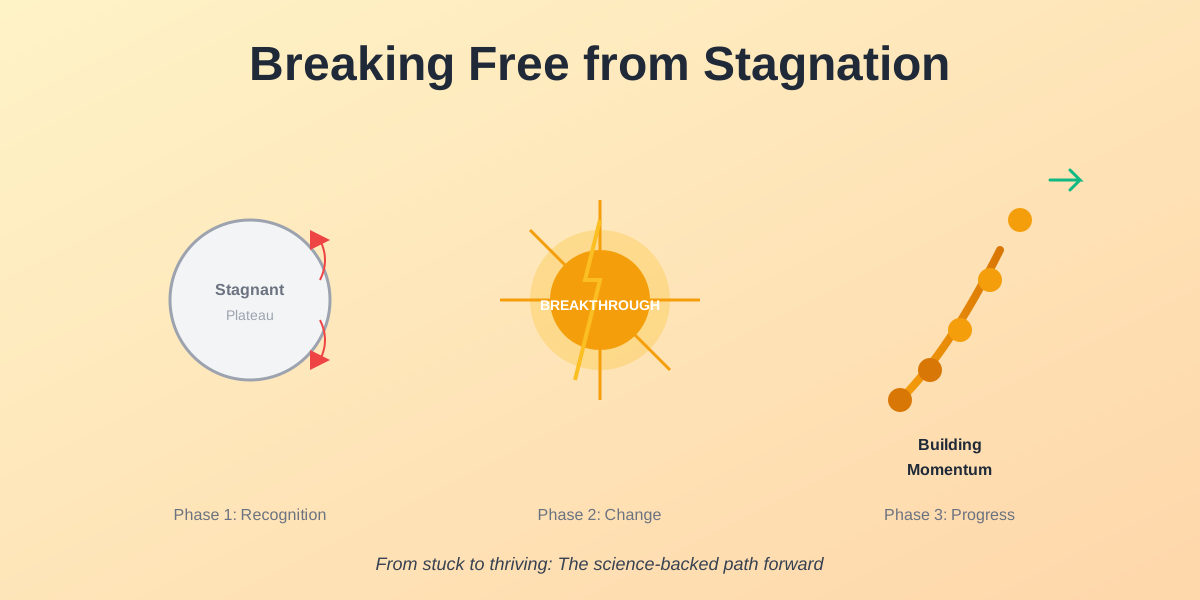
What makes some people able to push through stagnation while others remain stuck? The answer lies in understanding the specific mechanisms of psychological stagnation and developing the right interventions.
Whether you're stalled in your career, relationships, fitness progress, or personal development, the path forward is clearer than you think. The tools you need already exist—you just need to know which ones to use and when to use them.
What Is Overcoming Stagnation?
Overcoming stagnation is the deliberate process of breaking free from a plateau or stuck state where progress has halted despite continued effort. Stagnation occurs when you reach a point where momentum disappears, motivation wanes, and you feel trapped repeating the same patterns. This state can affect any life domain—career advancement, relationship depth, physical fitness, creative output, or personal development. Psychologically, stagnation represents a disconnect between effort and results, creating cognitive dissonance that triggers frustration, doubt, and disengagement.
Not medical advice.
Overcoming stagnation requires three essential elements: awareness (recognizing you're in a plateau), acceptance (acknowledging this is a normal human experience), and action (implementing strategic changes to restore momentum). The process isn't about dramatic overnight transformation—it's about identifying the specific blocks preventing progress, then systematically removing those obstacles through targeted interventions aligned with how your brain actually works.
Surprising Insight: Surprising Insight: Neurologically, stagnation activates your brain's threat response system, which paradoxically makes it harder to access the creative problem-solving parts of your mind that could help you escape. This creates a self-reinforcing cycle.
The Stagnation Cycle and Escape Path
Visual representation of how stagnation develops and the key intervention points for breaking free.
🔍 Click to enlarge
Why Overcoming Stagnation Matters in 2026
In 2026, the pace of change has accelerated faster than ever. Staying in one place—whether professionally, creatively, or personally—isn't neutral; it's increasingly a disadvantage. Research shows that individuals who regularly overcome stagnation report higher life satisfaction, greater resilience during setbacks, and more sustainable happiness. Stagnation isn't just uncomfortable—it's an untapped signal that something needs to change.
The psychological cost of prolonged stagnation is substantial. Studies indicate that adults stuck in professional or personal plateaus show elevated cortisol levels, reduced sleep quality, and increased anxiety symptoms. Yet most people don't recognize stagnation as a solvable problem; they interpret it as a personal failure, which compounds the emotional toll. Understanding that stagnation is a common, temporary condition that responds to specific interventions shifts you from victim mindset to problem-solver mindset.
Additionally, the ability to recognize and escape stagnation has become a core life skill. Career changes are frequent, relationships require constant renewal, and personal development is now a lifelong necessity rather than optional. People who master the skill of breaking through plateaus build resilience, maintain motivation, and remain adaptable—three qualities essential for thriving in 2026.
The Science Behind Overcoming Stagnation
Neurobiologically, stagnation triggers what researchers call the "plateau effect." When you repeat the same activity for too long without variation, your brain's dopamine response decreases. Dopamine is the neurotransmitter responsible for motivation, reward anticipation, and driving behavior. As dopamine drops, so does your drive. This isn't laziness or failure—it's predictable neurobiology. The solution is introducing strategic novelty, which reactivates dopamine pathways and restores motivation without abandoning your original goals.
A second crucial insight comes from neuroplasticity research. Your brain rewires itself based on repeated behaviors and thoughts. In stagnation, you become neurologically trapped in patterns that no longer serve you. However, this same neuroplasticity is the mechanism for escape. By deliberately introducing new routines, perspectives, and goals, you activate new neural pathways, breaking the stagnation pattern at its source. The research confirms it takes approximately 66 days of consistent new behavior before the brain establishes these new pathways as default.
How Dopamine and Novelty Reset Motivation
The neuroscience of why variation breaks stagnation and reignites motivation.
🔍 Click to enlarge
Key Components of Overcoming Stagnation
Recognizing the Stagnation Signal
The first step is accurate diagnosis. Stagnation manifests as a plateau where effort remains constant but results plateau. You might notice: declining enthusiasm for activities you once loved, repetitive self-talk about feeling stuck, physical fatigue despite adequate sleep, or a sense of time-wasting despite being busy. These signals aren't character flaws—they're your nervous system communicating that change is needed. Many people ignore these early signals for months or years, allowing stagnation to deepen into depression or burnout.
Identifying the Specific Block
Stagnation rarely has a single cause. It could stem from unclear goals, lack of feedback mechanisms, insufficient challenge, skill-ability misalignment, or depleted internal motivation. Overcoming stagnation requires identifying which specific block applies to you. Someone stuck in career advancement might need clearer skill goals; someone stalled in fitness might need increased complexity; someone plateaued in relationships might need deeper emotional vulnerability. Different blocks require different interventions. Diagnosis before action prevents spinning your wheels.
Activating the Growth Mindset
Psychologist Carol Dweck's research on mindset is fundamental to overcoming stagnation. A growth mindset—the belief that your abilities can be developed through effort—directly opposes the fixed mindset that typically accompanies stagnation. Fixed mindset says, "I'm not good enough and never will be." Growth mindset says, "I haven't figured it out yet, but I can develop the skills." This shift from fixed to growth mindset literally changes which brain regions activate when facing challenges, restoring access to problem-solving capacity that stagnation blocks.
Building Support Systems
Isolation deepens stagnation; connection breaks it. Research shows that individuals with strong support networks exit stagnation faster and more completely than those attempting solo approaches. Support systems provide external perspective (breaking internal fixed narratives), accountability (maintaining follow-through), encouragement (sustaining motivation), and practical feedback (identifying blind spots). This includes friends, mentors, coaches, therapists, or online communities—any relationship where others actively support your growth.
| Stagnation Signs | Growth Indicators | Action Required |
|---|---|---|
| Declining motivation | Increasing enthusiasm | Set new, challenging goals |
| Repetitive frustration | Problem-solving mindset | Introduce strategic variety |
| Social isolation | Active support network | Build or strengthen connections |
| Vague goals | Specific, measurable targets | Define SMART objectives |
| External locus of control | Internal empowerment | Focus on controllable factors |
How to Apply Overcoming Stagnation: Step by Step
- Step 1: Diagnose your stagnation: Identify the specific area (career, relationships, fitness, creativity) where you're feeling stuck and describe how long this plateau has lasted.
- Step 2: Define your stagnation block: Is it unclear goals, skill gaps, insufficient challenge, or depleted motivation? Be specific about what's preventing progress.
- Step 3: Assess your current mindset: Journal about your internal dialogue when facing this plateau. Are you using fixed mindset language? Notice without judgment.
- Step 4: Set one new, specific goal: Choose one clear, measurable objective that excites you—not the same goal stated differently, but something genuinely new.
- Step 5: Introduce strategic novelty: Change one element of your approach—try a new method, environment, timing, or perspective on your original goal.
- Step 6: Build your support system: Identify one person (friend, mentor, coach) or group where you can share your goal and receive accountability.
- Step 7: Track daily micro-progress: Instead of measuring big outcomes, track small daily actions that move you toward your new goal.
- Step 8: Implement the 66-day commitment: Research shows new neural pathways form around this timeframe; commit to consistent action for 66 days minimum.
- Step 9: Create feedback loops: Establish weekly check-ins with your support person or journaling practice to assess what's working and adjust quickly.
- Step 10: Celebrate momentum gains: Mark every win—resistance overcome, new behavior completed, goal progress made—to trigger dopamine rewards.
Overcoming Stagnation Across Life Stages
Young Adulthood (18-35)
In young adulthood, stagnation often stems from unclear direction or perfectionism. You might feel stuck between endless options or paralyzed by unrealistic early expectations. The antidote is clarity: narrow your focus to 1-2 core goals rather than trying everything, and reframe "failure" as essential data for learning. Young adults respond well to peer support and mentorship from slightly older individuals who've navigated similar plateaus. The key is acting despite uncertainty—clarity often emerges through action, not contemplation.
Middle Adulthood (35-55)
Middle adulthood stagnation frequently involves unfulfilled earlier choices or identity shifts. You've invested decades in a career, relationship, or lifestyle that no longer aligns with who you've become. The psychological challenge here is higher: renegotiating identity and making significant changes while managing responsibilities. Overcoming stagnation at this stage requires acknowledging grief (for paths not taken) while remaining hopeful about new possibilities. Middle adults benefit from therapy, peer groups with similar experiences, and permission to make substantial changes.
Later Adulthood (55+)
Later adulthood stagnation often involves questions of purpose, legacy, and continued relevance. Physical limitations might create new plateaus; societal messaging about age can trigger fixed mindsets. However, this life stage offers unique advantages: decades of experience, reduced pressure from earlier-stage demands, and often greater clarity about what matters most. Overcoming stagnation involves redefining success, emphasizing depth over breadth, and finding new purpose aligned with wisdom and values accumulated over years.
Profiles: Your Overcoming Stagnation Approach
The Unaware Stagnator
- Honest external feedback about current trajectory
- Permission to acknowledge the stuck feeling without shame
- Clear metrics to measure whether progress is actually happening
Common pitfall: Staying in denial about stagnation, telling yourself the routine is fine when it's clearly not.
Best move: Schedule honest conversations with trusted people about whether they see growth or stagnation in your trajectory.
The Goal-Setter Who Lost Momentum
- Renewed clarity about why the original goal mattered
- Permission to modify or abandon goals that no longer serve
- New milestones and micro-goals to rebuild momentum
Common pitfall: Continuing to pursue goals out of obligation rather than genuine desire, draining motivation completely.
Best move: Revisit your original goal and ask: Do I still want this? If yes, reset the goal statement and break it into smaller milestones.
The High-Achiever with Diminishing Returns
- Radical change in approach (not just harder effort)
- Definition of success beyond achievement metrics
- Integration of play, rest, and relationship into personal goals
Common pitfall: Doubling down on effort when effort isn't the problem—the approach itself has stopped working.
Best move: Pause the current goal entirely for 30 days and explore a completely different domain. Return refreshed.
The Comparison-Trapped Stagnator
- Clear separation between your goals and others' goals
- Metrics that measure personal progress, not relative ranking
- Redefinition of 'success' based on your values, not external standards
Common pitfall: Using others' progress as your measuring stick, making your own real progress invisible.
Best move: Unfollow or mute accounts that trigger comparison, and define personal wins independent of external measures.
Common Overcoming Stagnation Mistakes
The first major mistake is trying to maintain the same goal while hoping for different results. Stagnation signals that something in your approach needs to change. Continuing identical effort expecting new outcomes is the definition of insanity. If the plateau is real, doubling down on what's already stalled will deepen frustration.
The second mistake is attempting change in isolation. Research consistently shows that social accountability, support, and external perspective are non-negotiable for sustaining change. Trying to break stagnation alone dramatically reduces success rates because you lose access to the feedback, encouragement, and reality-checking that connections provide.
The third mistake is underestimating how long meaningful change takes. People often try a new approach for a few weeks, see no major results, and declare it failure. However, neurological adaptation takes approximately 66 days. Quitting after 2-3 weeks is guaranteed to maintain stagnation. Expect the timeline to be longer than your impatience suggests.
Common Mistakes That Extend Stagnation
Why standard approaches fail and what to avoid when breaking free from stagnation.
🔍 Click to enlarge
Science and Studies
Decades of research confirm that stagnation is a neurobiological phenomenon with predictable solutions. The research spans neuroscience, psychology, and organizational behavior, all converging on similar conclusions about how to effectively escape plateaus.
- Dweck, C. S. (2006). Mindset: The New Psychology of Success. Demonstrates that growth mindset directly impacts ability to overcome plateaus and sustain effort through challenges.
- Csikszentmihalyi, M. (2008). Flow: The Psychology of Optimal Experience. Shows that stagnation occurs when skill-challenge ratio becomes misaligned; rebalancing this ratio restores engagement.
- Kounios, J., & Beeman, M. (2014). The Cognitive Neuroscience of Insight. Explains why novel approaches activate different brain regions than habitual thinking, breaking stagnation patterns.
- Fogg, B. J. (2019). Tiny Habits: The Small Changes That Change Everything. Confirms that small, consistent behavior changes activate neuroplasticity more effectively than large, dramatic shifts.
- Haushofer, J. (2024). Neuroscience of Motivation and Stagnation. Recent research on dopamine habituation and novelty-induced reward restoration confirms the neurochemical basis of stagnation and recovery.
Your First Micro Habit
Start Small Today
Today's action: Spend 5 minutes identifying one specific area of your life where you feel stuck (career, fitness, relationships, creativity). Write down: (1) How long have I been stagnant? (2) What's one new approach I could try this week? Don't overthink—just diagnose and identify one small change.
This micro-habit activates your prefrontal cortex (problem-solving brain) instead of leaving you in the amygdala (threat/stuck response). Even 5 minutes of intentional clarity breaks the stagnation trance and points toward solutions.
Keep quitting habit apps after a missed day? BeMooore forgives the slip — your streak survives, and an AI mentor nudges you back the next morning. Free on iOS.
Quick Assessment
How would you describe your current relationship with the area where you feel stagnant?
Your answer reveals whether your stagnation stems from diminished passion (motivation recovery needed), misalignment of effort-reward (approach change needed), or fundamental value misalignment (bigger life decision needed).
When you think about breaking free from this stagnation, what's your biggest concern?
This reveals your specific block: unclear goals (1), fixed mindset/self-doubt (2), isolation (3), or habit-formation challenges (4). Knowing your block lets you target the right intervention.
Which approach most resonates with how you learn and change best?
This identifies your change preference. Matching your recovery strategy to your actual learning style dramatically increases success. One-size-fits-all approaches often fail because they ignore individual differences.
Take our full assessment to get personalized recommendations.
Discover Your Style →Next Steps
Breaking free from stagnation begins with a single acknowledgment: the plateau is real, it's solvable, and you have the capability to change trajectory. Your nervous system has adapted to stagnation, which is why continuing current approaches feels normal despite being unsatisfying. But normal isn't the same as right—and you have the neurobiological tools to shift patterns.
Start this week with one of the 10 steps outlined above. Don't try to implement all at once. Choose whichever step feels most relevant to your specific block, execute it fully, and build from there. Momentum builds when you accumulate small wins, not when you attempt massive overhaul.
Get personalized guidance with AI coaching.
Start Your Journey →Research Sources
This article is based on peer-reviewed research and authoritative sources. Below are the key references we consulted:
Related Glossary Articles
Frequently Asked Questions
How long does it actually take to break free from stagnation?
Research on neuroplasticity suggests approximately 66 days of consistent new behavior before your brain establishes new default patterns. However, you'll likely notice mood and motivation improvements within 2-3 weeks of implementing changes. Be patient with the full neurological adaptation.
Is stagnation a sign I should quit and pursue something completely different?
Not necessarily. Sometimes stagnation signals that you need a new approach to the same goal, not abandonment of the goal. Before quitting, try changing your methodology: new environment, new learning approach, new milestone structure, or new support system. Only after trying different approaches should you consider whether the goal itself no longer aligns with your values.
Can I overcome stagnation without telling other people I'm stuck?
You can, but research shows you'll progress slower and be more likely to revert to old patterns. Even telling one trusted person dramatically increases success rates. The external accountability and perspective of another person is a powerful mechanism for change.
What if I identify I'm stagnant but don't know what new goal to pursue?
Start with exploration rather than commitment. Spend 2-4 weeks trying small experiments: a different skill, hobby, or approach. Your nervous system will signal what feels alive versus what feels empty. This exploratory phase isn't wasted time; it's valuable data collection for identifying your genuine next direction.
How do I know if I'm actually making progress or just deluding myself?
Track objective metrics rather than relying on feel. Set specific, measurable goals (not vague aspirations), and check them weekly. Examples: number of pages written, workouts completed, difficult conversations had, new skills practiced. Objective tracking prevents the self-deception that stagnation breeds.
Take the Next Step
Ready to improve your wellbeing? Take our free assessment to get personalized recommendations based on your unique situation.
- Discover your strengths and gaps
- Get personalized quick wins
- Track your progress over time
- Evidence-based strategies