Fight Flight Freeze Fawn
Your body has an ancient survival system that activates instantly when danger appears. In moments of perceived threat—whether a car honking, a critical email, or a difficult conversation—your nervous system launches one of four automatic responses: fight (confront), flight (escape), freeze (immobilize), or fawn (appease). Understanding these trauma responses is the first step toward recognizing your patterns, calming your nervous system, and reclaiming control over your reactions. For decades, psychologists focused only on fight-or-flight, but research now reveals that freeze and fawn are equally powerful survival mechanisms that shape how you navigate stress, relationships, and everyday challenges.
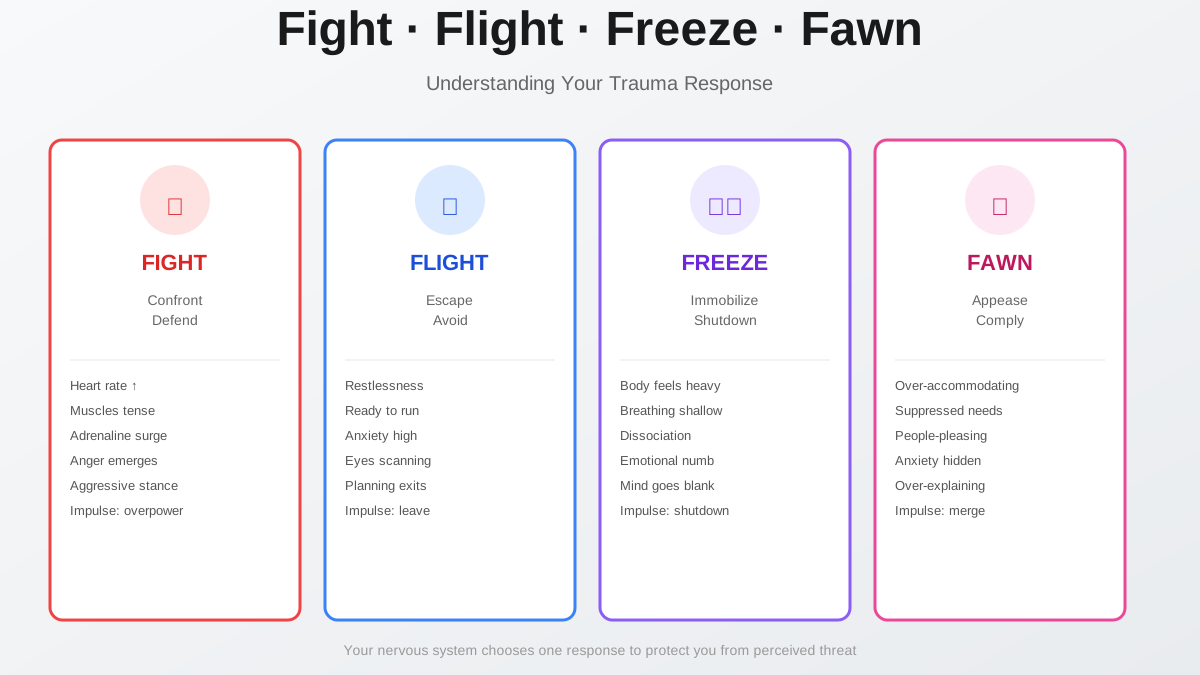
This article explores the neurobiology behind all four responses, why they persist in modern life, and practical strategies to recognize which pattern dominates your stress response.
By learning to identify your default trauma response, you can interrupt automatic patterns and choose calmer, more resourced reactions that serve your wellbeing and relationships.
What Is Fight-Flight-Freeze-Fawn?
Fight-flight-freeze-fawn are four automatic survival responses triggered when your brain perceives a threat. Your autonomic nervous system—the part of your nervous system that operates without conscious thought—activates one of these responses to protect you from danger. The amygdala, your brain's threat-detection center, processes sensory information in milliseconds and decides which survival strategy to deploy. These responses evolved over millions of years to keep humans alive in genuinely dangerous environments. However, your modern nervous system still reacts to perceived threats the same way it reacted to predators thousands of years ago, even when the threat is emotional rather than physical.
Not medical advice.
The four responses represent a spectrum of survival strategies. Fight engages your sympathetic nervous system (the accelerator) to mobilize confrontation. Flight also activates the sympathetic system but directs energy toward escape. Freeze engages the dorsal vagal system (shutdown response), creating immobility and numbness. Fawn activates a complex blend of neural circuits that prioritize appeasing others to maintain safety through connection and submission. Most people develop a dominant response pattern based on early childhood experiences, repeated trauma, attachment relationships, and cultural messaging about acceptable emotional expression.
Surprising Insight: Surprising Insight: The fawn response, discovered and named by therapist Pete Walker in the 2000s, is often mistaken for kindness. People with a fawn pattern may appear highly empathetic and accommodating, when actually they're operating from a trauma-driven survival strategy.
The Four Trauma Responses: Autonomic Nervous System Pathways
This diagram shows how the amygdala detects threat and activates four distinct neural pathways, each producing different physiological and behavioral responses.
🔍 Click to enlarge
Why Fight-Flight-Freeze-Fawn Matters in 2026
In 2026, understanding trauma responses is essential because chronic stress has become normalized. Digital connectivity creates constant low-level threat perception—social media judgments, email urgency, work-life boundary erosion, and global instability keep your nervous system semi-activated. If your baseline is already stressed, your trauma response threshold drops, meaning everyday frustrations trigger survival mechanisms designed for life-or-death situations. People stuck in fight patterns become reactive, aggressive in communication, and damaged in relationships. People in flight patterns avoid difficult conversations, procrastinate, and struggle with commitment. People in freeze patterns dissociate, feel emotionally numb, and struggle with motivation. People in fawn patterns lose themselves in service to others and develop resentment.
Recognizing which pattern dominates your stress response allows you to catch yourself mid-reaction and choose a more resourced response. This is the foundation of emotional regulation, healthy relationships, and professional effectiveness. Workplaces demand emotional intelligence and collaborative problem-solving, which become impossible when people are operating from trauma-driven survival mode. Understanding the 4Fs creates compassion for yourself and others—you recognize that your defensive reactions aren't character flaws but ancient protective mechanisms that made sense at some point.
Mental health professionals now universally recognize trauma responses as a framework for understanding PTSD, anxiety disorders, attachment issues, and relational patterns. Therapy modalities like EMDR, Internal Family Systems (IFS), and Somatic Experiencing specifically target trauma responses to help people access their window of tolerance—the zone where their nervous system can function optimally without triggering protective mechanisms.
The Science Behind Fight-Flight-Freeze-Fawn
Your autonomic nervous system has three main branches: the sympathetic nervous system (accelerator), the parasympathetic nervous system (brake), and the enteric nervous system (gut-brain). When threat is detected, your brain doesn't consult your conscious mind—it bypasses logical thinking entirely. Your amygdala receives sensory information (sight, sound, smell, touch) milliseconds before your prefrontal cortex (logic center) even becomes aware. This is why you might flinch at a sudden noise or feel angry before you've had time to think about what made you angry. The response is hardwired for speed, not accuracy. Your nervous system often mistakes modern stressors (emails, deadlines, social rejection) for actual predatory threats.
When the amygdala detects threat, it activates the hypothalamus-pituitary-adrenal (HPA) axis and the sympathetic-adreno-medullary (SAM) axis. These systems release stress hormones: adrenaline (epinephrine), noradrenaline (norepinephrine), and cortisol. These hormones prepare your body for physical action—heart rate increases, blood flows to muscles, digestion pauses, blood sugar increases, and pain sensitivity decreases. Your body is literally preparing to fight an attacker or run to safety. The fight and flight responses both activate this sympathetic mobilization. However, freeze and fawn involve different neural circuits. Freeze activates the dorsal vagal system (the ancient brake), which creates immobility, dissociation, and emotional numbness—playing dead in the presence of a predator. Fawn involves complex social-engagement circuits that activate your parasympathetic nervous system selectively, creating a state where you appear calm and compliant while internally remaining on high alert.
Physiological Changes During Each Trauma Response
This table illustrates the specific physiological and emotional changes your body experiences during each of the four survival responses.
🔍 Click to enlarge
Key Components of Fight-Flight-Freeze-Fawn
Fight: The Mobilization Response
When you activate fight mode, your sympathetic nervous system surges forward with mobilization energy. Your muscles tense, heart rate accelerates, and blood flows to your limbs and large muscle groups. Psychologically, you shift into confrontation mode—you want to resist, defend, argue, or overpower the threat. People with a dominant fight pattern often grew up in environments where assertiveness was necessary for safety, where emotions were expressed loudly, or where standing up for yourself was modeled. In modern contexts, fight responses appear as: aggressive communication, road rage, workplace confrontation, defensive arguing, controlling behaviors, or difficulty backing down in conflict. The fight response can feel energizing and empowering in the moment, but it damages relationships, increases conflict escalation, and creates a reputation for being difficult or aggressive.
Flight: The Escape Response
Flight also activates your sympathetic nervous system, but redirects energy toward escape. Your body wants to move, run, or get away from the threat. Your mind becomes hypervigilant—scanning for exits, evaluating danger, and planning escape routes. People with a dominant flight pattern often grew up in chaotic, unsafe, or unpredictable environments where leaving situations was the safest strategy. They learned that staying present meant danger, so they became practiced at mentally or physically departing. In modern life, flight responses appear as: avoidance (emails, conversations, difficult emotions), procrastination, restlessness, difficulty settling down, workaholism (staying busy to avoid home), substance use, dissociative internet/phone use, or leaving relationships/jobs impulsively. The flight response creates an illusion of freedom but prevents deep engagement with challenges, intimate relationships, and meaningful work. People often feel trapped in cycles of starting-and-abandoning.
Freeze: The Immobility Response
Freeze activates your dorsal vagal complex—an ancient brain system that creates total immobility and dissociation. This is the "playing dead" response that prey animals use when escape is impossible. Your body becomes heavy, your breathing becomes shallow and held, and your consciousness often dissociates (checking out mentally while your body remains present). People with a dominant freeze pattern often experienced inescapable trauma (abuse, abandonment, serious illness) where neither fighting nor fleeing was possible, so shutdown became survival. In modern life, freeze responses appear as: emotional numbness or flatness, difficulty with motivation or initiative, procrastination rooted in paralysis (not just avoidance), dissociation during stress, spacing out in conversations, brain fog, depression-like symptoms, difficulty making decisions, or feeling stuck. The freeze response provides temporary escape from overwhelming feeling, but creates long-term disconnection from life, emotions, and relationships. People often describe feeling like they're watching their life from outside their body.
Fawn: The Appeasement Response
Fawn is a relatively newly identified trauma response that activates social-engagement circuits mixed with submission. Instead of confronting, escaping, or shutting down, the fawn response attempts to prevent threat by appeasing, accommodating, and merging with the other person's needs. People with a dominant fawn pattern typically experienced environments where emotional safety depended on monitoring and managing other people's feelings and needs. This could be a parent with unpredictable moods, a family where the child became the emotional caretaker, or repeated experiences where their own needs caused rejection or punishment. In modern life, fawn responses appear as: chronic people-pleasing, difficulty saying no, over-functioning in relationships and work, suppressing your own needs and preferences, apologizing excessively, explaining/justifying your existence, difficulty with conflict, attracting demanding relationships, and feeling resentful (because your needs are never honored). The fawn response creates an external appearance of compatibility and helpfulness, but internally causes anxiety, rage, and profound disconnection from authentic self.
| Response | Typical Triggers | Immediate Behaviors |
|---|---|---|
| Fight | Perceived disrespect, boundary violations, loss of control, injustice | Arguing, raising voice, confrontation, blaming, controlling others, aggressive eye contact |
| Flight | Expectation of harm, unpredictability, emotional intensity, intimacy | Leaving situations, avoiding conversations, staying busy, checking out mentally, substance use |
| Freeze | Overwhelming threat, inescapability, traumatic reminders, shame | Going numb, dissociating, difficulty moving or speaking, shallow breathing, brain fog |
| Fawn | Conflict brewing, other person's disappointment, potential rejection, assertion required | Over-explaining, apologizing, accommodating others' needs, suppressing own needs, complying |
How to Apply Fight-Flight-Freeze-Fawn: Step by Step
- Step 1: Pause and notice your physical sensations when you feel stressed: increased heart rate, muscle tension, restlessness, numbness, or urge to comply. Your body's signals come before your mind's awareness.
- Step 2: Identify which trauma response is activating: Are you wanting to confront (fight), escape (flight), shut down (freeze), or accommodate (fawn)? Most people have a dominant pattern plus secondary responses.
- Step 3: Label your response with compassion: 'My nervous system is in fight mode right now' or 'I'm fawning again.' This simple labeling engages your prefrontal cortex (thinking brain) and reduces amygdala activation.
- Step 4: Use a grounding technique to signal safety to your nervous system: Feel your feet on the floor, hold ice in your hand, do 4-count breathing (inhale-4, hold-4, exhale-4), or name five things you can see.
- Step 5: Ask yourself: 'Is this a genuine physical threat to my life right now?' Usually the answer is no. This reality check helps your amygdala recalibrate.
- Step 6: Access your window of tolerance by doing something your vagus nerve finds calming: gentle movement, soothing self-touch, warm water, social connection, or humming.
- Step 7: Communicate your need for time before responding: 'I notice I'm getting reactive. I need 15 minutes to regulate before we continue this conversation.' This prevents regrettable words or actions.
- Step 8: Choose an intentional response instead of reacting: If you usually fight, try asking curious questions. If you usually flight, try staying present for one more minute. If you usually freeze, try one small movement. If you usually fawn, try saying one authentic preference.
- Step 9: Practice the opposite response in low-stakes situations: Fighters practice gentle disagreement. Flighters practice staying in conversations. Freezers practice small actions. Fawners practice gentle "no."
- Step 10: Celebrate small shifts: Notice each time you interrupt an automatic pattern. Your nervous system learns through repetition, so each intentional choice rewires your default response over time.
Fight-Flight-Freeze-Fawn Across Life Stages
Young Adulthood (18-35)
Young adults often show intense, unmodulated trauma responses because the prefrontal cortex is still developing (fully mature by age 25). A young adult with a fight pattern might engage in physical altercations, aggressive social media presence, or workplace conflicts that damage their career. A young adult with a flight pattern might cycle through jobs, relationships, and living situations rapidly, mistaking escape for freedom. Young adults in freeze might struggle with college performance, decision-making, or motivation despite high intelligence. Young adults in fawn might over-invest in friendships and romantic relationships, losing themselves entirely. This stage is crucial for developing awareness of your default pattern before it calcifies into lifelong relationship and career patterns.
Middle Adulthood (35-55)
By middle adulthood, trauma response patterns are deeply entrenched, influencing career trajectories, relationship satisfaction, and health outcomes. Middle-aged fighters often hold senior positions that reward their intensity but struggle in peer relationships, often feeling isolated despite success. Middle-aged flighters frequently face consequences of avoidance: health problems ignored, financial mistakes, relationship breakdowns triggered by distance. Middle-aged freezers often describe feeling numb, depressed, or stuck in careers that feel meaningless. Middle-aged fawners have often given decades to serving others' needs and now face burnout, resentment, and health crises. This is the critical stage where understanding trauma responses can reverse decades of destructive patterns before the final third of life begins.
Later Adulthood (55+)
In later adulthood, trauma responses either solidify into chronic health problems and relationship dissatisfaction, or become wisdom resources if integrated. Older adults who fight may face isolation and estrangement from adult children and partners. Older adults who flight often regret not having settled into meaningful work or deep relationships. Older adults who freeze frequently experience depression, cognitive decline, and loss of purpose. Older adults who fawn often face financial exploitation and exhaustion from ongoing over-caretaking. However, older adults with nervous system awareness can model healthy response modification for younger generations, mentoring others toward emotional maturity, and finding peace in having finally understood their own patterns. Grief and acceptance become central emotional tasks—grieving the decades spent in reactive mode while celebrating the freedom that understanding brings.
Profiles: Your Fight-Flight-Freeze-Fawn Approach
The Warrior (Fight-Dominant)
- Outlets for your intensity and protective energy: leadership roles, competitive sports, justice-focused work
- Practices that channel aggression into power: martial arts, intense exercise, challenging projects that require your strength
- Awareness of when assertiveness becomes aggression: noticing the moment you shift from healthy boundary-setting into domination
Common pitfall: Using your intensity to intimidate people, winning arguments at the cost of relationships, creating conflict wherever you go, difficulty backing down or admitting mistakes.
Best move: Develop a pause practice: When you feel anger rising, literally pause for 10 seconds before responding. Ask yourself: 'Will this response get me what I actually want?' Often, warriors want respect and connection but their fight pattern destroys both.
The Runner (Flight-Dominant)
- Stimulation and novelty that satisfies your need for movement: adventure work, frequent changes, projects with momentum
- A commitment practice that challenges your escape tendency: one long-term relationship, one career focus area, one community you stay in
- Honesty about the cost of avoidance: noticing how each escape feels freeing in the moment but creates long-term regret
Common pitfall: Starting important conversations then disappearing, leaving jobs/relationships before working through difficulties, using busyness to avoid intimacy, chronic procrastination rooted in panic.
Best move: Practice 'sitting with discomfort': When you feel the urge to flee, stay for just one more minute. Notice that the anxiety doesn't kill you. Gradually expand that time. Each moment you stay rewires your nervous system.
The Statue (Freeze-Dominant)
- Safe environments where you can gradually unfreeze: trauma-informed therapy, somatic practices, gradual exposure to feeling
- Movement practices that mobilize stuck energy: dance, shaking, gentle yoga that reconnects you with your body
- Permission to move slowly and honor your pace: understanding that unfreezing takes time and isn't failure
Common pitfall: Emotional numbness that feels protective but prevents joy and connection, decision-making paralysis that creates missed opportunities, depression-like symptoms that worsen with isolation.
Best move: Start with tiny movements: Shake your hands for 30 seconds, dance to one song, take a cold shower, jump up and down. These small mobilizations signal to your nervous system that it's safe to feel and move again.
The Peacekeeper (Fawn-Dominant)
- Permission to have needs and express preferences: coaching that helps you practice saying no, therapy addressing people-pleasing patterns
- Exposure to low-stakes conflict where you won't be abandoned: learning that disagreement doesn't destroy relationships
- Recognition that your over-accommodation has costs: noticing resentment, loss of self, attracting demanding relationships that exploit your compliance
Common pitfall: Exhaustion from meeting everyone else's needs while ignoring your own, attracting people who take advantage of your accommodation, chronic resentment toward people you're helping, lost sense of who you actually are.
Best move: Practice gentle assertion: Start with tiny acts of authentic self-expression: 'I prefer the Italian restaurant,' 'I need to rest this weekend,' 'I disagree with that idea.' Notice that people don't abandon you when you have needs. Gradually expand to bigger assertions.
Common Fight-Flight-Freeze-Fawn Mistakes
The biggest mistake people make is fighting their trauma response instead of understanding it. You might think: 'I shouldn't get so angry,' 'I shouldn't avoid things,' 'I should be able to move,' or 'I should stop being so nice.' This internal judgment activates shame, which only strengthens your nervous system dysregulation. Your trauma response isn't a character flaw—it's a protective mechanism that made sense at some point. Shame about your response pattern prevents the compassion and understanding necessary for genuine change.
Another common mistake is expecting change to happen quickly through willpower alone. You might resolve: 'I'm going to stop being so reactive,' 'I'm finally going to face my fears,' 'I'm going to start saying no,' or 'I'm going to get motivated.' Willpower engages your conscious mind, but trauma responses are automatic nervous system patterns that operate below conscious awareness. Genuine change requires rewiring your nervous system through repetition—doing the opposite of your automatic response in small, manageable doses until your nervous system learns that safety is available even when you don't use your default response.
A third mistake is trying to change in isolation. Your trauma response is partly relational—it developed in relationships and largely exists within relationships. Trying to resolve patterns alone often intensifies them. If you're a fighter, you need someone who won't escalate when you get intense. If you're a flighter, you need someone who can stay present. If you're a freezer, you need someone who can gently draw you out. If you're a fawner, you need someone who encourages your authentic self-expression. Trauma-informed therapy or support groups provide the relational safety necessary for genuine nervous system recalibration.
The Vicious Cycle: How Trauma Responses Create More Trauma
This diagram shows how unexamined trauma responses create situations that reinforce the same nervous system patterns, creating self-perpetuating cycles of dysregulation.
🔍 Click to enlarge
Science and Studies
Over 40 years of neuroscience research has documented the physiological mechanisms underlying trauma responses. Stephen Porges' Polyvagal Theory (1994) revolutionized understanding by identifying three distinct vagal systems governing automatic responses. Modern fMRI and neuroimaging studies show that during trauma responses, the prefrontal cortex (thinking brain) literally goes offline, and the amygdala (threat-detection center) takes over. Research from NICABM, Harvard Health, and the NIH demonstrates that sympathetic nervous system hyperarousal—sustained activation of fight-or-flight—predicts PTSD development, anxiety disorders, depression, and chronic health problems. Landmark studies show that trauma-informed therapies specifically target nervous system dysregulation to produce lasting change.
- Porges, S. W. (1995). "Orienting in a defensive world: Mammalian modifications of our evolutionary heritage." Psychophysiology, showing the neural basis of different threat responses.
- Van der Kolk, B. A. (2014). "The Body Keeps the Score," documenting how trauma becomes encoded in the nervous system and body.
- National Center for PTSD: "The Neurobiology of Trauma," from the U.S. Department of Veterans Affairs, explaining amygdala, hippocampus, and prefrontal cortex involvement.
- Siegel, D. J. (2012). "The Developing Mind," second edition, explaining how trauma responses develop in childhood and persist into adulthood.
- Levine, P. A. (1997). "Waking the Tiger," introducing Somatic Experiencing therapy based on understanding how animals naturally complete threat responses.
Your First Micro Habit
Start Small Today
Today's action: For one full day, notice your trauma response pattern without trying to change it. When you feel stress rising, pause and identify: Am I wanting to fight, flee, freeze, or fawn? Simply noticing creates awareness that interrupts automaticity.
Awareness is the first step toward change. Your nervous system has been running the same protective program for years without conscious attention. Even 24 hours of noticing begins rewiring the neural pathways that automatically trigger your default response. This micro habit takes zero willpower—just observation.
Track your observations and get personalized AI coaching with our app.
Quick Assessment
When facing a stressful situation or conflict, which response feels most automatic for you?
Your answer reveals your default trauma response pattern. This is your nervous system's go-to survival strategy. Understanding this pattern is the foundation for recognizing when you're reactive and choosing more resourced responses.
How has your dominant response pattern affected your relationships and work?
Recognizing the consequences of your pattern creates motivation for change. Each response pattern has predictable costs in relationships, career, and health. Understanding these costs helps you commit to nervous system regulation practices.
What would become possible if you could access a calm, resourced response instead of automatically triggering your trauma response?
This vision of what's possible becomes your north star. Nervous system regulation practices work because they make access to these resourced states increasingly available. As your window of tolerance expands, these responses shift from fantasy to lived experience.
Take our full assessment to get personalized recommendations for your nervous system.
Discover Your Style →Next Steps
Your next step is to develop nervous system awareness over the next week. Notice your trauma response patterns as they show up without judgment. When you notice yourself about to fight, flee, freeze, or fawn, pause and take three deep breaths—this single act begins rewiring your automatic response. Download a trauma-informed therapy resource or join a support group where you can practice recognizing these patterns with others who understand. Most importantly, recognize that understanding your trauma response is an act of self-compassion. You're not broken—your nervous system is doing exactly what it was designed to do. Now you're simply updating the system with new information.
If you find yourself stuck in these patterns despite awareness, consider working with a trauma-informed therapist who specializes in nervous system regulation. Therapies like EMDR, Somatic Experiencing, and Internal Family Systems have strong evidence for resolving trauma responses. Your body has wisdom encoded in its protective patterns—with professional support, you can integrate that wisdom while developing more flexible, resourced ways of meeting life's challenges.
Get personalized guidance with AI coaching.
Start Your Journey →Research Sources
This article is based on peer-reviewed research and authoritative sources. Below are the key references we consulted:
Related Glossary Articles
Frequently Asked Questions
Can you have more than one trauma response pattern?
Yes, absolutely. Most people have a dominant pattern but show different responses in different contexts. You might fight at work but fawn in intimate relationships, or freeze under certain types of stress but flight under others. Your nervous system has flexibility—it chooses responses based on past experience, current safety perception, and the specific threat context. Understanding all four responses helps you recognize your full spectrum of protective strategies.
If I had a good childhood, why do I still have a trauma response?
Trauma responses aren't limited to childhood abuse. Anything your nervous system perceived as inescapable threat can activate these patterns: surgery, medical emergency, bullying, breakup, job loss, accident, betrayal, or even ongoing unpredictability in a seemingly "normal" family. Additionally, you may have inherited trauma responses through epigenetic transmission (your parents' unprocessed nervous system patterns influenced your early neurological patterning). Lastly, modern life itself—constant digital stimulation, uncertainty, comparison, and threat narratives—can activate trauma responses in people without obvious trauma history.
Is my trauma response permanent?
No. Your nervous system is neuroplastic—it can learn new patterns through repetition and practice, especially in safe relational contexts. Trauma-informed therapies (EMDR, Somatic Experiencing, IFS, CPT-CBT) specifically target nervous system rewiring. With consistent practice of grounding techniques, opposite-response exercises, and relational safety, you can gradually expand your window of tolerance and develop new default patterns. Change requires time and repetition—typically months to years—but genuine change is absolutely possible.
Can trauma responses cause physical health problems?
Yes, extensively documented. Chronic nervous system dysregulation (staying in fight-or-flight activation or in freeze-shutdown) causes elevated cortisol, suppressed immunity, digestive issues, inflammation, cardiovascular problems, chronic pain, sleep disruption, and autoimmune problems. The mind and nervous system directly influence physical health through the gut-brain axis, the HPA axis, and the sympathetic-parasympathetic balance. This is why trauma-informed care increasingly appears in primary care medicine—treating nervous system dysregulation prevents many chronic diseases.
What if my trauma response has become my identity?
Many people feel: 'I'm just an angry person,' 'I'm just someone who runs,' 'I'm just not motivated,' or 'I'm just a people-pleaser.' This identity-level attachment to your response pattern actually makes change harder because changing feels like losing yourself. The truth is: your trauma response is a strategy your nervous system developed for protection, not your essential self. Your essential self exists underneath the protective pattern, waiting to be accessed. Therapy can help you differentiate between the protective strategy and your authentic self, creating freedom to choose responses that actually serve you.
Take the Next Step
Ready to improve your wellbeing? Take our free assessment to get personalized recommendations based on your unique situation.
- Discover your strengths and gaps
- Get personalized quick wins
- Track your progress over time
- Evidence-based strategies