People-Pleasing
You said yes again. Not because you wanted to, but because the thought of saying no made your stomach drop. Maybe it was a friend asking for a favor you had no time for, or a colleague adding yet another task to your plate. You smiled, you agreed, and somewhere inside, a small voice whispered: what about me? If this pattern feels familiar, you are not alone. People-pleasing is one of the most common behavioral patterns in modern relationships, and it quietly erodes your <a href="/g/self-worth.html">self-worth</a>, your <a href="/g/energy-levels.html">energy levels</a>, and your ability to form <a href="/g/connection.html">genuine connections</a>.
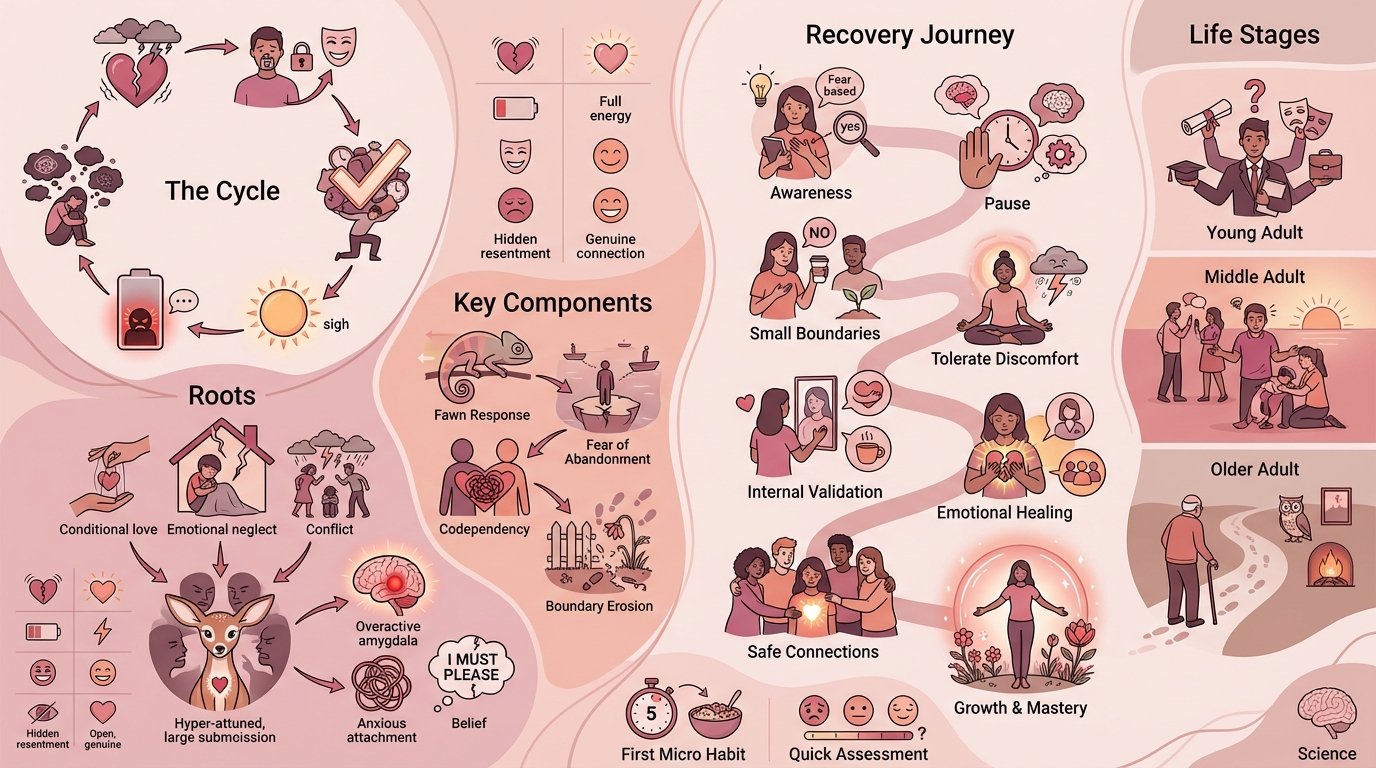
In this guide, you will learn exactly what drives people-pleasing behavior, how it connects to the fawn trauma response, and most importantly, how to break free without becoming unkind or disconnected from the people you love.
Whether you struggle with saying no at work, feel responsible for everyone else's emotions, or simply lose yourself in relationships, this article will give you a clear path toward authentic living and healthier boundary setting.
What Is People-Pleasing?
People-pleasing is a behavioral pattern where a person consistently prioritizes the needs, desires, and approval of others over their own wellbeing. It goes beyond simple kindness or generosity. While being considerate of others is a healthy social skill, people-pleasing becomes problematic when it is driven by fear of rejection, abandonment, or conflict rather than genuine care. The people-pleaser often suppresses their own opinions, feelings, and needs to maintain harmony and avoid disapproval, leading to chronic stress and a diminished sense of self-esteem.
Not medical advice.
Psychologists recognize people-pleasing as a deeply ingrained coping strategy that often originates in childhood. When a child grows up in an environment where love feels conditional, where expressing needs leads to punishment or withdrawal of affection, the child learns that safety comes from making others happy. This pattern gets carried into adult relationships, work dynamics, and even friendships. Understanding this origin is the first step toward change, because people-pleasing is not a personality flaw. It is a learned survival response, closely related to what trauma researchers call the fawn response. Developing emotional awareness and self-compassion are foundational to healing this pattern.
Surprising Insight: Surprising Insight: Research on trauma responses identifies four main reactions to threat: fight, flight, freeze, and fawn. The fawn response, coined by therapist Pete Walker, describes how some people survive threatening situations by becoming hyper-attuned to the needs of others and suppressing their own identity. This makes people-pleasing not just a personality trait but a nervous system survival strategy.
The People-Pleasing Cycle
How people-pleasing creates a self-reinforcing loop of approval-seeking and self-abandonment
🔍 Click to enlarge
Why People-Pleasing Matters in 2026
In a world of constant digital connectivity, the pressure to please has never been greater. Social media platforms reward agreeableness and punish dissent. Workplace culture often celebrates the team player who never says no. The always-on communication era means that boundaries are harder to maintain than ever, with messages arriving at all hours and expectations of immediate responses. Understanding digital wellness and burnout prevention has become essential for anyone caught in the people-pleasing trap.
The mental health impact is significant. People-pleasers report higher rates of anxiety, depression, and burnout. They are more likely to stay in unhealthy relationships, tolerate workplace mistreatment, and neglect their own mental health. As awareness of emotional boundaries and attachment styles grows in mainstream culture, more people are recognizing these patterns in themselves and seeking change.
The good news is that recovery from people-pleasing is entirely possible. With the right understanding and practical tools, you can learn to honor your own needs while still being a caring, connected person. The journey involves building assertiveness, developing emotional resilience, and rewiring the deep belief that your worth depends on what you do for others. This is not about becoming selfish. It is about becoming whole, which ultimately makes you a better partner, friend, and colleague.
The Science Behind People-Pleasing
Neuroscience reveals that people-pleasing has roots in the brain's threat-detection system. The amygdala, which processes fear and social threat, becomes hyperactive in people who have learned that displeasing others leads to danger. When faced with a request they want to decline, people-pleasers experience a genuine stress response: elevated cortisol, increased heart rate, and activation of the sympathetic nervous system. Saying no literally feels dangerous to their nervous system, even when the actual situation is perfectly safe. This explains why willpower alone rarely breaks the pattern. The change needs to happen at the level of the nervous system through practices like mindfulness, breathing techniques, and gradual exposure to setting boundaries.
Attachment theory provides another crucial lens for understanding people-pleasing. Researchers like John Bowlby and Mary Ainsworth demonstrated that our earliest relationships create templates for how we relate to others throughout life. Children with anxious attachment, who learned that love was unpredictable, often develop people-pleasing as a strategy to keep caregivers close. Understanding your own attachment patterns can illuminate why certain situations trigger your people-pleasing response more than others. Cognitive behavioral research shows that people-pleasers hold specific core beliefs, such as if I set a boundary, people will leave me or my needs are less important than theirs, that can be identified and gradually restructured with therapeutic support and behavioral change strategies.
Roots of People-Pleasing Behavior
The psychological and neurological foundations that drive people-pleasing patterns
🔍 Click to enlarge
Key Components of People-Pleasing
The Fawn Response
The fawn response is a trauma-based survival mechanism where a person automatically attempts to appease others to avoid conflict or danger. Therapist Pete Walker first identified this as the fourth trauma response alongside fight, flight, and freeze. When fawning becomes your default mode, you lose touch with your own preferences, opinions, and identity. You become a mirror reflecting what others want to see rather than expressing your authentic self. Healing from the fawn response involves building emotional regulation skills and learning to tolerate the discomfort of potentially disappointing others.
Fear of Abandonment and Rejection
At the core of most people-pleasing behavior lies a deep fear that asserting your needs will result in being abandoned or rejected. This fear is often rooted in early experiences where expressing needs was met with withdrawal of love or attention. The people-pleaser operates under an unconscious equation: my compliance equals my safety. Breaking free requires building confidence in your inherent worth, separate from what you do for others. Practicing vulnerability in safe relationships helps retrain the nervous system to understand that authentic expression does not lead to abandonment.
Codependency Patterns
People-pleasing and codependency are closely related but not identical. Codependency involves an excessive emotional reliance on a partner or relationship, where your sense of identity becomes enmeshed with another person. People-pleasing often feeds into codependent dynamics because the pleaser derives their sense of worth from being needed. Understanding the difference matters because the recovery path, while overlapping, has distinct elements. Building a strong sense of self-worth and practicing emotional healing are central to breaking both patterns.
Boundary Erosion
One of the most visible consequences of chronic people-pleasing is the gradual erosion of personal boundaries. Boundaries are the invisible lines that define where you end and another person begins. They protect your time, energy, emotional space, and values. People-pleasers struggle with boundary setting because every boundary feels like a potential trigger for conflict or rejection. Over time, the absence of boundaries leads to resentment, exhaustion, and a loss of identity. Learning to establish and maintain emotional boundaries is one of the most transformative skills a recovering people-pleaser can develop.
| Dimension | People-Pleasing | Genuine Kindness |
|---|---|---|
| Motivation | Fear of rejection or conflict | Authentic care and compassion |
| Emotional state | Anxious, drained, resentful | Energized, fulfilled, peaceful |
| Saying no | Feels impossible or terrifying | Feels natural when needed |
| Own needs | Suppressed or ignored | Acknowledged and balanced |
| After helping | Exhaustion and hidden resentment | Satisfaction and joy |
| Self-worth source | External approval from others | Internal sense of value |
How to Stop People-Pleasing: Step by Step
- Step 1: Recognize the pattern: Start noticing when you say yes out of fear rather than genuine desire. Keep a journal for one week tracking every time you agree to something. Note how your body feels, whether it is tension, dread, or relief. This <a href="/g/emotional-awareness.html">emotional awareness</a> is the foundation of change.
- Step 2: Identify your core fears: Ask yourself what is the worst thing that could happen if I said no. Write down your fears honestly. Most people-pleasers discover that their fears center around abandonment, anger, or being seen as selfish. Naming these fears reduces their power and builds <a href="/g/psychological-flexibility.html">psychological flexibility</a>.
- Step 3: Practice the pause: When someone makes a request, train yourself to say let me think about that and get back to you. This simple delay breaks the automatic yes response and gives your rational brain time to engage. Even a brief pause supports better <a href="/g/decision-making.html">decision-making</a>.
- Step 4: Start with small boundaries: Begin setting limits in low-stakes situations. Tell the barista your coffee order was wrong. Decline an invitation to an event you do not want to attend. Each small act of <a href="/g/assertiveness.html">assertiveness</a> builds the neural pathways for bigger boundary-setting later.
- Step 5: Use clear, kind language: Practice boundary scripts like I care about you and I am not able to do that right now or That does not work for me. Effective <a href="/g/communication-skills.html">communication skills</a> allow you to be honest without being harsh.
- Step 6: Tolerate the discomfort: Setting boundaries will feel uncomfortable at first. Your nervous system will sound alarms. This is normal. Use <a href="/g/breathing-techniques.html">breathing techniques</a> and <a href="/g/coping-strategies.html">coping strategies</a> to sit with the anxiety rather than rushing to fix it by giving in.
- Step 7: Build your internal validation system: People-pleasers rely on external approval to feel worthy. Start building an internal source of validation by acknowledging your own accomplishments, honoring your feelings, and practicing <a href="/g/self-compassion.html">self-compassion</a> daily.
- Step 8: Address the root wounds: Consider working with a therapist to explore the childhood experiences that created your people-pleasing pattern. Approaches like Internal Family Systems, EMDR, and cognitive behavioral therapy can accelerate <a href="/g/emotional-healing.html">emotional healing</a> significantly.
- Step 9: Surround yourself with safe people: Seek out relationships where your boundaries are respected and your authentic self is welcomed. Healthy <a href="/g/friendship.html">friendships</a> and <a href="/g/connection.html">connections</a> provide evidence that you can be loved without performing.
- Step 10: Track your progress: Recovery is not linear. Use a journal or the Bemooore app to monitor your boundary-setting wins, notice patterns, and celebrate growth. Building new <a href="/g/habit-formation.html">habits</a> takes time and consistent practice.
People-Pleasing Across Life Stages
Young Adulthood (18-35)
Young adults often encounter people-pleasing most intensely in romantic relationships and early career dynamics. The desire to be liked by peers, to impress a new boss, or to keep a partner happy can override authentic self-expression. This is also the stage where many people first recognize the pattern, often after a painful breakup or burnout experience. Building self-esteem and learning conflict resolution skills early can prevent decades of self-abandonment. Young adults benefit from exploring their attachment styles and understanding how childhood dynamics show up in current relationships.
Middle Adulthood (35-55)
By middle adulthood, people-pleasing often manifests in family dynamics, parenting, and long-term partnerships. The person who always volunteers at school events, who mediates every family conflict, who never asks for help: these are classic signs. Burnout is common at this stage because the demands are greater and the pattern is deeply entrenched. The silver lining is that midlife often brings a natural motivation to change, a sense that life is too short to keep abandoning yourself. This is an ideal time to invest in personal growth, set firmer boundaries with extended family, and model healthy relationship habits for children.
Later Adulthood (55+)
Older adults who have been people-pleasing for decades may experience a profound sense of loss, recognizing how much of their life was spent meeting others' expectations rather than their own. However, this stage also holds tremendous potential for healing. With fewer external obligations and greater life wisdom, later adulthood can be a time of reclaiming your authentic self. Practices like mindfulness, gratitude practice, and investing in genuine friendships support this transformation. Many people find that the relationships they build after recovering from people-pleasing are the most honest and fulfilling of their lives.
The Connection Between People-Pleasing and Relationships
People-pleasing profoundly impacts every type of relationship. In romantic partnerships, it creates an imbalance where one person constantly gives while the other unknowingly takes. The pleaser may appear easygoing and agreeable on the surface, but underneath, resentment builds. Over time, the partner may feel confused when the pleaser suddenly snaps or withdraws, having never been told that anything was wrong. Developing authentic communication and practicing emotional expression are essential for healing couple dynamics affected by people-pleasing.
In friendships, people-pleasing can lead to one-sided relationships where the pleaser is always the listener, the helper, the one who adjusts. True friendship requires reciprocity and honesty, both of which are impossible when one person is hiding their true feelings. At work, people-pleasing leads to overcommitment, difficulty delegating, and vulnerability to exploitation. Learning to apply assertiveness across all relationship contexts is a key part of recovery.
The path to healthier relationships starts with understanding that trust is built through honesty, not compliance. When you express your genuine needs and feelings, you give others the opportunity to truly know and love you. This is the foundation of emotional intimacy and lasting connection.
Profiles: Your People-Pleasing Approach
The Silent Supporter
- Permission to express personal opinions and preferences
- Practice saying no in safe, low-stakes situations
- Daily self-compassion exercises to build internal validation
Common pitfall: Believing that having needs makes you selfish or burdensome to others
Best move: Start each day by identifying one thing you want and communicating it to someone you trust
The Conflict Avoider
- Gradual exposure to healthy disagreements
- Scripts for expressing differing opinions respectfully
- Understanding that conflict can strengthen rather than destroy relationships
Common pitfall: Confusing all conflict with danger and avoiding necessary conversations
Best move: Practice one honest micro-disagreement per week to build your tolerance muscle
The Over-Giver
- Clear limits on time and energy given to others
- Recognition that giving from depletion is not genuine generosity
- Regular check-ins with personal energy levels and emotional state
Common pitfall: Using excessive giving as a way to feel worthy and needed
Best move: Before saying yes to any request, ask yourself: would I do this even if nobody thanked me?
The Identity Chameleon
- Dedicated time exploring personal values, tastes, and preferences
- Journaling about who you are when nobody is watching
- Connection with your authentic emotional responses
Common pitfall: Losing yourself completely by mirroring whoever you are around
Best move: Create a list of ten things you genuinely enjoy and practice choosing them even when others prefer something different
Common People-Pleasing Mistakes
The first major mistake is swinging from people-pleasing to people-repelling. When someone first recognizes their pattern, they sometimes overcorrect by becoming harsh, rigid, or dismissive of others. This is not healthy boundary setting; it is the pendulum swinging to the opposite extreme. True recovery means finding a balanced middle ground where you can be both kind and honest, both caring and boundaried. The goal is not to stop caring about others but to start caring about yourself equally. This requires emotional regulation and patience with the process.
The second mistake is trying to change the pattern through willpower alone. People-pleasing is rooted in the nervous system, not just in conscious thought. You cannot simply decide to stop people-pleasing any more than you can decide to stop a fear response. Lasting change requires body-based approaches like meditation, somatic practices, and therapeutic support alongside cognitive strategies. Building resilience is a gradual, layered process that honors both mind and body.
The third mistake is expecting everyone to support your changes. When you stop people-pleasing, some people in your life will resist. Those who benefited from your compliance may push back, guilt-trip you, or express disappointment. This does not mean you are doing something wrong. It means the relationship dynamic is shifting, and not everyone will adjust. Surrounding yourself with people who celebrate your growth, and developing strong coping strategies for handling pushback, is essential. Remember that forgiveness, both of yourself and others, is part of the journey.
Recovery from People-Pleasing
The stages of moving from chronic people-pleasing to balanced, authentic relating
🔍 Click to enlarge
People-Pleasing and Emotional Health
Chronic people-pleasing takes a significant toll on emotional wellbeing. When you consistently suppress your own needs and feelings, those emotions do not disappear. They go underground. Suppressed anger becomes passive aggression or depression. Unacknowledged needs surface as chronic anxiety or physical symptoms like headaches, digestive issues, and fatigue. Research on emotional health consistently shows that emotional suppression is linked to poorer mental and physical outcomes.
Recovery involves learning to feel and express the full range of human emotions, including anger, disappointment, and desire, without shame. This is where emotional intelligence becomes a practical tool rather than an abstract concept. By developing the ability to identify what you feel, understand why you feel it, and express it appropriately, you reclaim the emotional energy that people-pleasing has been consuming. Practices like emotional coping and stress management support this process.
Many recovering people-pleasers find that their happiness and sense of fulfillment increase dramatically once they begin living authentically. Relationships become more honest and satisfying. Energy that was spent managing others' emotions becomes available for personal growth, creativity, and genuine belonging. The paradox is that by pleasing yourself, you often become a better, more present, and more generous person.
Practical Tools for Breaking the Pattern
Body-based practices are among the most effective tools for recovering from people-pleasing. Because the pattern lives in the nervous system, approaches that calm the body's stress response create the safety needed to set boundaries. Deep breathing exercises, progressive muscle relaxation, and regular meditation practice help regulate the fight-or-flight activation that makes saying no feel dangerous. Even simple grounding techniques, like feeling your feet on the floor before responding to a request, can interrupt the automatic yes.
Journaling is another powerful tool. Write about situations where you people-pleased and explore what you were afraid would happen if you had set a boundary. Often, the feared outcome, such as being abandoned or hated, is catastrophic and unlikely. Cognitive behavioral techniques help you test these beliefs by gradually setting boundaries and observing the actual results. Most of the time, the outcome is far less dramatic than feared, and this evidence builds confidence over time.
Creating a personal values list is essential. When you know what matters to you, decisions become clearer. Before agreeing to any request, check it against your values. Does this align with what I care about, or am I doing it to avoid someone's displeasure? This simple filter, combined with the pause technique and strong self-worth, transforms reactive people-pleasing into intentional, values-based living. Investing in personal growth through reading, therapy, and help-seeking accelerates the process.
Science and Studies
The scientific understanding of people-pleasing draws from multiple fields including trauma psychology, attachment theory, and neuroscience. Research consistently shows that people-pleasing behaviors are associated with higher rates of anxiety, depression, and relationship dissatisfaction. Studies on the fawn response, while still emerging, build on decades of established research about trauma responses and their long-term effects on behavior and behavioral health.
- Pete Walker (2013): Complex PTSD: From Surviving to Thriving. This foundational work identified the fawn response as a fourth trauma response and linked it directly to people-pleasing and codependency patterns.
- Bowlby, J. (1969): Attachment and Loss. The landmark attachment theory research that explains how early caregiver relationships create lasting templates for adult relationship behavior, including people-pleasing.
- Gross, J. J. (2002): Emotion regulation: Affective, cognitive, and social consequences. Research demonstrating that habitual emotional suppression is associated with poorer social outcomes, greater negative emotion, and reduced wellbeing.
- Walker, P. (2003): The Fawn Response in Complex PTSD. Detailed clinical descriptions of how the fawn response develops as a survival strategy and its connection to codependency and boundary difficulties.
- Mikulincer, M. & Shaver, P. R. (2007): Attachment in Adulthood. Comprehensive research linking anxious attachment patterns to approval-seeking behaviors and difficulty with assertiveness in adult relationships.
Your First Micro Habit
Start Small Today
Today's action: Once each day, when someone asks you a preference question like where to eat or what to watch, give your honest answer within five seconds instead of saying I do not mind or whatever you want.
This tiny practice rebuilds your connection to your own preferences and trains your brain that expressing your desires is safe. Over time, these micro-expressions of authenticity expand into bigger boundary-setting skills.
Keep quitting habit apps after a missed day? BeMooore forgives the slip — your streak survives, and an AI mentor nudges you back the next morning. Free on iOS.
Quick Assessment
When a friend asks you to do something you do not want to do, what is your most common response?
Your default response reveals where you fall on the people-pleasing spectrum. Moving from automatic yes toward honest, guilt-free responses is a gradual process that builds with practice.
How do you typically feel after spending a full day helping others with their needs?
The emotional aftermath of helping reveals your motivation. Genuine generosity leaves you energized, while people-pleasing leaves you depleted and resentful.
When you imagine setting a firm boundary with someone important to you, what feeling comes up first?
Your emotional response to boundary-setting reflects the depth of your people-pleasing pattern. Intense fear suggests deeper work may be needed, while mild discomfort shows growing resilience.
Take our full assessment to get personalized recommendations for building healthier boundaries and stronger self-worth.
Discover Your Style →Next Steps
Breaking free from people-pleasing is one of the most courageous journeys you can take. It requires facing the fears that have driven your behavior for years and choosing authenticity over approval. Start with the micro habit of expressing one honest preference each day. Notice how it feels in your body. Track your progress, celebrate your wins, and be patient with yourself when old patterns resurface. Every boundary you set is a vote for your own self-worth and a step toward more genuine connection with the people around you.
Remember that you do not have to do this alone. Seek support from a therapist, trusted friends, or our community. Explore related topics like boundary setting, emotional resilience, self-compassion, and attachment styles to deepen your understanding. The person you are becoming, someone who can be both kind and honest, both loving and boundaried, is someone worth getting to know. Take the first step today by completing our wellbeing assessment and discovering your unique path to fulfillment and happiness.
Get personalized guidance with AI coaching to overcome people-pleasing and build authentic connections.
Start Your Journey →Research Sources
This article is based on peer-reviewed research and authoritative sources. Below are the key references we consulted:
Related Glossary Articles
Frequently Asked Questions
Is people-pleasing a mental health disorder?
People-pleasing is not classified as a mental health disorder in itself. It is a behavioral pattern that can contribute to or coexist with conditions like anxiety, depression, and codependency. If people-pleasing significantly impacts your daily functioning and relationships, working with a mental health professional can help you address the underlying causes and develop healthier patterns.
What causes someone to become a people-pleaser?
People-pleasing most commonly develops in childhood when a child learns that their safety or love depends on meeting others' needs. This can result from growing up with emotionally unavailable parents, experiencing conditional love, witnessing conflict, or enduring emotional neglect or abuse. The fawn trauma response creates a nervous system pattern that carries into adulthood.
Can you stop people-pleasing without becoming selfish?
Absolutely. Stopping people-pleasing does not mean you stop caring about others. It means you start including yourself in the circle of people you care for. Healthy boundaries actually improve relationships because they are built on honesty rather than resentment. You become a more present, generous, and authentic person when you are not running on empty.
How long does it take to recover from people-pleasing?
Recovery is a gradual process that varies for each person. Most people notice meaningful changes within a few months of consistent practice, especially with therapeutic support. However, deeply ingrained patterns may take longer to fully transform. The key is progress, not perfection. Each small boundary you set rewires your brain toward healthier patterns.
What is the difference between being kind and people-pleasing?
Kindness is a choice made from a place of genuine care and emotional abundance. People-pleasing is a compulsion driven by fear of rejection or conflict. The key difference is motivation and aftermath. After genuine kindness, you feel good. After people-pleasing, you often feel drained, resentful, or invisible. Kindness has boundaries; people-pleasing does not.
How does people-pleasing affect romantic relationships?
People-pleasing creates an imbalance in romantic relationships where one partner consistently suppresses their needs. This leads to hidden resentment, lack of emotional intimacy, and eventual disconnection. Partners may feel confused because they never know what the pleaser truly wants. Recovery involves practicing honest communication and building trust through vulnerability.
What is the fawn response and how is it related to people-pleasing?
The fawn response is a trauma survival mechanism identified by therapist Pete Walker. It is the fourth trauma response alongside fight, flight, and freeze. When fawning, a person automatically appeases others to avoid perceived danger. People-pleasing is the everyday expression of this response, where appeasing becomes the default way of navigating relationships and social situations.
Take the Next Step
Ready to improve your wellbeing? Take our free assessment to get personalized recommendations based on your unique situation.
- Discover your strengths and gaps
- Get personalized quick wins
- Track your progress over time
- Evidence-based strategies