Codependency Recovery
You have spent years pouring every ounce of energy into someone else's problems, convincing yourself that love means sacrifice. You have ignored your own hunger, your own exhaustion, your own quiet voice whispering that something is wrong. Then one morning you wake up and realize you cannot remember the last decision you made purely for yourself. That moment of recognition is both terrifying and liberating, because it marks the beginning of <a href="/g/codependency-recovery.html">codependency recovery</a>. This guide walks you through every stage of the journey, from awareness to lasting transformation, using approaches backed by psychology research and clinical practice.
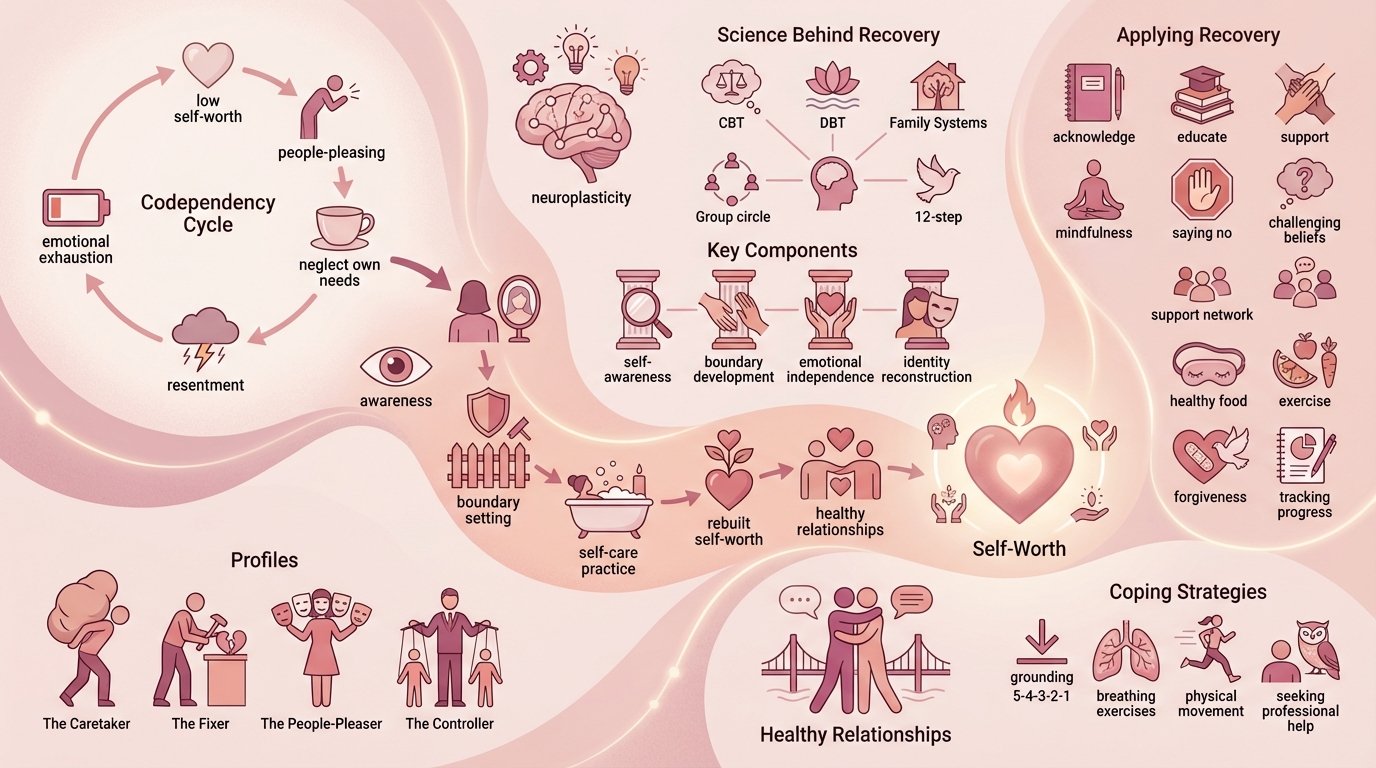
Inside this article you will discover the neuroscience behind codependent patterns, practical steps for rebuilding <a href="/g/self-worth.html">self-worth</a>, and how to develop the <a href="/g/boundary-setting.html">boundary-setting</a> skills that protect your wellbeing without destroying your relationships.
Whether you are just starting to question unhealthy patterns or you have been working on recovery for months, the strategies here will meet you where you are and help you move forward with clarity and self-compassion.
What Is Codependency Recovery?
Codependency recovery is the intentional process of unlearning patterns of excessive caretaking, people-pleasing, and emotional enmeshment that cause you to lose your sense of self in relationships. It involves recognizing that your identity and self-esteem have become dependent on managing, fixing, or controlling another person's behavior, emotions, or problems. Recovery means shifting from an external locus of validation to an internal one, where your worth is no longer contingent on how much you sacrifice for others.
Not medical advice.
The concept gained widespread attention through Melody Beattie's groundbreaking book Codependent No More, first published in 1986, which has sold over eight million copies worldwide. Beattie defined codependency as allowing another person's behavior to affect you while being obsessed with controlling that person's behavior. Since then, organizations like Co-Dependents Anonymous (CoDA) have adapted the twelve-step model to help people recover from codependent patterns. Today, evidence-based therapies including cognitive behavioral therapy, dialectical behavior therapy, and family systems therapy offer structured paths toward emotional healing and healthier relationship dynamics.
Surprising Insight: Surprising Insight: Research published in the Journal of Clinical Psychology found that codependent individuals often score higher on measures of empathy and emotional sensitivity than the general population. The challenge in recovery is not to diminish these qualities but to redirect them, learning to extend the same compassion to yourself that you naturally offer others.
The Codependency Cycle and Recovery Path
How codependent patterns form and how recovery interrupts the cycle
🔍 Click to enlarge
Why Codependency Recovery Matters in 2026
In a world where social media constantly rewards self-sacrifice narratives and toxic relationship dynamics are glamorized in popular culture, codependency patterns are more prevalent than ever. The pressure to be endlessly available through digital communication blurs healthy boundaries between caring and controlling. Understanding emotional boundaries has become essential for maintaining mental health in an always-connected age.
The rise of awareness around attachment styles and attachment patterns has helped millions recognize that their relationship difficulties stem from learned behaviors rather than personal failings. This understanding removes shame from the recovery process and replaces it with curiosity and hope. When you realize that codependency is a pattern you adopted to survive difficult circumstances, you also realize it is a pattern you can change.
Recovery from codependency does not just improve your romantic relationships. It transforms every area of your life, from family dynamics and friendships to workplace interactions and your relationship with yourself. People in recovery consistently report improvements in anxiety management, stress management, and overall emotional wellbeing, making this work one of the highest-return investments you can make in your quality of life.
The Science Behind Codependency Recovery
Neuroscience research reveals that codependent behaviors activate the brain's reward circuitry in ways similar to other compulsive patterns. When you rescue someone or receive validation for self-sacrifice, your brain releases dopamine, reinforcing the cycle. Over time, your nervous system becomes wired to seek worth through caretaking rather than through internal sources of self-worth. Recovery involves building new neural pathways through consistent practice of healthier behaviors, a process known as neuroplasticity.
Cognitive behavioral therapy (CBT) has shown strong results in treating codependency by helping individuals identify distorted thought patterns such as I am only lovable when I am useful or If I set a boundary, I will be abandoned. By challenging these core beliefs and replacing them with more balanced perspectives, CBT helps rewire the cognitive frameworks that sustain codependent behavior. Dialectical behavior therapy (DBT) adds another layer by teaching emotional regulation, distress tolerance, mindfulness, and interpersonal effectiveness, four skill sets that directly address the deficits common in codependency.
Evidence-Based Approaches to Codependency Recovery
Therapeutic modalities and their primary focus areas in codependency treatment
🔍 Click to enlarge
Key Components of Codependency Recovery
Self-Awareness and Pattern Recognition
The foundation of codependency recovery is developing emotional awareness about your own patterns. This means learning to notice when you are abandoning your own needs to manage someone else's emotions, when you are saying yes while your body screams no, or when you are taking responsibility for problems that belong to another person. Journaling, therapy, and meditation are powerful tools for building this awareness muscle. Many people find that once they start paying attention, they see codependent patterns everywhere in their lives, from how they handle conflict at work to how they respond to a friend's crisis.
Boundary Development
Learning to set and maintain healthy boundaries is perhaps the most transformative skill in codependency recovery. Boundaries are not walls designed to keep people out. They are guidelines that communicate what you need to feel safe, respected, and valued in any relationship. Effective boundary setting requires assertiveness, the ability to express your needs clearly without aggression or apology. Start with small boundaries in low-stakes situations and gradually build your capacity for the more challenging conversations. Remember that other people's reactions to your boundaries are their responsibility, not yours.
Emotional Independence
Emotional independence means developing the ability to regulate your own emotions without depending on another person's mood, approval, or behavior to feel okay. This does not mean becoming emotionally isolated or refusing to be vulnerable. It means building a stable inner foundation so that your emotional resilience does not collapse when someone is upset with you or when a relationship hits turbulence. Practices like self-compassion, mindfulness, and building a diverse support network all contribute to emotional independence.
Identity Reconstruction
Many people in codependency recovery discover that they have lost touch with their own preferences, passions, and values because they spent so long organizing their identity around someone else. Reconnecting with your authentic self is a gradual and sometimes uncomfortable process. It involves asking yourself questions you may not have considered in years: What do I actually enjoy? What are my values? What would I do with my time if no one needed me? This process of rebuilding your sense of self is essential for creating the foundation of genuine self-esteem rather than borrowed worth.
| Codependent Pattern | Healthy Alternative | Recovery Skill |
|---|---|---|
| Saying yes to avoid conflict | Honest communication even when difficult | Assertiveness training |
| Fixing other people's problems | Offering support while respecting autonomy | Boundary awareness |
| Deriving worth from being needed | Finding worth from within | Self-esteem building |
| Suppressing your own emotions | Expressing feelings openly and safely | Emotional regulation |
| Controlling through caretaking | Allowing others their own journey | Letting go and trust |
| Ignoring personal needs | Practicing consistent self-care | Self-awareness practice |
How to Apply Codependency Recovery: Step by Step
- Step 1: Acknowledge the pattern. Write down three specific situations where you prioritized someone else's needs at the expense of your own wellbeing. Notice the emotions that arise without judging them.
- Step 2: Educate yourself about codependency. Read Codependent No More by Melody Beattie or explore resources from Co-Dependents Anonymous (CoDA) to understand the roots and mechanisms of codependent behavior.
- Step 3: Find professional support. A therapist trained in <a href="/g/behavioral-health.html">behavioral health</a> and codependency can provide personalized guidance. Look for practitioners experienced in CBT, DBT, or family systems therapy.
- Step 4: Start a daily <a href="/g/mindfulness.html">mindfulness</a> practice. Spend five minutes each morning checking in with yourself. Ask: What do I need today? What am I feeling right now? This builds the self-awareness foundation that recovery requires.
- Step 5: Practice saying no in small situations first. Decline an invitation you do not want to accept. Choose a restaurant you prefer. These micro-boundaries build your assertiveness muscle gradually.
- Step 6: Identify your core beliefs about yourself and relationships. Write down statements you hold as true, such as I must earn love or Other people's feelings are my responsibility. Challenge each one with evidence from your own experience.
- Step 7: Build a support network beyond one person. Strengthen <a href="/g/friendship.html">friendships</a>, join a CoDA group, or find an online <a href="/g/connection.html">connection</a> community. Diversifying your emotional support reduces reliance on any single relationship.
- Step 8: Develop a self-care routine that is non-negotiable. Schedule activities that nourish you physically, emotionally, and mentally. Treat these commitments with the same seriousness you give to obligations toward others.
- Step 9: Practice <a href="/g/forgiveness.html">forgiveness</a> toward yourself. Recovery is not linear, and you will have setbacks. <a href="/g/self-compassion.html">Self-compassion</a> during difficult moments is not weakness but the very skill you are developing.
- Step 10: Track your progress with a recovery journal. Document boundary successes, emotional insights, and moments when you chose yourself. Reviewing this evidence of growth strengthens your commitment during challenging periods.
Codependency Recovery Across Life Stages
Young Adulthood (18-35)
Young adults often first recognize codependent patterns in romantic relationships, where the intensity of early love can mask unhealthy dynamics. At this stage, recovery frequently involves examining the family dynamics you grew up with and understanding how childhood roles such as the caretaker, the peacemaker, or the fixer followed you into adult relationships. Building confidence and a strong sense of identity during this period creates a foundation that supports healthier relationships for decades to come. Young adults benefit greatly from communication skills training and learning to recognize attachment styles in themselves and their partners.
Middle Adulthood (35-55)
Middle adulthood often brings codependency recovery into sharp focus through a major life event: a divorce, a child's substance abuse problem, or burnout from decades of caretaking. At this stage, you may have deeply entrenched patterns and a long history of prioritizing others. Recovery requires behavioral change at a fundamental level, and many people find that individual therapy combined with group support such as CoDA meetings provides the accountability and community needed for lasting transformation. Reconnecting with abandoned passions and interests becomes an important part of rediscovering your authentic self.
Later Adulthood (55+)
Later adulthood codependency recovery often involves redefining long-established relationship roles, particularly within marriages of many decades or in caretaking relationships with aging parents or adult children. The grief of recognizing years spent in codependent patterns can be profound, but so can the freedom that follows. At this stage, acceptance becomes a powerful tool. You cannot change the past, but you can choose differently going forward. Many people in later adulthood find that recovery brings a depth of emotional intimacy and fulfillment they never experienced before.
Profiles: Your Codependency Recovery Approach
The Caretaker
- Permission to put your own needs first without guilt
- Practice with saying no and tolerating the discomfort that follows
- A clear distinction between helping and controlling
Common pitfall: Replacing one person to caretake with another, cycling through relationships without addressing the underlying pattern.
Best move: Start each day by identifying one thing you need and one thing you want, then act on both before attending to anyone else's requests.
The Fixer
- Understanding that other people's problems are theirs to solve
- Developing tolerance for watching someone struggle without intervening
- Redirecting problem-solving energy toward your own growth
Common pitfall: Intellectualizing recovery without doing the emotional work, treating it as another problem to solve rather than a process to experience.
Best move: When you feel the urge to fix someone, pause and ask yourself: Did they ask for my help? Is this my responsibility? Can I support without taking over?
The People-Pleaser
- Building internal validation rather than seeking approval from others
- Learning that disappointing someone does not make you a bad person
- Developing an identity that exists independently of others' opinions
Common pitfall: People-pleasing your therapist or recovery group by performing recovery rather than genuinely engaging in it.
Best move: Practice one honest but uncomfortable conversation each week where you share your true opinion or preference, even when you know the other person disagrees.
The Controller
- Recognizing that control is driven by anxiety, not love
- Building distress tolerance for uncertainty and outcomes you cannot influence
- Learning to trust others to manage their own lives
Common pitfall: Attempting to control the recovery process itself by setting rigid timelines or demanding specific outcomes from therapy.
Best move: Identify one area of your life each week where you intentionally release control and observe what happens without intervening.
Common Codependency Recovery Mistakes
One of the most common mistakes in codependency recovery is swinging from one extreme to another. After years of having no emotional boundaries, some people overcorrect by shutting down emotionally and refusing all vulnerability. Healthy recovery is not about building walls. It is about building doors that you can open and close intentionally. True emotional intelligence means knowing when to let someone in and when to protect your space.
Another frequent mistake is trying to recover in isolation. Codependency develops in relationship, and it heals in relationship. Avoiding all close connections out of fear is not recovery. It is avoidance. Instead, use your growing awareness to practice healthier dynamics with safe people. Consider joining a CoDA group, working with a therapist, or developing friendships where you can practice vulnerability and trust in measured, intentional ways.
A third mistake is expecting recovery to follow a straight line. You will have days when old patterns surface with full force, when you catch yourself people-pleasing or caretaking on autopilot. These moments are not failures. They are information. Each relapse into old behavior is an opportunity to practice self-compassion, deepen your awareness, and strengthen your commitment to change. Resilience in recovery means getting back up, not never falling down.
Recovery Progress: Non-Linear Growth Pattern
How codependency recovery actually progresses over time with setbacks and breakthroughs
🔍 Click to enlarge
Building Healthy Relationships After Codependency
As you progress in recovery, you will notice a shift in what attracts you in relationships. Where you once gravitated toward people who needed rescuing, you begin to appreciate partners, friends, and colleagues who are capable, self-aware, and willing to do their own emotional work. This shift can feel unfamiliar and even boring at first, because your nervous system was conditioned to equate chaos with connection. Trust the process. Healthy love is not supposed to feel like a rescue mission.
Developing healthy relationship habits requires ongoing practice with communication skills, conflict resolution, and empathy that flows in both directions. In a healthy relationship, both people take responsibility for their own emotions while remaining compassionate toward each other's struggles. You learn to ask for what you need instead of hoping someone will read your mind, and you learn to accept that you cannot meet all of another person's needs, nor should you try.
The goal of codependency recovery is not to become self-sufficient to the point of never needing anyone. Humans are wired for connection and belonging. The goal is interdependence: a dynamic where two whole people choose to share their lives while maintaining their individual identities, their own emotional regulation capacities, and their right to say no. This is where genuine emotional connection lives.
The Role of Self-Worth in Recovery
At the core of every codependent pattern lies a belief that you are not enough as you are, that you must earn love through service, sacrifice, or submission. Rebuilding self-worth is therefore the central task of recovery. This is not about developing arrogance or self-absorption. It is about arriving at a quiet, steady conviction that you matter, that your needs are valid, and that you deserve the same compassion you extend to others.
Self-esteem in recovery is built through action, not affirmation. Every time you honor a boundary, express a genuine feeling, or choose your own wellbeing over automatic caretaking, you deposit evidence into your internal account of worth. Over time, these deposits compound. You begin to trust yourself. You begin to believe, not just intellectually but in your bones, that you are worthy of love without conditions. This shift in beliefs transforms every relationship you have, including the one with yourself.
Practices that support self-worth development include personal growth activities, self-improvement through skill building, gratitude for your own qualities and efforts, and surrounding yourself with people who reflect your value back to you. Psychological flexibility allows you to hold both the pain of past patterns and the hope of new possibilities without being overwhelmed by either.
Coping Strategies During Recovery
Recovery from codependency often surfaces intense emotions that were buried beneath years of caretaking. Grief, anger, fear, and sadness are all natural parts of the process. Having reliable coping strategies ensures these emotions do not derail your progress. Grounding techniques, such as the 5-4-3-2-1 sensory exercise, can bring you back to the present moment when anxiety spikes. Breathing techniques activate your parasympathetic nervous system, calming the fight-or-flight response that codependency often triggers.
Physical movement is a powerful recovery tool. Exercise releases stored tension from the body and generates endorphins that support emotional recovery. Whether you prefer walking, yoga, or strength training, consistent movement helps regulate the nervous system dysregulation that accompanies codependency. Pairing physical activity with mindfulness creates a dual benefit: you process emotions through the body while strengthening your awareness muscles.
If you struggle with depression or anxiety during recovery, know that these experiences are common and treatable. Seeking professional help is not a sign of failure but a sign of the very self-advocacy you are learning to practice. A therapist can help you develop personalized coping strategies and provide a safe space to process the complex emotions that surface during recovery.
Science and Studies
Research on codependency continues to evolve, with increasing recognition of its impact on mental health, physical health, and relationship quality. While codependency is not a formal diagnosis in the DSM-5, clinical studies consistently demonstrate the effectiveness of therapeutic interventions for codependent behaviors. The following sources provide a foundation of evidence for the approaches discussed in this article.
- Beattie, M. (1986). Codependent No More: How to Stop Controlling Others and Start Caring for Yourself. Hazelden Publishing. The foundational text that brought codependency into public awareness and defined core recovery principles.
- Dear, G.E., Roberts, C.M., & Lange, L. (2005). Defining codependency: A thematic analysis of published definitions. In S. Shohov (Ed.), Advances in Psychology Research. Systematic review establishing that codependency involves self-sacrifice, control, and external validation patterns.
- Marks, A.D., et al. (2012). Maladaptive, adaptive, and dark traits: Toward a framework for codependency. Journal of Psychology. Research linking codependency to attachment theory and identifying both adaptive and maladaptive components of caretaking behaviors.
- Bacon, I., et al. (2020). The lived experience of codependency: An interpretative phenomenological analysis. International Journal of Mental Health and Addiction. Qualitative study revealing that codependency involves loss of self, control behaviors, and difficulty with emotional processing.
- Hughes-Hammer, C., Martsolf, D.S., & Zeller, R.A. (1998). Development and testing of the Codependency Assessment Tool. Archives of Psychiatric Nursing. Validated assessment instrument measuring codependency across five dimensions: other focus, self-neglect, low self-worth, hiding self, and medical problems.
Your First Micro Habit
Start Small Today
Today's action: Each morning, before checking messages or responding to anyone else, spend 60 seconds asking yourself: What is one thing I need today? Write the answer down and commit to honoring it.
This micro habit interrupts the codependent pattern of starting each day focused on others. By consistently checking in with your own needs first, you build the neural pathways for self-awareness and self-advocacy that are essential for lasting recovery.
Keep quitting habit apps after a missed day? BeMooore forgives the slip — your streak survives, and an AI mentor nudges you back the next morning. Free on iOS.
Quick Assessment
When someone close to you is upset, what is your first instinct?
Options C and D reflect healthier boundaries. If you chose A or B, you may be taking excessive responsibility for others' emotional states, a core codependency pattern worth exploring further.
How do you typically respond when someone sets a boundary with you?
Healthy recovery involves seeing others' boundaries as positive rather than threatening. If boundaries trigger panic or shame, exploring your attachment patterns with a therapist may be particularly valuable.
When was the last time you did something purely for your own enjoyment, with no connection to helping or pleasing someone else?
Difficulty engaging in activities purely for yourself often signals codependent patterns. Recovery involves gradually reclaiming your right to pleasure, rest, and personal fulfillment without guilt.
Take our full assessment to get personalized recommendations.
Discover Your Style →Next Steps
Codependency recovery is one of the most courageous journeys you can undertake. It requires you to face uncomfortable truths, challenge beliefs you have held for a lifetime, and learn entirely new ways of relating to yourself and others. But the reward is immense: a life where your relationships are built on genuine connection rather than obligation, where your sense of worth comes from within rather than from how much you sacrifice, and where you finally give yourself permission to be fully, unapologetically human. Start with one small step today, whether that is reading a book on codependency, scheduling a therapy session, or simply asking yourself what you need right now and honoring the answer.
Continue your journey of personal growth by exploring our guides on boundary setting, self-worth, emotional healing, and healthy relationship habits. Each of these topics connects to and supports your codependency recovery work. Remember that happiness is not found in being everything to everyone. It is found in being authentically, completely yourself.
Get personalized guidance with AI coaching.
Start Your Journey →Research Sources
This article is based on peer-reviewed research and authoritative sources. Below are the key references we consulted:
Related Glossary Articles
Frequently Asked Questions
How long does codependency recovery take?
Recovery is an ongoing process rather than a destination with a fixed timeline. Most people begin noticing meaningful changes within three to six months of consistent therapeutic work and boundary practice. However, deeply ingrained patterns may continue surfacing for years. The key is progress, not perfection. Each boundary you set, each moment of self-awareness, and each act of self-care is evidence of recovery in action.
Can a codependent relationship become healthy without ending it?
Yes, many relationships can transform when both partners commit to growth. However, this requires both people to engage in their own recovery work. If only one person changes while the other resists, the relationship dynamic may become unsustainable. Couples therapy with a codependency-informed therapist can help both partners develop healthier patterns of communication, boundary-setting, and emotional responsibility.
What is the difference between being caring and being codependent?
Caring involves offering support from a place of genuine compassion while maintaining your own wellbeing and boundaries. Codependency involves compulsive caretaking driven by a need for validation, a fear of abandonment, or a belief that your worth depends on being needed. The key distinction is motivation and cost: caring enhances your life, while codependency depletes it.
Is codependency a mental health diagnosis?
Codependency is not currently recognized as a formal diagnosis in the DSM-5. However, it is a well-documented behavioral pattern with significant clinical research supporting its existence and the effectiveness of treatment approaches. Many therapists and mental health professionals treat codependency as a legitimate condition that significantly impacts quality of life, relationships, and emotional health.
Can you recover from codependency on your own?
While self-help resources like books and online courses provide valuable knowledge, most recovery experts recommend working with a therapist or joining a support group like Co-Dependents Anonymous. Codependency develops in relationship, and healing benefits enormously from relational experiences. A skilled therapist can identify blind spots, challenge deeply held beliefs, and provide the safe relationship context in which new patterns can develop.
What causes codependency?
Codependency typically develops in childhood, often in families where emotional needs were not consistently met, where a parent struggled with addiction or mental illness, or where children were forced into caretaking roles prematurely. These early experiences teach children that love is conditional, that their worth depends on what they do rather than who they are, and that expressing needs is dangerous or selfish.
How do I know if I need codependency recovery?
Common signs include chronic people-pleasing, difficulty saying no, taking responsibility for others' emotions, neglecting your own needs, feeling anxious when not needed by someone, staying in unhealthy relationships out of fear of being alone, and having a weak sense of personal identity. If these patterns cause significant distress or impairment in your life, exploring codependency recovery can be transformative.
Take the Next Step
Ready to improve your wellbeing? Take our free assessment to get personalized recommendations based on your unique situation.
- Discover your strengths and gaps
- Get personalized quick wins
- Track your progress over time
- Evidence-based strategies