Internal Family Systems Therapy
You feel pulled in different directions. Part of you wants to rest, while another pushes you to work harder. One voice criticizes your body, while another craves comfort food. These aren't personality flaws—they're protective parts of your mind, each trying to keep you safe. Internal Family Systems (IFS) therapy recognizes this internal multiplicity and teaches you to access your core Self: a calm, compassionate space that can lead and heal your entire system. Developed by Dr. Richard Schwartz in the 1980s, IFS combines family systems theory with the revolutionary insight that the mind works like an internal family, with distinct parts that can be understood, heard, and integrated.
What makes IFS different from talk therapy alone is its direct focus on communicating with your parts. Instead of analyzing why you procrastinate, IFS helps you locate the part that fears failure, understand what it's protecting you from, and gradually shift its role. This isn't about eliminating parts—it's about harmony.
Whether you struggle with anxiety, trauma, depression, or simply feeling fragmented, IFS offers a map to find wholeness. By the end of this guide, you'll understand your internal system, know which parts are driving your behaviors, and learn concrete steps to access your Self—the wise, healing center that's been there all along.
What Is Internal Family Systems?
Internal Family Systems (IFS) is a non-pathologizing, evidence-based psychotherapy model that views the mind as composed of multiple 'parts'—distinct subpersonalities or internal voices—with an overarching core Self that naturally leads and coordinates them. Unlike traditional therapy that may pathologize these inner voices as symptoms of dissociation or delusion, IFS recognizes them as protective adaptive responses to life experiences. The core premise is that each part developed for a reason, usually to manage pain, prevent harm, or maintain functioning. When these parts work together under Self-leadership, psychological health emerges. When they conflict or become 'burdened' by trauma, emotional pain follows.
Not medical advice.
Dr. Richard Schwartz developed IFS in the 1980s while working in family therapy. He noticed that individual clients described internal experiences similar to dysfunctional family dynamics. This insight led him to ask: if families can be helped through systems thinking, why not the internal family? The model has since evolved into one of the most researched approaches in modern psychotherapy, with growing evidence for treating trauma, depression, anxiety, and chronic pain. The IFS Institute, established to advance training and research, now certifies therapists worldwide, and major mental health organizations including SAMHSA have recognized IFS as evidence-based.
Surprising Insight: Surprising Insight: In IFS, the problem is never the part—it's the burden the part is carrying. A part that sabotages your relationships isn't 'bad'; it learned that relationships are dangerous and is trying to protect you. Healing doesn't require eliminating the part; it requires updating its job description.
The IFS System: Parts, Self, and Healing
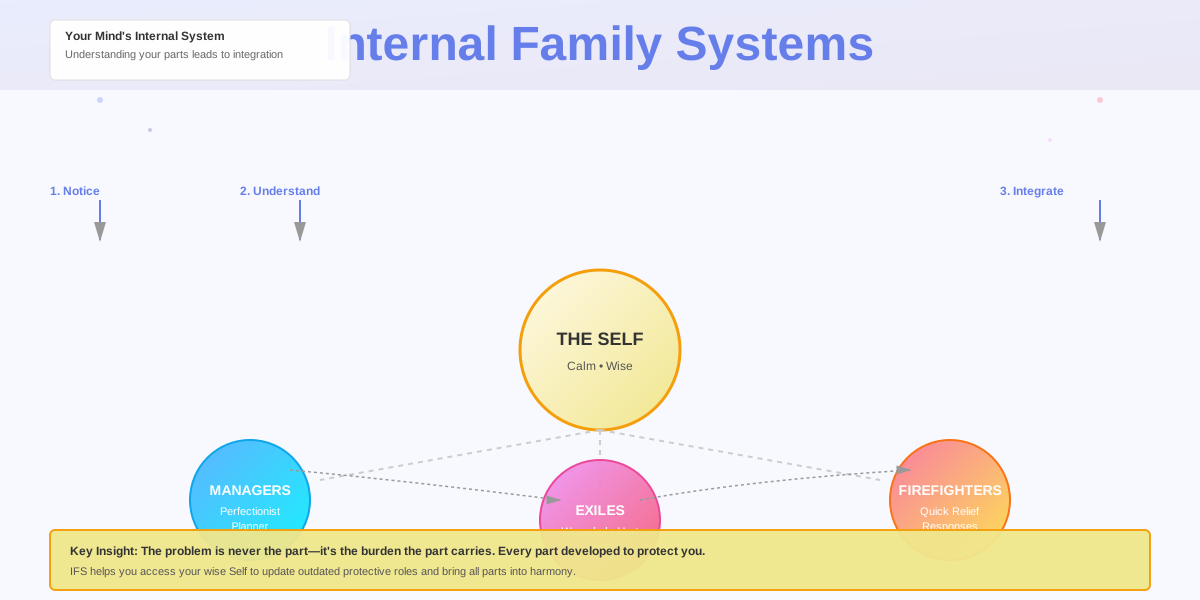
Shows how different parts (Managers, Exiles, Firefighters) relate to each other and the Self, illustrating their protective roles and how they interact in response to emotional triggers.
🔍 Click to enlarge
Why Internal Family Systems Matters in 2026
Mental health challenges in 2026 are increasingly recognized as rooted in internal fragmentation. Anxiety, depression, perfectionism, and trauma aren't simple chemical imbalances—they're often symptoms of internal parts in conflict. Traditional medication alone or surface-level coping strategies leave the underlying system unchanged. IFS directly addresses this root cause by bringing coherence to your internal world, which naturally reduces symptoms.
The modern world creates particular pressures that activate our protective parts. Work demands activate the perfectionist manager. Social media triggers shame in exiles. Uncertainty fires up anxiety protectors. IFS gives you the toolkit to recognize when a part has taken over and to access your Self—the state where you can respond wisely rather than react defensively. Research from 2024-2025 shows IFS reduces PTSD symptoms in 92% of participants, significantly decreases depression comparable to CBT, and improves emotion regulation and self-compassion.
Whether you're managing trauma, navigating complex relationships, or simply feeling fragmented and overwhelmed, IFS in 2026 represents access to evidence-based healing that traditional therapy often misses. The approach has moved from fringe to mainstream, with clinical research expanding rapidly and training programs growing. Understanding your parts isn't luxury—it's fundamental mental health literacy.
The Science Behind Internal Family Systems
The science of IFS integrates neurobiology, attachment theory, and systems psychology. When we experience overwhelming stress or trauma, our brain compartmentalizes these experiences to protect us. Different neural networks activate to handle different emotional states, creating what feels like distinct 'parts.' Brain imaging studies show that during parts-focused therapy, activity shifts between different neural regions depending on which part is active—confirming that parts have neurobiological reality, not just psychological metaphor.
A 2024 scoping review in Clinical Psychologist found IFS to be a 'promising therapeutic approach' for PTSD, depression, and chronic pain, with pilot trials showing significant symptom reduction. The mechanism appears to work through several pathways: first, by increasing emotional awareness through parts dialoguing; second, by reducing the activation of hypervigilant protective parts; third, by accessing Self-energy—a state associated with prefrontal cortex activation and parasympathetic regulation; and fourth, by updating traumatic memories through reparenting and resource work. Neurologically, this shifts the brain from threat-detection mode (amygdala/survival brain) to present-moment clarity (prefrontal/wise brain).
How IFS Heals: The Mechanism of Change
Illustrates the transformation process: from fragmented parts in conflict, through Self-connection, to integrated wholeness with parts in their authentic roles.
🔍 Click to enlarge
Key Components of Internal Family Systems
The Self: Your Core Center
The Self is not another part—it's the calm, clear center of your consciousness that's present underneath all the noise. It's characterized by qualities like curiosity, compassion, courage, creativity, clarity, calmness, and connectedness. The Self is described as undamaged by trauma, innate from birth, and capable of leading your entire system. When you're in Self-energy, you feel grounded, wise, and able to respond to situations with perspective. You can listen to different parts without being hijacked by them. Accessing the Self is the primary goal of IFS because when the Self is in charge, the whole system naturally heals.
Managers: The Protective Planners
Managers are parts that work tirelessly to prevent pain from being triggered and reaching awareness. They manage daily life, plan ahead, analyze problems, and try to control outcomes. Common managers include the perfectionist (nothing can go wrong if I'm perfect), the people-pleaser (I'll be safe if everyone likes me), and the planner (I can prevent bad things through preparation). Managers aren't trying to harm you—they're trying to keep you functioning. The problem arises when they become hyperactive and rigid, leading to perfectionism, anxiety, overwork, or chronic stress. Understanding managers helps you see that your perfectionism isn't a character flaw; it's a protective strategy that once served you.
Exiles: The Wounded Parts
Exiles hold the emotional wounds, shame, fear, or hurt from difficult experiences, especially childhood trauma or ongoing pain. Managers work to keep exiles contained—preventing them from entering consciousness—because their pain feels unbearable. An exile might be the young part of you that was criticized and learned 'I'm not good enough,' or the vulnerable part that was rejected and learned 'I'm unlovable.' Exiles don't cause problems by themselves; they're silenced by managers. The healing happens when the Self can safely access exiles, hear their story, and update their outdated beliefs with present-day wisdom and safety.
Firefighters: The Crisis Response Team
Firefighters are activated when an exile's pain breaks through despite managers' efforts. Their job is to extinguish the emotional fire at any cost—through distraction, dissociation, substance use, binge eating, rage, or any immediate relief strategy. A firefighter isn't 'bad'—it's desperately trying to stop unbearable emotional pain. The problem is that firefighter strategies often create new problems. Understanding that your self-sabotaging behaviors are firefighter responses, not character flaws, opens compassion rather than self-judgment. Healing means connecting with the Self to address the underlying exile pain so firefighters don't need to activate.
| Part Type | Primary Role | Common Examples | When Overburdened |
|---|---|---|---|
| Managers | Prevent pain through control & planning | Perfectionist, People-pleaser, Logical Analyzer, Overachiever | Anxiety, perfectionism, control issues, inability to relax |
| Exiles | Hold emotional wounds & shame | Vulnerable child, Rejected self, Shamed part, Fearful part | Depression, deep shame, hopelessness, hidden pain |
| Firefighters | Extinguish pain through distraction | Binge eater, Substance user, Rage part, Thrill-seeker | Impulsive behaviors, addiction, rage outbursts, self-harm |
How to Apply Internal Family Systems: Step by Step
- Step 1: Notice your inner experience: When you feel emotional reactivity, pause and ask 'What am I feeling right now?' This emotion is often a part's voice. Anxiety, shame, rage—each is a part trying to communicate.
- Step 2: Name the part: Give it a simple label—'the worrier,' 'the critic,' 'the protector.' Naming helps you relate to it as something separate from your whole Self.
- Step 3: Get curious without judgment: Ask the part 'What are you trying to do for me? What are you afraid will happen if you don't do this? What do you want me to know?' Curiosity disarms defensiveness.
- Step 4: Identify what the part is protecting: Most parts have a positive intent buried under problematic behavior. The perfectionist wants to prevent shame. The procrastinator wants to avoid overwhelm. Finding this protective intention is key.
- Step 5: Locate the part in your body: Close your eyes and ask 'Where do I sense this part in my body?' You might feel heaviness in your chest, tightness in your stomach, or numbness in your heart. This embodied connection strengthens the dialogue.
- Step 6: Ask what burden it carries: 'What belief does this part hold? What does it fear? What happened that created this protection?' Often, the part is carrying someone else's message—'You're not good enough'—from childhood.
- Step 7: Invite Self-energy: Once you understand the part's protective role, ask 'Can my Self talk to you? I want to understand you better.' The transition from identified-with-the-part to Self-centered is the turning point.
- Step 8: Update the part's belief: From Self-energy, you can address the outdated belief. 'You learned that you're not safe if others don't like you. That was true when you were small. Now you have me—your Self—to keep you safe. You can relax now.'
- Step 9: Assign a new role: As the part releases its burden, offer it an updated job. The perfectionist becomes 'excellence-attainer'—pursuing quality from Self-energy rather than desperate control. The worrier becomes 'planner'—problem-solving from calm clarity.
- Step 10: Notice the shift: With IFS, change often feels immediate. After unburdening a part, people report lightness, easier breathing, and greater spaciousness in their mind. This is the felt sense of integration.
Internal Family Systems Across Life Stages
Young Adulthood (18-35)
Young adults often benefit from IFS when struggling with identity, perfectionism, or relationship patterns. This age typically involves high manager activation—proving yourself, building career, meeting expectations. IFS helps young adults recognize that their overwork isn't personality; it's a protective part afraid of failure or rejection. Many discover that their relationship struggles stem from exiles carrying childhood wounds (unmet needs, criticism, abandonment). Accessing the Self in young adulthood often creates profound shifts because the nervous system is still plastic and responsive. Young adults can quickly learn to notice when a part has taken over and choose a different response.
Middle Adulthood (35-55)
Middle-aged adults often come to IFS after decades of accumulated stress, burnout, or realization that their coping strategies aren't working. By this stage, many have managed symptoms through willpower alone—working harder, controlling more, pushing feelings away. IFS offers permission to stop fighting and start understanding. Middle-aged clients often experience profound 'aha' moments: realizing their workaholic pattern stems from a terrified part, or their emotional distance from family comes from a protective exile. The advantage at this stage is wisdom and motivation for lasting change. Many middle-aged adults report that IFS-based changes create noticeable improvements in relationships, joy, and meaning.
Later Adulthood (55+)
Older adults frequently discover IFS valuable for processing accumulated life regrets, relationship repair, and finding peace. As mortality becomes real, exiles that have been hidden for decades often emerge—grief, loss, unmet dreams. IFS allows older adults to access these parts with Self-compassion rather than judgment. Many report healing old family patterns and finally releasing perfectionism. Research shows that older adults using IFS often experience significant improvements in sleep, reduced rumination, and increased life satisfaction. The Self in later adulthood is often described as particularly wise and grounded.
Profiles: Your Internal Family Systems Approach
The Perfectionist Protector
- Permission to be 'good enough' rather than flawless
- Understanding that your standards protect against shame, not create success
- Access to Self-energy that knows you're inherently worthy
Common pitfall: Working harder, achieving more, setting impossible standards as a way to prove worth
Best move: Have your perfectionist part rest for one day weekly. Notice what actually happens. Usually: nothing catastrophic. This updates its threat-beliefs.
The Vulnerable Exile
- Witness and validation of its wounds—someone to finally hear and care
- Self-protection that doesn't require manager control or firefighter escape
- Permission to be small, hurt, scared, or sad without managers rushing to 'fix' it
Common pitfall: Managers isolating the part so completely that depression or numbness develops
Best move: Spend 10 minutes daily in Self-energy, talking directly to your vulnerable part. Just listen. No fixing required.
The Rage Firefighter
- Recognition that rage isn't your true nature—it's a desperate alarm when exiles are threatened
- A safer way to protect vulnerable parts besides explosion
- Connection to the Self's calm strength rather than rage's reactive power
Common pitfall: Managers judging the rage part, creating shame spirals that feed more firefighter activation
Best move: Before you explode, pause and ask: 'What part of me just got hurt? What's that part afraid of?' This redirects firefighter energy toward protection-through-understanding.
The Avoidant Manager
- Gradual exposure to emotions rather than forcing confrontation all at once
- Assurance that feeling things won't destroy you; the Self can handle it
- A new job where it uses its planning skills to support wellness, not just avoid pain
Common pitfall: Fleeing emotions indefinitely, leading to isolation, numbness, or disconnection
Best move: Set a timer for five minutes. Choose one feeling you've been avoiding. Just feel it fully for five minutes. No fixing, no changing—just feeling. Notice you survive.
Common Internal Family Systems Mistakes
A frequent mistake is trying to eliminate parts rather than understand them. Many people attempt IFS expecting to 'get rid of' the anxious part, the critical part, or the urge to binge. This misses the entire point. Every part deserves to exist and be valued. The goal isn't elimination; it's updated roles. The perfectionist part has gifts—high standards, attention to detail, commitment—that become assets when no longer driven by fear.
Another common error is bypassing the Self and trying to 'fix' parts through willpower. You can't negotiate with a firefighter part when you're still identified with a manager's agenda. Real shifts happen when you first access your Self—that calm, clear center—and from there address the system. Self-energy can't be forced; it emerges when protective parts step back.
Many also make the mistake of attempting complex trauma work alone without a trained IFS therapist. While basic parts recognition and curiosity are self-directed practices, serious trauma unburdening requires professional support. A skilled IFS therapist knows how to pace the work, manage firefighter activation, and help exiles release their burdens safely. Attempting to force an exile into consciousness too quickly can overwhelm your system.
What IFS Is and Isn't
Contrasts common misconceptions about IFS with actual practice, clarifying what to expect from the therapeutic approach.
🔍 Click to enlarge
Science and Studies
Internal Family Systems has accumulated substantial research evidence over the past decade, moving from fringe to mainstream recognition in mental health. The research demonstrates significant effectiveness for trauma, mood disorders, anxiety, and pain conditions. Key findings show that IFS works through specific mechanisms: increasing emotional awareness, reducing threat-activation in protective parts, accessing Self-regulated nervous system states, and updating traumatic memories through guided imagery and reparenting.
- Birkeland et al. (2025): 92% of PTSD participants no longer met diagnostic criteria after IFS treatment, with sustained improvements at follow-up
- Sweezy & Schwartz (2024): IFS effectiveness for depression comparable to CBT and IPT in multiple pilot RCTs
- Clinical Psychologist (2025): Scoping review identified IFS as 'promising therapeutic approach' for PTSD, depression, and chronic pain
- Subramanian et al. (2024): Online group-based IFS for comorbid PTSD and substance use showed significant symptom reduction
- SAMHSA (2023): Internal Family Systems included in National Registry for Evidence-Based Programs and Practices
Your First Micro Habit
Start Small Today
Today's action: Spend 2 minutes noticing an emotional reaction today. When you feel a strong emotion—frustration, sadness, anxiety, excitement—pause and ask: 'What part of me is feeling this? What does this part want?' Just notice without judgment. Write one sentence about what you discover.
This micro habit begins your parts literacy. Instead of being unconsciously controlled by emotions, you start creating space between your Self and your parts. This tiny practice—repeated daily—builds the neural pathway between awareness and choice. Over weeks, you'll naturally notice parts earlier and respond from Self-energy more often.
Keep quitting habit apps after a missed day? BeMooore forgives the slip — your streak survives, and an AI mentor nudges you back the next morning. Free on iOS.
Quick Assessment
When you experience strong emotions, do you typically notice what's driving them or do you react automatically?
Your answer reflects your current Self-to-parts ratio. The more self-aware you are before reacting, the more you're already accessing Self-energy. The more reactive you feel, the more parts have taken over.
Which internal conflict feels most familiar to you?
These conflicts are your parts in conversation with each other. They're completely normal and fixable. IFS helps you translate these conflicts into parts that can collaborate instead of fight.
If you could change your inner experience, what would shift first?
Your answer points to which parts are most burdened right now. IFS directly addresses these: the harsh inner critic is a manager protecting exiles; anxiety is a manager trying to prevent bad outcomes; guilt is a manager saying rest is dangerous; numbness is a firefighter protecting from overwhelm. All are fixable.
Take our full assessment to get personalized recommendations.
Discover Your Style →Next Steps
Your journey with Internal Family Systems begins with curiosity. Start noticing your inner experience. When you feel strong emotions, pause and ask yourself: 'What part of me is this? What is this part trying to do for me?' This simple practice opens awareness that naturally leads to change.
Consider exploring the resources below, finding a trained IFS therapist if your challenges feel significant, or beginning with books and online courses to deepen your understanding. The most important step is recognizing that your internal conflicts aren't failures—they're your system working exactly as designed to protect you. With IFS, you can thank your parts for their service and gently update their roles so you can live from your true Self.
Get personalized guidance with AI coaching.
Start Your Journey →Research Sources
This article is based on peer-reviewed research and authoritative sources. Below are the key references we consulted:
Related Glossary Articles
Frequently Asked Questions
Is IFS the same as dissociative identity disorder (DID)?
No. IFS is a normal psychological process everyone experiences. We all have different internal voices and perspectives. DID is a severe trauma response involving involuntary amnesia and parts taking over consciousness against the person's will. IFS is a therapeutic model for working with normal parts; it's not a pathology and doesn't cause DID.
Can I do IFS work on my own, or do I need a therapist?
You can begin parts awareness and basic curiosity on your own. Many people benefit from reading about IFS or using self-help resources. However, for trauma processing, significant emotional pain, or complex systems, working with a trained IFS therapist is recommended. Therapists know how to pace the work safely, manage intense reactions, and ensure you don't overwhelm your system. Think of self-directed work as helpful awareness-building; professional work as guided healing.
How long does IFS therapy typically take?
This varies widely. Some people experience significant shifts in 10-15 sessions. Others with complex trauma may benefit from longer-term work—sometimes 6 months to 2+ years. The pace depends on trauma severity, system complexity, and how quickly parts can update their protective roles. Importantly, IFS isn't about 'finishing'—it's about building an internal skill set you keep using. Once you understand your parts, you have tools for life.
Will IFS replace my antidepressants or anti-anxiety medication?
IFS works well alongside medication. It's not either/or. Many people take medication to stabilize their nervous system enough to do deeper IFS work. Others find that as their parts update and their system becomes more integrated, medication needs decrease—but only under medical guidance. Always discuss any medication changes with your prescribing doctor.
What if I can't access a trained IFS therapist in my area?
The IFS Institute maintains a directory of certified therapists (ifs-institute.com). Many now offer virtual sessions, expanding access. Additionally, books like 'Internal Family Systems Therapy' by Schwartz and 'Self-Therapy' provide guided exercises. Online support communities can also help. While professional support is ideal for trauma, education and self-awareness can begin independently.
Take the Next Step
Ready to improve your wellbeing? Take our free assessment to get personalized recommendations based on your unique situation.
- Discover your strengths and gaps
- Get personalized quick wins
- Track your progress over time
- Evidence-based strategies