Trauma Response
When you face danger, your body doesn't ask for permission—it acts. Within milliseconds of perceiving a threat, your brain triggers a cascade of physical and psychological responses designed to keep you alive. These survival mechanisms, known as trauma responses, shift your physiology into high alert: your heart races, breathing quickens, muscles tense. For most people, these reactions fade once the threat passes. But for those who've experienced severe trauma, these responses can remain activated, creating a persistent sense of danger even in safe situations. Understanding how trauma responses work is the first step toward recovery.
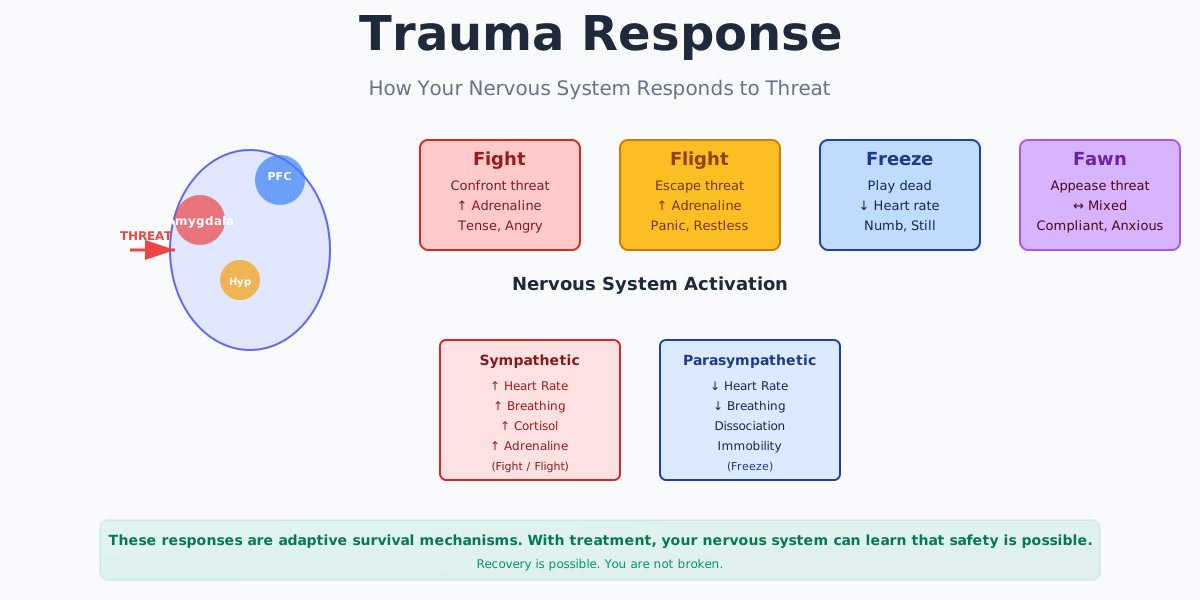
The four primary trauma responses—fight, flight, freeze, and fawn—represent different survival strategies your nervous system chooses based on the perceived threat and context.
These responses aren't flaws; they're evolutionary adaptations that have helped humans survive for millennia. The challenge today is learning to recognize when these ancient survival programs activate unnecessarily and how to downregulate your nervous system when safety is actually present.
What Is Trauma Response?
A trauma response is an automatic, involuntary reaction of your nervous system when it perceives a threat to your safety or survival. It's a coordinated response involving the amygdala (threat detection center), the hypothalamus (command center), and the periaqueductal gray (response coordinator) in the brainstem. These brain regions activate faster than your conscious, rational mind can process information—which is why you might freeze in fear before you realize what's happening. The response manifests through the sympathetic nervous system (accelerating arousal) or the parasympathetic nervous system (creating immobility), depending on which survival strategy the brain selects.
Not medical advice.
Trauma responses are normal reactions to abnormal events. They become problematic when they persist after the threat has passed, or when they activate in situations that don't actually pose danger. This dysregulation of the nervous system is characteristic of post-traumatic stress disorder (PTSD) and acute stress disorder (ASD). Research shows that approximately 60-80% of people experience a traumatic event in their lifetime, yet only 3-4% develop PTSD—suggesting that most people naturally recover from trauma responses, while others require targeted treatment.
Surprising Insight: Surprising Insight: Your nervous system doesn't distinguish between a genuine threat and a reminder of past trauma. A car backfire can trigger the same physiological response as actual gunfire, which is why context and safety cues are crucial for recovery.
The Trauma Response Cascade
Flow diagram showing how a perceived threat triggers a cascade of neural and physiological responses through the amygdala, hypothalamus, and sympathetic nervous system.
🔍 Click to enlarge
Why Trauma Response Matters in 2026
In 2026, we're experiencing a mental health crisis with rising rates of anxiety, depression, and PTSD globally. The COVID-19 pandemic, climate anxiety, economic uncertainty, and social media exposure to traumatic events have collectively increased the prevalence of unprocessed trauma. Understanding trauma responses is no longer optional for personal wellbeing—it's essential. Mental health professionals report that recognizing trauma responses is the foundation for effective treatment and self-regulation.
Beyond individual wellness, understanding trauma responses has implications for workplaces, schools, and relationships. Many behavioral problems—aggression, withdrawal, procrastination, perfectionism—are actually trauma responses being misinterpreted as character flaws. When we recognize the nervous system's role, we shift from judgment to compassion, enabling genuine healing rather than self-blame.
The 2025 APA Clinical Practice Guidelines emphasize that early recognition and intervention in trauma responses—even in the acute stress disorder phase (first 3 days to 1 month after trauma)—significantly improves long-term outcomes. This knowledge empowers individuals to seek help early rather than waiting until chronic PTSD develops.
The Science Behind Trauma Response
Your brain contains specialized regions that work together to detect and respond to threats. When you see danger, the amygdala (your threat detection center) processes the information milliseconds before your prefrontal cortex (rational thinking) can catch up. In people with PTSD, neuroimaging shows decreased activation in the prefrontal cortex and anterior cingulate cortex—regions responsible for regulation and context processing—while the amygdala shows increased activation. This neurological pattern explains why PTSD sufferers have difficulty recognizing safe situations and controlling fear responses.
The hypothalamus coordinates the physiological response by triggering the HPA axis (hypothalamic-pituitary-adrenal axis), which releases cortisol and adrenaline. These hormones prepare your body for immediate action: blood pressure rises, respiration increases, digestive function shuts down (conserving energy), and muscles prepare for rapid movement. The response itself is elegant and adaptive—until it becomes stuck in the 'on' position. In trauma survivors, the HPA axis becomes sensitized and hyperactive, meaning it continues releasing stress hormones even when the threat has passed.
Neural Pathways in Trauma Processing
Comparison of normal threat processing versus dysregulated processing in PTSD, showing the role of prefrontal cortex, amygdala, and hippocampus.
🔍 Click to enlarge
Key Components of Trauma Response
Fight Response
The fight response occurs when your brain decides to confront or resist the threat. This activates your sympathetic nervous system, flooding your body with adrenaline and cortisol. Physically, you experience muscle tension (especially in the jaw and shoulders), increased heart rate, aggressive thoughts, and a surge of anger. In everyday contexts, this might manifest as becoming argumentative, defensive, or even violent when triggered. Professionals in high-stress jobs (first responders, military) may habitually adopt fight responses. The adaptive version—standing up for yourself or setting boundaries—is healthy; the dysregulated version becomes aggression or rage reactivity.
Flight Response
The flight response activates when your brain chooses to escape the threat. Similar to fight, this is sympathetically mediated with elevated heart rate and adrenaline, but the energy is directed toward avoidance rather than confrontation. You might experience restlessness, racing thoughts, panic, or an overwhelming urge to leave. In chronic trauma, this manifests as avoidance behaviors: refusing to go certain places, avoiding conversations about the trauma, or constantly seeking exits. Some people develop anxiety disorders where flight activation becomes spontaneous even without real danger. The key neurological difference from fight is that flight mobilizes you outward (away), while fight mobilizes you inward (toward).
Freeze Response
The freeze response is mediated by the parasympathetic nervous system, specifically the vagal brake mechanism. When the brain perceives an inescapable threat, it halts arousal activation, resulting in immobility accompanied by heart rate deceleration. This 'playing dead' strategy evolved because many predators have evolved to detect movement; remaining still might allow the organism to survive. In humans, freeze manifests as dissociation, going blank, feeling paralyzed, or experiencing time distortion. People who freeze during trauma often report feeling numb, outside their bodies, or unable to move or speak. This response can feel deeply shameful afterward ('Why didn't I fight back?'), but it's a legitimate nervous system survival strategy, not a choice.
Fawn Response
The fawn response—a term coined by therapist Pete Walker—involves appeasement, compliance, or people-pleasing directed at the perceived threat. This response assumes: if I make myself agreeable, non-threatening, and helpful, the threat will choose not to harm me. Fawn is often developed in childhood through repeated exposure to threats from caregivers, where compliance was the safest survival strategy. In adulthood, fawn-oriented individuals may struggle with boundaries, over-apologize, be highly attuned to others' moods, and sacrifice their own needs for others' approval. While superficially adaptive (fawn rarely triggers acute danger), it often leads to emotional depletion, resentment, and a fragmented sense of self.
| Response Type | Nervous System Activation | Physical Symptoms | Behavioral Pattern |
|---|---|---|---|
| Fight | Sympathetic (high arousal) | Muscle tension, elevated heart rate, anger | Confrontation, aggression, defensiveness |
| Flight | Sympathetic (high arousal) | Restlessness, racing thoughts, panic | Avoidance, escape-seeking, hypervigilance |
| Freeze | Parasympathetic (low arousal) | Immobility, dissociation, numbness | Paralysis, blankness, disconnection |
| Fawn | Mixed (situational regulation) | Anxiety, over-compliance, nervous energy | People-pleasing, boundary dissolution, appeasement |
How to Apply Trauma Response: Step by Step
- Step 1: Develop nervous system awareness: Begin observing when your body shifts into a trauma response. Notice the early signs—shoulder tension before anger, chest tightness before panic, or numbness before dissociation. This awareness is foundational because you cannot regulate what you don't notice.
- Step 2: Name your response: Identify which response you tend toward under stress. Are you a fighter (confrontational), flyer (avoidant), freezer (paralyzed), or fawner (compliance-oriented)? Most people have a primary response and a secondary one.
- Step 3: Recognize triggers: Identify the situations, sensations, or reminders that activate your trauma response. This might be crowded places, loud noises, certain times of day, or specific relationship dynamics. Triggers are neural pathways, not arbitrary.
- Step 4: Create safety signals: Develop tangible ways to signal safety to your nervous system. This might be holding a specific object, being in a particular location, or being with a trusted person. Your nervous system learns through repetition that these signals precede safety.
- Step 5: Practice grounding techniques: When activated, use grounding to reconnect with present-moment safety. The 5-4-3-2-1 technique (name 5 things you see, 4 you feel, 3 you hear, 2 you smell, 1 you taste) engages the prefrontal cortex and downregulates the amygdala.
- Step 6: Regulate your breathing: Slow, deep breathing (especially extended exhales) activates the parasympathetic nervous system. Inhale for 4 counts, hold for 4, exhale for 6. This directly signals safety to your vagus nerve.
- Step 7: Move your body: Trauma gets stored in the body, and movement helps discharge the activation. Gentle exercise, dancing, or even shaking can help complete the interrupted defensive response.
- Step 8: Seek professional support: Evidence-based treatments like Prolonged Exposure (PE), Cognitive Processing Therapy (CPT), and trauma-focused CBT have success rates of 40-95% for eliminating PTSD diagnosis. These shouldn't be options—they should be accessed early.
- Step 9: Build a safety network: Isolation amplifies trauma responses. Gradually build trusted relationships and community where you feel genuinely safe. Your nervous system learns safety through consistent positive relational experiences.
- Step 10: Practice patience with yourself: Trauma responses developed over time and will unwind over time. Your nervous system is not broken; it's trying to protect you using outdated information. Compassion accelerates healing more than self-judgment.
Trauma Response Across Life Stages
Young Adulthood (18-35)
Young adults often experience trauma through accidents, violence, sexual assault, or sudden loss. This is also the age range where PTSD onset is most common. Young adults may initially hide trauma responses or cope through high-risk behaviors (substance use, reckless driving), which can complicate recovery. The advantage of this age is neuroplasticity—the brain is still highly capable of creating new neural pathways. Early intervention in this age group typically leads to faster recovery. Young adults also often have fewer resources (financial, time) to dedicate to treatment, making accessibility a real barrier.
Middle Adulthood (35-55)
Middle adults often carry cumulative trauma—childhood experiences plus adult experiences. By this age, trauma responses may have become deeply integrated into personality and relationship patterns. Middle adults often have more resources to access treatment but may be skeptical of mental health support due to generational attitudes. Career pressures and family responsibilities (caring for children or aging parents) can make seeking help feel impossible. Paradoxically, this is also when people often have sufficient self-awareness to recognize how trauma responses are limiting their life quality and relationships, creating motivation for change.
Later Adulthood (55+)
Older adults may have decades of unprocessed trauma, or new trauma from health crises, loss, or aging-related changes. Trauma responses in later adulthood can complicate medical conditions, interfere with recovery from surgery, and affect cognitive function. However, later adults often bring wisdom, perspective, and acceptance to healing work. Some older adults report that finally addressing trauma in their 60s or 70s transforms not just their remaining years but also their legacy and family relationships. Loneliness and isolation are risk factors for chronic trauma response in this age group.
Profiles: Your Trauma Response Approach
The Protector (Fight-Oriented)
- Healthy outlets for protective energy
- Clear distinctions between real threats and false alarms
- Leadership roles where their vigilance serves a purpose
Common pitfall: Remaining in a state of constant defensive readiness, seeing threats everywhere, becoming exhausting to relationships.
Best move: Channel protective instincts into boundary-setting and advocacy. Recognize that being the protector doesn't require fighting; it means being strategically alert and protective of those you love.
The Escape Artist (Flight-Oriented)
- Permission to move and create distance when needed
- Understanding that avoidance provides short-term relief but long-term entrapment
- Gradual, supported exposure to avoided situations
Common pitfall: Building an entire life around avoidance, missing opportunities, relationships, and growth by running from reminders.
Best move: Recognize that in most current situations, the threat isn't real—it's a memory. Start with small exposures to avoided situations while practicing grounding techniques. Celebrate each step.
The Disconnected (Freeze-Oriented)
- Gentle reconnection with body sensations
- Understanding that numbness was adaptive, not a permanent state
- Safe, predictable environments for nervous system resettlement
Common pitfall: Remaining dissociated and numb, missing life, relationships, and joy while being physically present.
Best move: Work with a trauma-informed therapist on somatic (body-based) therapies. Start with gentle movement, breathing exercises, and sensory awareness. Thawing out takes time but is absolutely possible.
The Peacekeeper (Fawn-Oriented)
- Practice saying 'no' without guilt
- Exposure to relationships where your needs matter
- Gradual reclamation of preferences, opinions, and boundaries
Common pitfall: Disappearing into others' needs, developing resentment, losing sense of self, enabling dysfunction.
Best move: Start small: state one preference a day, set one boundary a week. Notice that relationships don't end when you have needs. Build your sense of inherent worth independent of others' approval.
Common Trauma Response Mistakes
Mistake #1: Judging yourself for having the response. Your nervous system isn't broken or shameful; it's doing exactly what it evolved to do. Beating yourself up for freezing, fighting, or fleeing actually retraumatizes your nervous system and prevents healing. Self-compassion is the neurobiological prerequisite for recovery.
Mistake #2: Believing you must overcome it alone. Trauma responses are about connection to danger and disconnection from safety. Recovery involves re-establishing safety through relationships and professional support. Isolation doesn't prove strength; it prevents healing.
Mistake #3: Trying to think your way out before processing your body's experience. The amygdala processes before the prefrontal cortex, which means logic alone cannot resolve trauma responses. You must address the nervous system's activation through body-based therapies (somatic experiencing, EMDR, yoga) before cognitive work becomes fully effective.
The Trauma Recovery Journey
Progression from trauma activation through nervous system regulation to integrated recovery, showing typical timelines and key milestones.
🔍 Click to enlarge
Science and Studies
Recent trauma research from 2025-2026 reveals important findings about neural resilience, treatment efficacy, and the role of social factors in recovery. The research below represents the current gold standard in trauma science:
- National Center for PTSD (VA.gov): Acute Stress Disorder diagnosed 3 days to 1 month post-trauma. Research shows 60% of ASD patients no longer meet criteria after trauma-focused treatment, maintaining improvements at 28-month follow-up.
- Frontiers in Psychology (2026): Complex PTSD treatment study shows epistemic trust (ability to trust one's own and others' judgment) is a key change mechanism. Therapies targeting trust development show superior outcomes.
- Nature Molecular Psychiatry (2025): Social hierarchy and resilience regulate stress susceptibility through the Uba7 gene and microglia inflammation in the medial prefrontal cortex—suggesting future interventions targeting inflammation may enhance psychological treatment.
- APA Clinical Practice Guidelines (2025): Prolonged Exposure, Cognitive Processing Therapy, and trauma-focused CBT strongly recommended. PE shows 41-95% remission of PTSD diagnosis with treatment completion.
- NIH Neurobiology of Trauma (2023): Fear extinction learning occurs in the amygdala-ventromedial prefrontal cortex circuit. Understanding this circuit guides both pharmacological (SSRIs) and psychological interventions (exposure therapy).
Your First Micro Habit
Start Small Today
Today's action: For 2 minutes today, practice the 4-count breath: inhale for 4, hold for 4, exhale for 6. Do this in a safe space where you feel comfortable. Notice what happens in your body.
Extending your exhale activates your vagus nerve, which directly signals safety to your nervous system and downregulates the amygdala. This is neurobiology, not psychology—your body will respond before your mind catches up.
Keep quitting habit apps after a missed day? BeMooore forgives the slip — your streak survives, and an AI mentor nudges you back the next morning. Free on iOS.
Quick Assessment
When you experience high stress, which response do you typically recognize in yourself?
Your dominant trauma response is your nervous system's default survival strategy. None is better or worse—they all served a purpose. Recognizing yours is the first step toward flexibility.
How often do your trauma responses activate in situations that don't objectively pose danger?
How often your responses misfire indicates your nervous system's current state of calibration. There's no judgment here—trauma recalibrates the threat-detection system. The good news: it can be recalibrated back.
What support would most help you process trauma responses?
Different people need different entry points. Some start with understanding, others with techniques, some with professional help, and others with community. Your answer reveals your optimal starting point.
Take our full assessment to get personalized recommendations.
Discover Your Style →Next Steps
Understanding trauma responses is foundational, but understanding alone doesn't rewire your nervous system. The next step is practice—consistent, gentle practice of regulation techniques in increasingly challenging contexts. Start with your micro habit today. Notice what shifts in your body when you extend your exhale. This subtle neurobiological change is the beginning.
If your trauma responses are significantly impacting your life, seeking professional support isn't weakness—it's following the evidence. Trauma-focused CBT, Prolonged Exposure, EMDR, and somatic experiencing all have strong research backing 40-95% efficacy rates. Your nervous system has been working overtime to keep you alive. It deserves professional support to learn that safety is possible.
Get personalized guidance with AI coaching.
Start Your Journey →Research Sources
This article is based on peer-reviewed research and authoritative sources. Below are the key references we consulted:
Related Glossary Articles
Frequently Asked Questions
Is having a trauma response the same as having PTSD?
No. Trauma responses are normal reactions to abnormal events. Most people experience them after trauma and naturally recover. PTSD is diagnosed when responses persist for more than one month, significantly impair functioning, and show specific symptom clusters (intrusion, avoidance, negative mood changes, hyperarousal). Acute Stress Disorder is diagnosed 3 days to 1 month post-trauma with similar symptoms. The distinction matters for treatment timing.
Can I rewire my nervous system to not respond to trauma triggers?
Complete elimination of the conditioned response is rare, but significant reduction is very achievable. The goal of trauma therapy isn't erasure but flexibility—recognizing triggers, pausing, and choosing a response rather than automatically reacting. Evidence-based treatments achieve 40-95% reduction in PTSD symptoms. Your nervous system can learn new patterns; it just takes time and consistent practice.
Why do I sometimes not remember what happened during a trauma?
This is called dissociative amnesia and occurs because the prefrontal cortex (involved in memory encoding) shuts down during extreme stress as the brain prioritizes survival over memory formation. The memories are typically accessible through trauma therapy, particularly through eye movement desensitization and reprocessing (EMDR) or somatic experiencing.
Is it too late to heal trauma if it happened decades ago?
Absolutely not. The brain maintains neuroplasticity throughout life. People have successfully processed decades-old trauma in their 60s, 70s, and beyond. The timeline for healing depends more on the intensity of treatment and individual factors than on how long ago the trauma occurred. It's never too late to signal safety to your nervous system.
What if my trauma responses have become part of my identity?
This is remarkably common, especially when responses have been active for years. Your identity has adapted to include these protective patterns. Healing involves a gradual identity shift as you experience yourself without constant threat activation. This shift takes time and typically requires professional support, but it's profoundly transformative—you discover parts of yourself that were always there but hidden beneath survival mode.
Take the Next Step
Ready to improve your wellbeing? Take our free assessment to get personalized recommendations based on your unique situation.
- Discover your strengths and gaps
- Get personalized quick wins
- Track your progress over time
- Evidence-based strategies