Money Management
Money management is the foundation of financial freedom and peace of mind. Whether you're struggling to make ends meet, dreaming of building wealth, or simply want to stop living paycheck-to-paycheck, the right money management approach can transform your financial life. In 2026, with rising costs and economic uncertainty, more than ever before, people are recognizing that managing money isn't about luck—it's about systems, behaviors, and intentional choices. The difference between those who build wealth and those who don't often comes down to one thing: how well they manage the money they have right now. This guide walks you through evidence-based strategies, psychological insights, and practical steps to take control of your finances.
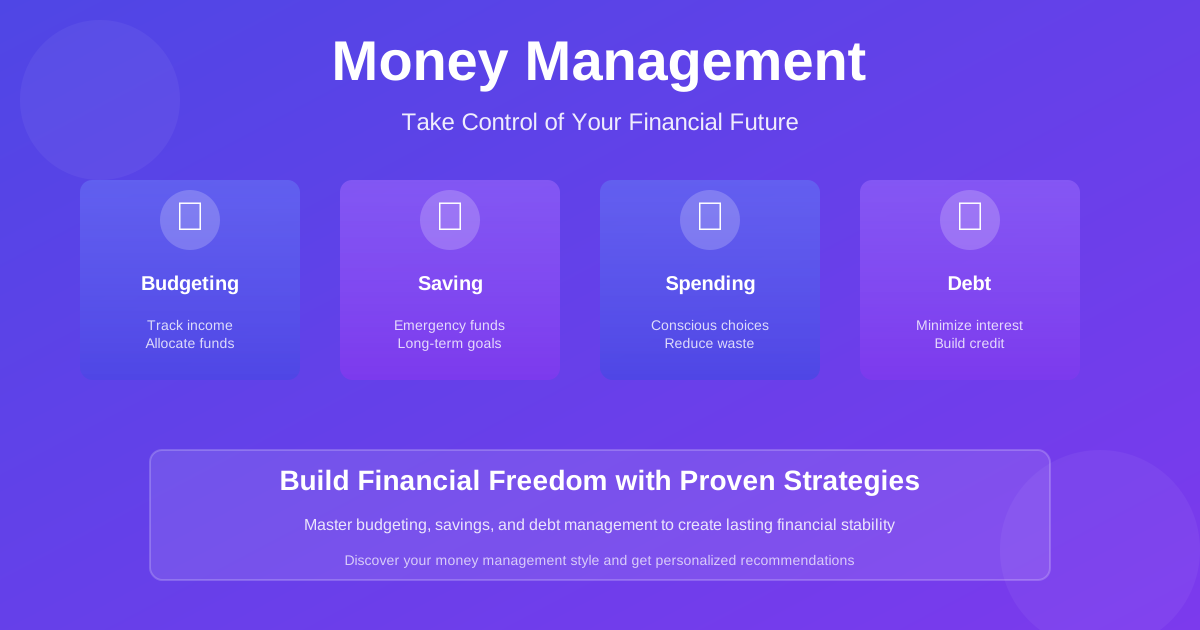
Imagine having complete clarity about where your money goes each month. Picture yourself making confident financial decisions aligned with your values. That's what effective money management creates—freedom, confidence, and genuine financial security.
Throughout this guide, you'll discover how to build systems that work automatically, overcome the psychological barriers that sabotage your finances, and create a money management approach tailored to your personality and life stage.
What Is Money Management?
Money management is the deliberate process of earning, budgeting, saving, investing, and spending money in ways that align with your values and support your long-term financial goals. It encompasses everything from tracking daily expenses to planning for retirement, from managing debt to building wealth. Modern money management recognizes that your relationship with money is both psychological and behavioral—it's not just about numbers, but about the habits, beliefs, and systems that drive your financial decisions. At its core, money management is about alignment—ensuring that how you spend money reflects what you actually value. Many people spend money in ways completely misaligned with their values: they spend on subscriptions they never use, impulse purchases that bring regret, and obligations they resent. Effective money management creates harmony between your values and your spending, which is deeply satisfying at a psychological level.
Not medical advice.
Money management is fundamentally about designing systems that make good financial choices easier and automatic. Rather than relying on willpower or discipline alone, effective money management uses automation, clear rules, and behavioral psychology to help you make decisions that serve your future self. It's about working with your psychology instead of against it.
Surprising Insight: Surprising Insight: Research shows that 84% of Americans have new financial resolutions for 2026, yet most fail because they rely on willpower instead of systems. The difference between success and failure isn't motivation—it's automation and environmental design.
Money Management: The Five Core Pillars
Visual framework showing budgeting, saving, debt management, investing, and spending as interconnected components of holistic money management.
🔍 Click to enlarge
Why Money Management Matters in 2026
Financial stress is now the leading cause of stress in America, surpassing work, health, and relationships. The 2026 economic landscape combines rising living costs, stagnant wages, and an affordability crisis that touches nearly every household. In this environment, money management shifts from a luxury to a necessity. Those with clear money management systems experience lower stress, better relationships, and improved physical and mental health. When financial stress dominates your thoughts, it impairs cognitive function, makes decision-making harder, and reduces your ability to focus at work or school. People experiencing financial stress report 40% more health issues, higher rates of depression and anxiety, and damaged relationships with partners and family members. Conversely, those with strong financial management experience measurable improvements in sleep quality, reduced anxiety, better immune function, and more stable relationships. Money management isn't just about numbers—it's about buying yourself peace of mind and protecting your health.
Money management also provides the foundation for pursuing your deeper life goals. Whether you want to retire early, start a business, travel the world, or support causes you care about, money management gives you the control and clarity to make these dreams possible. It transforms money from a source of anxiety into a tool for creating the life you want.
Beyond personal benefits, strong money management practices protect you from unexpected financial emergencies and position you to take advantage of opportunities when they arise. In 2026, with artificial intelligence changing job markets and economic volatility increasing, having solid money management skills is more valuable than ever.
The Science Behind Money Management
Behavioral finance reveals that humans are not rational economic actors—we're emotional beings influenced by cognitive biases and psychological patterns. Understanding this science is key to effective money management. Cognitive biases like loss aversion (fearing losses more than we value gains), mental accounting (treating different money sources differently), and herd behavior (following others without clear reasoning) all influence how we handle money. Loss aversion explains why people hold losing investments too long, hoping to break even, even when cutting losses and reinvesting would create better outcomes. Mental accounting explains why people can spend $200 without guilt on a vacation but agonize over a $50 tool for their home—the money came from different mental 'buckets.' Understanding these biases isn't about judging yourself; it's about designing systems that work with human nature rather than against it. When you know that loss aversion makes selling losing stocks hard, you can create automatic rebalancing in your investment portfolio. When you know that mental accounting affects your spending, you can create spending categories that align with how your brain naturally thinks about money.
The solution isn't to fight these patterns through willpower; it's to design systems that acknowledge them and work within them. When you automate savings, use visual budgeting tools, and create clear spending rules, you're essentially 'programming' better financial behavior into your environment. Research on financial wellness shows that those who have higher financial literacy, stronger self-control systems, and better investment decision-making practices experience significantly higher financial well-being and lower financial stress.
Behavioral Finance: How Psychology Impacts Money Decisions
Shows common cognitive biases that derail financial plans and evidence-based countermeasures.
🔍 Click to enlarge
Key Components of Money Management
1. Income Tracking and Understanding
Effective money management begins with complete clarity about your income. This includes your salary, bonuses, side income, investment returns, and any other money coming in. Many people underestimate or forget about variable income sources. A critical first step is knowing your net monthly income—the actual amount you receive after taxes and deductions. Understanding whether you're living on fixed income or variable income changes how you should structure your budgeting and savings approaches.
2. Budgeting and Expense Tracking
Budgeting is the framework that ensures your money aligns with your priorities. The most popular frameworks include the 50/30/20 rule (50% essentials, 30% discretionary, 20% savings), the 60/30/10 method, and zero-based budgeting where every dollar is allocated before spending. The key isn't which system you choose, but rather which system matches your personality and lifestyle. Apps have revolutionized budgeting by automating expense categorization, eliminating the tedium that historically derailed budget plans.
3. Debt Management and Credit Building
Debt management involves both eliminating high-interest debt and using strategic debt to build wealth. High-interest debt like credit cards should be prioritized for payoff because it compounds against you. Low-interest debt like mortgages can be strategic if the money is invested wisely. Credit building is equally important—your credit score determines the interest rates you'll pay on future loans, affecting your financial life for decades. Paying bills on time and maintaining low credit utilization are foundational practices.
4. Saving and Emergency Funds
Saving is the cornerstone of financial security. Research shows that those who accumulate emergency funds—typically 3-6 months of expenses—experience significantly lower financial stress and are better protected against life disruptions. Automated savings are critical because they remove the decision-making barrier. Setting up automatic transfers to savings accounts immediately after payday ensures you 'pay yourself first' before discretionary spending tempts you.
| Method | Structure | Best For |
|---|---|---|
| 50/30/20 Rule | 50% essentials, 30% wants, 20% savings | Those with moderate variability in income |
| Zero-Based Budgeting | Every dollar assigned to a category before spending | Detail-oriented people seeking complete control |
| 60/30/10 Method | 60% essentials, 30% discretionary, 10% savings/debt | Those with high essential expenses |
| Pay Yourself First | Automate savings immediately, budget remainder | Those who struggle with voluntary saving |
How to Apply Money Management: Step by Step
- Step 1: Calculate your true net income: After taxes, deductions, and benefits, determine the actual amount deposited to your account each month. Include variable income averaged over a year.
- Step 2: Audit your current spending: Use a tracking app or spreadsheet to capture every expense for 30 days. Categorize spending to understand your baseline spending patterns and identify waste.
- Step 3: Choose your budgeting framework: Decide whether 50/30/20, 60/30/10, or zero-based budgeting aligns with your personality and income variability. You can always adjust after testing.
- Step 4: Set up automated savings: Determine your savings target (starting at 10% of income if new to saving) and automate a transfer immediately after payday to a separate savings account.
- Step 5: Create spending categories and limits: Based on your audit and budget framework, establish specific limits for each category. Make these limits realistic to avoid constant frustration.
- Step 6: Implement automation for bills: Set up automatic payments for all fixed bills to ensure they're paid on time, building your credit and reducing mental load.
- Step 7: Establish an emergency fund goal: Aim for $1,000-$5,000 initially, then build toward 3-6 months of essential expenses. This single safety net dramatically reduces financial stress.
- Step 8: Track progress weekly, not daily: Check your budget once per week rather than obsessing daily. This reduces stress and provides enough frequency to catch problems.
- Step 9: Eliminate high-interest debt: Create a debt payoff strategy focused on high-interest debt first (like credit cards). Consider the snowball method (smallest balance first for psychological wins) or avalanche method (highest interest first for financial efficiency).
- Step 10: Refine and adjust: After 90 days, evaluate what's working and what isn't. Adjust spending limits, change apps, or switch budget methods. This is about finding your sustainable system, not perfection.
Money Management For Different Income Levels
Money management looks different depending on your income level because your constraints and priorities shift dramatically. For low-income earners ($25,000-$40,000 annually), the priority is survival—building emergency funds before investing, minimizing debt, and finding ways to increase income through skill development or side work. For middle-income earners ($50,000-$100,000), the focus shifts to optimization—maximizing tax-advantaged retirement accounts, strategically managing debt, and beginning wealth building through investments. For high-income earners ($150,000+), money management becomes about sophistication—tax optimization, asset protection, estate planning, and strategic wealth deployment.
Low-income earners often face the paradox that they need strong money management skills the most, yet have the least margin for error. Every dollar matters. The strategy for low-income households is ruthlessly prioritizing the essentials, building even tiny emergency funds ($500-$1,000), and relentlessly seeking income growth through education, certifications, or side income. Many low-income households discover that earning an extra $200-$400 monthly through freelance work transforms their financial situation more powerfully than cutting expenses.
Middle-income earners have the greatest opportunity to build wealth because they've solved survival but haven't yet settled into lifestyle inflation. This is the critical wealth-building decade. By maximizing retirement contributions ($7,000-$23,500 annually in 401k depending on age), automating investment contributions, and controlling lifestyle inflation (the tendency for spending to increase with income), middle-income earners can accumulate substantial wealth by retirement.
High-income earners face different challenges—the complexity of multiple income streams, significant tax implications, sophisticated debt strategies, and wealth protection. A high-income earner with poor money management can earn $300,000 annually but end up with less wealth than a middle-income earner earning $60,000 due to poor tax planning, excessive spending, or unprotected assets. High-income earners benefit tremendously from working with financial advisors and tax strategists.
Automation: The Secret to Sustainable Money Management
The most powerful money management secret isn't willpower or discipline—it's automation. When you automate savings, bill payments, and investing, you remove the decision-making requirement. You're no longer relying on yourself to 'decide' to save or pay bills. Instead, money flows to your savings account automatically before you have a chance to spend it. This aligns perfectly with how our brains actually work. We're far better at maintaining systems than relying on daily discipline.
Automation eliminates three major money management barriers. First, it removes the willpower requirement—you don't have to decide to save; it happens automatically. Second, it prevents 'out of sight, out of mind' spending—when money goes directly to savings before you see it, you naturally adjust your lifestyle to the remaining amount. Third, it builds habits through consistency. After three months of automated saving, saving becomes normal. After a year, you've forgotten what it felt like to not have money going to savings.
The automation hierarchy works like this: First, automate all bill payments to eliminate late payment risk and credit score damage. Second, automate savings immediately after payday to 'pay yourself first.' Third, automate investment contributions if you have investments. Fourth, automate quarterly or annual transfers to your emergency fund. Finally, automate any debt payoff beyond minimum payments. Each automated system removes one decision point and one opportunity for procrastination.
Research on automatic enrollment in retirement plans shows the power of automation. When employees must opt-in to retirement savings, only 60-70% participate. When participation is automatic with the ability to opt-out, 90-95% participate. The same principle applies to personal finances—systems are infinitely more powerful than intentions.
Money Management Across Life Stages
Young Adulthood (18-35)
Young adults face the challenge of building money management habits while managing entry-level income, student debt, and competing priorities. The advantage of this stage is time—compound interest works powerfully in your favor. Starting even small savings and investment habits now creates a dramatically different financial outcome by retirement. Young adults should focus on: establishing credit (through responsible credit card use), building a 6-month emergency fund despite other pressures, automating savings to fight lifestyle inflation, and understanding investment basics. The habits you build now become your financial blueprint for life.
Middle Adulthood (35-55)
Middle adulthood often brings higher income, but also peak expenses—mortgages, children's education, aging parents, and peak career demands. Money management at this stage requires balancing competing financial priorities while maximizing earning years before retirement. Focus shifts to: optimizing debt (refinancing mortgages for lower rates, eliminating high-interest debt), maximizing retirement contributions while you have the strongest earning capacity, protecting income through adequate insurance, and positioning for wealth building through investments. Many find that improving money management discipline at this stage compounds into significant wealth by retirement.
Later Adulthood (55+)
As you approach and enter retirement, money management focuses on preservation and planning for longevity. Priorities include: ensuring retirement savings are sufficient and positioned for income generation, transitioning from accumulation to distribution strategies, protecting wealth through tax-efficient planning, planning for healthcare costs, and thinking about legacy and estate planning. Even at this stage, adapting your money management system—particularly to account for inflation and longevity—remains important for maintaining purchasing power throughout retirement.
Profiles: Your Money Management Approach
The Systematic Planner
- Clear framework and rules to follow
- Data visualization showing progress toward goals
- Regular review checkpoints
Common pitfall: Becoming too rigid when life circumstances change, staying with a budget that no longer fits your reality
Best move: Choose zero-based budgeting or detailed tracking apps; schedule quarterly reviews to adjust as needed rather than viewing the system as unchanging
The Automated Minimalist
- Simple rules that require minimal attention
- Automatic systems that run without intervention
- Quarterly rather than monthly check-ins
Common pitfall: Not noticing problems until they're serious because you're not reviewing finances regularly enough
Best move: Set up complete automation for savings and bills, use a simple framework like pay-yourself-first, but commit to quarterly 30-minute reviews
The Visual Progress Tracker
- Apps and tools showing visual progress and wins
- Gamification elements that motivate action
- Regular celebration of milestones
Common pitfall: Getting discouraged during slow progress periods or becoming obsessed with tracking instead of taking action
Best move: Use budgeting apps with visual dashboards, set smaller milestones within larger goals for frequent wins, schedule monthly money dates to review progress
The Values-Based Manager
- Clear alignment between spending and personal values
- Meaningful purpose behind financial goals
- Freedom to spend in aligned categories
Common pitfall: Feeling restricted by budgets that don't reflect what matters to you, abandoning systems that feel misaligned
Best move: Start by clarifying your top 3-5 life values; build your budget around protecting spending in these areas; reduce spending in non-aligned categories guilt-free
Common Money Management Mistakes
The most widespread money management mistake is relying on willpower instead of systems. When you depend on making 'good' financial decisions every single day, you're fighting against human nature. Instead, design systems where the right choice is the automatic choice. This is why automating savings, setting up bill payments, and using spending categories with clear limits are so powerful—they remove the decision-making barrier.
Another critical mistake is ignoring your psychology and choosing a money management system that doesn't match your personality. If you're detail-oriented, zero-based budgeting works beautifully. If you prefer simplicity, pay-yourself-first approaches with loose categorization might be better. Forcing yourself into a system that feels wrong guarantees failure. The best system is the one you'll actually maintain.
A third common mistake is setting emergency funds as optional rather than foundational. People often focus on investing or saving toward goals while neglecting emergency funds. Yet research consistently shows that the single biggest impact on financial wellness comes from having an emergency fund. Without this safety net, any unexpected expense—car repair, medical bill, job loss—forces you into high-interest debt, derailing all other financial progress.
Money Management Pitfalls and Solutions
Common mistakes people make with money management and evidence-based strategies to overcome each one.
🔍 Click to enlarge
Science and Studies
The research on money management is clear and compelling. Studies from the National Institute for Health Research, Columbia University, and PMC databases consistently show that financial wellness directly impacts physical and mental health. Those with higher financial literacy, stronger self-control systems, and better money management practices experience dramatically lower stress, better relationships, and improved health outcomes. One particularly important finding: the ability to accumulate emergency funds has a protective effect against future stress, while those who struggle with money management report elevated cortisol levels and stress-related health issues.
- Columbia University research demonstrates a direct link between financial well-being and physical health, with financial stress showing measurable impacts on cardiovascular health.
- PMC studies on financial wellness show that financial contentment is influenced by financial literacy, financial capability, and financial activity—all manageable through improved money management systems.
- Research on money-management behaviors identified five key categories: budgeting, saving, spending, borrowing, and debt settlement—with spending awareness and debt management showing strongest correlation to financial wellness.
- Self-Determination Theory research found that autonomous (self-motivated) financial management produces better outcomes than controlled (pressured) management, suggesting intrinsic motivation matters in money management success.
- A study on undergraduate money management found that variables pertaining to financial beliefs, self-efficacy, and social support from family were strongly associated with better money management practices and improved outcomes.
Your First Micro Habit
Start Small Today
Today's action: Track one spending category for one week: Choose either groceries, dining out, or entertainment. For the next 7 days, save every receipt or note every transaction in that category. You'll build awareness without overwhelm. This single action—awareness without judgment—is the first step every money management expert recommends.
You don't need to change behavior immediately to build momentum. Awareness itself triggers change. Knowing where money goes in just one category provides insight that naturally adjusts future behavior. This micro habit is small enough to succeed at, but substantive enough to create real awareness.
Keep quitting habit apps after a missed day? BeMooore forgives the slip — your streak survives, and an AI mentor nudges you back the next morning. Free on iOS.
Quick Assessment
When thinking about your current money management system, what feels most like you?
Your answer reveals your current money management style and where you might need support. Those with systems experience 3x less financial stress than those without. Starting where you are and building from there is key.
What's your biggest challenge with money management right now?
Each challenge requires a different solution. Those earning lower incomes need different strategies than high earners with variable expenses. Identifying your specific barrier helps you choose targeted solutions that actually work for you.
What would change about your life if you had complete control over your finances?
Understanding your 'why' for money management is powerful. Research shows that those motivated by deeper values—not just accumulating money—maintain better money management habits and experience greater well-being.
Take our full assessment to get personalized recommendations.
Discover Your Style →Real-World Obstacles and How to Overcome Them
Understanding money management principles is one thing; maintaining them when life gets messy is another. Real obstacles emerge constantly—unexpected expenses, income loss, relationship changes, health issues, and simple human inconsistency. The difference between people who succeed with money management and those who abandon it isn't their circumstances; it's their response to obstacles. Successful money managers expect obstacles and have plans for handling them.
Obstacle 1: Unexpected Expenses Derailing Your Budget
Even with planning, unexpected expenses happen—car repairs, medical bills, home maintenance, appliance replacement. These aren't failures of money management; they're part of normal life. The solution is building flexibility into your budget. Rather than a rigid zero-based budget, maintain a buffer category. If you budgeted $1,000 for dining out and spend only $800, that $200 rollover acts as a cushion for unexpected expenses. Another strategy is running 'surplus' in some categories intentionally. Budget conservatively for utilities and discretionary spending, knowing that underspending these categories creates a buffer for surprises.
Emergency funds specifically exist to handle these obstacles without derailing your entire financial plan. When unexpected expenses arrive and you have emergency funds, you handle them without going into debt or abandoning your savings plan. This is why emergency funds are foundational—they're the bridge between the real world and your financial plan. Without them, unexpected expenses become financial catastrophes that reset your progress.
Obstacle 2: Income Loss or Income Interruption
Job loss, medical leave, business downturns, or reduced hours create immediate financial pressure. Income loss is one of the most stress-inducing financial obstacles because it affects every part of your financial plan simultaneously. The best protection is diversified income—even modest side income creates resilience. Someone with a primary job plus $300-500/month from freelance work maintains financial stability if either income stream drops.
When income loss occurs, the priority sequence is: (1) maintain essential housing and food, (2) maintain minimum payments on high-interest debt to prevent additional damage, (3) preserve your emergency fund unless absolutely necessary, and (4) temporarily reduce all other spending. This isn't the time to optimally allocate money or focus on savings—survival comes first. The emergency fund exists exactly for this scenario. After income stabilizes, your priority shifts to rebuilding your emergency fund back to target levels before resuming other financial goals.
Obstacle 3: Relationship and Life Changes
Marriage, divorce, children, moving, retirement, and other major life transitions disrupt established money management systems. Couples often discover they have completely different money management styles and values—one person is a saver, the other a spender; one focuses on security, the other on opportunity. Rather than viewing these differences as problems, effective couples treat them as complementary strengths to be integrated. The saver provides stability; the spender provides growth opportunities and prevents excessive scarcity thinking.
Life transitions require rebuilding your money management system to fit new circumstances. Having a baby requires budgeting for childcare and adjusting for reduced work hours. Retirement requires shifting from accumulation to distribution strategies. Moving to a new location might double housing costs, requiring wholesale budget restructuring. Rather than trying to maintain the old system, acknowledge that life changes require system updates. The flexibility to adapt your money management approach to new circumstances is more important than rigid adherence to the old system.
Obstacle 4: Psychological Resistance to Numbers
Some people avoid looking at their financial situation because the reality feels overwhelming or shame-inducing. If you've spent beyond your means, accumulated debt, or neglected savings, actually looking at the numbers can feel terrifying. This avoidance is completely human and understandable. However, avoidance prevents improvement. You can't fix what you don't acknowledge. The solution is self-compassion combined with systematic action: acknowledge past choices without judgment, understand the current situation clearly, and make intentional decisions going forward.
Breaking through this obstacle requires finding an accountability partner or working with a financial advisor who can provide non-judgmental guidance. Hearing a professional say 'this is fixable' transforms the conversation from shame-inducing to solution-focused. Many people discover that their financial situation, while requiring adjustment, isn't nearly as catastrophic as they feared. The unknown is often scarier than the actual reality.
Next Steps
Money management is fundamentally about taking control of one of the most powerful forces in your life—your financial decisions. Every choice you make with money either moves you toward your dreams or away from them. The good news is that you don't need to be naturally disciplined or high-earning to succeed. You just need a system designed for your personality, consistently applied.
Start this week with the micro habit: track one spending category for seven days. Let that awareness guide your next decision about which money management system to try. Remember that your system will evolve as your life changes, and that's healthy. The point isn't perfection—it's progress toward financial freedom, whatever that means to you.
Get personalized guidance with AI coaching.
Start Your Journey →Research Sources
This article is based on peer-reviewed research and authoritative sources. Below are the key references we consulted:
Related Glossary Articles
Frequently Asked Questions
What's the best budgeting method for someone just starting?
The best method is the one you'll actually use. If you're overwhelmed by detail, try pay-yourself-first (automate savings, budget the rest) or the 50/30/20 simple split. If you like control, try zero-based budgeting. Test one for 30 days, then adjust. The point isn't finding the 'perfect' method—it's finding one that matches your personality enough that you'll maintain it.
How much should I be saving each month?
Start with whatever percentage you can sustain without feeling deprived. Many experts suggest 10-20% of income, but starting with 5-10% is better than starting with 20% and quitting. Automate whatever you choose, then increase by 0.5-1% every quarter as raises come or you adjust to it. Consistency matters more than the initial percentage.
Should I focus on paying off debt or building savings first?
This depends on interest rates and psychology. For high-interest debt (credit cards >18%), prioritize payoff. For low-interest debt (mortgages), balance payment with building emergency savings. Psychologically, some people need an emergency fund first (even $1,000) to feel safe and maintain motivation. Others need quick wins by paying off debt. Choose based on which approach you'll stick with.
How often should I review my budget?
Daily checking leads to obsession and stress; weekly checking helps catch problems early without anxiety. Most experts recommend a 30-minute weekly review and a deeper quarterly review (90 minutes) where you assess what's working and adjust systems. This frequency catches problems early while avoiding daily stress spirals.
What's the first step if I have significant debt?
First, stop the bleeding—automate minimum payments on all debt and create a spending freeze on new debt. Second, build a small emergency fund ($1,000-$5,000) so unexpected expenses don't create new debt. Third, create a debt payoff plan targeting highest-interest debt first (avalanche method) or smallest balance first (snowball method for psychological wins). Finally, understand your spending triggers to prevent recurring debt accumulation.
Take the Next Step
Ready to improve your wellbeing? Take our free assessment to get personalized recommendations based on your unique situation.
- Discover your strengths and gaps
- Get personalized quick wins
- Track your progress over time
- Evidence-based strategies