Tax Planning
Every dollar you earn is an opportunity to shape your financial future, yet most people leave thousands on the table each year through poor tax planning. Tax planning involves analyzing your financial situation to intentionally reduce your overall tax liability by strategically timing income, managing expenses, maximizing deductions and credits, and employing tax-efficient investment strategies. The difference between passive tax filing and proactive tax planning can be substantial: someone earning $100,000 annually might save $5,000 to $15,000 through effective tax planning. This comprehensive guide reveals exactly how to take control of your taxes and keep more of what you earn, regardless of your income level or financial complexity.
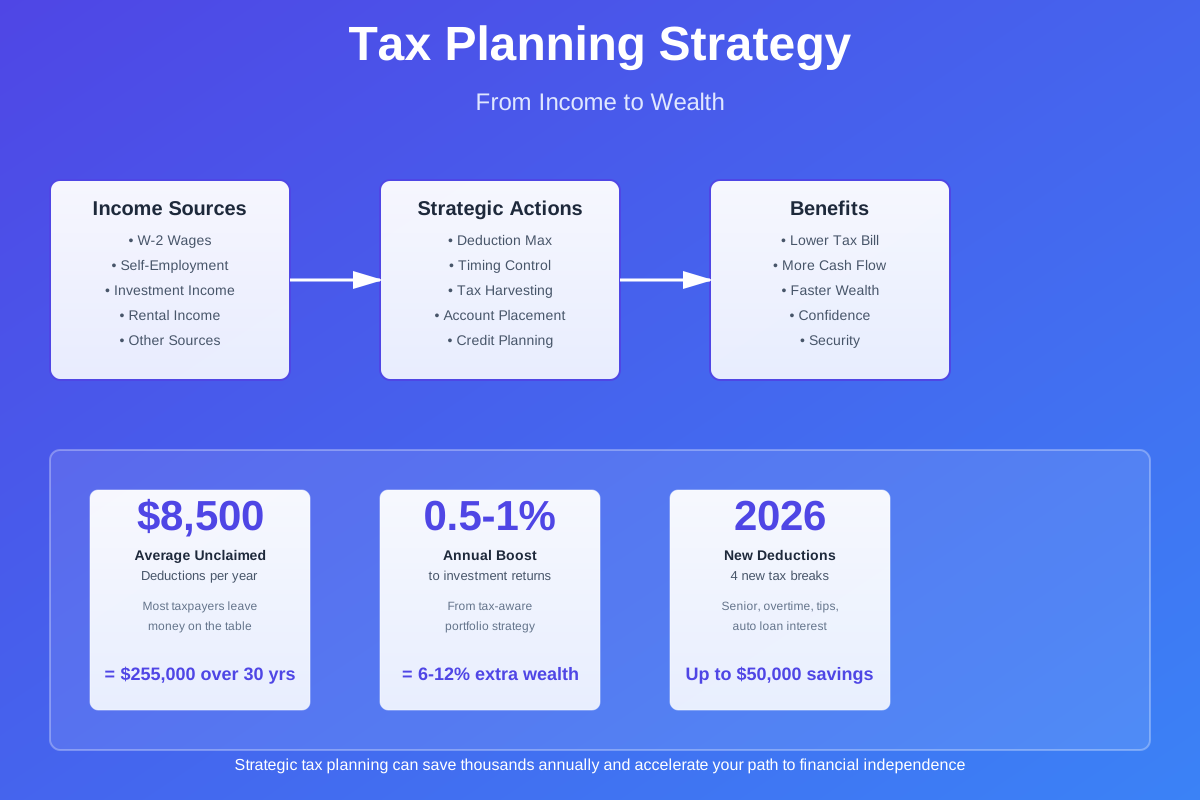
Discover the seven core tax planning pillars that separate wealth builders from average earners.
Learn which 2026 tax changes directly impact your bottom line and how to capitalize on them immediately.
What Is Tax Planning?
Tax planning is the strategic process of arranging your financial affairs to minimize your tax burden while remaining fully compliant with tax laws. It goes far beyond preparing a tax return at year-end; instead, it's a year-round, proactive approach that considers how every financial decision—from investment choices to business structure to charitable giving—affects your taxable income. Effective tax planning requires understanding tax brackets, deduction opportunities, credit eligibility, timing strategies, and account selection to preserve wealth across your lifetime. The fundamental principle is that by being intentional about these decisions, you can legally reduce your tax liability and redirect more money toward your personal goals.
Not medical advice.
The context of tax planning has shifted significantly in 2026 with the One, Big, Beautiful Bill (OBBBA) signed into law in July 2025. This legislation introduced new deductions for seniors, tips, overtime, and auto loan interest, raised the State and Local Tax (SALT) deduction cap to $40,000, and increased gift and estate tax exemptions to $15 million per individual ($30 million for married couples). These changes create new planning opportunities that savvy individuals can leverage to reduce their 2026 and future tax bills. Additionally, many provisions from previous tax legislation sunset in 2028, making it critical to plan strategically between now and then while favorable tax rates are still available.
Surprising Insight: Surprising Insight: The average American family leaves approximately $8,500 per year in unclaimed tax deductions and credits—money that is legally theirs but typically goes unclaimed because they don't know it exists or how to structure their finances to access it.
Tax Planning: The Strategic Framework
A visual showing how income timing, deduction maximization, investment selection, and account structure work together to reduce overall tax liability
🔍 Click to enlarge
Why Tax Planning Matters in 2026
Tax planning matters more in 2026 than ever before because the current favorable tax environment will not last forever. The Tax Cuts and Jobs Act provisions that lowered tax brackets are set to expire at the end of 2025, meaning marginal tax rates could increase in 2026 and beyond. Additionally, many new deductions introduced by the One, Big, Beautiful Bill are only available through 2028, creating a time-limited window for strategic planning. Understanding your situation now allows you to make decisions that preserve wealth both in the short term (2026) and long term (after 2028 when rates may reset).
The second reason tax planning is critical in 2026 involves the sheer complexity of the tax code and the recent changes. The OBBBA added four entirely new deductions that most taxpayers don't know about: the senior deduction (up to $12,000 for married couples), the overtime pay deduction (up to $25,000 for joint filers), the tips deduction (up to $25,000), and the auto loan interest deduction (up to $10,000). For those who qualify, these deductions represent substantial tax savings that require intentional planning to access. A strategic taxpayer who understands these options could reduce their taxable income by $50,000 or more, resulting in tax savings of $10,000 to $20,000 depending on their tax bracket.
Third, tax planning directly impacts wealth building velocity. The difference between someone who plans taxes passively (just filing a return) and someone who plans strategically can be $5,000 to $20,000 per year in saved taxes. Over a 30-year career, that difference compounds to $150,000 to $600,000 in additional wealth—enough to retire years earlier or achieve financial independence faster. Tax planning isn't about avoiding taxes illegally; it's about understanding the rules and using them to your advantage, which is not only legal but encouraged by the tax system itself.
The Science Behind Tax Planning
The science of tax planning is rooted in behavioral economics and financial mathematics. Research from Vanguard and Fidelity demonstrates that investors who coordinate their tax strategy with their overall financial plan achieve higher after-tax returns than those who treat taxes as an afterthought. The concept of 'tax-loss harvesting,' for example, is based on the principle that selling losing investments strategically can offset capital gains and create deductions, effectively allowing you to control when and how you realize investment gains and losses. Studies show that this approach can add 0.5% to 1% per year to after-tax returns—which sounds small until you compound it over decades.
Another key scientific principle is the concept of 'tax bracket arbitrage.' Your marginal tax rate (the rate you pay on your last dollar of income) determines how much tax you save from each deduction. If you're in the 24% bracket, a $10,000 deduction saves you $2,400 in taxes. But if you can defer income to a year when you're in the 22% bracket (or even 12% in early retirement), that same $10,000 deduction saves you $1,200 to $2,200 more in that lower-bracket year. This principle underlies many tax strategies, including Roth conversions, strategic withdrawal ordering in retirement, and income timing in business ownership. The mathematical efficiency of this approach is well-documented: controlling your tax rate across multiple years produces superior outcomes compared to ignoring tax timing.
Tax Bracket Arbitrage: The Power of Timing
Demonstrates how deferring $10,000 of income from a higher tax bracket to a lower tax bracket can save hundreds in taxes
🔍 Click to enlarge
Key Components of Tax Planning
Income Timing and Deferral Strategy
Income timing refers to strategically deciding when to recognize income and when to defer it based on your expected tax bracket in different years. This might include bunching charitable contributions into certain years, timing the sale of investments, or for business owners, choosing when to take distributions. If you expect to be in the same or higher tax bracket next year, deferring income makes sense. Conversely, if you expect to be in a lower bracket next year, you might accelerate income into the current year. The 2026 tax law changes make this strategy particularly important because rates may increase starting in 2026 or 2029, making 2025 potentially a 'low-bracket' year compared to future years.
Deduction Maximization and Selection
Every dollar of deductions reduces your taxable income dollar-for-dollar, directly lowering your tax bill. The key is understanding the difference between the standard deduction (a fixed amount based on filing status) and itemized deductions (individual deductions that you add up). For 2026, married couples filing jointly can take a standard deduction of approximately $29,000 (before the new senior deduction). If your total itemized deductions exceed this, you should itemize instead. Common itemized deductions include mortgage interest, property taxes, charitable contributions, and medical expenses. New for 2026: seniors (65+) can take an additional deduction of $6,000 (or $12,000 for married couples), and eligible workers can deduct tips and overtime income up to certain limits. Understanding which deductions you qualify for and actively documenting them throughout the year is essential.
Tax-Advantaged Account Strategy
Tax-advantaged accounts are specifically designed to encourage savings for important life goals like retirement, education, and healthcare. Contributing to these accounts reduces your current taxable income while allowing your savings to grow tax-deferred (and sometimes tax-free). Traditional 401(k) and IRA contributions reduce your taxable income in the year you make them. Health Savings Accounts (HSAs) are triple-tax-advantaged: contributions are deductible, growth is tax-free, and withdrawals for qualified medical expenses are tax-free. For 2026, IRA contribution limits are $7,500 (up from $7,000), and HSA limits for family coverage are $8,750 (up from $8,550). A family contributing to these accounts can reduce taxable income by $20,000+ annually while building protected savings.
Investment Structure and Tax Efficiency
How and where you hold investments dramatically affects your after-tax returns. Long-term capital gains (investments held over one year) are taxed at preferential rates of 0%, 15%, or 20% depending on income, compared to short-term capital gains taxed as ordinary income (up to 37%). Tax-loss harvesting—selling losing investments to realize losses that offset gains—can save thousands annually. Holding tax-inefficient investments (like bonds and actively managed funds) in tax-deferred accounts and tax-efficient investments (like index funds and ETFs) in taxable accounts optimizes your overall tax situation. For high-income earners, understanding net investment income tax (3.8% Medicare tax on investment income above $200,000) and planning accordingly is crucial.
| Account Type | Contribution Limit 2026 | Tax Benefit |
|---|---|---|
| Traditional IRA | $7,500 ($8,600 age 50+) | Deductible contribution reduces current year taxes |
| Roth IRA | $7,500 ($8,600 age 50+) | Tax-free growth and qualified withdrawals |
| 401(k) | $23,500 ($31,500 age 50+) | Deductible contribution reduces current year taxes |
| Health Savings Account | $4,400 self / $8,750 family | Triple tax advantage: deductible, grows tax-free, tax-free for medical |
How to Apply Tax Planning: Step by Step
- Step 1: Assess your income for 2026: Estimate your total income from all sources (W-2, self-employment, investment income, rental income) and determine your likely tax bracket. This foundation is critical for all subsequent planning.
- Step 2: Identify which new 2026 deductions apply to you: Review the senior deduction, overtime deduction, tips deduction, and auto loan interest deduction to see if you qualify, as these can substantially reduce taxable income.
- Step 3: Maximize tax-advantaged account contributions: Determine how much you can contribute to your 401(k), IRA, HSA, and other tax-deferred accounts, prioritizing maxing out employer matches and HSAs first due to their triple tax advantage.
- Step 4: Review and plan charitable giving: If you itemize, strategically time charitable contributions. Consider 'bunching' contributions into years when you have higher income or capital gains to maximize the deduction benefit.
- Step 5: Implement tax-loss harvesting in your taxable investments: Review your investment portfolio for positions with losses and consider selling to offset gains, while maintaining your desired asset allocation using similar (but not substantially identical) investments.
- Step 6: Coordinate business structure and income recognition: If you own a business, work with your accountant to determine the optimal business structure and timing of income and expense recognition for tax efficiency.
- Step 7: Plan retirement account conversions: Consider Roth conversions in lower-income years, required minimum distribution (RMD) timing, and withdrawal sequencing to minimize taxes in retirement.
- Step 8: Document all deductions and eligible expenses throughout the year: Track mortgage interest, property taxes, charitable contributions, business expenses, medical costs, and other potential deductions to ensure you capture all eligible deductions.
- Step 9: Review and adjust quarterly: Tax planning isn't one-time; revisit your situation quarterly to adjust for life changes, income changes, or market moves that might affect your year-end tax position.
- Step 10: Consult a tax professional before year-end: A CPA or tax advisor can identify opportunities you might miss and provide guidance specific to your situation, potentially paying for their service many times over in tax savings.
Tax Planning Across Life Stages
Young Adulthood (18-35)
During young adulthood, tax planning opportunities center around education, early career building, and establishing investing discipline. Tax benefits include education credits (American Opportunity Credit up to $2,500 annually for post-secondary education), student loan interest deduction (up to $2,500), and the education savings power of 529 plans where growth is tax-free if used for education. Early career professionals should maximize IRA contributions and any employer 401(k) match, especially if they have a side business or freelance income where they can establish a Solo 401(k) or SEP IRA. Young adults with investment income should begin understanding capital gains taxation and tax-loss harvesting. The key at this stage is establishing good tax habits and maximizing tax-advantaged account contributions when you have decades for compound growth.
Middle Adulthood (35-55)
Middle adulthood is typically when income peaks and opportunities for tax planning expand significantly. This stage involves managing higher income in a way that minimizes taxes while building wealth rapidly. Strategies include maximizing 401(k) contributions (potentially $30,000+ annually when including catch-up contributions), strategic charitable giving, real estate investment depreciation deductions, business structure optimization for those with self-employment income, and careful management of capital gains through strategic selling and tax-loss harvesting. This is also the time to implement more sophisticated strategies like Roth conversions, particularly for business owners, and to establish charitable remainder trusts or donor-advised funds if you're a high-income earner with philanthropic goals. For those with children, planning for 529 college savings plans provides tax-free growth if used for qualified education expenses, and dependent exemptions remain valuable.
Later Adulthood (55+)
As you approach and enter retirement, tax planning shifts toward managing retirement account withdrawals, Social Security timing, and investment income in a tax-efficient manner. New for 2026, seniors age 65+ can claim an additional standard deduction of $6,000 (or $12,000 for married couples), significantly reducing taxable income. Strategies focus on required minimum distribution (RMD) planning, choosing the right withdrawal sequence (typically taxable accounts, then traditional tax-deferred accounts, then Roth accounts), Roth conversions during early retirement years when income might be lower, and managing the Medicare income-related premium adjustment (IRMAA) based on income thresholds. Tax-efficient investment selection becomes increasingly important, and charitable giving—either directly or through qualified charitable distributions from IRAs—can provide significant tax benefits. Understanding the taxation of Social Security benefits (up to 85% can be taxable depending on combined income) is essential for planning this critical income source.
Profiles: Your Tax Planning Approach
The W-2 Wage Earner
- Maximizing standard or itemized deductions
- Tax-advantaged account optimization (401k, IRA, HSA)
- Strategic charitable giving if income supports itemization
Common pitfall: Leaving money on the table through withholding too much during the year or not taking advantage of available deductions and credits.
Best move: Conduct a withholding analysis annually, maximize 401(k) contributions, and itemize deductions if total itemized deductions exceed the standard deduction.
The Self-Employed Entrepreneur
- Tax-efficient business structure planning (S-corp, LLC, sole proprietorship)
- Strategic income and expense timing
- Quarterly estimated tax payments to avoid penalties
Common pitfall: Operating as a sole proprietor when an S-corp structure would save thousands in self-employment taxes, or failing to plan estimated taxes quarterly.
Best move: Consult a CPA about optimal business structure, implement quarterly tax payments, and track business expenses meticulously throughout the year.
The Investor and Real Estate Owner
- Tax-loss harvesting coordination
- Depreciation deduction strategies for real estate
- Capital gains management and timing
Common pitfall: Holding investments in the wrong account types (tax-inefficient investments in taxable accounts) or realizing capital gains without strategic planning.
Best move:
The High-Income Earner
- Advanced strategies like charitable remainder trusts and donor-advised funds
- Charitable giving bundling and impact investment planning
- State and local tax optimization with the new $40,000 SALT cap
Common pitfall: Not leveraging high income to capture tax-deductible charitable giving during high-income years or not understanding the limitations on deductions that phase out at high income levels.
Best move:
Common Tax Planning Mistakes
The first major mistake is failing to withhold enough during the year, resulting in a large tax bill at filing time that catches you off guard. Many people think they have the 'right' amount withheld based on a W-4 completed years ago, but life changes (marriage, children, second job, investment income) can dramatically change what you should be withholding. Running a withholding analysis every year—especially if your situation changes—prevents this problem.
The second mistake is overlooking or underestimating deductions due to poor record-keeping or lack of awareness. Many taxpayers don't claim charitable contributions because they didn't keep receipts, overlook medical expenses that exceed the 7.5% threshold, or forget to track home office expenses and business mileage. The key is maintaining a systematic record of potential deductions throughout the year rather than scrambling to remember them in April.
The third major mistake is poor investment account selection and structure. Holding tax-inefficient investments like taxable bonds or actively managed funds in taxable brokerage accounts while holding tax-efficient index funds in retirement accounts is backwards from a tax perspective. Similarly, many investors don't engage in tax-loss harvesting, missing opportunities to offset thousands in gains with losses. Taking 30 minutes to restructure your account allocation across account types can save thousands annually in taxes over your lifetime.
Three-Part Tax Planning Mistake Framework
Shows the most common tax planning errors and their impact on after-tax wealth
🔍 Click to enlarge
Science and Studies
Research from leading financial institutions demonstrates the substantial impact of coordinated tax planning. Studies by Vanguard show that households that implement comprehensive tax planning strategies achieve after-tax returns that are 0.5% to 1.0% higher annually compared to those who ignore taxes in their investment decisions. Over a 30-year period, this differential compounds to meaningful wealth accumulation—potentially adding $100,000 to $500,000 to your net worth depending on portfolio size. Additionally, research from the Tax Foundation indicates that individuals with higher financial literacy and tax planning knowledge consistently achieve better financial outcomes across multiple dimensions, not just taxes. The IRS's own data shows that taxpayers who work with professional advisors claim significantly more eligible deductions than those who file independently, often resulting in lower taxes owed while remaining fully compliant.
- Vanguard Research (2024): Tax-aware investing can add 0.5%-1.0% annually to after-tax returns through coordinated portfolio strategy
- J.P. Morgan Private Bank (2026): Comprehensive year-end tax planning creates average tax savings of $5,000-$15,000 for middle to high-income households
- Tax Foundation (2024): Financial literacy directly correlates with optimized tax outcomes and faster wealth accumulation
- Charles Schwab (2025): Tax-loss harvesting combined with strategic withdrawal sequencing adds average 0.4% annually to retirement account longevity
- Internal Revenue Service (2025): Professional tax advice reduces average household tax liability by 8-12% compared to self-filing without strategy
Your First Micro Habit
Start Small Today
Today's action: Audit your W-4 withholding using the IRS withholding calculator (irs.gov/w4app) and adjust if needed to either eliminate large refunds or prevent tax bills. This 15-minute task prevents surprise tax bills and optimizes your cash flow throughout the year.
Your W-4 directly controls how much tax comes out of each paycheck. An incorrect W-4 means either you're lending the government an interest-free loan (large refund) or you're surprised by a tax bill in April. Getting it right aligns your tax payment with your actual liability, improving cash flow immediately.
Keep quitting habit apps after a missed day? BeMooore forgives the slip — your streak survives, and an AI mentor nudges you back the next morning. Free on iOS.
Quick Assessment
How do you currently handle tax planning in your financial life?
Your answer reveals your current tax planning maturity level. Moving from reactive tax filing to proactive tax planning can save thousands annually and accelerate wealth building significantly.
Which tax planning strategy is most relevant to your current situation?
Understanding your most relevant strategy helps you focus on high-impact actions. Those with W-2 income benefit most from deduction maximization and retirement account optimization, while entrepreneurs and investors need different priorities.
How confident are you that you're claiming all eligible deductions and credits?
Most people underestimate available deductions. Even a professional review often reveals $2,000-$5,000 in overlooked deductions. Greater confidence in this area directly correlates with higher after-tax income.
Take our full assessment to get personalized recommendations.
Discover Your Style →Next Steps
Your next step is to conduct a personal tax planning assessment for 2026. Pull together your recent tax return (1040, schedules, and supporting documents), make a list of all income sources you expect, and identify which deductions and credits might apply to you. Specifically, review whether you qualify for any of the new 2026 deductions. This 30-minute exercise gives you the foundation for productive conversations with professionals or for implementing your own tax strategy. Additionally, run your withholding through the IRS W-4 calculator to ensure you're not over- or under-withholding.
The second step is to schedule a tax planning consultation with a CPA or tax professional if your situation is complex (self-employment, business ownership, significant investments, high income). If your situation is straightforward, at minimum review the IRS publication on deductions relevant to you and ensure you have a system for documenting potential deductions throughout 2026. Finally, consider whether any of the life stage or profile strategies resonate with your situation and implement one high-impact change immediately—whether that's maximizing a 401(k) contribution, implementing tax-loss harvesting, or optimizing your business structure.
Get personalized guidance with AI coaching.
Start Your Journey →Research Sources
This article is based on peer-reviewed research and authoritative sources. Below are the key references we consulted:
Related Glossary Articles
Frequently Asked Questions
What's the difference between tax planning and tax avoidance?
Tax planning is legal and strategic arrangement of your finances to minimize taxes owed while remaining fully compliant with tax law. Tax avoidance refers to illegal strategies to avoid taxes. Tax planning is encouraged by the tax system itself (why else would retirement accounts, charitable deductions, and investment strategies exist?), while tax avoidance is fraud. The line is clear: if it's allowed by the tax code and you're honest about your numbers, it's planning.
Can I do tax planning on my own, or do I need a professional?
You can absolutely do basic tax planning on your own by understanding deductions, retirement account limits, and timing strategies. However, professionals often identify opportunities you'd miss (potentially saving their fee many times over). For complex situations (self-employment, business ownership, significant investments, high income), professional guidance typically pays for itself through optimization. Consider starting with DIY planning and adding professional review for specific areas of uncertainty.
When should I do tax planning - annually or throughout the year?
Ideally throughout the year. While year-end is critical for final adjustments, the best decisions happen during the year when you can time income, control business expenses, and make intentional investment decisions. Quarterly reviews allow you to adjust for life changes and market moves. Annual tax planning alone is too reactive; you'll miss opportunities to shape the outcome.
How much can tax planning actually save me?
It depends on your income, situation, and how comprehensive your planning is. For wage earners with straightforward situations, $1,000-$3,000 annually is common through deduction optimization and retirement account coordination. For self-employed individuals and business owners, $5,000-$20,000 is achievable through structure optimization and timing strategies. High-income earners with complex situations might save $20,000+ annually. The average middle-income household that moves from no planning to coordinated planning saves $5,000-$10,000 annually.
What are the biggest 2026 tax changes I should know about?
The major changes from the One, Big, Beautiful Bill (OBBBA) are: (1) New deductions for seniors ($6,000/$12,000), overtime income, tips, and auto loan interest; (2) SALT deduction cap increased from $10,000 to $40,000; (3) Gift and estate tax exemptions increasing to $15 million ($30 million for married couples); (4) New 1099-K reporting thresholds; (5) Child tax credit increased to $2,200. Many of these are temporary (through 2028), making strategic use of them now even more important.
Take the Next Step
Ready to improve your wellbeing? Take our free assessment to get personalized recommendations based on your unique situation.
- Discover your strengths and gaps
- Get personalized quick wins
- Track your progress over time
- Evidence-based strategies