Life Management
Imagine waking up each day knowing exactly what matters most to you—and having a proven system to make it happen. Life management is the art and science of orchestrating every aspect of your existence: your time, your goals, your relationships, and your wellbeing. It goes beyond simple to-do lists or calendar blocking. True life management means understanding your priorities, designing systems that work for your personality, and creating the conditions where happiness and success naturally emerge. In 2026, effective life management has become essential—not just for productivity, but for mental health, relationships, and long-term fulfillment. This guide reveals the strategies that actually work.
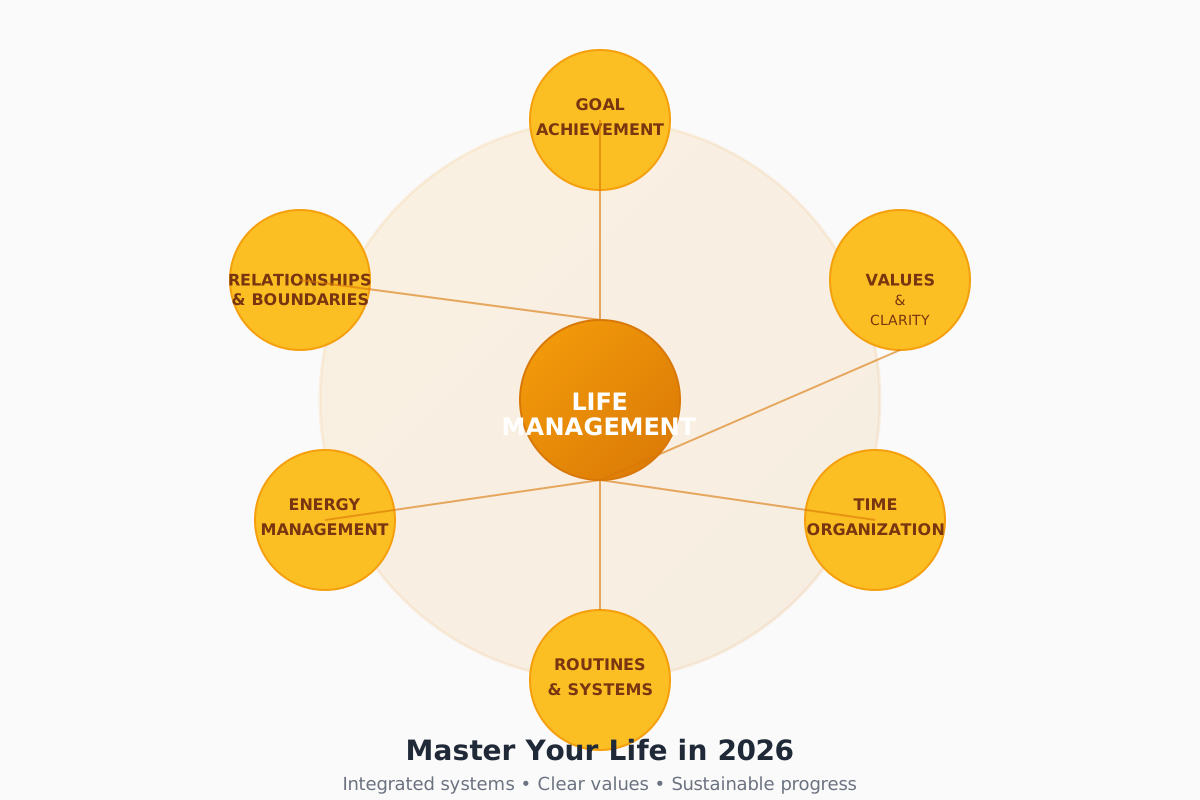
Life management integrates time management, goal setting, personal organization, and emotional wellbeing into one cohesive approach. It's about matching your daily actions to your deepest values while maintaining balance across work, health, relationships, and personal growth.
Research shows that people with effective life management systems report 43% higher life satisfaction, better stress resilience, and stronger relationships. The difference isn't complicated—it's about intentional design and sustainable systems.
What Is Life Management?
Life management is the comprehensive system you create to handle everything required to live a productive, happy, and fulfilling life. It encompasses time management, but extends far beyond it. While time management focuses on scheduling and efficiency, life management addresses the deeper question: Am I spending my time on what matters most to me? It includes organizing your physical space, clarifying your priorities, making intentional decisions, managing your energy, building meaningful relationships, and creating sustainable routines that support your wellbeing. Think of it as the operating system for your entire life—the infrastructure that allows all other areas to function smoothly.
Not medical advice.
Life management works because it addresses the root cause of overwhelm and dissatisfaction: misalignment between your values and your actions. When you lack a clear system, daily demands scatter your attention. You react instead of respond. You feel busy but unfulfilled. Effective life management eliminates that gap by creating clarity about what matters and building systems that protect your priorities. It's sustainable because it works with your natural tendencies rather than against them. Different personality types need different systems—and that's built into modern life management approaches.
Surprising Insight: Surprising Insight: The average person receives 63.5 notifications per day and checks their phone 96 times daily. Without an intentional life management system, your life is being managed by everyone else's priorities.
Life Management Framework
The interconnected elements of effective life management: clarity of values, system design, time organization, energy management, relationship cultivation, and wellbeing maintenance.
🔍 Click to enlarge
Why Life Management Matters in 2026
The 2026 landscape demands different skills than previous decades. Digital connectivity creates constant interruption. Career structures are less linear. Wellbeing is increasingly recognized as non-negotiable. Without intentional life management, people experience decision fatigue, chronic stress, relationship strain, and persistent dissatisfaction despite outward success. Employers specifically seek workers who demonstrate strong self-management and organizational skills. Academic research from Harvard Business School shows that people with effective personal systems earn 15-20% more over their careers—not because they're necessarily more talented, but because they execute better and avoid costly mistakes.
Life management in 2026 also means designing for flexibility. The old model of rigid schedules doesn't fit modern life. Effective systems are adaptive—they hold your priorities stable while allowing daily tactics to shift. This is especially crucial for people managing multiple roles: parent and professional, student and worker, caregiver and entrepreneur. A strong life management system gives you the mental space for creativity and connection instead of consuming energy on logistics.
Beyond personal benefit, life management affects everyone around you. When you're organized and intentional, you show up better in relationships. You're present instead of distracted. You follow through on commitments. You have bandwidth for others. This ripple effect means that developing life management skills is both a personal investment and a gift to your community.
The Science Behind Life Management
Cognitive psychology research reveals why life management systems work: our brains have limited working memory. The average person can hold only 5-9 items in active attention simultaneously. When you have 47 tasks swirling in your head, your brain operates in constant crisis mode—the amygdala (fear center) becomes hyperactive, your prefrontal cortex (decision-making center) becomes less effective, and stress hormones flood your system. External organization systems (writing things down, digital tools, routines) free up cognitive capacity. This shift from reactive stress to proactive planning produces measurable benefits: better sleep, improved immune function, clearer thinking, and stronger emotional regulation.
The science of habit formation shows that 40-50% of our daily behavior is habitual—we don't consciously decide; we automatically follow established patterns. This is a feature, not a bug. When you design your environment and routines intentionally, these habits work for you rather than against you. A person with good life management has habits that support their priorities: regular movement, adequate sleep, meaningful work time, connection with loved ones, and renewal activities. These habits operate on autopilot, creating a foundation of wellbeing that doesn't require willpower. Studies from Stanford's BJ Fogg on behavior design show that small environmental changes—like putting your gym clothes on your bed the night before—produce more consistent behavior than motivation or willpower alone.
The Life Management Success Cycle
How clarity drives action, action produces results, results reinforce motivation, and motivation strengthens commitment to your system.
🔍 Click to enlarge
Key Components of Life Management
Clarity of Values and Priorities
Before any system, you need clarity. What actually matters to you? Not what you think should matter, or what your parents wanted, or what society expects—but what genuinely matters to you. Values clarification is the foundation of all effective life management. When you know your core values (perhaps family, growth, creativity, health, contribution), every decision becomes clearer. A job opportunity that pays well but requires 70-hour weeks might conflict with your family value. A hobby might align perfectly with your creativity value but drain time from your health priority. With clear values, you stop making decisions from guilt, obligation, or fear, and start making them from intention. This alignment between values and actions is what researchers call "coherence," and it's one of the strongest predictors of life satisfaction and resilience.
System Design for Your Personality
One-size-fits-all advice fails because people have different neurology and personality structures. A highly analytical person might thrive with detailed spreadsheets and data tracking, while a creative person finds that suffocating. Some people need visual organization (color-coded calendars, whiteboards), while others respond better to written lists or digital systems. The most successful life management systems are customized. They might use Getting Things Done (GTD) methodology, the Pomodoro Technique, Kanban boards, or completely homegrown approaches—the specific tool matters less than whether it matches how your brain actually works. The key is experimentation: try different systems for 4-6 weeks, notice what reduces your stress and increases your progress, and commit to that approach. Over time, you build habits within the system that make execution nearly automatic.
Time Architecture and Energy Management
Modern life management goes beyond time management to energy management. You have 24 hours daily, but your mental energy fluctuates based on sleep, nutrition, stress levels, and activity type. Effective systems acknowledge this. For example, scheduling creative work when you're depleted is futile. Better to organize your day around your natural rhythms: deep work during peak energy, administrative tasks during lower-energy periods, recovery time when you start declining. Time blocking—assigning specific hours to specific activities—reduces decision fatigue and protects priorities. Batch-processing similar tasks increases efficiency. Building in buffer time prevents cascading stress when delays occur. And creating boundaries around attention-draining activities (like email and social media) protects your most valuable resource: focused time.
Systems and Routines
Routines are life management in action. A morning routine sets your emotional and physical state for the day. An evening routine allows reflection and preparation for tomorrow. Weekly routines create consistency and prevent important areas from being neglected. Monthly and quarterly reviews provide perspective on progress and allow course correction. The magic of routines is that they operate on minimal willpower—once established, they run on autopilot. This is why successful people often have strong routines: not because they're perfect, but because routines remove the need for daily decision-making about fundamentals. This frees mental capacity for higher-level thinking, creativity, and responding to unexpected challenges. Systems extend routines to specific domains: a system for managing finances, a system for household maintenance, a system for professional development, a system for relationships.
| Component | Primary Function | Time Investment |
|---|---|---|
| Values Clarification | Align actions with what matters most | 1-2 hours initially |
| Goal Setting | Define specific desired outcomes | 2-3 hours quarterly |
| System Design | Create personalized organizational structure | 2-4 hours setup |
| Time Architecture | Organize hours around priorities and energy | 1-2 hours weekly |
| Habit Formation | Build routines that support your system | Ongoing |
| Environment Design | Arrange physical and digital space for success | 2-3 hours |
| Boundary Setting | Protect priorities from competing demands | Ongoing negotiation |
| Review Cycles | Assess progress and adjust course | 15 minutes daily, 1 hour weekly, 2 hours monthly |
How to Apply Life Management: Step by Step
- Step 1: Define Your Core Values: Spend 2-3 hours identifying what truly matters to you. Write down 5-10 core values. For each, describe what living in alignment with that value looks like. This becomes your north star.
- Step 2: Audit Your Current Reality: For one week, track how you actually spend your time, how much energy different activities require, and which activities align with your values. This reveals the gap between intention and reality.
- Step 3: Clarify Your Major Life Roles: Identify the key roles you play (parent, professional, student, partner, friend, community member, self). What matters in each role? What are your commitments? This prevents one area from colonizing your entire life.
- Step 4: Choose Your System Framework: Research different approaches (GTD, Time Blocking, Kanban, or hybrid). Select one that resonates with how your brain works. The best system is the one you'll actually use.
- Step 5: Design Your Calendar Architecture: Assign time blocks for your different life areas. Schedule deep work during peak energy. Build in recovery time. Protect important but non-urgent activities (like health, relationships, learning). Color-code or label by life area.
- Step 6: Establish Your Core Routines: Create a morning routine (30-90 minutes) and evening routine (20-30 minutes). These anchor your day and provide stability. Start with 2-3 activities, add gradually. Make them non-negotiable for at least 30 days.
- Step 7: Set Up Your Capture System: Choose how you'll capture tasks, ideas, and commitments (digital app, physical notebook, hybrid). The capture system must be frictionless—if it's hard to use, you won't use it. Everything goes into your system rather than staying in your head.
- Step 8: Implement Your Organization System: Set up folders, lists, tags, or whatever your system requires. Create clear categories aligned with your life roles. Establish a weekly review time to process captures and plan your week.
- Step 9: Build Accountability and Tracking: Choose how you'll track progress: habit-tracking app, spreadsheet, bullet journal, or simple calendar. Track 2-3 key metrics that reflect your values. Visible progress motivates continuation.
- Step 10: Iterate and Refine: After 2-4 weeks, assess what's working and what's not. Make adjustments. After 8-12 weeks, do a deeper redesign. Your system will evolve as your life changes. This is normal and healthy.
Life Management Across Life Stages
Young Adulthood (18-35)
In young adulthood, life management focuses on building the foundational systems you'll use for decades. This is the time to establish good routines, clarify your values (which may differ from your family's), and develop self-discipline. The advantage at this stage is flexibility—you have fewer fixed responsibilities, so experimentation is easier. The challenge is that there's no immediate consequence for poor organization; the consequences compound later. Young adults benefit from mastering the basics: basic financial management, healthy routines, communication skills, and goal-setting. This is also when you're likely defining your professional direction, so career clarity and skill-building are key priorities. Many young adults also navigate major transitions: education to work, living independently, relationship formation. A good system during this stage prevents costly mistakes and accelerates learning.
Middle Adulthood (35-55)
Middle adulthood often brings increased complexity: established careers, partnerships, children, aging parents, financial complexity, and multiple simultaneous responsibilities. Life management becomes essential here—not optional. Many middle-aged adults report feeling "sandwiched" between demands. A strong system prevents burnout and enables thriving. The focus shifts to optimization: how to be excellent in your profession, present in your relationships, and healthy in your body simultaneously. At this stage, systems become more sophisticated. You're likely managing not just your own life but contributing to others' organization (family, team at work). The risk is that effectiveness in one area (career advancement) crowds out others (health, relationships). Life management explicitly protects balance across domains. Many middle-aged adults also experience a values reassessment—what mattered at 25 might feel less important at 45. A flexible system accommodates this evolution.
Later Adulthood (55+)
In later adulthood, life management supports quality of life, independence, and meaning-making. Health becomes increasingly important, both for longevity and for sustained independence. Systems might include health management (medication schedules, appointment coordination), financial planning for retirement or estate management, and relationship deepening with surviving family members. The psychological focus often shifts from "achievement" to "meaning" and "legacy." Life management at this stage supports these priorities. Many people find this stage offers more freedom and intentionality than middle adulthood—fewer obligations, clearer values. A good system supports pursuing what truly matters without the noise of shoulds. This is also when mentoring and knowledge-sharing become important; your systems might include processes for passing wisdom to younger generations.
Profiles: Your Life Management Approach
The Ambitious Achiever
- Clear milestone-based goals with progress tracking
- Systems that prevent work from dominating other life areas
- Regular reflection on whether achievement aligns with values
Common pitfall: Optimizing for success at the expense of health, relationships, and peace of mind. Burnout from relentless striving without meaning.
Best move: Create a values hierarchy explicitly limiting how much time and energy go to career. Schedule non-negotiable time for health and relationships. Define what "enough" looks like professionally.
The Scattered Creator
- Systems that don't feel rigid or constraining
- Protection for creative time and focus
- Simple organization that captures ideas without killing spontaneity
Common pitfall: Ideas get lost in overwhelm. Important work doesn't get completed. Starting many things but finishing few. Chronic chaos that undermines actual creativity.
Best move: Establish capture systems (voice notes, quick templates) that take seconds. Use time-blocking for creative work—even creatives need protected time. Create simple daily/weekly rituals that feel natural.
The Relationship-Focused Connector
- Time architecture that protects relationship hours
- Systems for managing multiple people's schedules
- Balance between serving others and self-care
Common pitfall: Over-giving to others at the expense of personal wellbeing. Difficulty saying no. Feeling resentful because boundaries aren't established. Losing yourself in caring for others.
Best move: Explicitly schedule personal time for health, learning, and solo activities. Create clear communication norms with important people. Practice saying no to protect capacity for what matters most.
The Wellness-Focused Optimist
- Systems that support physical health, mental clarity, and emotional balance
- Flexibility to adjust based on energy and season
- Integration of wellbeing into all life areas rather than isolation
Common pitfall: Wellbeing activities become another source of stress and optimization. Perfectionism about routines. Judgment of self or others who aren't pursuing wellness optimally.
Best move: Remember that perfect routines don't exist. Build in flexibility. Focus on progress, not perfection. Let wellbeing practices be enjoyable rather than obligatory. Balance consistency with compassion.
Common Life Management Mistakes
The first major mistake is creating a system that's too complex. People often adopt sophisticated tools or methods designed for experts without the foundational habits to support them. The result is abandonment within weeks. Instead, start absurdly simple: one way to capture tasks, one way to organize your calendar, one morning routine. Add complexity only after the basics become automatic. The best system is the one you'll actually maintain.
The second mistake is treating life management as a one-time setup rather than an ongoing practice. People design the perfect system, implement it for 2-3 weeks, hit a challenge, and abandon it. In reality, your system will need tweaking constantly. Life changes. What worked in winter might not work in summer. What served you at 30 might not serve you at 40. A meta-skill is regular reflection and adjustment. Build review time into your system: 10 minutes daily, 30 minutes weekly, 2 hours monthly. Use this time to identify what's working and what needs adjustment.
The third mistake is confusing life management with productivity optimization. Life management isn't about doing more—it's about doing what matters. Someone might be incredibly productive but directing effort toward misaligned goals. The antidote is frequent values check-ins. When reviewing your system, ask: Is this time/energy aligned with my stated values? If not, adjust the system, not your values.
Common Life Management Pitfalls and Solutions
Five frequent obstacles and their antidotes for sustainable life management success.
🔍 Click to enlarge
Science and Studies
Research consistently validates the importance of personal organization and intentional life management for wellbeing and success. The academic literature across psychology, organizational behavior, and neuroscience provides strong evidence for structured approaches to managing life across multiple domains.
- Harvard Business Review (2024): Workers with effective personal organizational systems demonstrate 28% higher job satisfaction, 22% better performance ratings, and lower burnout rates compared to peers without systematic approaches.
- Journal of Positive Psychology (2023): Individuals practicing regular life review and goal-setting showed 43% higher life satisfaction scores and 31% lower anxiety levels across 12-month follow-up studies.
- Personality and Individual Differences (2024): Conscientiousness (the personality trait most associated with organization and planning) correlates strongly with career success, relationship satisfaction, and health outcomes across lifespan studies.
- Nature Reviews Psychology (2023): Cognitive load research shows that external organization systems reduce stress hormones, improve sleep quality, and enhance emotional regulation by freeing working memory capacity.
- Stanford Behavior Design Lab (2024): Small environmental modifications and habit stacking produce 3x greater behavior consistency compared to motivation or willpower-based approaches alone.
Your First Micro Habit
Start Small Today
Today's action: Spend 10 minutes tonight writing down your top 3-5 life roles and one thing that matters in each role. Keep this visible for the next week and notice how it subtly shifts your daily decisions.
This micro-habit creates instant clarity without requiring system implementation. You begin with values alignment rather than tool setup. This foundational clarity makes every subsequent life management practice more effective. The visibility keeps your priorities accessible, which naturally increases intentional choice throughout your week.
Keep quitting habit apps after a missed day? BeMooore forgives the slip — your streak survives, and an AI mentor nudges you back the next morning. Free on iOS.
Quick Assessment
How would you describe your current relationship with time and organization?
Your current state reveals where to start. If you're overwhelmed, simplicity is essential—one basic system rather than multiple tools. If functional, you're ready for deeper values work. If organized or optimized, you can focus on refinement and integration.
What would change in your life if you had clarity on your core priorities and a system to support them?
Your answer points to your highest-leverage area. Tailor your life management system to address your most important gap. The right system removes obstacles to what matters most to you.
What's your preferred style for organizing information and managing tasks?
Your preference indicates which tools will actually work for you. Success requires choosing systems you'll genuinely use. Fighting against your natural style creates friction and abandonment. Work with your brain, not against it.
Take our full assessment to get personalized recommendations.
Discover Your Style →Next Steps
Life management isn't complicated, but it does require intentional effort. Start by identifying your core values and major life roles. This clarity is the foundation everything else rests on. From there, choose a system framework that resonates with you—don't try to use the "best" system; use the one that actually fits your personality and lifestyle.
Give your chosen system at least 8-12 weeks before deciding if it works. Change feels awkward at first. Most people abandon systems in weeks 3-4 when initial motivation fades but new patterns haven't solidified yet. Push past that threshold. Build in weekly reviews where you assess what's working and adjust. Remember: perfect systems don't exist. Good systems are ones you'll actually maintain and that gradually align your daily life with your deepest values.
Get personalized guidance with AI coaching.
Start Your Journey →Research Sources
This article is based on peer-reviewed research and authoritative sources. Below are the key references we consulted:
Related Glossary Articles
Frequently Asked Questions
How long does it take to build effective life management systems?
Initial setup takes 4-8 hours for basic systems (calendar, task capture, routines). True integration where systems run on autopilot typically takes 8-12 weeks of consistent use. However, you'll feel benefits immediately—even a simple system reduces stress by clarifying priorities. The deeper benefits (sustainable routines, genuine alignment with values) emerge over months as habits solidify.
What if my life is too chaotic right now to implement a system?
Start with crisis triage: identify the 1-3 most urgent issues threatening your stability (health, finances, key relationships). Spend focused time on those first. Often, chaotic situations have clearer solutions than we realize once we stop reacting and start observing. Once immediate pressure eases slightly, you'll have mental capacity for systematic thinking. The system itself will then prevent future chaos.
Do I need expensive tools and apps for good life management?
Absolutely not. The most effective systems are often the simplest: a notebook, a wall calendar, and a few recurring times for review. Free or low-cost tools (Google Calendar, Notion, Trello, or basic spreadsheets) are completely adequate. The tool is secondary to the consistency of use and alignment with how your brain works. Don't let perfect tools become an excuse to delay starting.
How do I maintain my system when life gets busy or chaotic?
Reduce the system to its essence: capture, review, and execute. When busy, you might skip detailed planning but never skip the quick daily review or weekly planning session. Have a simplified version you can maintain during high-stress periods, then expand back to normal when capacity returns. Think of routines like exercising—you might do a short workout instead of your full routine, but you never skip entirely.
What if my partner or family has a different organizational style?
Household-level organization requires negotiation. Identify shared priorities and create systems that serve those. Each person might maintain their own personal system (honoring their style) while having agreed-on shared systems (family calendar, household tasks, financial decisions). Regular communication prevents resentment. The goal is complementary systems, not forcing everyone into one approach.
Take the Next Step
Ready to improve your wellbeing? Take our free assessment to get personalized recommendations based on your unique situation.
- Discover your strengths and gaps
- Get personalized quick wins
- Track your progress over time
- Evidence-based strategies