Financial Planning for Retirement
Financial planning for retirement is the process of determining how much money you need to retire comfortably and creating a strategic roadmap to accumulate those assets. It involves assessing your current financial situation, estimating retirement expenses, setting savings targets, and choosing appropriate investment vehicles to generate income during your non-working years. Retirement planning encompasses budgeting, tax optimization, and regular portfolio reviews to ensure you stay on track toward your financial independence goals.
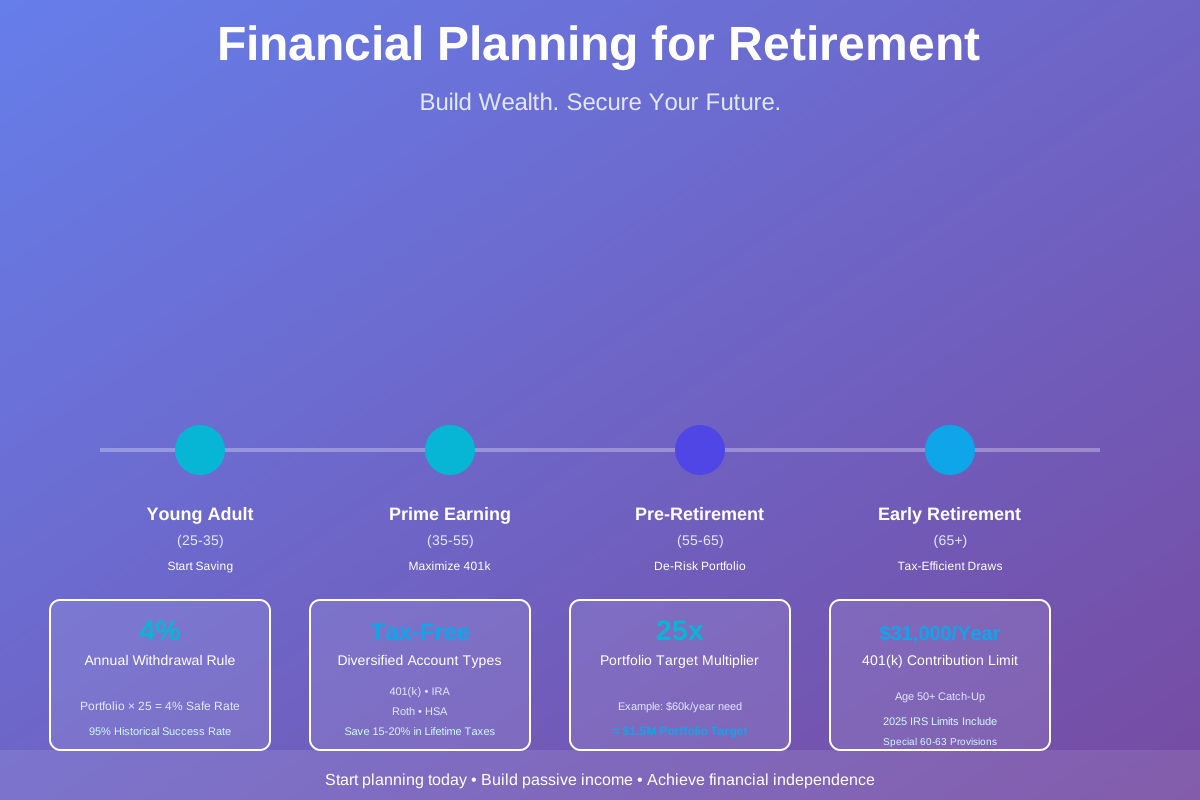
Retirement planning isn't just about saving money—it's about creating a sustainable income stream for 20, 30, or potentially 40+ years of retirement living.
The earlier you start, the more time compound interest has to work in your favor, potentially turning modest contributions into substantial retirement wealth.
What Is Financial Planning for Retirement?
Financial planning for retirement is a comprehensive strategy that bridges your working years and your retirement years. At its core, it answers a fundamental question: How will you support yourself when you stop working? The answer depends on three key factors: your desired retirement lifestyle, your life expectancy, and your investment returns. A solid retirement plan accounts for inflation, healthcare costs, market volatility, and longevity risk—the possibility that you might live longer than expected and outlive your savings.
Not medical advice.
Retirement planning differs from general savings because it requires a multi-decade perspective and careful management of assets to ensure they last throughout your retirement. This involves selecting the right mix of tax-advantaged accounts like 401(k)s, IRAs, and taxable investment accounts, then strategically withdrawing from them to minimize taxes and maximize purchasing power.
Surprising Insight: Surprising Insight: The retirement industry is projected to manage $52 trillion in assets by 2029, reflecting growing recognition that strategic planning is essential for financial security.
Retirement Planning Timeline Overview
A comprehensive timeline showing key phases of retirement planning from current age through early retirement, mid-retirement, and legacy planning phases.
🔍 Click to enlarge
Why Financial Planning for Retirement Matters in 2026
In 2026, retirement planning is more critical than ever due to several converging factors: rising healthcare costs, increased longevity, pension decline, and market volatility. People are living longer than previous generations—a 65-year-old today can expect to live into their mid-80s, potentially requiring 25+ years of retirement income. Social Security alone typically replaces only 40% of pre-retirement income, leaving a significant funding gap that must be filled through personal savings and investments.
Healthcare costs represent one of the largest retirement expenses. A couple retiring at 65 may need $300,000+ for healthcare expenses alone during retirement, according to industry estimates. Additionally, inflation erodes purchasing power—money today will be worth significantly less in 20 years, making proactive investing essential to maintain your desired lifestyle.
The shift from defined benefit pensions to defined contribution plans like 401(k)s means individuals now bear the responsibility and risk of retirement planning. Unlike previous generations who could rely on employer pensions, today's workers must become retirement strategists, making the right investment decisions and withdrawal plans critical to success.
The Science Behind Financial Planning for Retirement
The NIH-supported Health and Retirement Study (HRS), which has tracked over 43,000 individuals since 1992, demonstrates that individuals who engage in proactive retirement planning experience significantly better financial and psychological outcomes in retirement. Research shows that comprehensive planning increases retirement welfare and life satisfaction, while those who procrastinate on retirement planning face financial anxiety and inadequate resources.
A foundational principle in retirement planning is the 4% rule, introduced by financial planner William Bengen in 1994. This rule suggests that a retirement portfolio equal to 25 times your annual expenses can sustain long-term withdrawals at 4% per year, adjusted for inflation. For example, if you need $50,000 annually in retirement, you should target a portfolio of $1.25 million. This approach is rooted in historical market data analysis and has proven effective across various market cycles.
The 4% Rule: Portfolio to Annual Income
Visual representation of the 4% withdrawal rule and how different portfolio sizes support various annual retirement income levels.
🔍 Click to enlarge
Key Components of Financial Planning for Retirement
Retirement Savings Targets and Income Replacement
Financial planners typically recommend replacing 70-90% of your pre-retirement income to maintain your lifestyle. If you earned $100,000 annually, you should plan for $70,000-$90,000 in annual retirement income. This accounts for reduced expenses (no work commute, lower taxes) but includes healthcare and leisure activities. The key is calculating your specific retirement expenses: housing, utilities, healthcare, food, travel, and discretionary spending. Once you know your annual need, multiply by 25 to find your portfolio target using the 4% rule.
Tax-Advantaged Investment Accounts
A critical retirement strategy involves diversifying across account types: traditional 401(k)s, Roth 401(k)s, traditional IRAs, Roth IRAs, and taxable investment accounts. Each offers different tax benefits. Traditional accounts provide upfront tax deductions but require paying taxes on withdrawals. Roth accounts are funded with after-tax money but grow tax-free and offer tax-free withdrawals in retirement. Having a mix of taxable, tax-deferred, and tax-free accounts gives retirees flexibility to manage income and minimize lifetime tax burden. For 2025, the 401(k) contribution limit is $23,500, with catch-up contributions of $7,500 for those 50+, and special catch-up provisions for workers 60-63.
Investment Portfolio Construction and Asset Allocation
Your retirement portfolio should be strategically allocated across stocks, bonds, and alternative investments based on your age, risk tolerance, and time horizon. A common framework is the "age in bonds" rule: if you're 40 years old, hold about 40% in bonds and 60% in stocks. As you approach retirement, gradually shift toward a more conservative allocation—perhaps 50-60% stocks and 40-50% bonds. This reduces volatility and sequence-of-return risk, where poor returns early in retirement can severely impact long-term sustainability. Regular portfolio rebalancing and diversification across asset classes help manage risk while maintaining growth potential.
Healthcare Planning and Longevity Risk Management
Healthcare is often the largest unbudgeted retirement expense. Medicare covers many expenses at age 65, but premiums, deductibles, and long-term care aren't fully covered. Many retirees underestimate healthcare costs, which can consume 15-20% of retirement income. Strategies include Health Savings Accounts (HSAs) for pre-65 healthcare, long-term care insurance or self-insuring with savings, and careful Medicare planning including Part D prescription coverage. Additionally, sequence-of-return risk—experiencing poor market returns early in retirement—can devastate long-term sustainability. Managing this through conservative withdrawal strategies, having cash reserves, and potentially delaying Social Security can significantly improve retirement security.
| Account Type | 2025 Contribution Limit | Tax Treatment & Key Benefits |
|---|---|---|
| Traditional 401(k) | $23,500 ($31,000 with 50+ catch-up) | Pre-tax contributions, tax-deferred growth, required distributions at 73 |
| Roth 401(k) | $23,500 ($31,000 with 50+ catch-up) | After-tax contributions, tax-free growth and withdrawals, no required distributions |
| Traditional IRA | $7,000 ($8,000 with 50+ catch-up) | Pre-tax contributions if eligible, tax-deferred growth, required distributions at 73 |
| Roth IRA | $7,000 ($8,000 with 50+ catch-up) | After-tax contributions, tax-free growth and withdrawals, no required distributions, income limits apply |
| Health Savings Account (HSA) | $4,300 individual / $8,550 family | Triple tax-advantaged: deductible contributions, tax-free growth, tax-free healthcare withdrawals |
How to Apply Financial Planning for Retirement: Step by Step
- Step 1: Calculate your estimated annual retirement expenses by reviewing your current spending and projecting changes (reduced work expenses, increased healthcare/travel). Include discretionary spending and inflation adjustments.
- Step 2: Determine your retirement income sources: Social Security, pensions (if any), and required portfolio withdrawals. Use Social Security's online calculator to estimate benefits.
- Step 3: Calculate your portfolio target using the 4% rule: multiply annual retirement expenses by 25. For example, $60,000 annual need × 25 = $1.5M portfolio target.
- Step 4: Assess your current retirement savings and calculate the gap. If you're 10 years from retirement and have $500,000 but need $1.5M, you have a $1M gap to close.
- Step 5: Determine your required annual savings based on your investment return assumptions (typically 7-8% for balanced portfolios). Use online retirement calculators to determine monthly contribution targets.
- Step 6: Open and maximize contributions to tax-advantaged accounts: 401(k), traditional IRA, Roth IRA, and HSA (if eligible). Prioritize employer 401(k) matches first—they're immediate returns.
- Step 7: Build a diversified investment portfolio aligned with your age and risk tolerance. Consider low-cost index funds and ETFs for broad market exposure and diversification.
- Step 8: Review your portfolio annually and rebalance to maintain your target asset allocation. Adjust as you approach retirement to reduce risk.
- Step 9: Implement tax-efficient withdrawal strategies: plan which accounts to withdraw from and in what order to minimize lifetime taxes. Generally, withdraw from taxable accounts first, then traditional accounts, then Roth.
- Step 10: Reassess your plan every 1-3 years or after major life changes. Update retirement date estimates, adjust savings rates if ahead/behind, and refine healthcare and longevity assumptions.
Financial Planning for Retirement Across Life Stages
Young Adulthood (18-35)
In your 20s and 30s, retirement feels distant, but this is your greatest advantage: time. Starting with even modest contributions ($100-300/month) allows compound interest to work in your favor. If you invest $300/month at age 25 with 7% annual returns, you'll have approximately $1.6 million by age 65. Focus on maximizing employer 401(k) matches (free money!), understanding investment basics, and building an emergency fund. Avoid high-interest debt and consider tax-advantaged accounts like Roth IRAs, which grow tax-free for decades.
Middle Adulthood (35-55)
Your peak earning years (35-55) are crucial for retirement acceleration. Aim to substantially increase contributions as income rises, capturing the full 401(k) match, and maximizing Roth contributions if eligible. By 50, you can make catch-up contributions of an additional $7,500-$8,000 annually. This is the time to review your portfolio for appropriate asset allocation—typically 60-70% stocks, 30-40% bonds. Calculate your retirement gap (target portfolio minus current savings) and determine if you're on track. If behind, consider increasing savings rates or working 1-2 years longer.
Later Adulthood (55+)
In your 55+ years, focus on finalizing your retirement plan and managing sequence-of-return risk. Gradually shift to a more conservative portfolio (50-60% stocks, 40-50% bonds) to reduce volatility as you approach retirement. Take advantage of catch-up contributions and maximize tax-advantaged accounts. Begin planning Medicare enrollment (which begins at 65) and estimate healthcare costs. Consider delaying Social Security from 62 to 70 if financially feasible—each year of delay increases benefits by approximately 8%, significantly improving retirement security. Five years before retirement, conduct a comprehensive retirement analysis with updated numbers and adjust spending or work plans accordingly.
Profiles: Your Financial Planning for Retirement Approach
The Conservative Planner
- Lower-risk, stable investment approach prioritizing capital preservation
- Detailed healthcare cost planning and long-term care insurance evaluation
- Regular financial advisor consultations for guidance and accountability
Common pitfall: Over-conservative portfolios that fail to keep pace with inflation, eroding retirement purchasing power over 30+ years
Best move: Maintain a balanced portfolio (50% stocks, 50% bonds) throughout retirement to balance growth and stability, gradually adjusting as needed
The FIRE Enthusiast
- Aggressive savings targets and disciplined expense management
- Tax optimization strategies to maximize after-tax returns
- Early retirement calculations and healthcare coverage solutions before Medicare
Common pitfall: Pursuing early retirement with insufficient portfolio size, leading to inadequate income or forced re-employment
Best move: Ensure your portfolio is at least 25-30x annual expenses before early retirement, maintain a 3-5 year cash buffer, and have healthcare coverage plan pre-Medicare
The Balanced Builder
- Moderate, consistent contributions aligned with income growth
- Periodic portfolio rebalancing and risk assessment
- Flexible retirement date planning with multiple scenarios
Common pitfall: Setting a retirement date too rigidly and failing to adjust for market conditions or life changes
Best move: Build flexibility into your plan with 'soft' retirement dates and scenarios (retire at 62, 65, or 68) to adapt to actual circumstances
The Legacy Focused
- Tax-efficient withdrawal and estate planning strategies
- Roth conversion opportunities to minimize estate taxes
- Charitable giving and trust planning for wealth transfer
Common pitfall: Underutilizing tax-efficient withdrawal strategies, resulting in unnecessarily high lifetime taxes and reduced legacy amounts
Best move: Coordinate with an estate planning attorney and tax professional to implement Roth conversions, strategic charitable giving, and trust structures
Common Financial Planning for Retirement Mistakes
One of the most common retirement planning mistakes is underestimating expenses. People often assume they'll spend significantly less in retirement, but research shows retirees typically maintain similar spending levels, especially in early retirement when they travel and pursue leisure activities. Healthcare costs, inflation, and longevity are consistently underestimated, leading to inadequate savings targets and financial stress in later retirement.
Another critical mistake is poor sequence-of-return management. Experiencing significant market downturns early in retirement—particularly in the first 5-10 years—can devastate long-term portfolio sustainability. A retiree who withdrew 4% in a strong year but faced 30% portfolio loss followed by poor returns in year two may not recover. Strategies to mitigate this include maintaining 3-5 years of expenses in cash/bonds, using bond/stock rebalancing as a "buffer," and potentially delaying Social Security to reduce early withdrawal pressure.
A third major mistake is neglecting tax optimization. Many retirees withdraw from accounts inefficiently, paying more taxes than necessary across their retirement. Strategic withdrawal sequencing—drawing from taxable accounts first, then traditional accounts, then Roth accounts—can save tens of thousands in lifetime taxes. Additionally, Roth conversions during low-income years (before Social Security begins, before required distributions at age 73) can create a substantial tax-free retirement income stream.
Common Retirement Planning Mistakes and Solutions
A comparison showing the most common retirement planning errors and practical solutions to avoid them.
🔍 Click to enlarge
Science and Studies
Extensive research supports the importance of comprehensive retirement planning. The NIH Health and Retirement Study has generated nearly 4,000 peer-reviewed publications examining retirement outcomes, and consistently demonstrates that proactive planning leads to better financial and psychological outcomes. Psychological research by Hershey and colleagues shows that planning before retirement increases post-retirement welfare and life satisfaction, while procrastination leads to financial anxiety and inadequate resources.
- National Institute on Aging Health and Retirement Study: Longitudinal research tracking 43,000+ individuals since 1992, showing that comprehensive planning significantly improves retirement security and life satisfaction.
- The 4% Rule (Bengen, 1994): Historical analysis of market returns spanning 1926-1992 indicates that withdrawing 4% annually from a balanced portfolio (60% stocks, 40% bonds) provides a 95% success rate over 30-year retirements.
- Morningstar Retirement Research: Studies show that a disciplined, multi-account tax strategy can save retirees 15-20% in lifetime taxes compared to ad-hoc withdrawal approaches.
- Center for Retirement Research (Boston College): Research demonstrates that delaying Social Security from age 62 to age 70 increases lifetime income by 24-32% and reduces poverty risk among oldest-old retirees.
- Vanguard Retirement Planning Studies: Analysis of behavioral finance shows that automated savings increases, rebalancing discipline, and accountability to a financial plan improve long-term wealth accumulation by 1-2% annually—a significant compound effect.
Your First Micro Habit
Start Small Today
Today's action: Spend 15 minutes today reviewing your last three months of spending by category (housing, food, transportation, entertainment, etc.). Total each category and divide by three to get your monthly average. This is the foundation of retirement expense planning.
Understanding your actual current spending is the essential first step in retirement planning. Many people guess and significantly underestimate, leading to inadequate retirement savings targets. This micro habit creates immediate awareness and accountability, and provides the data needed for accurate retirement calculations.
Track your spending categories and get personalized retirement readiness recommendations with our app's financial planning tools.
Quick Assessment
How would you describe your current retirement savings progress?
Your savings history reveals your readiness level. Early action and consistency matter more than perfect planning. If you're not yet saving, starting today with any amount begins the compound growth process.
What's your primary concern about retirement financial planning?
Your concern area identifies your next action step. Those uncertain about needed amounts should calculate retirement expenses; those worried about investments need a strategy; those concerned about markets need risk management planning; those confident should focus on tax optimization.
How would you prefer to approach retirement planning?
Your preference determines your tools and approach. DIY investors benefit from education and calculators; advisor clients gain professional guidance; combined approaches balance independence and expertise; FIRE enthusiasts need aggressive but disciplined strategies and early healthcare planning.
Take our full assessment to get personalized retirement recommendations.
Discover Your Style →Next Steps
Start your retirement planning journey by calculating your retirement expenses and comparing them to your current savings using the framework provided in this guide. Use the 4% rule to determine your portfolio target, and assess your gap. If you're ahead of schedule, celebrate and consider if you want to retire earlier or increase lifestyle spending. If behind, determine whether you need to save more aggressively, work longer, or adjust retirement expectations.
Take advantage of tax-advantaged accounts available to you—maximize your 401(k) match, open or max a Roth IRA, and consider an HSA if eligible. These accounts provide immediate tax benefits that compound over decades. Finally, commit to reviewing your plan annually: reassess your progress, rebalance your portfolio, and adjust contributions as your income and circumstances change. Retirement planning is not a one-time event but an ongoing process that evolves with your life.
Get personalized guidance with AI coaching.
Start Your Journey →Research Sources
This article is based on peer-reviewed research and authoritative sources. Below are the key references we consulted:
Related Glossary Articles
Frequently Asked Questions
How much money do I need to retire?
Using the 4% rule, multiply your annual retirement expenses by 25. If you need $60,000/year, you need $1.5M. However, this depends on your specific situation: life expectancy, healthcare costs, planned activities, and Social Security income. Financial calculators and advisors can provide personalized estimates.
When should I start saving for retirement?
The best time to start is now, regardless of age. Starting at 25 vs. 35 costs approximately 2x the monthly savings due to compound growth. However, even if you're starting late, consistent contributions and working a few extra years can dramatically improve outcomes. Starting late is better than never starting.
Should I prioritize 401(k), IRA, or taxable investments?
Prioritize in this order: (1) Contribute enough to your 401(k) to get the full employer match (free money), (2) Max out Roth IRA ($7,000/year), (3) Return to 401(k) to max it out ($23,500/year), (4) Contribute to HSA if eligible ($4,300/year), (5) Use taxable brokerage accounts for additional savings. This optimizes tax advantages.
Is the 4% rule still reliable in 2026?
The 4% rule remains a solid guideline based on historical data, though current valuations suggest some flexibility may be needed. In expensive markets, a 3.5% withdrawal rate may be safer; in cheaper markets, 4-5% may be sustainable. Regular portfolio rebalancing and monitoring remain essential. Consider consulting a financial advisor for personalized guidance.
How do I minimize taxes in retirement?
Tax-efficient retirement requires strategic withdrawal sequencing: withdraw from taxable accounts first (lower tax impact), then traditional accounts (at favorable rates), then Roth (tax-free). Use Roth conversions during low-income years, harvest tax losses, coordinate with Social Security timing, and consider charitable giving strategies. An accountant or financial advisor can optimize your specific situation.
Take the Next Step
Ready to improve your wellbeing? Take our free assessment to get personalized recommendations based on your unique situation.
- Discover your strengths and gaps
- Get personalized quick wins
- Track your progress over time
- Evidence-based strategies