Learning and Development
Learning and development isn't just about acquiring new skills—it's a transformative journey that reshapes how you see yourself, your potential, and your place in the world. In today's rapidly changing landscape, your ability to learn, grow, and adapt determines not just your career success, but your personal fulfillment and happiness. Whether you're navigating a career transition, seeking deeper expertise, or simply wanting to expand your understanding of life, learning and development creates the foundation for meaningful growth. The research is clear: people who invest in continuous learning report higher satisfaction, greater resilience, and improved mental wellness.
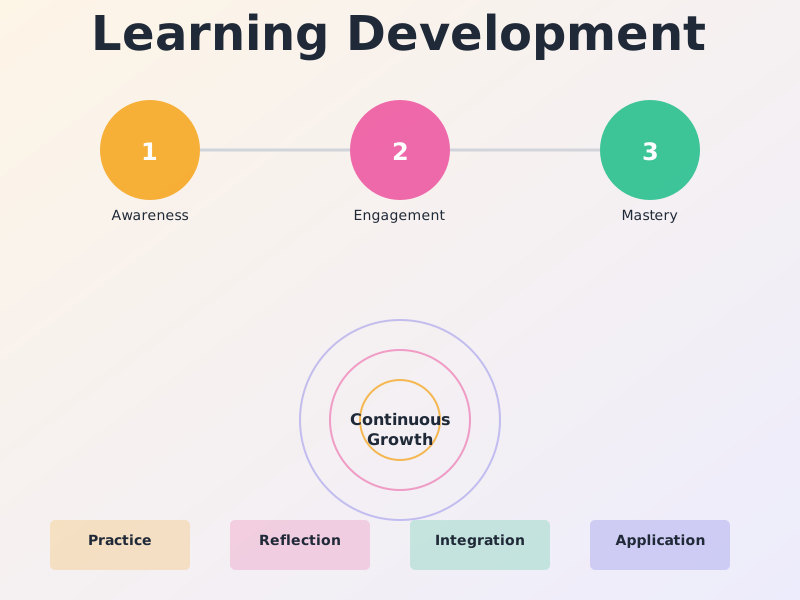
The most successful and fulfilled people share one thing in common—they never stop learning. They understand that growth is not a destination but an ongoing process of discovery, challenge, and transformation.
Your potential is not fixed. Every skill you learn, every perspective you gain, and every challenge you overcome rewires your brain and expands what's possible for you. Learning development is the bridge between who you are now and who you want to become.
What Is Learning and Development?
Learning and development refers to the systematic process of acquiring new knowledge, skills, competencies, and perspectives that enhance your personal and professional capabilities. It encompasses formal education, mentorship, practical experience, and self-directed learning. Learning and development is not confined to classrooms or corporate training rooms—it's a holistic approach to expanding your abilities and understanding across all life domains.
Not medical advice.
More broadly, learning and development is about cultivating a growth mindset—the belief that your abilities are not fixed but can be developed through dedication, persistence, and effective strategies. This perspective transforms how you approach challenges, setbacks, and opportunities. When you view obstacles as learning opportunities rather than threats, you unlock your capacity for continuous improvement and resilience.
Surprising Insight: Surprising Insight: Companies that invest $1,500+ per employee annually in learning and development report earning 24% more profit than those with smaller budgets, while employees say they'll stay 83% longer at organizations that support their growth.
The Learning Development Cycle
Visual representation of how knowledge acquisition, skill building, practical application, and reflection create continuous improvement
🔍 Click to enlarge
Why Learning Development Matters in 2026
In 2026, the pace of change is unprecedented. Technologies evolve in months, industries transform in years, and the skills valued today may become obsolete tomorrow. Learning and development is no longer optional—it's the core currency of modern life. Those who embrace continuous learning thrive; those who resist fall behind.
Beyond career considerations, learning development directly impacts your happiness and life satisfaction. Research shows that people who engage in active learning report higher levels of engagement, purpose, and fulfillment. Learning activates your brain's reward centers, releases dopamine, and creates a sense of achievement that enhances overall wellbeing. When you're learning, you're not just acquiring competencies—you're experiencing growth, agency, and progress.
Learning development also builds resilience. Each new skill you master, each challenge you overcome, and each perspective you gain strengthens your confidence and adaptability. In uncertain times, this psychological resilience becomes invaluable. People who view themselves as capable learners handle change better, recover from setbacks faster, and maintain optimism about their future.
The Science Behind Learning and Development
Your brain is fundamentally plastic—it changes and rewires throughout your life based on experience. Neuroplasticity research shows that when you learn something new, your brain forms new neural connections and strengthens existing pathways. This isn't just metaphorical—it's a measurable biological process. Every time you practice a skill, repeat information, or engage deeply with new material, you're literally reshaping your brain's architecture.
Cognitive science research reveals that effective learning requires active engagement, not passive consumption. When you struggle with a challenging concept, make mistakes, and persist through difficulty, your brain releases neurotrophic factors that strengthen neural connections. Spacing learning over time, testing yourself repeatedly, and applying knowledge in varied contexts all optimize retention and transfer. This means the most effective learning is often uncomfortable—it requires effort, iteration, and deliberate practice.
Brain Plasticity and Skill Mastery
How neural pathways strengthen through deliberate practice and repetition over time, supporting long-term skill development
🔍 Click to enlarge
Key Components of Learning and Development
Goal Clarity and Intention
Effective learning begins with crystal-clear goals. When you know exactly what you want to learn and why it matters to you, your brain can focus attention, filter relevant information, and organize new knowledge within your existing understanding. Vague intentions like 'I want to learn more' are less effective than specific targets like 'I want to master Python data analysis to transition into data science roles.' Clarity creates direction; direction creates momentum.
Active Engagement and Deep Practice
Learning is not a spectator sport. You must actively engage with material—asking questions, solving problems, creating examples, teaching others, and applying knowledge in real contexts. This active engagement creates stronger memories and deeper understanding. Passive consumption of content, whether reading or watching videos, produces minimal learning. The most effective learning involves struggle, iteration, and deliberate practice focused on improving specific aspects of performance.
Reflection and Integration
Learning isn't complete until you reflect on what you've learned and integrate it with your existing knowledge. Reflection means pausing to consider what worked, what didn't, what surprised you, and how this new knowledge connects to what you already know. This metacognitive process transforms isolated facts into integrated understanding. Journaling, discussion, teaching others, and deliberate application all facilitate reflection and integration.
Growth Mindset and Resilience
Your beliefs about learning shape your persistence. People with fixed mindsets—who believe abilities are unchangeable—give up quickly when faced with difficulty. People with growth mindsets—who believe abilities develop through effort—view challenges as opportunities and persist through struggle. This mindset isn't just motivational psychology; it's neurologically sound. Your effort literally changes your brain. Cultivating a growth mindset means reframing failure as feedback, difficulty as opportunity, and feedback as gift rather than criticism.
| Life Area | Learning Investment | Reported Impact |
|---|---|---|
| Career Advancement | 1-2 hours/week professional development | 23% higher career progression rate |
| Relationship Quality | Communication & emotional intelligence skills | 31% improvement in relationship satisfaction |
| Mental Wellness | Active learning in any domain | 42% lower anxiety & depression scores |
| Life Satisfaction | Continuous skill development | 38% higher overall life satisfaction |
| Job Retention | Employer-supported training programs | 83% longer employment duration |
| Income Growth | Specialized skill certification | 15-25% average salary increase |
How to Apply Learning and Development: Step by Step
- Step 1: Define your learning goal with specificity. What exactly do you want to learn? Why does it matter to you? How will it change your life? Write this down with concrete details.
- Step 2: Assess your current level honestly. What do you already know about this domain? Where are the gaps? This creates a realistic starting point and identifies what to focus on.
- Step 3: Research and gather quality learning resources. Identify books, courses, mentors, communities, and materials aligned with your goal. Prioritize credible, evidence-based sources over entertainment-focused content.
- Step 4: Create a structured learning plan with timeline and milestones. Break your larger goal into smaller, manageable chunks. Schedule regular learning sessions—consistency beats intensity for most learning.
- Step 5: Engage actively with material through application. Don't just consume content; solve problems, create projects, teach others, and apply learning in real contexts. This is where neural pathways strengthen.
- Step 6: Seek feedback and corrections regularly. Find mentors, peers, or experts who can provide honest feedback on your progress. Feedback accelerates learning by highlighting blind spots and adjusting your approach.
- Step 7: Practice deliberately with focused intensity. Identify the specific aspects of performance you want to improve. Practice those aspects repeatedly with full attention, pushing slightly beyond your current capability.
- Step 8: Reflect systematically on your learning. Regularly journal about what you've learned, how understanding has shifted, what surprised you, and how this knowledge connects to other areas of your life.
- Step 9: Teach others what you're learning. Explaining concepts to others forces you to organize knowledge clearly, reveals gaps in understanding, and deepens your own mastery through articulation.
- Step 10: Adjust your approach based on results. Track your progress against clear metrics. If your current method isn't producing results, experiment with different resources, schedules, or techniques. Learning how to learn is itself a critical skill.
Learning and Development Across Life Stages
Young Adulthood (18-35)
Young adulthood is your window for building foundational expertise and exploring diverse domains. Your brain is still highly plastic, and you have time to recover from skill investments that don't pan out. Focus on both breadth and depth—explore multiple areas to discover your passions, but commit to developing genuine expertise in domains that matter. Seek mentors actively. Build networks with people ahead of you on paths you admire. Your learning in these years compounds dramatically over a lifetime.
Middle Adulthood (35-55)
Middle adulthood is when learning shifts from broad exploration to strategic deepening. You likely know your general domain; now the focus becomes mastery, leadership, and specialization. Learning becomes more purposeful and career-focused, but don't abandon personal growth pursuits. The combination of domain expertise and continuous learning in this stage positions you for leadership and impact. This is also when maintaining learning becomes essential—without active engagement, cognitive decline accelerates. Prioritize learning that develops wisdom—integrating knowledge across domains and connecting learning to meaningful purpose.
Later Adulthood (55+)
Learning in later adulthood serves different functions—maintaining cognitive health, staying engaged with evolving society, pursuing long-neglected interests, and transmitting wisdom to younger generations. Cognitive aging is real but learning combats it effectively. Adults over 55 who engage in consistent learning maintain better cognitive function, report higher life satisfaction, and experience more meaning and purpose. Learning becomes less about career advancement and more about growth, enjoyment, and contribution. Mentoring younger learners, pursuing creative projects, and learning for learning's sake all become viable and deeply satisfying.
Profiles: Your Learning and Development Approach
The Ambitious Achiever
- Clear metrics for progress and mastery
- Structured programs with milestones and credentials
- Challenging goals that stretch current capabilities
Common pitfall: Over-scheduling learning at the expense of integration and rest; prioritizing credentials over actual capability development
Best move: Combine ambitious goal-setting with adequate time for reflection, integration, and consolidation. Track deeper measures beyond credentials—actual skill improvement and application.
The Curious Explorer
- Freedom to explore diverse topics without strict timelines
- Communities of fellow explorers and makers
- Projects and applications that synthesize learning across domains
Common pitfall: Scattered learning across too many domains without depth; collecting information without integrating into coherent understanding
Best move: Regularly step back and identify patterns across your learning. Periodically choose one domain for deeper focus while maintaining breadth elsewhere. Create synthesis projects.
The Practical Learner
- Concrete, immediately applicable skills
- Real-world projects and hands-on experience
- Clear connection between learning and practical outcomes
Common pitfall: Under-investing in theoretical understanding and foundational knowledge; focusing only on immediate application
Best move: Balance practical application with theoretical understanding. Invest some time in foundational knowledge that expands your long-term capabilities beyond immediate problems.
The Social Learner
- Communities and collaborative learning environments
- Mentors and peers to learn alongside
- Teaching and discussion opportunities to deepen understanding
Common pitfall: Over-reliance on others' direction; difficulty with solitary, self-directed learning; diffuse focus following group interests
Best move: Seek structured communities with clear learning objectives. Develop self-directed learning skills alongside your collaborative learning. Take on mentoring roles to deepen your own understanding.
Common Learning and Development Mistakes
The first major mistake is confusing consumption with learning. Watching educational videos, reading books, or attending lectures creates an illusion of learning—you feel like you're learning, content is entering your mind—but without active engagement, little sticks. Passive consumption rarely translates into retained knowledge or behavioral change. Effective learning requires struggle, application, and testing yourself.
The second mistake is expecting learning to be linear and smooth. In reality, learning follows a pattern called the learning curve—initial rapid progress, followed by plateaus where progress feels invisible. Many people interpret these plateaus as failure and quit. Understanding that plateaus are normal and productive deepens your resilience. During plateaus, your brain is consolidating and integrating learning at a neurological level even when subjective progress seems stalled.
The third mistake is learning without reflecting and integrating. You acquire information, but never pause to connect it to what you already know, consider how it changes your thinking, or explore how it applies to your life. This creates isolated knowledge islands rather than integrated understanding. Regular reflection—journaling, discussion, teaching—transforms information into integrated wisdom.
The Learning Development Journey: Common Obstacles
Visual map of typical challenges learners face and how growth mindset transforms obstacles into opportunities
🔍 Click to enlarge
Science and Studies
Scientific research across psychology, neuroscience, and organizational behavior consistently demonstrates the transformative power of intentional learning and development. Studies show measurable impacts on career outcomes, mental wellness, relationship quality, and life satisfaction. Here are the key findings from recent research:
- Meta-analysis in Frontiers in Developmental Psychology (2025): Continuous professional development with hands-on training and mentorship shows 73.5% of participants reporting professional advancement and 72.5% feeling more qualified.
- LinkedIn Workplace Learning Report (2022): Organizations emphasizing training increase average employee tenure from 2.9 years to 5.4 years, indicating strong retention from learning investment.
- World Bank Skills Development Research: Skills development reduces unemployment, increases productivity, improves living standards, and creates foundation for personal and social mobility.
- Neuroplasticity Research (Stanford, MIT, Cambridge): Deliberate practice and active learning create measurable changes in brain structure and neural pathways, with effects visible in brain imaging within weeks.
- Harvard Professional Development Studies: Continuous learning is linked to lower risk of leaving employment, higher job satisfaction, and increased intention to stay with current organization.
Your First Micro Habit
Start Small Today
Today's action: Commit to 15 minutes of active learning in one domain that matters to you, followed by 5 minutes of reflection journaling about what you learned and how it connects to your life.
This habit combines active engagement (the key to effective learning) with reflection (which integrates learning). Starting with just 15 minutes removes the activation barrier while building the neural pathways and psychological identity as someone who learns consistently. The reflection component ensures this time produces lasting learning rather than just information consumption.
Keep quitting habit apps after a missed day? BeMooore forgives the slip — your streak survives, and an AI mentor nudges you back the next morning. Free on iOS.
Quick Assessment
When facing a challenging skill to learn, what's your typical initial response?
Your response reveals your growth mindset level. Excitement and determination indicate belief in your ability to develop capabilities, which is the strongest predictor of learning success. If you lean toward hesitation or avoidance, practicing reframing challenges as learning opportunities can significantly enhance your growth mindset.
How do you typically spend time on learning when learning something new?
The more you move toward application, practice, and teaching, the more effective your learning becomes. If you're primarily consuming content, you're likely experiencing an illusion of learning without developing lasting capabilities. Shift toward active application and you'll see dramatic improvements in what you retain and can apply.
What's the primary driver of your learning goals currently?
All motivation sources are valid. Career-driven learning is pragmatic. Curiosity-driven learning is sustainable. Challenge-driven learning is focused. Vision-driven learning is purposeful. The strongest learners often integrate multiple sources. If your learning lacks clear purpose, connecting it explicitly to a vision of your future self strengthens motivation and persistence.
Take our full assessment to get personalized recommendations.
Discover Your Style →Next Steps
Your next step is clarity. Choose one domain you're genuinely interested in learning more deeply. Not something you think you 'should' learn—something that genuinely intrigues you. Write down what specifically you want to learn, why it matters to you, and how developing this capability would change your life. This clarity becomes your north star, guiding learning decisions and sustaining motivation through difficulty.
Then take action immediately. Find one high-quality resource in your chosen domain and commit to engaging with it actively—not just consuming, but solving problems, creating examples, teaching others. Schedule this learning time on your calendar as a non-negotiable commitment to yourself. Start small (15 minutes daily beats sporadic longer sessions), but start now. Your brain is ready to grow.
Get personalized guidance with AI coaching.
Start Your Journey →Research Sources
This article is based on peer-reviewed research and authoritative sources. Below are the key references we consulted:
Related Glossary Articles
Frequently Asked Questions
Am I too old to start serious learning and development?
No. Your brain retains neuroplasticity throughout life, and learning at any age combats cognitive decline, enhances mental wellness, and increases life satisfaction. While younger brains may learn faster in some domains, adult learners have advantages—clearer goals, more relevant context, greater motivation, and integration with deeper life experience. Many of history's greatest achievements came from people learning new domains in their 50s, 60s, and beyond.
How long does it take to develop real competence in a domain?
Research suggests 10,000 hours of deliberate practice for mastery of complex domains. However, meaningful competence—ability to create value and help others—typically emerges much faster, within 1,000-2,000 hours of focused learning. This breaks down to roughly 1-2 years of part-time learning or 6-12 months of full-time engagement. The key is quality of learning (active engagement, feedback, deliberate practice) not just quantity of time.
What's the best way to stay motivated when learning feels difficult?
Connect learning to a compelling vision of yourself. Instead of abstract motivation ('I should learn this'), connect to identity ('I'm becoming someone who understands this domain'). Break learning into smaller wins that create regular success experiences. Find learning communities where you learn alongside others. Track progress visually. Most importantly, reframe difficulty as evidence that your brain is growing rather than evidence that you're failing.
How do I choose what to learn with limited time?
Prioritize learning that serves multiple purposes—develops career skills while aligning with personal interests, supports multiple life domains simultaneously. Consider opportunity cost—which learning has highest leverage for your goals? Does learning one skill unlock easier learning of others? What knowledge is becoming increasingly important in your field? Start with domains where motivation is highest, as high motivation drives the consistency needed for real learning.
Can I learn multiple domains simultaneously without losing focus?
Yes, with structure. Most successful learners maintain one primary focus area where they're developing deeper expertise, while exploring additional domains with lighter engagement. The primary domain provides depth and mastery experience, while secondary domains provide breadth and connection-making. Without a clear primary focus, learning becomes scattered. The brain is capable of multi-domain learning if structured intentionally.
Take the Next Step
Ready to improve your wellbeing? Take our free assessment to get personalized recommendations based on your unique situation.
- Discover your strengths and gaps
- Get personalized quick wins
- Track your progress over time
- Evidence-based strategies