Gratitude Appreciation
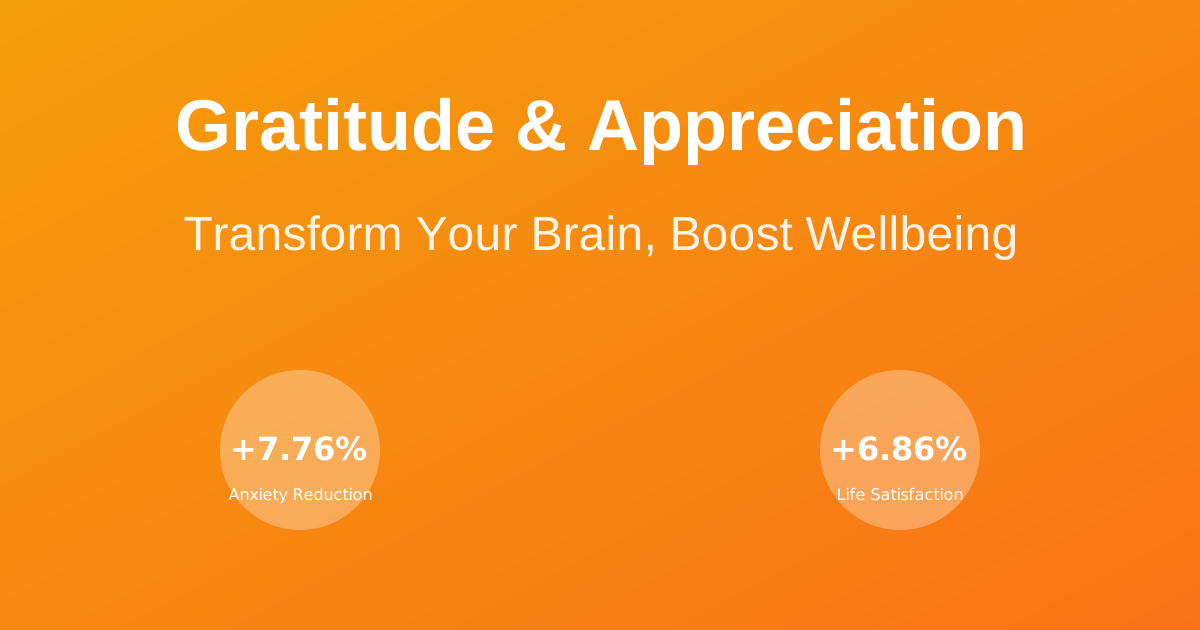
Gratitude and appreciation are powerful emotional practices that transform how we experience life. When you consciously recognize and value the good things around you—big and small—your brain releases dopamine and serotonin, the neurochemicals of happiness and wellbeing. Research shows that people who practice gratitude report 6.86% higher life satisfaction, 5.8% better mental health, and 7.76% fewer anxiety symptoms. This isn't just feeling good; it's rewiring your nervous system for resilience, improved relationships, and lasting contentment.
The beauty of gratitude and appreciation is accessibility. You don't need perfect circumstances to practice it—in fact, gratitude works best when life is challenging, helping you find meaning amid struggle.
Most people underestimate the power of simply stopping to notice what they already have. Gratitude isn't about toxic positivity; it's about accurate accounting of your real blessings.
What Is Gratitude Appreciation?
Gratitude appreciation is the conscious practice of recognizing, acknowledging, and valuing the positive aspects of your life. It's both an emotional response (feeling thankful) and an intentional habit (regularly noticing blessings). When you appreciate something, you see its true value—you might appreciate a friend's loyalty, your health, a moment of sunshine, or overcoming a challenge. Gratitude deepens this by expressing or internally recognizing that value with genuine warmth.
Not medical advice.
Appreciation and gratitude work together: appreciation is seeing the good, gratitude is feeling and expressing thanks for it. Together, they create a psychological state that literally changes brain chemistry. Your brain interprets grateful thoughts as safe, abundant signals—which reduces cortisol (stress hormone) and increases oxytocin (the bonding hormone). This shift doesn't happen by accident; it requires attention and practice.
Surprising Insight: Surprising Insight: Studies show that thanking someone you've never properly thanked produces the largest single boost in happiness of any gratitude intervention—effects lasting a month.
The Gratitude-Wellbeing Cycle
How gratitude and appreciation trigger neurochemical changes that enhance mental and physical health
🔍 Click to enlarge
Why Gratitude Appreciation Matters in 2026
In 2026, we live in an environment of constant comparison—social media, news cycles, and infinite options make dissatisfaction the default state. Gratitude appreciation is an antidote. Practicing gratitude counteracts the hedonic treadmill (where we quickly adapt to good things and return to baseline happiness) by deliberately resetting your baseline toward contentment. People who practice gratitude report better relationships, stronger immunity, and even longer lifespans.
Workplace burnout, anxiety disorders, and depression are at all-time highs. Yet simple gratitude practices—15 minutes daily for six weeks—produce lasting changes in mental health. This matters because gratitude is free, evidence-based, and accessible to anyone regardless of circumstance. You don't need perfect conditions to be grateful; you need attention.
Most crucially, gratitude rebuilds your ability to notice the good. Many people in high-stress situations develop 'blessing blindness'—they stop seeing their genuine advantages. Practicing gratitude restores that vision, which paradoxically makes you more motivated, not less. When you appreciate your job (not worship it), you perform better. When you appreciate your partner, the relationship strengthens. Gratitude fuels growth rather than complacency.
The Science Behind Gratitude Appreciation
Neuroscience reveals that gratitude activates the ventromedial prefrontal cortex—the brain region linked to reward and social bonding. When you practice gratitude, your brain interprets it as safety and abundance, downregulating your amygdala (fear center) and releasing neurotransmitters that promote calm and connection. A meta-analysis of 70 studies involving 26,000+ participants found that higher gratitude consistently correlated with lower depression. The mechanism: gratitude reshapes how you interpret life events. Instead of defaulting to criticism or worry, you notice value and possibility.
Physical health benefits follow mental shifts. Gratitude practitioners show reduced cortisol (stress hormone), improved cardiac function, better sleep quality, and lower inflammatory markers. A 2024 study found that people in the highest gratitude third had 9% lower mortality risk over four years—a protection that held across multiple causes of death including cardiovascular disease.
Neurochemical Changes from Gratitude
How practicing gratitude shifts brain chemistry and physiology
🔍 Click to enlarge
Key Components of Gratitude Appreciation
Noticing (The Foundation)
Gratitude begins with attention. Noticing means deliberately observing what's already present—a kind gesture, a beautiful moment, a problem solved. Most people skip this step, assuming gratitude should come naturally. It doesn't. Your brain is wired to notice threats and problems (survival mechanism). Gratitude requires retraining that lens. A simple practice: at meals, pause and notice three things—the taste, the person you're with, the fact that you have food. This rewires your brain toward abundance recognition.
Feeling (The Emotional Layer)
After noticing comes feeling. Genuine gratitude isn't intellectual agreement; it's an emotional warmth toward what you've noticed. You might feel tender appreciation for a parent's sacrifice, or quiet joy at a quiet morning. Some days the feeling is strong; other days it's subtle. Both count. The key is allowing the feeling to arrive rather than forcing it. When you write 'I'm grateful for my health,' pause to actually feel the relief and privilege of having it. That emotional component is what triggers the neurochemical cascade.
Expressing (The Integration)
Expression anchors gratitude in behavior. This might be a thank-you note, a spoken word, a journal entry, or simply smiling at someone in appreciation. Expression doesn't require grand gestures—a text saying 'I appreciate you' counts. Research shows that written gratitude (especially thank-you letters) produces the strongest and most lasting wellbeing boosts. Expression also deepens relationships because it signals to others that you value them, which strengthens bonds.
Reflection (The Habit)
For gratitude to become a lasting trait (not just a fleeting emotion), it needs to be a practice. Reflection means regularly returning to gratitude—daily journaling, weekly reflection, or seasonal stock-taking. Over time, reflection rewires your brain's default mode toward noticing value. People who practice gratitude reflection for six weeks show sustained improvements in mental health and life satisfaction, with benefits persisting months after the practice ends.
| Practice | Duration & Frequency | Reported Benefits |
|---|---|---|
| Gratitude Journaling | 10-15 min, 3-5x/week | 6.86% higher life satisfaction, improved sleep |
| Thank You Letters | 30 min, once or 2-3x | Largest happiness boost (~35%), lasts one month |
| Three Good Things | 5 min daily | Better sleep, 5.8% improved mental health |
| Mental Subtraction | 10 min, 2-3x weekly | Greater appreciation, more aware of blessings |
| Expressing Gratitude | Verbal or written, regular | 7.76% fewer anxiety symptoms, stronger relationships |
How to Apply Gratitude Appreciation: Step by Step
- Step 1: Start with pausing. Three times today, take 30 seconds to stop and notice something—a taste, a person, a solved problem, or a feeling. Don't analyze; just notice.
- Step 2: Name it specifically. Instead of 'I'm grateful for my family,' say 'I appreciate how my sister remembered my birthday and texted me this morning.' Specificity engages your brain deeper.
- Step 3: Feel it. After naming the specific good thing, pause to feel genuine appreciation—warmth, relief, joy, or tenderness. Let the feeling arise naturally without forcing.
- Step 4: Write it down. Keep a simple journal (phone note is fine) with three to five specific things you noticed and appreciated that day. Include how you felt.
- Step 5: Express it to someone. Tell one person this week that you appreciate them—be specific about why. A text counts. Notice how both of you feel.
- Step 6: Scale it up gradually. Week 1: daily noticing. Week 2: add journaling. Week 3: express appreciation to someone new. Week 4: combine all three.
- Step 7: Notice the shift. After two to three weeks, notice if your brain starts naturally spotting good things. This is the rewiring happening.
- Step 8: On hard days, use subtraction. When you're frustrated, imagine one aspect of your life disappearing (your home, your skills, your health). Immediately, appreciation resurfaces.
- Step 9: Return to it. When stress rises again (it will), gratitude softens. Come back to this practice. It gets easier with repetition.
- Step 10: Make it yours. Adapt these steps to your style. Some people prefer voice journaling, others prefer shared gratitude with a friend. The form matters less than the consistency.
Gratitude Appreciation Across Life Stages
Young Adulthood (18-35)
Young adults often chase the next achievement, making present gratitude feel like stopping progress. Yet this stage is ideal for building gratitude habits. Gratitude in young adulthood prevents the accumulation of resentment in relationships, sharpens focus (appreciating your work makes you more motivated, not lazy), and builds resilience before major life challenges. Young adults benefit most from expressing gratitude to mentors and people who've supported them—research shows this has outsized relationship-building benefits.
Middle Adulthood (35-55)
Middle age brings the highest stress and responsibility—career peaks, raising children, aging parents. Gratitude is protective here. People in this stage who practice gratitude show better stress recovery, fewer burnout symptoms, and stronger marriages. The practice shifts from future-focused ('I'm grateful for opportunities ahead') to present-focused ('I'm grateful for today's simple moments'). Middle adults benefit from brief daily practices (three good things) that don't add burden but restore perspective.
Later Adulthood (55+)
Older adults who practice gratitude show better life satisfaction, stronger immunity, and lower mortality risk. Gratitude in later life often deepens—there's less comparison pressure and more perspective on what truly mattered. Older adults benefit from legacy gratitude: expressing appreciation to those who shaped their lives, reviewing memories for lessons learned, and appreciating the body and mind that carried them through decades. This stage often sees gratitude shift from want (gratitude for future achievements) to appreciation for being itself.
Profiles: Your Gratitude Appreciation Approach
The Achiever
- Permission to appreciate progress without stopping effort
- Understanding that gratitude fuels motivation, not complacency
- Specific, measurable gratitude practices tied to goals
Common pitfall: Skipping gratitude because it feels like settling or wasting time
Best move: Before each work session, name one thing you appreciate about the goal. This sharpens focus and sustains energy.
The Stressed
- Quick, effective practices that reduce overwhelm
- Proof that gratitude actually lowers stress hormones
- Permission to appreciate imperfect situations
Common pitfall: Feeling toxic positivity pressure instead of relief from gratitude
Best move: Use three good things (5 minutes) or mental subtraction when stressed. Gratitude interrupts the stress cycle at the neurochemical level.
The Connector
- Relationship-focused gratitude practices
- Ways to deepen connections through appreciation
- Shared gratitude experiences
Common pitfall: Expressing gratitude inconsistently, then wondering why relationships feel surface-level
Best move: Create a weekly 'appreciation moment' with someone important—share three specific things you appreciate about them and why.
The Skeptic
- Scientific evidence, not motivational rhetoric
- Acknowledgment that gratitude is a practice, not a personality trait
- Practical, no-nonsense applications
Common pitfall: Dismissing gratitude as unscientific before trying it long enough to feel effects
Best move: Commit to three weeks of journaling. The neurochemical changes are measurable and will show up in your sleep, mood, and relationships.
Common Gratitude Appreciation Mistakes
Mistake one: Forcing the feeling. You sit down to journal gratitude, but the feeling won't come because you're angry or sad. Stop trying to generate false positivity. Instead, acknowledge the difficult emotion, then notice one small true thing you appreciate. The feeling often follows genuine noticing rather than forcing.
Mistake two: Treating gratitude as obligation. When gratitude becomes a 'should,' it loses power and becomes another source of guilt. If your journaling practice isn't working, stop. Try a different approach. Gratitude is liberating, not limiting. If it doesn't feel that way, you're doing it wrong for your temperament.
Mistake three: Comparing your gratitude to others'. Some days you'll feel deeply grateful; other days you'll feel flat. Both are normal. Consistency of practice matters more than intensity of feeling. Show up for gratitude even when it feels lukewarm.
Gratitude Pitfalls and Paths Forward
Common mistakes in practicing gratitude and evidence-based corrections
🔍 Click to enlarge
Science and Studies
The scientific evidence for gratitude is remarkably robust. Over the past 15 years, hundreds of controlled studies have documented measurable benefits across mental health, physical health, relationships, and longevity. Here's what the research consensus shows.
- A meta-analysis of gratitude interventions (70 studies, 26,000+ participants) found that gratitude practice reduced depression by 7.76%, increased life satisfaction by 6.86%, and improved mental health by 5.8% on average.
- A 2024 JAMA Psychiatry study found that participants in the highest gratitude third had 9% lower mortality risk over four years—benefits observed across all major causes of death.
- Gratitude writing interventions show persistent effects: people who wrote thank-you letters showed happiness boosts lasting at least one month, the largest single effect found in any gratitude study.
- Brain imaging studies show that gratitude activates the ventromedial prefrontal cortex and nucleus accumbens—regions associated with reward, social bonding, and trust.
- A study in Psychological Science showed that even children in first grade significantly boost well-being through 10-15 minute daily gratitude practices like journaling or creating gratitude collages.
Your First Micro Habit
Start Small Today
Today's action: Name three specific things you noticed or appreciated today (one person, one moment, one blessing). Say or write them down in under 2 minutes.
This micro habit rewires your attention toward positivity without adding burden. The specificity engages your brain deeper than generic gratitude, and two minutes fits any schedule. When repeated daily, this trains your brain to notice blessings automatically.
Saying them is faster than writing them. Speak your three things and keep them as text: VoxFlow turns your voice into text on your iPhone, offline, in 99 languages. Free on the App Store.
Keep quitting habit apps after a missed day? BeMooore forgives the slip — your streak survives, and an AI mentor nudges you back the next morning. Free on iOS.
Quick Assessment
How often do you consciously notice and appreciate the good things in your life?
People who practice gratitude awareness daily show 6.86% higher life satisfaction. If you rarely notice blessings, starting a two-minute daily practice could significantly shift your baseline happiness.
What would help you build a gratitude practice that actually sticks?
Your preferred format matters. People who choose a gratitude method aligned with their temperament maintain it longer and see deeper benefits. Consistency beats intensity.
How do you typically respond when life feels difficult?
Gratitude is most powerful during challenges. If you find yourself stuck in problem-focus, a mental subtraction practice (imagining life without something you have) can reset your perspective in minutes.
Take our full assessment to get personalized recommendations.
Discover Your Style →Next Steps
You now understand the science of gratitude and appreciation—how it works, why it matters, and how to start. The next step is choosing one practice that fits your life. Whether it's three good things, journaling, expressing appreciation, or mental subtraction, pick one and commit to three weeks. That's long enough to see measurable changes in mood, sleep, and relationships.
Gratitude is not about ignoring problems or pretending life is perfect. It's about accurate accounting—noticing what's genuinely working alongside what needs attention. This balanced vision makes you more resilient, more motivated, and more connected to the people you care about. Start small, be consistent, and let the practice reshape your brain and life.
Get personalized guidance with AI coaching.
Start Your Journey →Research Sources
This article is based on peer-reviewed research and authoritative sources. Below are the key references we consulted:
Related Glossary Articles
Frequently Asked Questions
Is gratitude practice the same as positive thinking?
No. Positive thinking tries to convince yourself that everything is good, which can feel inauthentic. Gratitude notices what actually is good—which is always something, even in hard situations. It's realistic appreciation rather than forced optimism.
How long does it take to see benefits from gratitude practice?
Most people notice mood improvement within 3-7 days of consistent practice. Measurable brain changes appear around three weeks. Lasting personality shifts typically require six weeks of regular practice. The key is consistency, not intensity.
Can gratitude help with depression or anxiety?
Yes, gratitude is evidence-based for both. Studies show 7.76% reduction in anxiety and depression symptoms on average with consistent practice. However, severe depression or anxiety may need professional support alongside gratitude. The practices work best together.
What if I don't feel grateful even when I try to?
That's normal, especially if you're stressed or depressed. Try these: (1) Use mental subtraction—imagine losing something you have; (2) Switch to noticing instead of gratitude—just observe good things without feeling pressure; (3) Express appreciation to someone else first—this often triggers the feeling back.
Does gratitude journaling have to be long and detailed?
No. Research shows that brief journaling (three to five items, a few sentences each) is as effective as lengthy entries. Quality of noticing matters more than length. Some people find even faster practices like voice memos work better than writing.
Take the Next Step
Ready to improve your wellbeing? Take our free assessment to get personalized recommendations based on your unique situation.
- Discover your strengths and gaps
- Get personalized quick wins
- Track your progress over time
- Evidence-based strategies