Community Monetization
Imagine transforming your passion for connecting people into a sustainable income stream. Community monetization is the art and science of turning engagement into revenue—whether through membership fees, exclusive events, courses, or services. In 2026, creators and entrepreneurs are earning an average of $665,000 annually from their communities, with nearly half achieving six-figure incomes. This isn't about squeezing money from members; it's about creating genuine value that people are willing to pay for because it genuinely improves their lives.
The shift from free-first to revenue-first communities marks a fundamental change in how we think about online platforms.
Successful community monetization requires understanding both the psychology of community and the mechanics of revenue generation.
What Is Community Monetization?
Community monetization is the strategic process of generating revenue from an online community through multiple income streams. Rather than relying on a single monetization method, successful communities diversify: they combine memberships, events, digital products, coaching, and affiliate partnerships to create stable, predictable income. The key distinction is that monetized communities maintain their core value proposition—connection, learning, belonging—while adding premium tiers or services that provide additional benefits.
Not medical advice.
In the creator economy of 2026, 54% of creators use paid memberships as their primary revenue source, but the most successful communities generate 234% more revenue per member by implementing multiple monetization strategies simultaneously. This shift reflects a fundamental understanding: members don't mind paying for exceptional value, and creators deserve to be compensated for the time and expertise they pour into building and maintaining vibrant communities.
Surprising Insight: Surprising Insight: Communities with multiple revenue streams see 234% higher revenue per member than single-stream communities—but the most sustainable growth comes from diversification, not aggressive pricing.
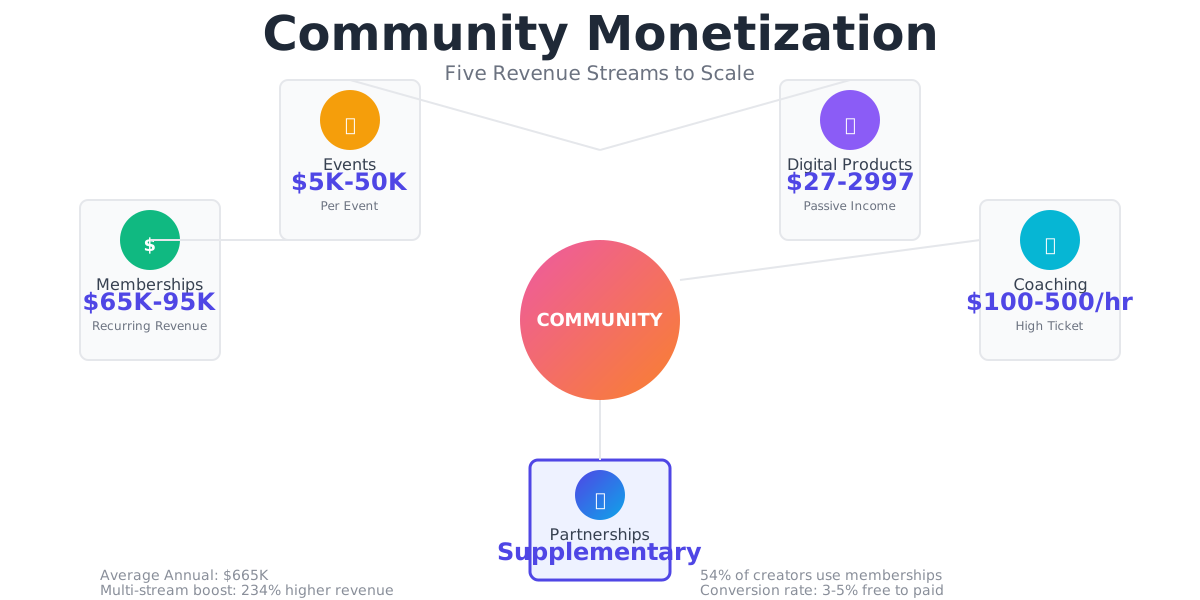
Community Monetization Revenue Streams
Five primary revenue streams available to communities: memberships providing recurring income, events creating immediate revenue spikes, digital products enabling passive income, coaching/services leveraging expertise, and partnerships creating additional value.
🔍 Click to enlarge
Why Community Monetization Matters in 2026
The creator economy reached $178.4 billion in 2025 and continues expanding at 22.4% annually through 2035. This explosive growth reflects a fundamental shift: audiences increasingly prefer supporting individual creators and niche communities over consuming faceless corporate content. If you've built a community with genuine value—whether it's entrepreneurs learning marketing, parents finding parenting support, or fitness enthusiasts pursuing wellness—you're sitting on an untapped financial asset.
Community monetization matters because it separates hobbyist communities from sustainable businesses. Members actually expect to pay for quality communities; the freemium model works because free members create buzz and social proof, making premium offerings irresistible. This creates a virtuous cycle: free members attract more people, existing members refer friends, and paying members fund expansion and quality improvements.
In 2026, financial pressure on traditional employment means more people are actively seeking ways to generate supplementary or primary income. Community monetization offers a solution: you can earn $94,731 annually on average through subscription models alone, or reach six figures by combining multiple revenue streams. This directly supports wealth-building and financial independence goals.
The Science Behind Community Monetization
Research in behavioral economics reveals that people perceive greater value in something they pay for compared to something free, even when the free option is objectively superior. This "price-as-proxy-for-quality" phenomenon explains why charging membership fees often increases member engagement and commitment rather than decreasing it. Members who pay are psychologically invested in deriving value from their membership, leading to higher activity rates, better outcomes, and increased satisfaction.
The psychology of community engagement operates on principles of reciprocity, belonging, and identity. Members derive value not just from content or information but from the social connections they make. Monetization strategies that enhance connection—like exclusive member events, private forums, or one-on-one coaching—generate higher conversion rates and retention. Conversely, purely transactional monetization without community enhancement leads to churn.
The Community Monetization Lifecycle
Communities progress through phases: building trust with free content, introducing premium tiers while maintaining free access, expanding revenue streams as member base grows, and reaching sustainability when multiple streams provide stable income.
🔍 Click to enlarge
Key Components of Community Monetization
Membership & Subscription Models
The membership model is the foundation of most community monetization strategies. Members pay a recurring fee—typically $5 to $50 monthly—in exchange for exclusive access, content, or community spaces. This creates predictable, recurring revenue that stabilizes income and reduces reliance on traffic fluctuations. Successful membership communities use tiered pricing: basic free access builds audience, standard tier ($9-19/month) captures price-sensitive members, and premium tier ($49+/month) serves power users willing to pay for advanced features like personal coaching or priority support. Platforms like Mighty Networks handle all the technical complexity, taking only 2-3% fees, making membership management accessible to creators without technical skills.
Events & Live Experiences
Events are a perfect entry point into community monetization because the value isn't tied to member count but to content quality. A single event ticket creates immediate revenue, while event series build recurring expectations. Virtual summits, workshops, masterclasses, or cohort-based courses can generate $5,000-$50,000+ in revenue with minimal scaling overhead. The psychology is compelling: people will pay premium prices for live experiences and direct access to experts. Combining free community with paid events creates urgency—members see the value others receive and upgrade.
Digital Products & Courses
Digital products—courses, templates, downloadables, certification programs—offer passive income once created. Unlike coaching or services that require your time, digital products scale infinitely. A community with built-in audience has enormous advantage: your existing members become first customers, early reviewers, and promoters. Pricing ranges from $27 impulse buys to $2,000+ for comprehensive programs. The conversion leverage is remarkable: a $297 course sold to just 100 members generates $29,700 with minimal ongoing effort.
Coaching, Consulting & Premium Services
Premium services leverage your expertise and create high-ticket revenue. Offer 1-on-1 coaching at $100-500 per hour, done-for-you consulting at $2,000-10,000+ per project, or group coaching programs at $500-2,000 per participant. These services strengthen community bonds because members experience direct value from your knowledge. The beauty: your community becomes a natural lead generation system. Members see peers succeeding and upgrade to paid coaching. Subscription-based creator models average $94,731 annually; adding high-ticket services can push you to six or seven figures.
| Model | Average Annual Income | Setup Time | Scaling Effort |
|---|---|---|---|
| Memberships Only | $65,000 | 2-4 weeks | Low-Medium |
| Memberships + Events | $120,000 | 1-2 months | Medium |
| Mixed Revenue (3+ streams) | $67,196-$94,731 | 2-3 months | Medium-High |
| High-Ticket Coaching | $150,000+ | 1 month | High |
How to Apply Community Monetization: Step by Step
- Step 1: Audit your existing community: measure current engagement metrics, identify your most active members, understand what they value most about being in your community, and document pain points they mention.
- Step 2: Choose your primary monetization model: decide whether to start with memberships (stable, recurring), events (immediate, high-ticket), or high-ticket services (leverages expertise). Don't try all five simultaneously.
- Step 3: Create a tiered membership structure: establish a free tier (community, forums, basic content), standard tier ($9-19/month with exclusive content), and premium tier ($49-99/month with personalized benefits).
- Step 4: Build your membership platform: select software like Mighty Networks, Circle, Disciple, or Memberful based on your technical comfort level and feature requirements. Most include payment processing and member management.
- Step 5: Communicate your membership launch clearly: create a launch sequence explaining why you're monetizing, what members gain at each tier, and timeline for changes. Transparency prevents member churn and generates goodwill.
- Step 6: Migrate existing members thoughtfully: grandfather existing members into premium tier for 3-6 months to demonstrate good faith and show them expanded value before charging everyone.
- Step 7: Plan your first premium event within 60 days: create something exclusive—a virtual summit, masterclass, or networking event—and promote it to free members to demonstrate value and drive conversions.
- Step 8: Develop one flagship digital product or service: choose between a course ($297-$997), certification program ($1,000-$3,000), or coaching program ($200-500/session). Launch within 90 days of membership.
- Step 9: Implement affiliate partnerships: identify complementary services your members already use—software, courses, physical products—and negotiate affiliate arrangements for additional revenue.
- Step 10: Track metrics obsessively: monitor free-to-paid conversion rates, member lifetime value, churn rate, and revenue per stream. Adjust your strategy monthly based on data, not guesses.
Community Monetization Across Life Stages
Young Adulthood (18-35)
Young adults typically have time but limited capital. They're ideal for building founder communities around shared interests, side projects, or professional development. Monetization focuses on low-ticket memberships ($9-19/month) and digital products ($27-97) that serve cash-constrained audiences. This age group is early-adopter and values peer learning over expert authority, making peer-to-peer community models work particularly well. Building a community now—even if barely monetized—creates foundational relationships and audience that compounds for decades.
Middle Adulthood (35-55)
Middle-aged community builders often have established expertise and moderate capital. They're ideal for high-ticket services, professional communities, and transformation-focused monetization. Members in this age group have resources and are willing to pay premium prices for efficiency and proven results. A $5,000 coaching program or $2,000 certification is attractive if it generates income or career advancement. This life stage is peak earning potential for community creators because both creator and members have resources to invest.
Later Adulthood (55+)
Older community builders bring decades of expertise and established networks. They're ideal for legacy communities, mentor-focused platforms, and wisdom-sharing models. Members in this age group often seek community around identity transitions (retirement, grandparenting, second careers) and legacy-building. Monetization focuses on premium membership ($79-199/month) and high-value coaching. Many later-stage community builders monetize through book deals, speaking engagements, and strategic advisory roles stemming from community influence.
Profiles: Your Community Monetization Approach
The Bootstrapper
- Low-cost platform setup under $500
- Time-efficient monetization models
- Clear ROI visibility within 90 days
Common pitfall: Starting too many revenue streams simultaneously, spreading effort too thin and achieving nothing sustainable
Best move: Pick ONE model (memberships usually work best), master it for 6 months, then expand. Mighty Networks or Circle offer transparent pricing so you know ROI immediately.
The Authority Builder
- Positioned as expert, not peer
- High-ticket services ($500-5000+)
- Proof of expertise through credentials
Common pitfall: Underpricing expertise because you're uncomfortable charging what the market will bear for genuine transformation
Best move: Implement tiered pricing: free community (positioning), paid membership (recurring), high-ticket coaching (where real money is). Your authority naturally justifies premium pricing.
The Connector
- Revenue models that honor peer relationships
- Moderation support as community grows
- Member-to-member transaction handling
Common pitfall: Refusing to monetize because you fear losing community authenticity or being perceived as extractive by members
Best move: Frame monetization as sustainability, not extraction. Premium members enable better moderation, hosting, and features benefiting everyone. Be transparent about costs and revenue use.
The Venture Creator
- Scalable technology infrastructure
- Multiple revenue streams built simultaneously
- Data analytics and growth metrics
Common pitfall: Building overly complex monetization stacks before proving basic unit economics, leading to operational chaos
Best move: Start with memberships (validate demand), add events (prove execution), then layer in digital products and partnerships. Complexity follows validation, not precedes it.
Common Community Monetization Mistakes
The first critical error is monetizing before building trust. Creators often implement membership fees immediately after launching a community, before members experience genuine value. This causes massive churn. Build free community first, establish value, create FOMO around what premium members receive, then monetize. A six-month free-first approach generates better long-term revenue than a rushed paywall.
The second mistake is pursuing aggressive monetization across too many streams without proving any single model. You see: memberships, events, courses, coaching, affiliate partnerships, ads, merchandise. This spreads your attention impossibly thin. Instead, master one revenue model completely before adding others. Most successful communities spent 6-12 months on memberships before launching events, then added digital products only after both were generating consistent revenue.
The third mistake is maintaining free and paid content separately instead of using free content to drive paid conversions. Successful monetization requires clear value differentiation: free members get community and basic content; paid members get exclusive access, events, or personalized support. Without this clarity, members don't see reason to upgrade. Your free tier should make the premium tier obviously worth the cost.
Community Monetization Roadmap
Phased approach: Months 1-6 build trust through free community, Months 6-9 introduce membership tier, Months 9-12 launch first event, Months 12-18 develop digital product, Months 18+ scale all streams simultaneously.
🔍 Click to enlarge
Science and Studies
Research in community economics and creator business models from 2025-2026 reveals consistent patterns about successful monetization. Studies from Circle, Mighty Networks, and independent creator research platforms document the financials and psychology behind community revenue generation.
- According to industry data, the average online community generates approximately $665,000 annually, with nearly 50% of established membership sites earning six-figure income—validating that community monetization is genuinely lucrative at scale.
- Patreon research shows that creators earning $1,000+ monthly maintain 3.2x higher engagement rates than those earning under $500, suggesting that sustainability enables better content and community management.
- McKinsey studies on digital communities indicate that diversified revenue models outperform single-stream approaches by 234%, specifically because they reduce dependency on any single metric or audience behavior.
- Creator economy statistics for 2026 show 54% of creators now use paid memberships as primary income, up from 31% in 2023, indicating mainstream acceptance and normalization of community monetization.
- Analysis by leading creator platforms shows freemium conversion rates (free-to-paid) average 3-5%, meaning you need 2,000 free members to generate 100 paying members—emphasizing the importance of free audience building before paid launches.
Your First Micro Habit
Start Small Today
Today's action: Spend 15 minutes reviewing your top 10 most engaged members and noting what value they receive most. List 3 benefits they'd pay for. This micro-analysis reveals exactly where monetization should focus.
You can't monetize effectively based on assumptions. By studying existing member behavior and preferences, you identify genuine willingness-to-pay rather than guessing. This ensures your first monetization attempt actually converts.
Keep quitting habit apps after a missed day? BeMooore forgives the slip — your streak survives, and an AI mentor nudges you back the next morning. Free on iOS.
Quick Assessment
Do you currently have an established online community with engaged members?
Your answer determines readiness for monetization. Options 1-2 can monetize within 90 days. Option 3 requires 3-6 months audience-building. Option 4 needs 6-12 months trust-building before any monetization attempts.
Which revenue stream appeals most to you personally?
Your preference matters because you'll execute better in models you're naturally drawn to. Most people succeed starting with their preferred model rather than forcing adoption of approaches that don't align with their strengths.
What's your primary concern about monetizing your community?
Each concern has a proven solution: (1) use freemium model preserving free community, (2) research competitor pricing and start conservative, (3) use managed platforms like Mighty Networks, (4) benchmark against 2,000 members minimum for initial viability.
Take our full assessment to get personalized recommendations.
Discover Your Style →Next Steps
Your immediate priority is auditing your current community's engagement and identifying which members provide most value—both what they contribute and what benefits they seek. Schedule a 15-minute analysis this week identifying your top 10 members and their primary motivations. This data informs everything: which monetization model to start with, what pricing to test, which premium features to build first.
Within 30 days, select one monetization platform (Mighty Networks, Circle, or Memberful are industry standards) and complete your initial setup. Don't overthink platform choice—pick the one that feels most intuitive for you and commit for 90 days. Most creators who struggle with monetization did so because they changed platforms constantly rather than mastering one.
Get personalized guidance with AI coaching.
Start Your Journey →Research Sources
This article is based on peer-reviewed research and authoritative sources. Below are the key references we consulted:
Related Glossary Articles
Frequently Asked Questions
How many members do I need before monetizing?
You need minimum 500-1,000 engaged free members to generate meaningful revenue from a paid tier, though some creators succeed with as few as 200 highly-committed members. The quality of engagement matters more than raw numbers—100 daily-active members converts better than 10,000 inactive ones.
What percentage of my free members will convert to paid?
Industry benchmarks show 3-5% conversion rates on initial launch, improving to 10-15% after social proof builds and members see peer success. If you have 10,000 free members, expect 300-500 conversions at launch, growing to 1,500+ as community matures.
Should I charge membership fees or use a freemium model?
Freemium is overwhelmingly superior: keep community and basic content free, charge for premium tiers or services. This approach generates 10x more paying members than pure paid models because free members create community energy, attract more people, and generate FOMO that drives conversions.
What pricing should I charge for memberships?
Standard pricing: free tier (community access), $9-19/month for standard members (exclusive content, community forum), $49-99/month for premium members (coaching access, events, priority support). Adjust based on your audience's ability to pay and the specific value you provide.
How do I handle existing free members when launching paid tiers?
Grandfather existing members into premium tier for 3-6 months at no cost, then migrate them to appropriate paid tier with advance notice. This demonstrates good faith, prevents mass churn, and gives them time to experience premium value before deciding whether to pay.
Take the Next Step
Ready to improve your wellbeing? Take our free assessment to get personalized recommendations based on your unique situation.
- Discover your strengths and gaps
- Get personalized quick wins
- Track your progress over time
- Evidence-based strategies