Creator Economy
Imagine waking up to a notification that someone on the other side of the world just purchased your online course while you slept. That is the promise of the <a href="/g/creator-economy.html">creator economy</a>, a $214 billion industry where individuals turn their knowledge, skills, and passions into thriving businesses. Yet for every creator earning six figures, dozens struggle with inconsistent income and platform dependency. The difference between the two groups rarely comes down to talent alone. It comes down to strategy, systems, and understanding how modern <a href="/g/content-marketing.html">content marketing</a> really works.
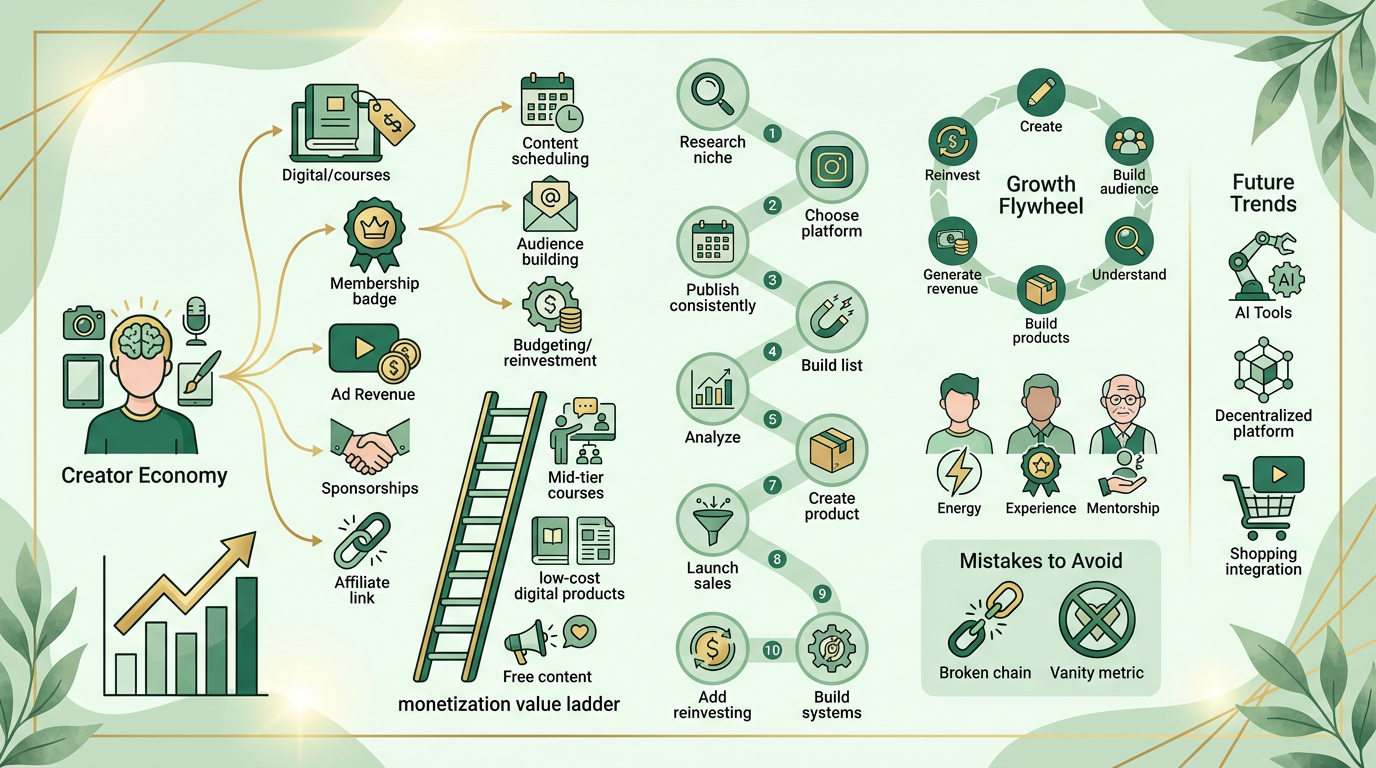
In this guide, you will learn the proven frameworks that separate sustainable creator businesses from hobbyist accounts. We cover everything from choosing your first <a href="/g/digital-products.html">digital products</a> to building <a href="/g/multiple-income-sources.html">multiple income sources</a> that compound over time.
Whether you are a complete beginner exploring side hustles or an established creator looking to scale, the principles here apply to every platform, niche, and content format.
What Is the Creator Economy?
The creator economy refers to the ecosystem of independent content creators, influencers, educators, and community builders who earn income through digital platforms. Unlike traditional employment, creators monetize their audience directly through digital products, subscriptions, sponsorships, affiliate marketing, and advertising revenue. The model shifts value creation from large corporations to individuals who can build trust with their audience.
Not medical advice.
Over 207 million creators are active worldwide, yet only about 4% earn more than $100,000 annually. This dramatic income gap highlights why treating content creation as a real business with proper financial planning and business strategy matters. The creators who thrive approach their work with the same rigor as any entrepreneurship venture. They build systems, diversify revenue, and invest in brand building that outlasts any single algorithm change.
Surprising Insight: Surprising Insight: Nearly 70% of successful creators maintain three or more revenue streams. Creators with diversified income earn an average of $75,000 more per year than those relying on a single platform's ad revenue.
Creator Economy Revenue Streams
Overview of how creators monetize their audience through multiple channels
🔍 Click to enlarge
Why the Creator Economy Matters in 2026
The creator economy market was valued at $178.4 billion in 2025 and is projected to reach $214 billion in 2026, growing at a compound annual growth rate of 22.4%. This growth is not slowing down. Goldman Sachs estimates the market could reach $480 billion by 2027. For individuals seeking financial freedom and financial independence, the creator economy represents one of the most accessible paths to building wealth with minimal startup capital.
A significant shift in 2025-2026 is the emergence of the creator middle class. Research shows that 45.6% of creators now earn between $10,000 and $100,000 annually, demonstrating that consistent, professional content creation can support stable livelihoods. This is no longer a winner-take-all game. With the right digital business strategy, creators at every level can build meaningful income through passive income and recurring revenue.
The shift toward creator-owned revenue is accelerating. Recurring, community-based income now sits at the center of successful creator business models. Subscriptions, best-selling digital products, and community memberships are replacing platform-dependent income as the foundation of creator businesses. This means creators who invest in building their own audience and product ecosystem gain resilience that purely platform-dependent creators lack.
The Business Model Behind the Creator Economy
Understanding how the creator economy actually generates money is essential for anyone serious about career growth in this space. While ad revenue remains the most visible income stream at 21.6% of total creator earnings, it is far from the most profitable. Product and merchandise sales combined with affiliate marketing represent 21.2% of creator income, and these channels offer much higher margins and control.
Brand deals remain significant with 68.8% of creators citing them as a primary income source. However, dependency on sponsorships is declining as more creators move toward owned assets. The smartest creators treat sponsorships as funding for building their own digital products and subscription offerings. This transition from renting attention to owning a business is what separates hobbyists from true online business owners.
Influencer marketing spending hit $32.55 billion in 2025, a 35.6% increase over the previous year. This means brands are investing heavily in creators, creating opportunities for those who understand personal branding and customer acquisition. The key is positioning yourself as a trusted authority in a specific niche rather than trying to appeal to everyone.
YouTube's creative ecosystem alone contributed $55 billion to U.S. GDP in 2024, supporting the equivalent of 490,000 full-time jobs. Platform payments to creators increased by 79% compared to the previous year. These numbers show that content creation is not a passing trend but a fundamental shift in how economic value is created and distributed. Understanding financial management as a creator is just as important as creating great content.
Key Components of the Creator Economy
Content Creation and Distribution
Content is the foundation of every creator business. Whether you produce videos, podcasts, newsletters, or social media posts, your content serves as the primary vehicle for building trust and demonstrating expertise. The most successful creators focus on one primary platform and one primary content format before expanding. This allows them to master the platform's algorithm, build a loyal audience, and develop efficient production workflows. Quality content marketing compounds over time as older content continues to attract new audience members through search and recommendations.
Audience Building and Community
An audience is not just a number on your follower count. It is a group of people who trust your perspective and are willing to invest their time and money in your recommendations. Building a genuine community requires consistent value delivery, authentic communication skills, and a willingness to engage beyond surface-level interactions. The shift from followers to community members is what enables premium monetization. Creators who build strong communities through email marketing and direct channels own their audience rather than renting it from platforms.
Monetization Strategy
A clear monetization strategy turns attention into income. The most sustainable approach follows the value ladder: free content attracts an audience, low-cost products qualify buyers, and premium offerings serve your most committed fans. This model works across niches from fitness to finance. Your passive income strategies should include both active income from services like consulting and freelancing as well as passive income from digital products and selling digital products that sell while you sleep.
Business Operations and Systems
Running a creator business requires the same operational discipline as any other company. This includes budgeting, tax planning, content scheduling, time management, and building standard operating procedures that allow you to scale. Many creators hit a ceiling because they try to do everything themselves instead of building systems. Investing in tools, automation, and eventually team members is what allows a creator business to grow beyond the limits of one person's time. Smart business growth comes from working on your business, not just in it.
| Revenue Model | Income Potential | Control Level |
|---|---|---|
| Ad Revenue (YouTube, blog) | Low-Medium ($1-10 per 1K views) | Low (platform-dependent) |
| Brand Sponsorships | Medium-High ($500-50K per deal) | Medium (relationship-dependent) |
| Affiliate Marketing | Medium ($500-10K/month) | Medium (product-dependent) |
| Digital Products (courses, ebooks) | High ($1K-100K+/month) | High (fully owned) |
| Subscriptions & Memberships | High ($2K-50K+/month recurring) | High (community-owned) |
| Coaching & Consulting | High ($5K-50K+/month) | High (time-limited) |
How to Build a Creator Business: Step by Step
- Step 1: Choose your niche by identifying the intersection of your expertise, passion, and market demand. Research what people are searching for using free tools and validate that an audience exists for your topic before creating content.
- Step 2: Select one primary platform that matches your content style. Video creators should start on YouTube, writers on newsletters or blogs, and visual creators on Instagram. Focus beats spreading thin across multiple platforms.
- Step 3: Create a content calendar and publish consistently for at least 90 days before evaluating results. Consistency builds algorithmic trust and audience habits. Aim for quality content on a sustainable schedule rather than daily burnout.
- Step 4: Build your email list from day one using a lead magnet such as a free guide, checklist, or mini-course. Your <a href="/g/email-marketing.html">email list</a> is the one audience asset no platform can take away from you.
- Step 5: Study your analytics to understand what resonates with your audience. Double down on topics and formats that drive engagement and attract your ideal customers, not just casual viewers.
- Step 6: Create your first digital product based on your most popular free content. Transform your best-performing content into a structured course, ebook, or template that solves a specific problem for your audience.
- Step 7: Launch with a simple sales system including a landing page, payment processor, and email sequence. You do not need complex funnels to start. A clear offer with strong <a href="/g/conversion-optimization.html">conversion optimization</a> beats a complicated tech stack.
- Step 8: Diversify your income by adding complementary revenue streams one at a time. Layer <a href="/g/affiliate-marketing.html">affiliate marketing</a>, sponsorships, and additional products onto your foundation gradually.
- Step 9: Reinvest profits into improving your production quality, tools, and eventually hiring help. The <a href="/g/investment-strategies.html">investing</a> mindset applies to your creator business just as much as your portfolio.
- Step 10: Build systems and standard operating procedures for recurring tasks. Document your workflows so you can delegate effectively and focus your time on high-value creative and strategic work.
Creator Economy Across Life Stages
Young Adulthood (18-35)
Young adults have significant advantages in the creator economy. They are digital natives comfortable with platforms, often have lower financial obligations, and can take more risk. This is the ideal time to experiment with content formats, build an audience, and develop creative expression skills. Many successful creators started as side hustles alongside traditional employment. The key for this age group is starting before feeling ready and treating early content as practice rather than portfolio pieces. Building personal branding early compounds dramatically over a decade.
Middle Adulthood (35-55)
Mid-career professionals bring deep expertise and professional networks that younger creators often lack. This is the demographic best positioned for premium consulting, high-ticket courses, and B2B content creation. The challenge is often overcoming the belief that content creation is only for younger people. In reality, audiences seeking serious career development, financial planning, or industry expertise prefer creators with proven track records. Your decades of experience are your unfair advantage in the creator economy.
Later Adulthood (55+)
Older adults entering the creator economy can leverage lifetime expertise in ways that create enormous value. Teaching, mentoring, and sharing hard-won wisdom through content resonates deeply with audiences across all ages. This age group often excels at long-form, thoughtful content that builds deep trust. The creator economy offers a path to continued income and purpose during and after traditional career transitions and retirement. Focus on formats that feel natural, whether that is writing, audio, or video, and let your authentic perspective be your differentiator.
Profiles: Your Creator Economy Approach
The Educator Creator
- Structured curriculum design for <a href="/g/digital-products.html">digital products</a>
- Clear teaching methodology and content frameworks
- Student success tracking and testimonial collection
Common pitfall: Over-investing in production quality before validating that people will pay for the content
Best move: Launch a minimum viable course using existing free content as validation, then iterate based on student feedback
The Community Builder
- Strong <a href="/g/communication-skills.html">communication skills</a> and engagement systems
- A membership or subscription platform for recurring revenue
- Content that sparks discussion and connection among members
Common pitfall: Burning out trying to personally respond to every community member instead of building self-sustaining engagement loops
Best move: Create rituals, templates, and peer-to-peer connection opportunities that keep the community active without your constant presence
The Influencer Monetizer
- High-quality audience analytics to attract brand partners
- A media kit and clear sponsorship pricing structure
- Strong <a href="/g/networking.html">networking</a> skills for brand relationship management
Common pitfall: Accepting every sponsorship offer regardless of audience alignment, eroding trust and long-term earning potential
Best move: Build a selective partnership portfolio and transition sponsorship income into funding your own products
The Product-First Creator
- Deep understanding of audience pain points and willingness to pay
- Skills in <a href="/g/conversion-optimization.html">conversion optimization</a> and sales funnels
- Systems for product delivery, support, and iteration
Common pitfall: Building elaborate products before validating demand, leading to expensive launches with poor results
Best move: Pre-sell your product idea to a small audience segment, use their feedback to build exactly what the market wants
Common Creator Economy Mistakes
The most common mistake new creators make is chasing follower counts instead of building a monetizable audience. A creator with 5,000 engaged email subscribers who trust their recommendations will out-earn someone with 500,000 passive social media followers almost every time. Focus on depth of relationship rather than breadth of reach. This connects directly to effective marketing strategy and understanding that vanity metrics rarely correlate with revenue.
Another critical error is platform dependency. Creators who build their entire business on a single platform risk losing everything when algorithms change, accounts get suspended, or platforms decline. The solution is always owning your audience through email marketing lists and building revenue streams you control, such as your own digital products. Diversification in your creator business follows the same principles as diversification in investing.
Many creators also underinvest in the business side of their operation. They create brilliant content but have no financial management systems, no sales processes, and no growth strategy. Treating your creator business as a real company with proper budgeting, business strategy, and operational systems is what separates those who earn a living from those who just have an expensive hobby. Learning business networking and building professional relationships with other creators accelerates growth dramatically.
Creator Growth Flywheel
The compounding cycle that drives sustainable creator business growth
🔍 Click to enlarge
Platform Strategy for Creators
Choosing the right platform is one of the most important decisions a creator makes. Each platform rewards different content types and attracts different audiences. YouTube excels for long-form educational content and has the strongest ad revenue sharing model, paying creators 55% of ad income. Instagram and TikTok favor short-form visual content and are best for building brand awareness quickly. Newsletters and blogs work best for creators who think in written form and want to build deep reader relationships that support premium digital marketing strategy.
The ideal approach is to dominate one platform, then expand strategically. Repurpose your primary content across secondary platforms to maximize reach without multiplying your workload. A YouTube video can become a blog post, multiple short clips, an email newsletter, and several social media posts. This content multiplication approach is a core productivity habit of successful creators. Tools powered by AI are making content repurposing faster than ever, allowing solo creators to maintain presence across multiple channels efficiently.
Remember that platforms are distribution channels, not your business. Your business is the relationship with your audience and the products you create. Use platforms to reach people, but always drive them toward channels you own. Your email list, your website, and your product ecosystem are assets. Your social media following is rented attention that can disappear overnight. This distinction is fundamental to building real financial security as a creator.
Monetization Deep Dive: From Free to Premium
The value ladder is the most proven monetization framework in the creator economy. At the bottom, you offer free content that attracts and educates your audience. This includes blog posts, YouTube videos, podcasts, and social media content. The purpose of free content is not direct revenue but audience building, trust establishment, and demonstrating your expertise.
The next tier includes low-cost digital products priced between $7 and $97. These might be ebooks, templates, mini-courses, or workshops. These products serve two purposes: they generate revenue and they qualify buyers by identifying people in your audience willing to spend money. Best-selling digital products in this tier solve specific, urgent problems and deliver quick results.
Mid-tier offerings range from $97 to $997 and typically include comprehensive online courses, group coaching programs, or annual memberships. This is where most creator revenue concentrates. A well-designed course that delivers transformation for its students can generate passive income for years with minimal updates. The key is creating genuine transformation, not just information delivery.
Premium offerings at $1,000 and above include one-on-one consulting, masterminds, certification programs, and high-touch coaching. While these limit scalability, they generate the highest per-customer revenue and deepen your expertise through direct client interaction. Many creators use insights from premium clients to improve their scalable products, creating a virtuous cycle between service and product revenue.
Creator Value Ladder
Progressive monetization stages from free content to premium offerings
🔍 Click to enlarge
Science and Studies
Research from multiple institutions and market analysis firms provides compelling evidence about the creator economy's trajectory and the strategies that lead to sustainable success. Understanding these findings helps creators make data-driven decisions about platform selection, monetization models, and business growth approaches.
- Goldman Sachs Research (2024): Projected the creator economy to grow from $250 billion in 2024 to approximately $480 billion by 2027, driven by increasing brand spend and creator diversification into owned products.
- Oxford Economics & YouTube Impact Report (2024): Found YouTube's creative ecosystem contributed $55 billion to U.S. GDP in 2024, supporting 490,000 full-time equivalent jobs.
- The Influencer Marketing Factory Creator Economy Report (2026): Revealed 45.6% of creators earn between $10,000-$100,000 annually, confirming the emergence of a sustainable creator middle class.
- Research Nester Market Analysis (2025): Valued the creator economy at $178.4 billion in 2025 with a projected 22.4% CAGR through 2035, reaching an estimated $1.35 trillion.
- DemandSage Creator Economy Statistics (2026): Found that nearly 70% of successful creators maintain three or more income streams and that creators with diversified revenue earn an average of $75,000 more annually.
Your First Micro Habit
Start Small Today
Today's action: Spend 15 minutes each morning creating one piece of content or writing one idea for your creator business before checking social media or email.
Creating before consuming builds the production muscle that separates successful creators from passive consumers. This small daily investment compounds into a content library and expertise that drives long-term revenue.
Keep quitting habit apps after a missed day? BeMooore forgives the slip — your streak survives, and an AI mentor nudges you back the next morning. Free on iOS.
Quick Assessment
How would you describe your current approach to creating and sharing content online?
Your starting point determines your next best step. Early-stage creators should focus on consistent publishing, while established creators should prioritize monetization and systems.
What is your primary goal for participating in the creator economy?
Aligning your strategy with your goal prevents wasted effort. Side income seekers should start with affiliate marketing and digital products, while those building authority should focus on long-form content.
Which content format feels most natural and sustainable for you?
Starting with your natural strength reduces friction and increases consistency. You can always expand into other formats once you have established momentum on your primary channel.
Take our full assessment to get personalized recommendations for your creator economy journey.
Discover Your Creator Style →Building Financial Resilience as a Creator
Creator income is inherently variable, which makes financial management especially critical. Successful creators build financial resilience through several key practices. First, maintain an emergency fund covering at least six months of expenses. Variable income months are inevitable, and having a buffer prevents panic-driven decisions that could harm your long-term strategy. Understanding budgeting with irregular income is a skill every creator must develop.
Second, separate business and personal finances from day one. Even if you are just starting as a side hustle, treating your creator income as a business with its own accounts creates clarity and simplifies tax planning. As your income grows, reinvest a fixed percentage back into the business for equipment, tools, education, and eventually team members. This investing in your own business often generates higher returns than any other investment available to you.
Third, build toward recurring revenue as quickly as possible. One-time product sales and sponsorship deals create revenue spikes but not stability. Memberships, subscriptions, and retainer-based consulting agreements provide the predictable income base that allows you to plan, hire, and grow with confidence. This is the path to true financial freedom as a creator.
The Future of the Creator Economy
Several trends are shaping where the creator economy is headed. AI tools are democratizing content production, making it possible for solo creators to produce studio-quality content at a fraction of the previous cost. AI-powered side hustles and AI digital products are creating entirely new categories of creator businesses. Creators who learn to use AI as a productivity multiplier will have a significant advantage over those who resist these tools.
The trend toward creator-owned platforms and communities is accelerating. Instead of relying solely on social media algorithms, creators are building their own membership sites, apps, and community platforms. This gives them direct relationships with their audience, first-party data, and complete control over their digital business strategy. The most successful creators in 2026 and beyond will be those who think like media company founders rather than individual content producers.
Cross-platform commerce integration is making it easier than ever for creators to sell directly to their audiences without friction. Shoppable content, integrated checkout experiences, and creator-specific financial tools are removing the traditional barriers between content consumption and purchase. For creators committed to wealth building, this means the gap between creating content and generating revenue continues to shrink. The creator economy rewards those who combine creativity with business strategy and consistent execution.
Next Steps
The creator economy offers unprecedented opportunity for individuals willing to combine creativity with strategic thinking. Start by choosing one platform and one content format that plays to your strengths. Commit to 90 days of consistent publishing before making any judgments about results. Build your email list from day one and begin planning your first digital product based on the questions your audience asks most frequently. Explore related topics like social media marketing, best side hustles for 2025, and passive income strategies to expand your knowledge.
Remember that every successful creator started exactly where you are now. The difference between those who build thriving creator businesses and those who remain stuck is not talent or luck. It is the willingness to ship imperfect work, learn from data, and improve consistently over time. Your career growth in the creator economy is directly proportional to the value you create and the systems you build to deliver it. Start today, start small, and let the compounding effect of consistent entrepreneurship work in your favor.
Get personalized guidance with AI coaching to build your creator business.
Start Your Creator Journey →Research Sources
This article is based on peer-reviewed research and authoritative sources. Below are the key references we consulted:
Related Glossary Articles
Frequently Asked Questions
How much money can you realistically make in the creator economy?
Earnings vary enormously depending on niche, audience size, and monetization strategy. Research shows 48.7% of creators earn under $10,000 annually, 45.6% earn between $10,000 and $100,000, and 5.7% earn over $100,000. Creators with diversified income streams including digital products, memberships, and affiliate marketing consistently earn more than those relying on a single revenue source.
What is the best platform to start as a creator in 2026?
The best platform depends on your content format and audience. YouTube is ideal for long-form educational content with strong monetization. Newsletters work well for writers and thought leaders. Instagram and TikTok excel for visual and short-form content. Start where your natural skills align and where your target audience already spends time.
Do I need a large following to make money as a creator?
No. The creator middle class proves that moderate audiences can generate meaningful income. A focused email list of 1,000 to 5,000 engaged subscribers can support a full-time creator income through digital products and services. Audience quality and engagement matter far more than raw follower counts.
How long does it take to earn a full-time income from content creation?
Most successful creators report 12 to 24 months of consistent effort before earning a livable income. The timeline shortens significantly if you already have expertise in a high-demand niche, build an email list early, and create digital products rather than relying solely on ad revenue or sponsorships.
What are the biggest risks of becoming a full-time creator?
The primary risks are income variability, platform dependency, and burnout. Mitigate these by building multiple income streams, owning your audience through email lists, maintaining financial reserves, and creating systems that prevent overwork. Treating content creation as a business with proper financial planning dramatically reduces these risks.
How does AI affect the creator economy?
AI is transforming the creator economy by reducing production costs, enabling content repurposing across platforms, and creating new product categories. Creators who use AI tools for research, editing, and distribution gain efficiency advantages. However, human authenticity, original perspective, and genuine expertise remain the factors audiences value most.
Take the Next Step
Ready to improve your wellbeing? Take our free assessment to get personalized recommendations based on your unique situation.
- Discover your strengths and gaps
- Get personalized quick wins
- Track your progress over time
- Evidence-based strategies