Freelancing
Imagine waking up without an alarm, choosing your own clients, setting your own rates, and building wealth on your own terms. Freelancing isn't just a job—it's a complete reimagining of how you work and earn. In 2026, 86.5 million Americans will be freelancing, representing more than half the workforce. Whether you're escaping the corporate grind, seeking flexibility, or chasing six-figure independence, freelancing offers a path to financial freedom that traditional employment rarely provides. But success requires more than ambition. It demands strategy, resilience, and a clear roadmap for managing finances, building client relationships, and scaling your income.
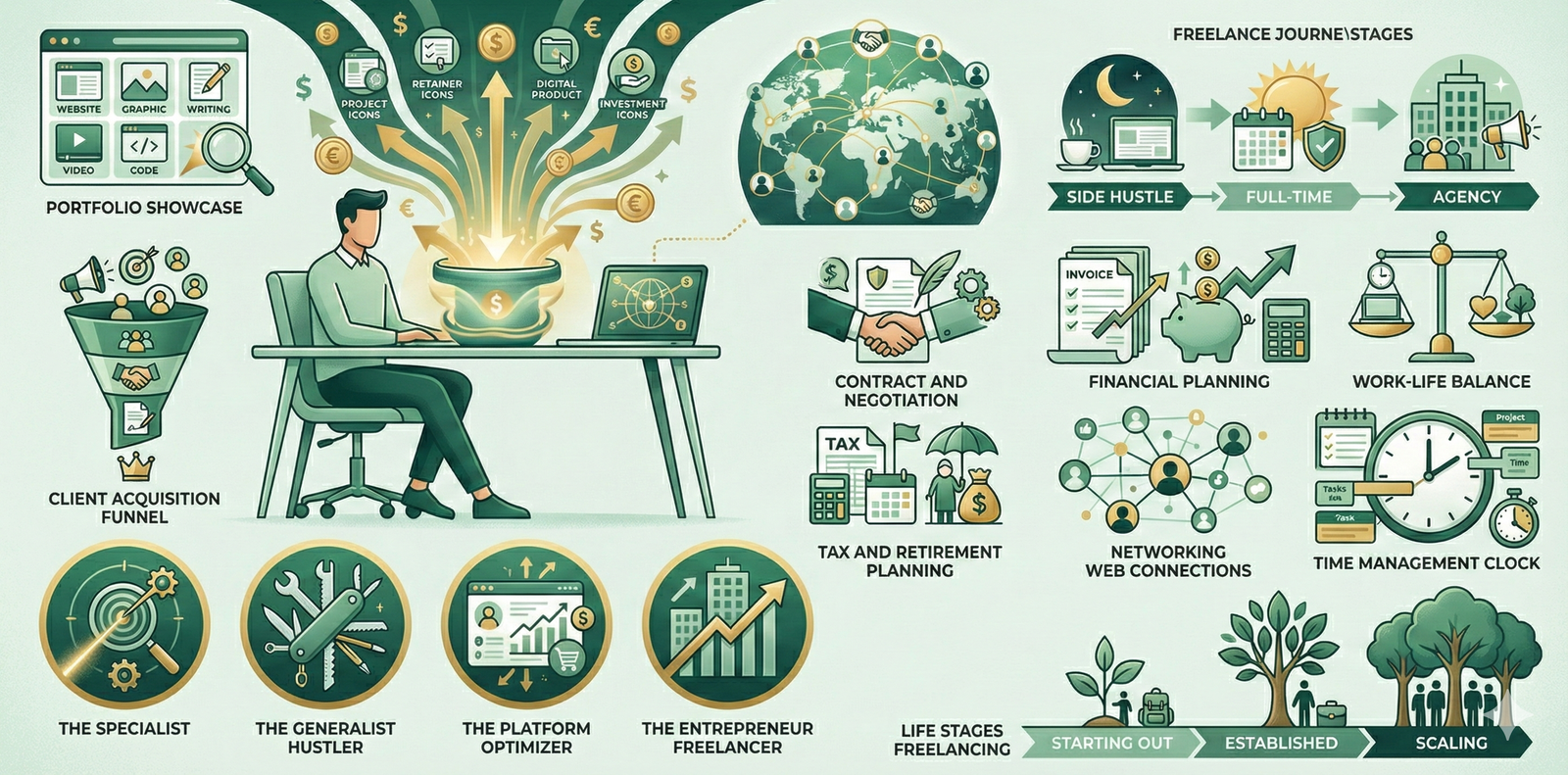
The global freelance market surged to $8.39 billion in 2025 and continues accelerating. Freelancers earn anywhere from $14.90 to $132.21 per hour, with most earning between $24.28 and $61.78. High-demand specialists like AI engineers and cybersecurity experts command $150–$300+ per hour. Yet income instability remains the biggest challenge—without employer stability and benefits, many freelancers struggle in their first years.
This guide walks you through building a sustainable freelance career. You'll discover how to position yourself competitively, manage finances like a business owner, maintain income stability, and leverage your mindset to succeed independently. Whether you're just starting or scaling an existing practice, you'll find practical frameworks, real-world strategies, and the personality insights that separate thriving freelancers from struggling ones.
What Is Freelancing?
Freelancing is self-employment where you offer services to multiple clients on a project-by-project basis, rather than working full-time for one employer. You control your schedule, choose your clients, set your rates, and build income from multiple revenue streams. Unlike gig economy work (delivery, rideshare), freelancing typically involves specialized skills: writing, design, programming, consulting, marketing, or any expertise clients will pay for.
Not medical advice.
Freelancing operates on a simple exchange: clients pay for your expertise and time, you deliver quality work, and both parties move forward. The relationship is transactional but can become ongoing if you deliver consistently. Modern platforms like Upwork, Fiverr, and Toptal connect freelancers with clients globally. Many successful freelancers eventually build direct client relationships and abandon platforms entirely, working directly with recurring clients at higher rates.
Surprising Insight: Surprising Insight: 75% of freelancers earn the same or more than they did in traditional employment, and 68% say they learn more on the job as freelancers than they ever did as employees. Flexibility, autonomy, and continuous skill development create natural motivation for excellence.
The Freelance Economy Ecosystem
How freelancers fit within the broader economy: platforms, clients, skills, and income streams interconnected
🔍 Click to enlarge
Why Freelancing Matters in 2026
The workforce is fundamentally shifting. Remote work, AI automation, and the gig economy have made traditional employment less secure. Companies now prefer freelancers for flexibility and cost control, while workers seek autonomy and work-life balance. Freelancing isn't a fringe career anymore—it's mainstream.
Financially, freelancing offers wealth-building potential unavailable in traditional jobs. Freelancers earning over $100,000 annually jumped from 3 million in 2020 to 4.7 million in 2024. You control your pricing, can scale income without promotion, and keep more earnings through business deductions. Your financial ceiling isn't set by corporate salary bands—it's determined by your skills, hustle, and pricing strategy.
Personally, 63% of freelancers report better work-life balance than traditional employees. You design your career around your life, not the reverse. Want to work three days a week? Travel while working? Focus on meaningful clients only? Freelancing enables this autonomy, which drives satisfaction, health, and long-term success.
The Science Behind Freelancing Success
Psychological research reveals that successful freelancers share distinct traits: self-discipline, persistence, resilience, communication skills, and a growth mindset. These aren't innate talents—they're developed through deliberate practice. Studies show that freelancers report higher levels of autonomy motivation and intrinsic satisfaction, which predict sustained performance and financial growth.
Neuroscience research on decision-making shows that entrepreneurs (including freelancers) exhibit stronger lateral thinking and creative problem-solving when facing ambiguous situations. The constant need to acquire clients, solve problems, and pivot strategies actually strengthens cognitive flexibility. Additionally, research on gig economy workers demonstrates that income volatility creates heightened financial awareness, leading to better budgeting and long-term planning when managed properly.
Freelancer Success Drivers
Core psychological and practical factors that predict freelancing success
🔍 Click to enlarge
Key Components of Freelancing
Specialized Skills and Expertise
Your skill is your product. High-demand 2026 freelance skills include AI/ML engineering ($150–$300+/hour), cybersecurity ($100–$200/hour), software development, data science, UX design, copywriting, and digital marketing. The more specialized and in-demand your skill, the higher your rates. Generalists earn less; specialists command premiums. Invest continuously in skill development—68% of freelancers report learning more as freelancers than as employees because their income directly depends on staying current.
Client Acquisition and Relationship Building
Finding clients is your primary operational challenge. Successful freelancers use multiple channels: platforms (Upwork, Fiverr), referrals, direct outreach, content marketing, LinkedIn, and word-of-mouth. The best long-term strategy is building direct client relationships that return repeatedly. Recurring clients eliminate the stress of constant job hunting and often pay premium rates for reliability. Developing strong communication, delivering on time, and exceeding expectations builds the reputation that attracts better clients and higher rates.
Financial Management and Cash Flow
Freelancers must manage finances differently than employees. Without steady paychecks, cash flow becomes crucial. You'll need to set aside 30% of income for taxes, build 3-6 months' emergency savings, and plan for irregular income months. Separating freelance and personal finances, tracking deductions, and budgeting around your lowest earning month ensures sustainability. Many freelancers fail not from lack of skill but from poor financial management.
Mindset and Resilience
Freelancing requires self-discipline, initiative, and persistence. Without a boss or deadline accountability, motivation must come internally. You'll face client rejection, income fluctuations, feast-or-famine cycles, and the isolation of working alone. Successful freelancers develop resilience through a growth mindset—viewing challenges as learning opportunities rather than threats. Tenacity separates those who succeed from those who quit after a slow month.
| Income Level | Typical Profile | Key Focus |
|---|---|---|
| $14–$30/hour | Beginner, platform-dependent, generalist skills | Building portfolio, getting first clients, learning systems |
| $30–$75/hour | Experienced, mixed platforms and direct clients, strong skills | Specializing, raising rates, building recurring clients |
| $75–$150/hour | Specialist, mostly direct clients, niche expertise, established reputation | High-value projects, retainers, mentoring others |
| $150+/hour | Expert, premium clients, rare skills (AI, security), recognized authority | Strategic pricing, brand positioning, scaling without trading time |
How to Apply Freelancing: Step by Step
- Step 1: Assess your current skills and identify high-demand specializations in your field. Research what clients pay for and what you can realistically deliver.
- Step 2: Build a portfolio showcasing your best work. Start with small projects, case studies, or samples that prove your capability to potential clients.
- Step 3: Decide your initial positioning: will you start on platforms like Upwork, or pursue direct client relationships? Platforms provide easier client access; direct clients offer better rates and stability.
- Step 4: Set your rate strategically. Research industry benchmarks, calculate your living expenses, and price above minimum to leave room for negotiation and account for unpaid time (admin, marketing, downtime).
- Step 5: Launch your presence: create a simple website, optimize LinkedIn, join relevant platforms, and write a compelling pitch that explains your unique value to clients.
- Step 6: Implement a system for finding clients: consistent outreach, content marketing, referral requests from satisfied clients, or strategic use of platforms. Treat client acquisition as ongoing work.
- Step 7: Establish financial systems immediately: separate bank account, accounting software, tax planning, and emergency savings. Track every expense and invoice promptly.
- Step 8: Deliver exceptional work and build long-term relationships. Ask satisfied clients for referrals. Recurring clients eliminate feast-or-famine cycles and pay better rates.
- Step 9: Continuously learn and raise your rates as you gain experience. Every 6–12 months, increase your rates by 10–20% as your reputation and skills grow.
- Step 10: Scale strategically: focus on retainers, premium clients, and passive income (digital products, courses) rather than trading hours for dollars indefinitely.
Freelancing Across Life Stages
Young Adulthood (18-35)
Young freelancers have fewer financial obligations, making this ideal for building skills and portfolios. Many start part-time while employed, reducing risk. The challenge: accepting lower rates to build reputation. Best strategy: hustle aggressively to build recurring clients, develop expertise, and increase rates rapidly. By 30, focus on transitioning to premium direct clients rather than remaining platform-dependent.
Middle Adulthood (35-55)
This stage brings both advantages and constraints. You have deep expertise commanding high rates, but likely have higher financial responsibilities (family, mortgage). Best strategy: prioritize income stability through retainers and recurring clients. Use established reputation to negotiate premium rates. Invest profits into retirement accounts (Solo 401k allows up to $69,000 annual contribution) and diversified income streams.
Later Adulthood (55+)
Many freelancers extend careers well past traditional retirement age, enjoying autonomy and meaningful work. Your decades of expertise command premium rates. Focus: retainer-based relationships with fewer clients, mentoring others, and building passive income. The flexibility of freelancing makes semi-retirement possible—work 10–15 hours weekly with high-value clients rather than disappearing entirely.
Profiles: Your Freelancing Approach
The Specialist
- Deep expertise in one niche
- Premium pricing confidence
- Direct client relationship focus
Common pitfall: Limiting income by staying too specialized without raising rates or teaching others
Best move: Position as an expert authority, command 2-3x rates, build retainer relationships with strategic clients
The Generalist Hustler
- Multiple income streams
- Strong client acquisition skills
- Systems to prevent burnout
Common pitfall: Spreading too thin across too many projects, sacrificing quality and earning less than specialists
Best move: Gradually specialize, raise rates selectively, and consolidate clients rather than constantly chasing new projects
The Platform Optimizer
- Strategic platform selection
- Profile optimization skills
- Consistent availability for requests
Common pitfall: Remaining platform-dependent forever, competing on price with thousands of other freelancers
Best move: Use platforms to build reputation and recurring clients, then transition to direct relationships at higher rates
The Entrepreneur Freelancer
- Business systems thinking
- Scaling mentality
- Focus on high-leverage work
Common pitfall: Scaling too fast without systems, taking on clients that disrupt profitability
Best move: Build a team, create digital products, develop productized services, or transition to strategic advisory roles
Common Freelancing Mistakes
Underpricing is the #1 mistake new freelancers make. They charge too low, attract price-sensitive clients, build unsustainable workload, and create a reputation trap. It takes years to raise rates from an underpriced position. Instead, start with fair rates based on your skill level and increase regularly. Research comparable rates and price at the top end of your experience level, not the bottom.
Neglecting financial planning creates crisis when income dips. Freelancers without emergency funds, tax planning, or retirement savings face stress, poor decisions, and unsustainable businesses. From day one, set aside 30% for taxes, build an emergency fund, and contribute to retirement. This isn't optional—it's foundational to freelance sustainability.
Staying platform-dependent forever limits income and control. Platforms take 20–30% commission, force you to compete on price, and provide no relationship continuity. Use them to build reputation, but systematically transition to direct client relationships at higher rates. Many successful freelancers earn 80% of income from direct clients within 3–5 years.
Common Freelance Failure Patterns
Why freelancers struggle: identifying and avoiding the most common pitfalls
🔍 Click to enlarge
Science and Studies
Research on freelancing workforce dynamics shows that successful freelancers combine specific traits: self-discipline, communication, persistence, and adaptive learning. The Global Freelancing Survey reveals that 85% of freelancers believe the best days are ahead for freelancing, indicating growing opportunity. Studies on gig economy workers show that those with diversified income streams and strong financial planning report higher satisfaction and sustainability. Research on remote work confirms that freelancers experience better work-life balance (63% satisfied vs. 43% of traditional employees) when they establish clear boundaries and systems.
- Upwork (2025): Global Freelancing Report documenting market growth to $8.39 billion annually with demand rising across tech, creative, and consulting services
- Demandsage (2026): Freelancing Statistics showing 1.57 billion global freelancers and projected growth to 86.5 million US freelancers by 2027
- Bureau of Labor Statistics: Self-employment research indicating that freelancers earning $100k+ grew from 3 million (2020) to 4.7 million (2024)
- FlexJobs (2025): Personality and skills research confirming that freelancers value autonomy, learning, and flexibility more than traditional employees
- Harvard Business School: Studies on gig economy sustainability showing that financial planning and emergency funds are primary predictors of freelance longevity
Your First Micro Habit
Start Small Today
Today's action: Identify one high-demand skill you have today and spend 30 minutes researching client rates for that skill on platforms like Upwork or Fiverr. Then write one sentence describing what problem you solve.
This micro habit forces you to clarify your value and understand market pricing—two foundations of successful freelancing. Knowing what clients pay immediately shifts your mindset from 'Can I do this?' to 'How do I position this?'
Keep quitting habit apps after a missed day? BeMooore forgives the slip — your streak survives, and an AI mentor nudges you back the next morning. Free on iOS.
Quick Assessment
How do you currently feel about the idea of managing your own income and finances?
Your comfort with financial uncertainty directly predicts freelance success. Those thriving have either built strong safety systems or enjoy the entrepreneurial challenge itself.
What approach appeals to you most for finding your first clients?
Successful freelancers often use multiple channels, but your natural preference reveals where to invest effort first. Match your approach to your personality for sustainability.
What's your biggest concern about freelancing?
Identifying your primary challenge allows you to build systems and support around it. Most concerns are manageable with proper strategy—your awareness is the first step.
Take our full assessment to get personalized recommendations for your path to financial freedom.
Discover Your Style →Next Steps
Your freelance journey begins with one decision: Will you commit to systematic skill development, client acquisition, and financial management? Most people think about freelancing. Successful people build systems and take action. Choose your first skill specialization, research market rates, and commit to finding your first three clients this month.
Remember: freelancing isn't a shortcut to wealth—it's a vehicle for it. Your success depends on the same fundamentals as any business: delivering value, building relationships, and managing finances responsibly. But if you execute with focus and persistence, freelancing offers wealth potential, flexibility, and autonomy that traditional employment simply cannot match. Your financial freedom starts with the decision to take control of your career.
Get personalized guidance on building sustainable income with AI coaching.
Start Your Journey →Research Sources
This article is based on peer-reviewed research and authoritative sources. Below are the key references we consulted:
Related Glossary Articles
Frequently Asked Questions
How much money do I need to start freelancing?
You can start with virtually nothing—a laptop and internet are enough. However, building an emergency fund of 3-6 months expenses before launching full-time reduces stress significantly. If starting part-time while employed, you need only funds for basic software tools ($20-50/month). The real investment is time building your portfolio and skills, not capital.
How long does it take to earn six figures as a freelancer?
Timeline varies dramatically by skill and strategy. High-demand specialists (AI engineers, cybersecurity) can reach six figures in 2-4 years. Most freelancers take 3-7 years. Those using platforms exclusively take longer than those building direct client relationships and specializing. Speed depends on skill demand, pricing strategy, and sales ability.
Do I need to have an LLC or business structure?
Not initially. You can freelance as a sole proprietor. Once you're consistently earning and want tax optimization, an LLC provides liability protection and potential tax benefits. Consult a tax professional for your situation, but don't let business structure paralyze your start—start simple and upgrade as you grow.
How do I handle inconsistent income and taxes?
Set aside 30% of every payment for taxes immediately. Open a high-interest savings account dedicated to quarterly tax payments. Budget around your lowest earning month to maintain essential expenses. Use accounting software (Wave, QuickBooks) to track expenses and income. File estimated quarterly taxes to avoid penalties. This system transforms income volatility from crisis to manageable cash flow.
Should I use platforms like Upwork or pursue direct clients?
Start with platforms to build reputation, portfolio, and initial cash flow with less sales burden. Use platforms to validate your skills and get reviews. Simultaneously build direct client relationships through referrals and networking. Gradually transition to 60–80% direct clients within 2–3 years. Direct clients pay 20–30% more and provide stability that platforms can't offer.
Take the Next Step
Ready to improve your wellbeing? Take our free assessment to get personalized recommendations based on your unique situation.
- Discover your strengths and gaps
- Get personalized quick wins
- Track your progress over time
- Evidence-based strategies