Customer Acquisition
Customer acquisition is the systematic process of attracting, engaging, and converting potential customers into paying clients for your business. It encompasses the entire journey from awareness through to the first purchase, representing one of the most critical metrics for business growth and profitability. In 2026, acquiring customers strategically requires understanding multiple channels, optimizing your customer acquisition cost (CAC), and building sustainable systems that generate consistent revenue without depleting your marketing budget.
Most businesses fail not because they lack a good product, but because they haven't mastered the art of finding and converting customers efficiently.
The companies winning in 2026 are those building sustainable acquisition engines—not chasing marketing fads or burning through budgets on ineffective channels.
What Is Customer Acquisition?
Customer acquisition is the strategic effort to identify prospects, engage them with valuable content and offers, and guide them through the decision-making process until they become paying customers. This involves understanding your target audience deeply, selecting the right marketing channels to reach them, crafting compelling messaging that resonates with their pain points, and optimizing your sales process to convert leads into customers efficiently. Not medical advice.
At its core, customer acquisition answers three fundamental questions: Who are your ideal customers? Where do you find them? And how do you convince them to choose you over competitors? The answer to these questions shapes every decision you make about marketing channels, messaging, offers, and measurement systems.
Surprising Insight: Surprising Insight: The average cost of acquiring a new customer has increased by 60% over the last five years, making efficiency and strategic focus more critical than ever before.
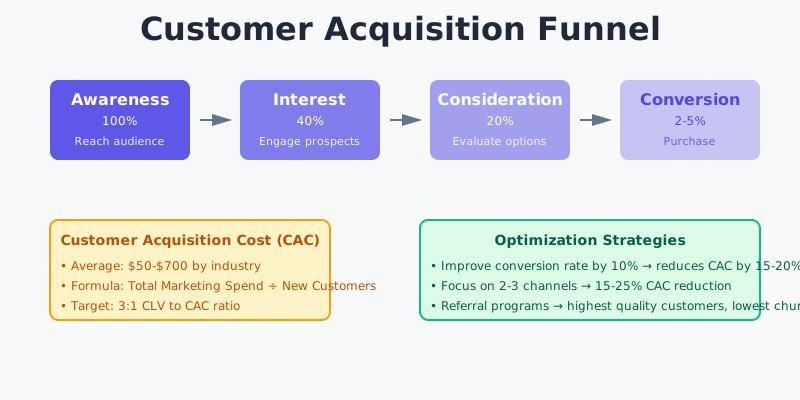
The Customer Acquisition Funnel
Shows the complete journey from awareness through conversion, including key metrics at each stage and common conversion rates.
🔍 Click to enlarge
Why Customer Acquisition Matters in 2026
In an increasingly competitive marketplace, companies that excel at customer acquisition are 60% more likely to outperform their competitors. Every business needs new customers to grow revenue and replace natural churn, yet most spend inefficiently, acquiring customers who don't stay or spend enough to justify the acquisition cost. This is why understanding and optimizing your acquisition strategy is foundational to sustainable business growth.
The business environment in 2026 demands strategic focus. Resources are finite, and spreading your budget across too many channels dilutes your ability to optimize any of them. Companies winning right now prioritize two to three acquisition channels, execute them consistently, and measure results obsessively. This focused approach allows for continuous improvement and better ROI than trying to be everywhere at once.
Customer acquisition directly impacts profitability. If you spend more acquiring a customer than they spend with you over their lifetime, you're building a business on a losing foundation. Conversely, mastering acquisition means scaling revenue without proportional increases in marketing spend—the definition of sustainable business growth and the path to stronger margins and long-term success.
The Science Behind Customer Acquisition
Customer acquisition operates on the principle of matching the right message, to the right person, through the right channel, at the right time. Neuroscience research shows that people make purchasing decisions based on emotion first, rationalization second. This means your acquisition strategy must engage both emotional and logical centers of decision-making. When your message resonates with a prospect's values and addresses their real pain points, conversion rates improve dramatically.
Data-driven acquisition strategies outperform intuition-based approaches by 3-5x. By tracking which channels drive the highest-quality customers, which messages resonate best with your audience, and which offers convert most effectively, you create feedback loops for continuous improvement. Every dollar spent becomes an experiment generating insights that inform the next dollar spent, compounding your acquisition efficiency over time.
Customer Acquisition Cost (CAC) Framework
Illustrates how to calculate CAC, the CLV:CAC ratio target, and the relationship between acquisition cost and customer lifetime value.
🔍 Click to enlarge
Key Components of Customer Acquisition
1. Target Audience Definition
The foundation of effective acquisition is knowing exactly who you're trying to reach. This goes beyond basic demographics—it includes understanding their pain points, aspirations, decision-making criteria, budget constraints, and buying timeline. When you deeply understand your ideal customer, you can craft messaging that speaks directly to their needs, select channels where they actively spend time, and design offers that feel irresistibly valuable to them specifically.
2. Channel Selection and Optimization
Different acquisition channels reach different audiences and serve different purposes. Organic search reaches people actively seeking solutions. Content marketing builds authority and trust over time. Paid advertising reaches people regardless of intent but requires careful targeting. Referrals leverage existing customer satisfaction. Email reaches engaged audiences directly. The key is identifying which channels your ideal customers use and where you can compete effectively with your resources and messaging.
3. Conversion Rate Optimization
Even small improvements in conversion rates dramatically reduce your CAC. A 10% improvement in landing page conversion can reduce CAC by 15-20%. This means every element of your customer journey matters—from the clarity of your messaging to the speed of your website to the trust signals on your sales page. Continuous testing, whether through A/B tests or multivariate experiments, compounds these improvements over time.
4. Measurement and Analytics
You cannot improve what you don't measure. Tracking customer acquisition metrics—CAC by channel, customer lifetime value, churn rate, viral coefficient, and more—creates visibility into which strategies work and which don't. This data becomes the basis for reallocating budget toward high-performing channels and away from low performers. Companies that measure consistently see 15-25% CAC reduction through smart budget allocation.
| Channel | Average CAC | Customer Quality |
|---|---|---|
| Organic Search (SEO) | $50-150 | Highest intent, best LTV |
| Content Marketing | $100-300 | High intent, strong engagement |
| Paid Search (PPC) | $75-200 | High intent, immediate |
| Social Media Ads | $150-500 | Varies by targeting precision |
| Email Marketing | $10-50 | Depends on list quality |
| Referral Programs | $25-100 | Highest LTV, best retention |
| Influencer Marketing | $200-2000 | Varies by influencer relevance |
| Direct Sales | $500-3000+ | Best for B2B, consultative |
How to Apply Customer Acquisition: Step by Step
- Step 1: Define your ideal customer profile by analyzing your best existing customers—identify common characteristics, pain points, buying triggers, and decision criteria.
- Step 2: Research where your ideal customers spend time online and offline—which platforms they use, which publications they read, which communities they participate in.
- Step 3: Map your acquisition channels by listing every possible way to reach your target audience, categorizing by cost, speed, and required resources.
- Step 4: Create your core messaging around the transformation your product enables and the specific problems you solve, tested and refined through customer conversations.
- Step 5: Select two to three channels to own deeply rather than spreading thinly—focus on channels aligned with your resources and where you can build competitive advantage.
- Step 6: Develop channel-specific strategies—optimize your website for organic search, create content that answers common questions, set up paid campaigns with tight audience targeting.
- Step 7: Implement measurement systems to track CAC, customer quality, churn rate, and lifetime value by channel, enabling data-driven optimization decisions.
- Step 8: Test continuously—A/B test landing pages, email subject lines, ad creative, messaging, and offers to incrementally improve conversion rates.
- Step 9: Analyze results monthly, identifying which channels deliver the best customers and highest lifetime value relative to acquisition cost.
- Step 10: Reallocate budget toward top-performing channels and away from underperformers, compounding your acquisition efficiency over time.
Customer Acquisition Across Life Stages
Young Adulthood (18-35)
Young entrepreneurs often lack capital for paid advertising and must bootstrap their customer acquisition through organic channels, content marketing, and leveraging personal networks. Social media and communities are natural acquisition channels for this demographic, both as entrepreneurs and as customers. The focus should be on building genuine relationships, creating valuable content, and establishing authority in a niche before scaling paid acquisition efforts.
Middle Adulthood (35-55)
Experienced business leaders at this stage typically have budget for paid acquisition and deeper understanding of their market. The focus shifts toward optimizing CAC through sophisticated targeting, building customer loyalty for repeat purchases, and scaling proven acquisition channels. At this stage, efficiency becomes paramount—measuring everything and allocating budget toward the highest-performing channels. Many successful businesses at this stage generate 50%+ of new customers through referrals from satisfied existing customers.
Later Adulthood (55+)
Mature business leaders focus on sustainable acquisition that doesn't burn cash, often emphasizing organic and referral-based channels that generate high-quality customers with strong lifetime value. The emphasis is often on building moats—competitive advantages like brand reputation, customer loyalty, and referral networks that make customer acquisition increasingly efficient without requiring more marketing spend. This stage emphasizes building businesses that run on their own momentum.
Profiles: Your Customer Acquisition Approach
The Growth Hacker
- Data and analytics infrastructure to measure everything
- Permission to experiment rapidly and fail cheaply
- Budget to test multiple channels simultaneously
Common pitfall: Chasing the latest growth hack without building sustainable systems; moving too fast to capture learnings.
Best move: Focus on building repeatable systems in 2-3 channels rather than constant experimentation. Measure quality alongside quantity.
The Content Creator
- Time and consistency to create valuable content regularly
- Distribution channels that reach their target audience
- Ability to convert audience attention into customers
Common pitfall: Creating great content that doesn't connect to business goals or customer acquisition. Building audience without monetization path.
Best move: Align content strategy directly with customer acquisition funnel. Know which content moves prospects toward purchase decisions.
The Sales Professional
- High-quality leads and prospects from marketing efforts
- Tools and processes to nurture relationships at scale
- Feedback loops to improve messaging and targeting
Common pitfall: Blaming marketing for poor lead quality while not optimizing sales process; not providing feedback on what makes leads convertible.
Best move: Partner closely with marketing to define ideal customer profile and qualification criteria. Measure and share conversion rates by source.
The Bootstrapper
- Free or low-cost acquisition channels that generate real results
- Leverage of time and network rather than paid advertising budget
- Focus and discipline to master one channel before expanding
Common pitfall: Trying to compete with well-funded competitors on paid channels; spreading effort across too many channels with insufficient focus.
Best move: Double down on organic channels and referrals. Build genuine relationships. Every dollar saved on CAC improves unit economics.
Common Customer Acquisition Mistakes
The most expensive mistake in customer acquisition is poor targeting—spending on reaching the wrong people. When you acquire customers who don't actually want what you're selling, they churn immediately, destroying unit economics. Every dollar spent acquiring them becomes a loss. Better to spend on fewer, more precisely targeted prospects than waste budget on poor fit customers.
The second critical mistake is ignoring customer lifetime value in favor of short-term metrics. Optimizing only for CAC without considering which channels drive the best customers creates a false economy. A customer acquired for $50 who spends $500 total is better than one acquired for $25 who spends $50. Track not just CAC but customer quality, retention, and lifetime value by channel.
The third mistake is spreading effort too thin across channels. Most successful acquisition strategies focus deeply on 2-3 channels rather than dabbling in many. This allows for real optimization, competitive advantage development, and efficient resource use. Spread yourself across 10 channels and you'll execute 10 strategies poorly; focus on 3 and you'll execute them well.
The Customer Acquisition Optimization Cycle
Shows the continuous cycle of measure, analyze, optimize, and execute that drives improving customer acquisition efficiency.
🔍 Click to enlarge
Science and Studies
Recent research and industry benchmarks provide clear guidance for effective customer acquisition strategies. Understanding these findings helps you benchmark your performance against peers and identify improvement opportunities.
- Harvard Business Review research shows referred customers have 16-25% higher lifetime value and convert 3-5x faster than paid-acquired customers.
- Marketing Dive analysis indicates companies allocating budget to 2-3 focused channels see 15-25% CAC reduction compared to multi-channel spreads.
- Gartner studies show AI-powered personalization in acquisition campaigns improves conversion rates by 20-30% on average.
- Shopify data demonstrates that optimizing conversion rate by 10% reduces CAC by 15-20% without additional traffic investment.
- LinkedIn research reveals that sales-marketing alignment improves customer acquisition efficiency by 40% and increases revenue growth by 38%.
Your First Micro Habit
Start Small Today
Today's action: Spend 15 minutes today identifying your top 5 existing customers and analyzing what they have in common—location, industry, problem they had, how they found you.
Your best customers are your greatest teachers. They reveal which messaging resonates, which channels work, and which value props truly matter. This insight becomes the foundation for all acquisition decisions. One 15-minute analysis beats hours of guessing.
Keep quitting habit apps after a missed day? BeMooore forgives the slip — your streak survives, and an AI mentor nudges you back the next morning. Free on iOS.
Quick Assessment
How clear are you currently about who your ideal customer is?
Clarity about your ideal customer is the foundation of efficient acquisition. The clearer you are, the more precisely you can target and message.
How many customer acquisition channels are you currently active in?
More channels doesn't mean more customers. Focused depth in 2-3 channels beats scattered effort across many. Quality of execution matters more than number of channels.
What metric do you track most carefully for customer acquisition?
Track both CAC and CLV to understand the full economics. CAC without CLV context is incomplete; you might be acquiring customers who don't generate profit.
Take our full assessment to get personalized recommendations.
Discover Your Style →Next Steps
Start by clearly defining your ideal customer profile. Who are they? What problems do they face? Where do they spend time? How do they make purchasing decisions? Document this in detail—the clarity you gain here cascades through every other decision about messaging, channels, and measurement. You can't acquire customers efficiently if you're unclear about who you're trying to reach.
Then select two acquisition channels to master deeply. Choose channels where your ideal customers are active and where you have reasonable resources to execute. Focus 80% of effort on these two channels for the next 90 days, measuring everything meticulously. After 90 days, analyze results, optimize your approach, and consider testing a third channel if the first two are working.
Get personalized guidance with AI coaching.
Start Your Journey →Research Sources
This article is based on peer-reviewed research and authoritative sources. Below are the key references we consulted:
Related Glossary Articles
Frequently Asked Questions
What is a good customer acquisition cost?
The ideal CAC depends on your industry and business model. A healthy benchmark is achieving a 3:1 CLV:CAC ratio—meaning the lifetime value should be 3x the acquisition cost. This allows margin for overhead and profit. E-commerce might target $50-100 CAC, while B2B SaaS might have $200-700 CAC.
Which customer acquisition channel is best?
There is no universally best channel—it depends on your product, audience, and resources. Organic search works best for high-intent searches. Content marketing builds long-term authority. Referrals deliver highest-quality customers. Paid ads scale quickly. The best channel for you is one your target audience uses and where you can execute effectively.
How long does customer acquisition strategy take to show results?
Results vary by channel. Paid ads can drive customers immediately. Organic search and content marketing take 3-6 months to show meaningful results but improve over time. Referral programs compound over months. Focus on consistent execution and measurement rather than expecting instant results.
Should I focus on acquiring new customers or keeping existing ones?
Both matter, but the ratio depends on your stage. Early-stage, focus 80% on acquisition, 20% on retention to find product-market fit. Mature companies often reverse this to 20% acquisition, 80% retention. Retention improves unit economics because keeping customers costs 5-7x less than acquiring new ones.
How do I know if a customer acquisition strategy is working?
Measure CAC, customer lifetime value, churn rate, repeat purchase rate, and profitability by channel. Compare against industry benchmarks and your own historical performance. Track cohort-based metrics—do customers acquired from Channel A spend more over time than those from Channel B? Let data guide your resource allocation.
Take the Next Step
Ready to improve your wellbeing? Take our free assessment to get personalized recommendations based on your unique situation.
- Discover your strengths and gaps
- Get personalized quick wins
- Track your progress over time
- Evidence-based strategies