Product Development
Product development is the strategic process of bringing a new product or service to market. It's the journey from your first spark of inspiration to a fully launched, revenue-generating offering that solves real problems for real customers. Whether you're a startup founder, an entrepreneur, or someone managing innovation within an established company, understanding product development can transform your ability to create offerings that customers genuinely want and are willing to pay for. The difference between products that succeed and those that fail often comes down to how well you navigate the product development process, validate your assumptions, and stay responsive to customer feedback throughout the journey.
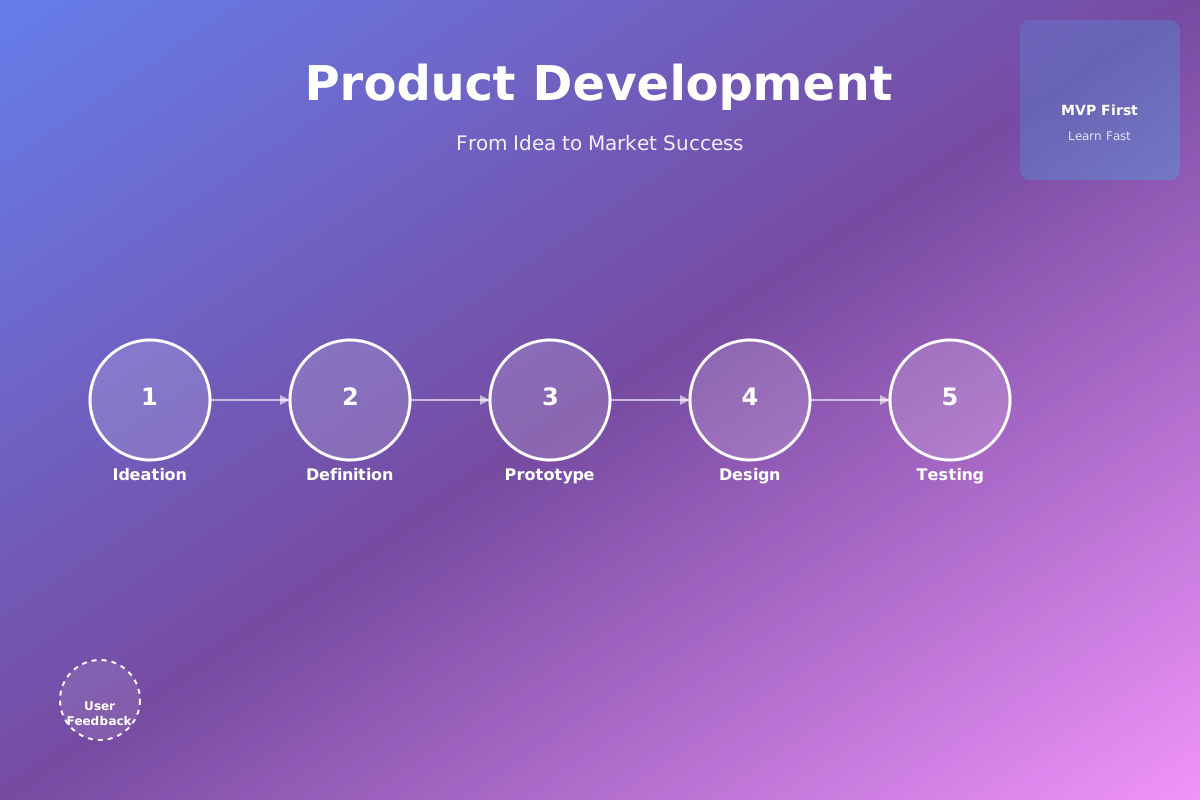
What makes product development truly powerful is that it's not a single flash of genius—it's a systematic approach that reduces risk, saves money, and accelerates your time to market. By learning to research your market, build minimum viable products, test prototypes, and gather user feedback before full-scale investment, you can avoid the costly mistake of building something nobody wants.
In this guide, you'll discover the complete product development framework that successful entrepreneurs use, the common mistakes that derail projects, and the practical steps you can take today to start developing your next breakthrough product.
What Is Product Development?
Product development is the complete process of taking a concept from initial idea through research, design, prototyping, testing, and finally launching it to the market. It involves identifying customer needs, creating solutions that address those needs, and validating that your product will resonate with your target audience before you invest heavily in manufacturing or scaling. Not medical advice.
Think of product development as a structured conversation between your business vision and your market reality. You start with a hypothesis about what customers need, then systematically test that hypothesis through research, prototypes, and user feedback. This iterative approach helps you refine your offering, reduce uncertainty, and make better decisions at every stage. The goal isn't perfection in your first attempt—it's gathering intelligence that guides you toward a product that truly fits the market.
Surprising Insight: Surprising Insight: According to BCG research, while 83% of companies prioritize innovation, only 3% actually succeed in converting those priorities into commercially viable results. The difference? Those successful 3% follow structured product development processes and prioritize user validation over assumptions.
The Six Stages of Product Development
Visual representation of the complete product development lifecycle from ideation through commercialization
🔍 Click to enlarge
Why Product Development Matters in 2026
In 2026, product development has become more critical than ever. The speed at which markets change, the availability of user feedback through digital channels, and the rise of agile methodologies mean that companies can no longer rely on lengthy research phases followed by a big launch. Instead, successful organizations use rapid prototyping, continuous user feedback, and iterative refinement to stay competitive. Product development is how you bridge the gap between what you think customers want and what they actually need.
The stakes are high: McKinsey research shows that companies using structured product development reduce their failure rates by 60% compared to those using ad-hoc approaches. In an economy where capital is competitive and customer attention is scarce, following a proven product development process isn't optional—it's essential. Whether you're bootstrapping a startup or managing innovation in an enterprise, product development gives you the tools to succeed faster and waste less.
Beyond reducing failure rates, product development in 2026 is increasingly about speed to market. With AI adoption in product development rising from 23% in 2022 to 46% in 2025, companies are using technology to accelerate user research, automate prototyping, and predict market reactions. Entrepreneurs who understand modern product development principles can compress what used to take years into months, gaining competitive advantage through faster iteration and learning cycles.
The Science Behind Product Development
Product development is rooted in several powerful scientific principles. The Build-Measure-Learn cycle, pioneered by the lean startup movement, demonstrates that rapid iteration with real customer feedback beats lengthy planning. Each cycle gives you data about what works and what doesn't, reducing the guesswork from product decisions. This creates a feedback loop where every iteration gets you closer to product-market fit—the holy grail of product development where your offering so perfectly matches market demand that growth becomes self-sustaining.
User research science shows that the best product insights come from observing actual user behavior and listening to their problems, not from assumptions made in conference rooms. Studies by Nielsen and other UX research firms consistently demonstrate that products developed with user input early and often have significantly higher adoption rates and customer satisfaction than those developed in isolation. When you validate assumptions through prototyping and testing, you're applying the scientific method to product development—forming hypotheses, testing them experimentally, and refining your understanding based on evidence.
The Build-Measure-Learn Feedback Loop
Iterative cycle showing how rapid prototyping and user feedback accelerate learning and product refinement
🔍 Click to enlarge
Key Components of Product Development
Market Research & Discovery
Before you build anything, you need to understand your market deeply. Market research involves identifying your target audience, understanding their pain points, analyzing competitors, and validating that a real problem exists that enough customers care about. This phase prevents the catastrophic scenario of spending months and resources building something nobody wants. Use techniques like customer interviews, surveys, and competitive analysis to gather intelligence that informs every downstream decision.
MVP Strategy & Validation
A Minimum Viable Product (MVP) is the lean version of your product with just enough features to satisfy early adopters and test your core hypothesis. The MVP approach, popularized through agile and lean startup methodologies, lets you validate market demand before heavy investment. The goal isn't to launch a perfect product—it's to launch quickly, gather real-world feedback, and make data-driven decisions about what to build next. Companies using structured MVP development reduce failure rates by 60%, according to industry research.
User Research & Testing
User research is continuous throughout product development, not a one-time event. It includes usability testing with prototypes, feedback sessions with target customers, behavior analysis, and iterative refinement based on what you learn. The science is clear: products developed with consistent user input have significantly higher adoption rates. Techniques range from informal customer interviews to structured usability tests to analytics-based behavioral tracking. Each reveals different types of valuable insight.
Prototyping & Design Iteration
Prototyping bridges the gap between abstract ideas and concrete feedback. A prototype might be as simple as paper sketches, a clickable wireframe, or a functional code implementation—whatever lets you test your hypothesis cost-effectively. Design iteration uses prototype feedback to refine your approach, eliminating bad ideas early and doubling down on promising ones. Modern product teams often create multiple prototypes and test them with users before committing to final design, dramatically reducing the risk of expensive mistakes downstream.
| Stage | Primary Activity | Success Metric |
|---|---|---|
| Ideation | Generate & evaluate ideas | Identified problem worth solving |
| Definition | Clarify problem & solution approach | Clear value proposition |
| Prototype | Build minimum viable version | Testable hypothesis |
| Design | Refine based on feedback | User approval of core concept |
| Testing | Validate with target market | Product-market fit signals |
| Commercialization | Scale & market to full audience | Revenue & retention metrics |
How to Apply Product Development: Step by Step
- Step 1: Identify a Problem: Start by identifying a genuine customer problem that affects enough people to support a business. Talk to potential customers, observe their workflows, and understand the gaps they're trying to fill. The best products solve problems that customers are currently spending time and money trying to solve in suboptimal ways.
- Step 2: Validate Market Demand: Before investing heavily, validate that real demand exists. Conduct customer interviews, create landing pages to measure interest, run small surveys, or pre-sell your concept. Aim for evidence that customers would actually pay for a solution, not just that they think it's a nice idea.
- Step 3: Define Your Core Value Proposition: Clearly articulate what your product does, who it's for, and why it matters more than alternatives. Your value proposition should be specific, testable, and focused on the primary benefit that justifies the customer's time and money investment.
- Step 4: Research & Competitive Analysis: Study existing solutions, understand what competitors are doing well and where they're falling short. Look for white space—problems that competitors aren't addressing well. This research helps you position your product effectively and identify genuine innovation opportunities.
- Step 5: Design Your Minimum Viable Product: Define the absolute minimum set of features needed to test your core hypothesis. Resist the urge to build everything you envision. An MVP for a mobile app might be 5-8 core features, not the 50 features you want to eventually build. This discipline gets you feedback faster and wastes less money.
- Step 6: Build & Prototype: Create your MVP using whatever approach gets you to user testing fastest. That might be a coded prototype, a paper mockup, a Figma design, or even a Wizard-of-Oz prototype where you simulate functionality manually. The goal is testable feedback, not polish.
- Step 7: Test with Real Users: Put your prototype in front of 10-20 target customers. Watch them use it, ask questions, gather feedback. What confuses them? What delights them? Where do they get stuck? This qualitative feedback is gold for product development because it reveals not just what people think but how they actually behave.
- Step 8: Iterate Based on Feedback: Use your testing insights to refine your prototype. Some feedback you'll ignore (inconsistent requests), some you'll implement (common problems), and some will reveal that you need to pivot your approach entirely. This iterative cycle is where most of the learning happens.
- Step 9: Achieve Product-Market Fit: Continue refining until you reach a point where your product resonates so strongly with your target market that growth becomes self-sustaining. You'll know you're there when customers are actively promoting your product to others and retention is strong. This is the moment to start thinking about scaling.
- Step 10: Scale & Commercialize: Once you have product-market fit, invest in scaling through better marketing, hiring, infrastructure, and expanding to adjacent customer segments. But don't scale before you have fit—scaling a product that doesn't resonate just amplifies your problems and wastes capital.
Product Development Across Life Stages
Young Adulthood (18-35)
For young adults starting their entrepreneurial journey, product development is about experimentation and learning. You likely have more time than capital and less to lose from failure, making this the ideal window to test ideas, build side projects, and develop the skill of understanding customers. Focus on identifying genuine problems in your own life or communities you're part of, then validate whether others share the same pain point. Embrace failure as data, not disaster. The product development discipline you build now compounds across your career, helping you recognize good opportunities and avoid bad ones more quickly over time.
Middle Adulthood (35-55)
In middle adulthood, product development becomes more strategic. You might be managing teams developing products within organizations, or you've launched ventures with more resources at stake. Your advantage is experience—you understand market cycles, organizational dynamics, and customer behavior more deeply. Apply that wisdom by being more rigorous about validation before heavy investment. Middle-career product developers can accelerate their teams by institutionalizing user research, building prototyping discipline, and creating feedback loops that prevent executives from pursuing pet projects instead of customer-validated directions. Your career impact multiplies through developing others in product development methodology.
Later Adulthood (55+)
Later-career professionals bring invaluable perspective to product development. You've seen how products age, which features actually matter to customers over time, and how market dynamics shift. Your contribution to product development at this stage is mentorship, strategic vision, and the courage to challenge assumptions when you see patterns repeating. Many successful later-career entrepreneurs focus on solving problems they've seen go unsolved for decades, bringing both urgency and deep expertise to product development. Your perspective on quality, longevity, and customer relationships helps younger teams avoid short-term thinking and build products designed to endure.
Profiles: Your Product Development Approach
The Visionary Innovator
- Permission to explore wildly different ideas without immediate ROI pressure
- User feedback loops that prevent getting lost in technical complexity
- Collaboration with practical problem-solvers who ground ideas in market reality
Common pitfall: Building impressive solutions to problems customers don't actually have, or feature-rich products that confuse users
Best move: Constrain your vision with an MVP requirement. Force yourself to solve one core problem exceptionally well, then expand. Pair with a business-focused partner who pushes back on complexity.
The Lean Strategist
- Data that justifies every decision and clear metrics for measuring progress
- Structured processes that prevent endless iteration and unclear decision gates
- Permission to make decisions with incomplete information when the cost of waiting exceeds the value of more data
Common pitfall: Analysis paralysis where you never feel you have enough data to proceed, resulting in slower time-to-market than competitors
Best move: Set clear decision gates. Define what data you need to make each decision, then commit to deciding by a specific date. Accept that some learning only happens after launch, not before.
The Customer Whisperer
- Deep relationship with target customer segments and permission to spend significant time with them
- Synthesis frameworks that turn qualitative customer feedback into clear product direction
- Authority to push back against internal stakeholders who want features customers don't need
Common pitfall: Building exactly what customers ask for without understanding the underlying problem, resulting in feature bloat and complexity
Best move: Listen for the problem behind the request, not the solution. Practice asking 'Why is that important?' and 'What are you trying to accomplish?' to get to root needs, then craft elegant solutions.
The Execution Master
- Clear requirements and scope boundaries to prevent endless scope creep
- Authority to make quality decisions without getting stuck in perfectionism
- Feedback mechanisms that reveal what's actually working with real customers, not what you assume
Common pitfall: Building products that are technically flawless but miss what customers actually care about because you skipped user feedback
Best move: Embrace done over perfect. Get your MVP in front of users even when it feels incomplete. Real user feedback will guide what refinement matters most, saving you time on improvements nobody cares about.
Common Product Development Mistakes
The most common mistake in product development is solving a problem nobody has. You become attached to your idea and assume the market will care because you care. The cure is ruthless customer validation. Talk to at least 20-30 potential customers before you invest significantly. If they're not genuinely excited about your solution, that's data—either your target audience definition is wrong, or your solution doesn't actually solve their problem well enough.
Another widespread mistake is building too much too soon. You think customers will be impressed by your feature-rich MVP, but instead they're confused. The discipline of building minimal products that test one core hypothesis is counterintuitive—it feels like you're shipping something incomplete. But users teach you what matters through their behavior. The features they use reveal priorities. The features they ignore were nice ideas but not essential. Building less initially lets you learn faster and adjust direction before heavy investment.
A third critical mistake is ignoring market signals that your hypothesis is wrong. You launch, gather feedback, and discover that customers aren't adopting as you expected. Instead of investigating what's actually happening, you assume you just need better marketing or a bigger launch event. The honest conversation is harder: does the market actually want this product? Is there a different segment that needs it more? Should we pivot our approach entirely? The companies that succeed in product development are the ones willing to face these hard truths early rather than throwing good money after bad.
Product Development Failure Points & Prevention
Common mistakes that derail product development projects and evidence-based prevention strategies
🔍 Click to enlarge
Science and Studies
Product development effectiveness is supported by extensive research from leading organizations. Studies from MIT, Stanford, and consulting firms like McKinsey and BCG consistently show that products developed with user input outperform those developed in isolation. The research also demonstrates clear patterns about what makes product development successful versus what leads to failure.
- McKinsey (2024): Companies using structured MVP development reduce failure rates by 60% compared to ad-hoc approaches, directly linking process discipline to commercial success
- BCG (2023): While 83% of companies prioritize innovation, only 3% convert priorities to results. Successful companies follow systematic product development processes
- Nielsen Norman Group (2023): Products tested with users during development have significantly higher adoption rates and user satisfaction than those developed without user input
- Lean Startup Studies (2022): Build-Measure-Learn cycles accelerate learning by 40-60% compared to traditional waterfall approaches, enabling faster iteration and better decisions
- Product School Research (2024): Teams using formal product development frameworks report 28% faster time-to-market and 45% higher product retention rates
Your First Micro Habit
Start Small Today
Today's action: Talk to three potential customers this week about a problem you want to solve. Ask open-ended questions about their workflow, what frustrates them, and what they'd pay for a solution. Don't pitch—just listen. Write down exactly what they say.
This single habit builds the customer obsession that separates successful product developers from those who build in isolation. Three conversations reveals patterns you'd miss from one. Weekly repetition creates a rhythm of customer engagement that becomes intuitive. You start thinking like a customer researcher instead of guessing what customers need.
Track your customer research conversations and get AI-powered prompts for better interview questions with our app.
Quick Assessment
When facing a product decision, what's your natural starting point?
Your answer reveals your natural product development style. Research-first thinkers prevent costly mistakes. Solution-first thinkers drive innovation. Prototype-first thinkers learn fastest. Plan-first thinkers ensure alignment. The most effective product developers blend all four approaches depending on context, but knowing your natural preference helps you strengthen your weaker areas.
When you get feedback that your product idea isn't working, what's your instinct?
This reveals your relationship with feedback and adaptability. The most successful product developers quickly recognize when market feedback indicates a fundamental mismatch rather than a messaging problem. They pivot before wasting years on a fundamentally flawed approach. That's not weakness—that's strategic thinking.
What type of uncertainty makes you most uncomfortable?
Different product developers fear different types of uncertainty. The best ones learn to manage their specific fear without letting it paralyze decision-making. Market uncertainty is managed through customer research. Design uncertainty is managed through prototyping. Adoption uncertainty is managed through testing. Stakeholder uncertainty is managed through communication and early wins.
Take our full assessment to get personalized recommendations.
Discover Your Style →Next Steps
The product development principles covered in this guide aren't theoretical—they've been proven across thousands of companies, from startups to enterprises. Your next step is moving from knowledge to action. Identify one product idea or improvement you want to develop, then follow the framework: start with customer research to validate that a real problem exists, create a hypothesis about your solution, build an MVP that tests that hypothesis, and gather feedback from real users. The discipline of this process, repeated rigorously, is how great products emerge.
Product development is ultimately about reducing the risk of failure through systematic learning. Every time you validate an assumption with customer feedback instead of guessing, every time you iterate based on real usage data instead of conference room debates, every time you pivot when the market signals that your hypothesis was wrong, you're applying proven principles that successful product developers live by. The companies and entrepreneurs that win aren't necessarily the ones with the best initial ideas—they're the ones most disciplined about testing, learning, and adapting those ideas based on market reality.
Get personalized guidance with AI coaching.
Start Your Journey →Research Sources
This article is based on peer-reviewed research and authoritative sources. Below are the key references we consulted:
Related Glossary Articles
Frequently Asked Questions
How long does product development typically take?
On average, product development takes about 2 years from initial concept to market launch. However, this varies significantly: a minimum viable product might take 3-6 months, while full feature development and scaling can extend beyond 2 years. Using agile approaches and focusing on MVP can compress this timeline to 6-12 months for first market entry.
What's the difference between MVP and a full product?
An MVP (Minimum Viable Product) is the stripped-down version with only essential features needed to test your core hypothesis and get user feedback. A full product has all the features, polish, design refinement, and infrastructure that create a complete customer experience. The MVP is about learning fast; the full product is about serving customers comprehensively. Most successful products evolve from MVP to full over several months or years.
How do I know if my product idea has real market demand?
True market demand is revealed through customer actions, not words. The strongest signals are: customers willing to pre-pay or pre-order your product, competitors already serving this market profitably, significant online searches or community discussions about the problem, and customers currently paying for inferior solutions. Weak signals are customers saying 'that's a great idea' or positive response to surveys without actual commitment.
Should I bootstrap or seek funding for product development?
Both approaches work. Bootstrapping forces financial discipline and ensures product-market fit before growth spending, but limits speed. Funding accelerates hiring and marketing but can pressure premature scaling before validation. The choice depends on market urgency, your personal financial situation, and whether the competitive landscape requires speed. Many successful products start bootstrapped and raise capital after achieving traction.
How do I balance innovation with listening to customers?
The best balance is innovation grounded in deep customer understanding. Listen for the problem customers are trying to solve, not necessarily the solution they propose. Then innovate in how you solve that problem. Blindly building what customers request creates feature bloat; ignoring customers entirely creates products nobody wants. The sweet spot is understanding customer needs so deeply that your innovation delights them.
Take the Next Step
Ready to improve your wellbeing? Take our free assessment to get personalized recommendations based on your unique situation.
- Discover your strengths and gaps
- Get personalized quick wins
- Track your progress over time
- Evidence-based strategies