Business Growth
Business growth is the pursuit of expanding your company's reach, revenue, and impact in meaningful ways. In 2026, growth isn't just about making more money—it's about building sustainable systems that create value for customers while strengthening your competitive position. Whether you're a solopreneur, small business owner, or scaling entrepreneur, understanding growth strategy is essential. Growth can feel daunting, but it becomes manageable when you break it into clear stages: market penetration, customer retention, expansion, and optimization. This comprehensive guide explores proven strategies, common pitfalls, and actionable steps to accelerate your business growth.
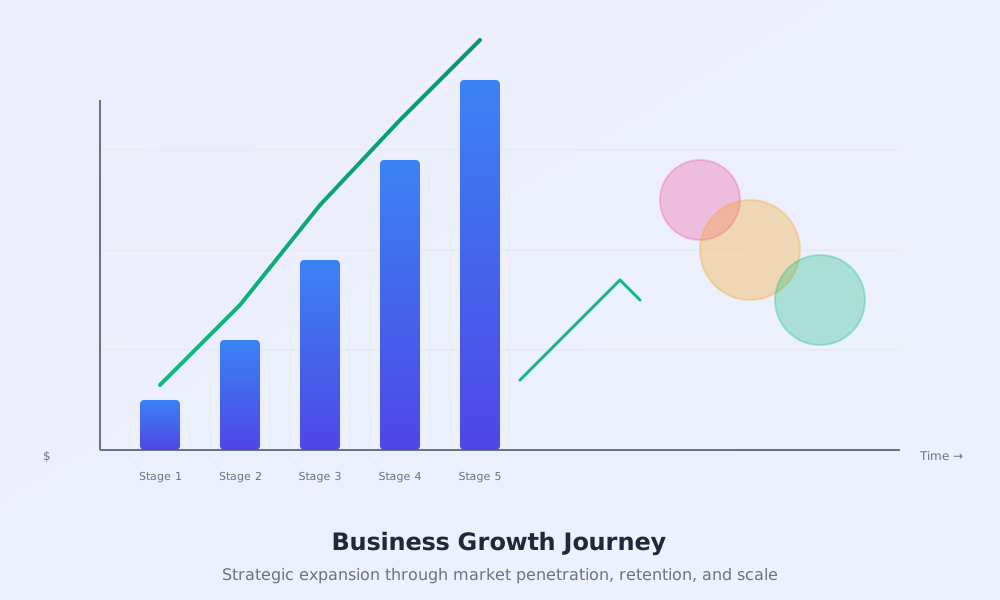
Ever noticed how some businesses grow 10x while others plateau? The difference isn't luck—it's strategy, execution, and understanding what drives growth in your specific market.
Business growth compounds over time. A 20% annual growth rate creates dramatic differences across five years, and companies that achieve this consistently share common practices: clear metrics, customer focus, and continuous optimization.
What Is Business Growth?
Business growth refers to the intentional expansion of a company's operations, customer base, revenue, and market presence. It's a multidimensional concept that encompasses increasing sales volume, entering new markets, expanding product or service offerings, improving profit margins, and building organizational capacity to serve more customers sustainably. Growth is measured not just in revenue, but in customer acquisition cost, lifetime value, market share, and operational efficiency. True business growth balances top-line revenue expansion with bottom-line profitability and long-term sustainability.
Not medical advice.
Business growth exists on a spectrum. Early-stage growth focuses on finding product-market fit and validating your value proposition. Mid-stage growth emphasizes scaling operations efficiently while maintaining quality. Mature growth involves market expansion, diversification, and optimizing margins. Each stage requires different strategies, metrics, and organizational structures. Understanding your current growth stage is essential for applying the right strategies at the right time.
Surprising Insight: Surprising Insight: Companies that focus primarily on customer retention grow 5X faster than those focused only on acquisition, yet most businesses spend 7X more on acquisition than retention.
The Business Growth Cycle
Four-stage growth progression showing market penetration, customer retention, expansion, and optimization phases.
🔍 Click to enlarge
Why Business Growth Matters in 2026
In 2026's competitive landscape, growth is necessary for survival. Stagnation isn't neutral—it's decline. Markets evolve rapidly, customer expectations shift continuously, and technology creates new opportunities and threats constantly. Companies that grow maintain relevance, attract talent, invest in innovation, and build resilience. Growth also creates psychological momentum that motivates teams and attracts investors, partners, and customers. A growing company signals health, innovation, and promise.
Growth funds future opportunities. Revenue growth provides capital for research, product development, market testing, and team expansion—all essential for staying competitive. Without growth, businesses become trapped in operational firefighting, unable to invest in innovation or improvement. Growth also improves company valuation, creates employee advancement opportunities, and enables higher compensation. For entrepreneurs, growth determines exit value and impact.
The 2026 growth imperative differs from previous years. Technology and automation reduce friction, making growth more accessible but also more competitive. Customer acquisition costs continue rising while attention spans shrink. At the same time, AI-powered tools, global connectivity, and data accessibility create unprecedented growth opportunities. The most successful businesses balance these forces through smart strategy, disciplined execution, and continuous learning.
The Science Behind Business Growth
Business growth follows predictable patterns grounded in economics, psychology, and organizational theory. The concept of compound growth—where each iteration builds on previous success—is fundamental. A 20% annual growth rate might seem modest, but over five years it multiplies revenue by 2.5X. This compounding effect is why early-stage growth investments often yield dramatic long-term returns. Growth also benefits from network effects: larger customer bases attract talent, enable better data analysis, reduce per-unit costs, and create more attractive acquisition targets.
From a psychological perspective, growth creates momentum that influences customer perception, employee engagement, and investor confidence. Customers prefer growing companies because they signal stability and innovation. Employees choose growing companies because they see advancement opportunities. Investors favor growing companies because they project viability. This self-reinforcing cycle is why some companies scale faster than others with similar products and markets. Understanding growth psychology helps you leverage momentum strategically.
Growth Compounding Effect
Visualization of how different growth rates compound over time, showing revenue multiplication.
🔍 Click to enlarge
Key Components of Business Growth
1. Market Penetration
Market penetration focuses on increasing your share of existing markets with your current products. This is typically the fastest way to grow because it requires minimal new product development and leverages existing infrastructure. Tactics include price optimization, enhanced marketing, improved distribution, and competitive positioning. Market penetration works best when your market is large, growing, and you have meaningful differentiation. Many successful businesses achieve 50-200% early growth through superior execution in established markets.
2. Customer Retention and Lifetime Value
Retention is economically powerful—acquiring a new customer costs 5-7 times more than retaining an existing one. Customer lifetime value (CLV) increases with retention, making long-term customers exponentially more profitable. Building strong retention requires excellent product quality, exceptional customer service, consistent value delivery, and regular communication. Companies that achieve 90%+ annual retention grow faster and more profitably than those with 70% retention, even with identical acquisition rates. Retention is also more predictable and scalable than acquisition.
3. Market and Product Expansion
Expansion involves entering new markets or launching new products. Geographic expansion targets customers in new regions with existing products. Customer segment expansion targets new buyer personas. Product expansion introduces complementary offerings. Expansion requires more investment than penetration because you're building new capabilities, learning new markets, and taking on new competitive dynamics. However, expansion reduces risk through diversification and opens larger addressable markets. Successful expansion requires market validation, adequate funding, and clear go-or-kill criteria.
4. Operational Excellence and Efficiency
Sustainable growth requires operational systems that scale efficiently. This means building processes, tools, and teams that deliver consistent quality at increasing volume without proportional cost increases. Key focus areas include automation, delegation, quality control, supply chain optimization, and technology infrastructure. Many scaling businesses fail because they prioritize growth speed over operational foundation. The most successful companies grow as fast as their operations can sustain profitably.
| Strategy | Timeline | Investment | Best For |
|---|---|---|---|
| Market Penetration | 6-18 months | Moderate | Early stage, established markets |
| Customer Retention | Ongoing | Low to Moderate | All stages, maximum ROI |
| Market Expansion | 18-36 months | High | Mature businesses, new geographies |
| Product Expansion | 12-24 months | Very High | Established customer base |
| Operational Scaling | Ongoing | Moderate | All stages, foundation for growth |
How to Apply Business Growth: Step by Step
- Step 1: Define Your Current Growth Stage: Accurately assess whether you're in early (product-market fit), mid (scaling), or mature (optimization) stage. This determines which strategies apply.
- Step 2: Identify Your Core Metrics: Define the 5-7 KPIs that drive growth in your business. For SaaS this might be MRR and churn; for e-commerce, customer acquisition cost and lifetime value; for services, capacity utilization and margins.
- Step 3: Conduct Market Analysis: Understand your total addressable market (TAM), your current market share, competitive positioning, and growth opportunities. Use research, customer interviews, and data analysis.
- Step 4: Test Growth Hypotheses: Rather than betting everything on one approach, run small experiments. Test pricing, messaging, channels, and value propositions with limited budget first.
- Step 5: Build Your Growth Model: Create a clear financial model showing how each growth lever impacts revenue, costs, and profitability. Understand unit economics—the cost to serve one customer.
- Step 6: Establish Growth Systems: Build repeatable processes for customer acquisition, onboarding, retention, and expansion. Automation and delegation are essential for scaling.
- Step 7: Measure Ruthlessly: Track your metrics daily or weekly. Create dashboards showing progress toward goals. Use data to guide decisions, not intuition.
- Step 8: Optimize Continuously: Growth is an optimization game. Every 4-12 weeks, analyze what's working and why. Double down on successful tactics and kill underperforming ones.
- Step 9: Scale What Works: Once you've validated a growth lever, invest more aggressively. Double marketing spend on top channels, hire sales people, add product features.
- Step 10: Rinse and Repeat: As you grow, earlier strategies plateau. Continuously develop new growth levers so growth remains sustainable and accelerating.
Business Growth Across Life Stages
Young Adulthood (18-35)
Early-career entrepreneurs are often starting their first business or exploring business ownership. This stage emphasizes learning, experimentation, and small-scale validation. Growth focus is on proving the concept works and finding initial customers. Capital is typically limited, so growth must be scrappy and efficient. Mentorship, learning from mistakes, and building foundational systems are priorities. This stage often involves 0-100 growth where simply getting first customers and delivering excellent service are the challenges.
Middle Adulthood (35-55)
Experienced entrepreneurs often manage established businesses with proven business models and growing customer bases. This stage emphasizes scaling operations, building teams, and pursuing more ambitious growth. Capital is more available through reinvestment or external funding. Growth challenges shift to operational capacity, talent acquisition, market competition, and strategic positioning. This stage often involves 100-1000 growth where systems, team capability, and execution excellence become critical success factors.
Later Adulthood (55+)
Seasoned entrepreneurs manage mature businesses with established market positions. Growth focus shifts to optimizing margins, managing succession, and deciding between harvesting profits or pursuing transformational growth. This stage emphasizes capital efficiency, risk management, and legacy building. Growth challenges involve market saturation, changing customer preferences, and emerging competition. Legacy considerations often influence strategy, with growth balanced against stability and personal goals.
Profiles: Your Business Growth Approach
The Rapid Scaler
- Clear competitive advantage
- Strong unit economics
- Abundant capital and talent
Common pitfall: Growing too fast, burning cash, sacrificing quality, losing culture
Best move: Slow growth to match operational capacity. Build sustainable systems before aggressive scaling. Maintain quality and culture.
The Efficient Builder
- Disciplined execution
- Capital efficiency
- Strong processes
Common pitfall: Growing too slowly, missing market opportunities, underinvesting in marketing
Best move: Balance efficiency with growth investment. Use early profitability to fund strategic expansion. Test more opportunities.
The Innovative Explorer
- Product differentiation
- Market education
- Brand building
Common pitfall: Feature creep, spreading resources thin, competing on price instead of innovation
Best move: Focus on core value proposition. Educate market about unique benefits. Build defensible advantage.
The Steady Accumulator
- Customer relationships
- Service excellence
- Profitable unit economics
Common pitfall: Avoiding risk, missing transformational opportunities, complacency
Best move: Explore adjacent markets and products. Consider strategic partnerships. Test new growth vectors.
Common Business Growth Mistakes
The biggest growth mistake is pursuing growth without clear metrics and accountability. Many businesses grow revenue while profitability declines, unit economics deteriorate, or customer satisfaction drops. Growth for its own sake destroys value. The solution is ruthless metric discipline: understand which growth is profitable, what your customer acquisition cost is, what your lifetime value is, and when these metrics indicate healthy growth.
A second critical mistake is neglecting retention while chasing acquisition. This creates a leaky bucket where you acquire customers faster than they leave but without the profitability to support growth. Retention is more controllable and scalable than acquisition. Focusing on creating such strong customer value that retention exceeds 90% ensures sustainable growth. This means regularly gathering customer feedback, improving products based on that feedback, and staying responsive to customer needs.
The third mistake is growing without building operational foundation. Many businesses achieve impressive top-line growth while losing money, delivering inconsistent quality, or burning out teams. Sustainable growth requires systems that scale: documented processes, trained team members, technology infrastructure, and quality control mechanisms. Companies that skip this foundation often struggle managing operations during rapid growth and sacrifice long-term viability for short-term speed.
Growth Mistakes and Solutions
Common pitfalls in business growth and how to avoid them.
🔍 Click to enlarge
Science and Studies
Research on business growth reveals consistent patterns across industries and company sizes. The most comprehensive studies emphasize that strategic clarity, operational execution, and customer focus are the three pillars of sustainable growth. Data from leadership research, economic studies, and business research institutions shows that companies implementing these principles grow 2-3X faster than peers.
- Bain & Company research on customer retention shows that a 5% improvement in retention increases profits by 25-95%, demonstrating the economic power of retention focus over pure acquisition.
- McKinsey studies on business scaling emphasize that successful scale-ups establish clear operating systems before aggressive growth, reducing operational risk and improving long-term viability.
- HubSpot research on growth metrics shows that companies tracking and optimizing 5-8 key KPIs grow 23% faster than those with poor metric discipline or misaligned metrics.
- Stanford GSB research on growth strategy shows that market penetration (improving execution in current market) accounts for 73% of growth in established markets, with market expansion and new products providing the remainder.
- BCG analysis of growth companies shows that diversified growth (combining retention, penetration, and expansion) is more resilient and sustainable than single-lever strategies.
Your First Micro Habit
Start Small Today
Today's action: Audit your current growth metrics today: calculate your customer acquisition cost, lifetime value, monthly recurring revenue, and annual retention rate. Write these numbers down. Most businesses don't know these critical numbers—knowing them puts you ahead of 80% of competitors.
Metric awareness is the first step toward growth. You can't improve what you don't measure. Once you have baseline numbers, you can test small improvements and see impact immediately. This creates momentum and confidence.
Keep quitting habit apps after a missed day? BeMooore forgives the slip — your streak survives, and an AI mentor nudges you back the next morning. Free on iOS.
Quick Assessment
What's your primary growth challenge right now?
Your answer reveals your growth stage. Acquisition focus suggests early stage, retention focus suggests scaling with growth fatigue, operational challenges suggest you're growing faster than systems, product challenges suggest mature market.
How would you describe your current business model's health?
This identifies whether your growth is healthy or creating underlying problems. Strong unit economics is essential for sustainable growth.
What scares you most about scaling your business?
Your fear identifies your biggest risk. Address it directly: capital risk requires financial planning, quality risk requires systems, team risk requires hiring and delegation, culture risk requires intentional values.
Take our full assessment to get personalized recommendations.
Discover Your Style →Next Steps
Business growth is within your control through disciplined strategy and excellent execution. Start by understanding your current growth stage, establishing clear metrics, and testing small growth hypotheses. Build a sustainable foundation before aggressive scaling. Focus on customer retention alongside customer acquisition. Most importantly, pursue growth that's profitable and sustainable rather than growth for its own sake.
The most successful growing companies share a common approach: they measure relentlessly, test continuously, and scale what works. Begin with today's micro habit—know your numbers. Then build from there. Growth compounds, and starting today creates momentum.
Get personalized guidance with AI coaching.
Start Your Journey →Career and money goals slip because nothing reminds you of them between one review and the next. Put the next twelve months on one board and keep it on your lock screen.
See the career board →Research Sources
This article is based on peer-reviewed research and authoritative sources. Below are the key references we consulted:
Related Glossary Articles
Frequently Asked Questions
What percentage annual growth should I target?
This depends on your stage and market. Early-stage startups often target 100%+ annual growth. Established SMBs typically target 20-30%. Mature companies target 5-15%. The right target balances growth ambition with operational capacity and profitability. Profitable growth at 20% is better than unprofitable growth at 100%.
Should I focus on growth or profitability?
Both simultaneously. Profitable growth is the goal. Many businesses mistakenly assume growth and profitability are tradeoffs. In reality, profitable growth is sustainable; unprofitable growth is a financial death spiral. Focus on unit economics (the profit on each customer) then scale that profitable unit.
How do I know which growth strategy to pursue?
Evaluate potential strategies using three criteria: (1) Does it align with your competitive advantage? (2) Is there market demand? (3) Can you execute with current resources? Test strategies with small experiments before major investment. Successful strategies can be escalated; unsuccessful ones are killed quickly.
What KPIs matter most for business growth?
Essential KPIs include: Customer Acquisition Cost (CAC), Customer Lifetime Value (CLV), Monthly Recurring Revenue (MRR), Annual Retention Rate, Gross Margin, and Operating Margin. The specific KPIs depend on your business model, but these provide a complete picture of growth health.
How do I scale without losing quality or culture?
Quality and culture are protected by clear systems and values. Document how work gets done, hire people aligned with your values, maintain regular communication, and involve team in growth decisions. Growing too fast without these systems breaks culture; sustainable growth with systems preserves and strengthens culture.
Take the Next Step
Ready to improve your wellbeing? Take our free assessment to get personalized recommendations based on your unique situation.
- Discover your strengths and gaps
- Get personalized quick wins
- Track your progress over time
- Evidence-based strategies