Construyendo Trust in Relationships
Trust is the invisible foundation that holds relationships together, yet it's often taken for granted until it breaks. Whether you're building trust with a romantic partner, family member, or close friend, the journey requires vulnerability, consistency, and emotional courage. Research shows that couples who report higher trust levels experience greater relationship satisfaction, better communication, and improved mental health. But trust isn't something that happens overnight. It's built through thousands of small moments where you show up authentically and your partner meets you with understanding. This guide explores the psychology of trust, how attachment styles influence your ability to trust, and practical strategies to deepen trust in your most important relationships. Understanding trust can transform how you connect with others and help you navigate both the beautiful and challenging moments that all relationships face.
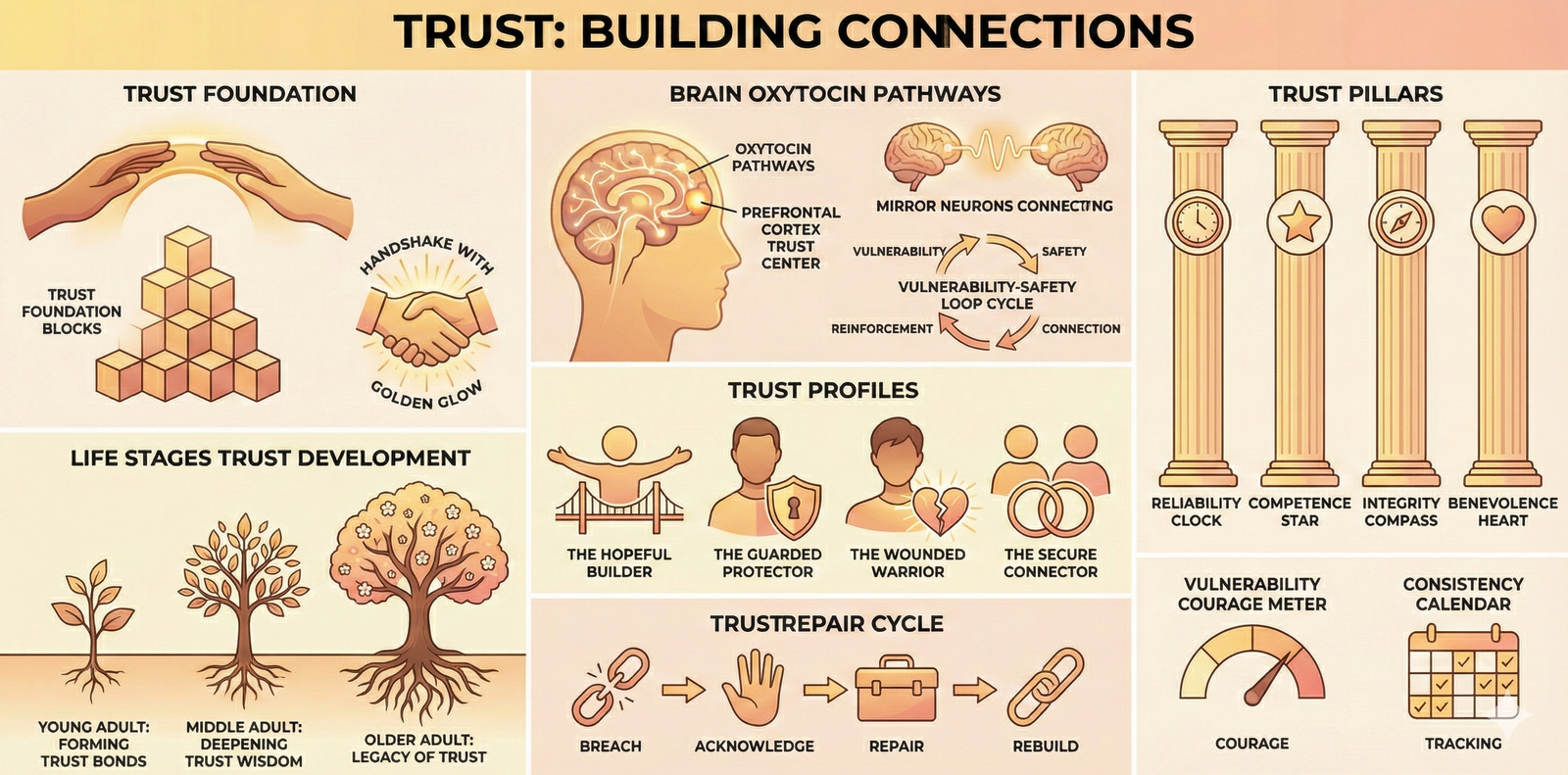
Trust becomes the difference between relationships that thrive and those that merely survive, determining whether your vulnerabilities are met with empathy or judgment.
The neuroscience reveals that when trust is present, both partners experience improved emotional regulation, reduced stress hormones, and activation of bonding pathways in the brain that literally make you more connected at a biological level.
What Is Trust?
Trust is the confident belief that another person will act in your best interest and won't deliberately harm you, even when vulnerability is involved. In relationships, it encompasses both behavioral trust (reliability and consistency) and emotional trust (safety to share your inner world). Psychological research identifies three core components: trusting that your partner has the ability to follow through on their commitments, believing in their benevolence toward you, and having faith in their integrity and honesty. Trust isn't a constant state; it exists on a spectrum and fluctuates based on experiences, communication patterns, and how conflicts are resolved. The absence of trust creates hypervigilance, emotional distance, and a constant state of guarded self-protection that prevents genuine intimacy from developing.
Not medical advice.
In 2025, relationship research reveals that trust is not innate but learned through early experiences with caregivers and subsequently shaped by adult experiences. Your attachment style, developed in childhood through interactions with primary caregivers, profoundly influences your ability to trust others as an adult. Secure attachment, formed when caregivers were consistently responsive and attuned, creates an internal working model where others are perceived as trustworthy and available. Conversely, anxious or avoidant attachment patterns may lead to difficulty trusting, even when partners provide consistent reassurance. Understanding your attachment style provides crucial insight into your trust patterns and reveals where healing and growth are possible.
Surprising Insight: Surprising Insight: Trust is built in the little moments of everyday life, not with grand gestures. Research by John Gottman, who has studied relationships for over 40 years, shows that trust accumulates through small, consistent actions that demonstrate reliability and emotional responsiveness over time.
The Trust Development Cycle
Trust develops through a reciprocal cycle where vulnerability leads to connection, which reinforces security and encourages deeper vulnerability.
🔍 Click to enlarge
Why Trust Matters in 2026
In our increasingly digital world where miscommunication happens through screens and relationships span multiple platforms, trust has become more essential than ever. The research from 2024-2025 shows that couples who explicitly work on building trust report 40% higher relationship satisfaction scores and experience fewer conflicts around commitment and fidelity. Trust affects not only your romantic life but also your mental health, with studies showing that people in high-trust relationships experience lower stress hormones, better sleep quality, and reduced anxiety symptoms. The pandemic and subsequent social changes have challenged many relationships, making trust-building skills more critical for relationship resilience.
Digital communication has created new trust challenges that didn't exist before. The constant availability of alternative connections, social media comparisons, and the ease of dishonesty online have made intentional trust-building more important. Partners must actively choose to build and maintain trust rather than assuming it will naturally develop. This requires clear communication about boundaries, transparency about concerns, and proactive reassurance that addresses modern relationship anxieties.
Recent psychological research also highlights the connection between self-trust and relationship trust. The more you trust yourself to know what you need and communicate it clearly, the more your partner can trust you and feel secure in the relationship. This creates a positive feedback loop where increasing self-trust strengthens relational trust, leading to deeper emotional connection and more resilient partnerships that can weather life's inevitable challenges.
The Science Behind Trust
Neuroscience has revealed that trust activates specific regions in your brain, particularly the prefrontal cortex and the limbic system, which work together to assess safety and drive bonding. When you're with someone you trust, your body releases oxytocin, often called the bonding hormone, which reduces stress hormones like cortisol and creates a physiological state of calm and openness. Mirror neurons, specialized cells that fire both when you perform an action and when you observe someone else performing it, allow you to attune to your partner's emotions and develop empathic understanding. This neurobiological basis explains why trust literally transforms how your brain functions, making you more capable of emotional connection and less reactive to perceived threats.
Attachment theory, developed by John Bowlby and expanded by modern neuroscience, explains how early experiences with caregivers become encoded in neural pathways and influence your relational patterns throughout life. The quality of your childhood attachment experiences creates internal working models—mental templates about whether people are trustworthy, whether your needs matter, and whether the world is safe. These models operate largely outside conscious awareness but powerfully shape how you approach trust in adult relationships. The good news is that neuroscience also confirms that these patterns are not fixed; through consistent positive experiences and intentional healing, you can develop more secure attachment patterns and increase your capacity for trust regardless of your childhood experiences.
Neurobiological Trust Response
When trust is present, multiple brain systems activate to create safety, bonding, and emotional openness.
🔍 Click to enlarge
Key Components of Trust
Authenticity
Authenticity means showing up as your true self rather than a curated version designed to please your partner. When you're authentic, you share your genuine thoughts, feelings, and vulnerabilities, even when they're inconvenient or uncomfortable. This creates permission for your partner to do the same, establishing a foundation where both people feel safe being real. Inauthentic behavior—whether small white lies, hidden feelings, or performing a false version of yourself—gradually erodes trust because it prevents true connection. Authenticity requires courage because it means risking rejection, but it's the only pathway to deep trust and genuine intimacy.
Reliability and Consistency
Trust is built through thousands of small moments where you do what you say you'll do. When you're reliable, your partner learns that they can depend on you, that your words have meaning, and that you follow through on commitments both big and small. Consistency means being roughly the same person across different situations and moods rather than unpredictably alternating between loving and distant. This doesn't mean being emotionally flat; it means maintaining your core values and commitments even when you're stressed, tired, or frustrated. Research shows that reliability in everyday interactions—remembering important details, showing up on time, following through on promises—is more predictive of trust than grand gestures or dramatic declarations of commitment.
Emotional Responsiveness
Emotional responsiveness means being attuned to your partner's emotional state and responding with empathy rather than judgment or defensiveness. When your partner shares something vulnerable, emotional responsiveness involves putting aside your agenda, making space for their feelings, and communicating that their inner world matters to you. This involves active listening where you focus on understanding their perspective rather than planning your response. Emotional responsiveness also includes being willing to be affected by your partner, allowing their emotions to matter to you and letting them see that they impact you. This creates the mutual influence that characterizes secure relationships where both partners feel genuinely important and valued.
Transparency About Struggles
Rather than presenting a problem-free version of yourself, transparency about your own struggles, fears, and limitations actually increases trust. When you're honest about finding something difficult or needing support, you invite your partner to know you more fully and to participate in your growth. This also creates psychological safety for your partner to admit their own vulnerabilities. Transparency doesn't mean oversharing everything; it means being honest about what's happening internally that affects the relationship. It means saying "I'm feeling disconnected and I'm not sure why" rather than pretending everything is fine when it's not, and it means exploring difficulties together as teammates rather than keeping them hidden.
| Component | What It Looks Like | Impact on Trust |
|---|---|---|
| Authenticity | Sharing your true thoughts and feelings without filtering | Creates safety for mutual vulnerability and genuine connection |
| Reliability | Doing what you say, following through consistently | Builds confidence in your partner's dependability |
| Emotional Responsiveness | Being attuned to and supportive of your partner's feelings | Creates felt safety and emotional intimacy |
| Transparency | Being honest about challenges and limitations | Prevents distance and allows for authentic problem-solving |
How to Apply Trust: Step by Step
- Step 1: Start with self-trust: Before you can fully trust another person, you need to trust yourself to know what you need, communicate it clearly, and advocate for your wellbeing. Reflect on areas where you doubt yourself and begin building confidence through small commitments to yourself that you keep.
- Step 2: Have difficult conversations: Instead of sweeping concerns under the rug, address them directly but compassionately. Say things like "I notice you've been distant lately and I'm worried about us. Can we talk about what's happening?" Difficult conversations are trust-building investments.
- Step 3: Practice radical honesty: Start sharing things you normally hide—not to overwhelm your partner but to give them access to your real inner world. This might be fears, insecurities, or difficult emotions you're experiencing.
- Step 4: Demonstrate reliability: Trust is earned through consistency. Make small commitments and keep them. Show up on time. Remember important details your partner shared. Follow through on plans. These daily demonstrations of reliability accumulate into deep trust.
- Step 5: Listen to understand, not to defend: When your partner shares something difficult, resist the urge to explain yourself or justify your actions. Instead, focus entirely on understanding their perspective and validating their feelings. This builds the sense that it's safe to be vulnerable with you.
- Step 6: Repair after conflict: How you handle ruptures in trust is more important than preventing them altogether. After a conflict, take responsibility for your part, genuinely apologize without defensiveness, and discuss what you'll both do differently. This shows that problems don't destroy the relationship.
- Step 7: Maintain transparency about boundaries: Healthy trust includes clear communication about what you need and expect. If something feels off-limits to discuss or if you need privacy in certain areas, say so explicitly rather than making your partner guess or feel rejected.
- Step 8: Be vulnerable first: If there's distance in your relationship, sometimes one person needs to be vulnerable first to create safety. Share something real and see if your partner meets you with understanding. This often shifts the dynamic and invites reciprocal openness.
- Step 9: Make time for connection: Trust deepens through quality time and physical affection. Consistent moments of true presence—without phones, with full attention—communicate that your partner is a priority and worthy of your best self.
- Step 10: Forgive and move forward: Trust includes the ability to forgive mistakes and disappointments without bringing them up repeatedly. This doesn't mean ignoring important patterns, but it means releasing the grudge and allowing the relationship to move forward rather than being stuck in past hurts.
Trust Across Life Stages
Adultez joven (18-35)
In young adulthood, trust formation is heavily influenced by exploring different relationship patterns and learning from experience. This is often a period of discovering what you need in partnerships and recognizing patterns inherited from your family of origin. Many young adults are developing their capacity for genuine vulnerability for the first time, learning to distinguish between infatuation and genuine trust-based connection. The challenges of this stage often involve moving beyond surface-level connection to emotional depth, navigating the transition from carefree dating to committed partnership, and recognizing how past experiences shape current trust issues. Young adults who take time to understand their attachment style and heal early wounds often develop more secure relationships, while those who avoid this work may repeat dysfunctional patterns.
Edad media (35-55)
Middle adulthood brings opportunities to deepen trust in long-term partnerships while managing new stressors like career demands, parenting, and aging parents. Couples at this stage often experience either deepening trust or accumulating resentment depending on how they've navigated earlier challenges. Many middle-aged adults report that trust actually increases when they've weathered significant life challenges together, particularly if they've handled conflicts constructively. However, this stage can also expose unresolved trust issues if communication has been poor. Common trust challenges include rebuilding trust after infidelity or major deception, renegotiating partnership terms as circumstances change, and maintaining connection when life feels overwhelming. The key is recognizing that trust isn't static; it requires ongoing attention and recommitment.
Adultez tardía (55+)
In later adulthood, trust often deepens into profound partnership as couples have spent decades navigating life together. Long-term couples often report that trust becomes less fragile and more resilient, hardened by the experiences they've shared. Mortality becomes more salient, which often motivates increased emotional presence and appreciation. However, physical changes, health challenges, and the possibility of one partner's decline can introduce new vulnerabilities that require deepening trust in new ways. Older adults also often experience greater acceptance of their partner's imperfections, having moved past the illusion of perfection into genuine love for the real person. For those in new partnerships in later life, building trust may happen more quickly because both partners have greater self-knowledge and often feel less need to pretend.
Profiles: Your Trust Approach
The Hopeful Builder
- Reassurance that vulnerability won't be used against you
- Clear communication about problems rather than silent distance
- Patience as you gradually increase trust
Common pitfall: Moving too fast into vulnerability before it's earned, overwhelming partners with emotional depth early on
Best move: Pace your vulnerability to match your partner's capacity to receive it, building trust incrementally rather than all at once
The Guarded Protector
- Time to assess trustworthiness before significant vulnerability
- Consistency and proof before fully opening up
- Respect for your need to move slowly
Common pitfall: Withholding yourself so completely that your partner feels rejected and gives up trying to connect
Best move: Take small risks with vulnerability, noticing that being known actually creates safety rather than danger
The Wounded Warrior
- Acknowledgment that your wariness makes sense given your history
- Patient reassurance that this partner is different
- Professional support to heal past betrayals
Common pitfall: Punishing current partners for past betrayals, constantly testing their trustworthiness
Best move: Work with a therapist to process past trust violations so you can approach current relationships with fresh perspective
The Secure Connector
- Partners who can meet your emotional openness
- Continued growth and deepening of connection
- Support for your partner's trust development
Common pitfall: Expecting all partners to naturally match your secure attachment style, becoming frustrated with those who need more time
Best move: Use your security as a gift to help your partner feel safer, recognizing that meeting someone where they are accelerates their growth
Common Trust Mistakes
One of the most common trust mistakes is confusing trust with the absence of doubt. Many people believe that if they ever question their partner or feel insecure, the trust is broken. In reality, all relationships involve occasional doubts and insecurities; what matters is how you handle them. Rather than immediately assuming your doubts are truth, explore them with curiosity: What am I really afraid of? Is this about my partner or about my own wounds? Trust can coexist with normal human doubts and concerns.
Another critical mistake is failing to communicate about trust explicitly. Many people expect their partners to somehow know that they need reassurance, consistency, or emotional presence without saying so directly. But your partner can't meet needs they don't know exist. You need to articulate what trust looks like for you: "When you remember small things I mentioned, it makes me feel trusted and valued" or "I need to know why you're late because mystery makes me anxious." This clarity prevents resentment from building and gives your partner the opportunity to show up in ways that actually matter to you.
A third mistake is not addressing trust ruptures quickly. When something happens that threatens trust—a betrayal, a lie, a broken promise—it's tempting to pretend it didn't happen or to give silent treatment as punishment. But unaddressed ruptures create distance and resentment that compounds over time. Instead, address them directly: acknowledge what happened, express how it affected you, and have an honest conversation about repair. Quick repair after ruptures often actually strengthens trust because it demonstrates that problems don't destroy the relationship.
Trust Mistakes and Corrections
Common trust mistakes and the healthier approaches that strengthen rather than undermine relationships.
🔍 Click to enlarge
Ciencia y estudios
Recent research from 2024-2025 reveals that trust is both more fragile and more resilient than previously thought. Trust can be damaged quickly through deception or betrayal, but it can also be rebuilt through consistent positive experiences and genuine commitment to change. The research highlights that trust operates on multiple levels simultaneously: behavioral trust (will they follow through on commitments), emotional trust (is it safe to be vulnerable), and character trust (do they have integrity). Each level must be rebuilt separately, which is why rebuilding trust after betrayal is a complex, long-term process.
- Frontiers in Psychology (2025): Research on trust in romantic relationships shows that partners with secure attachment styles are 3x more likely to report high trust levels, and that early experiences with trustworthiness from parents significantly predict adult relationship trust patterns.
- PMC Research (2024): Neurobiological studies confirm that trust activates reward centers in the brain and reduces activation in fear centers, literally making your nervous system safer when you're with trusted partners.
- Psychology Today (2024): Studies on infidelity and trust reveal that while infidelity severely damages trust, relationships can recover and become stronger if both partners commit to transparency, accountability, and emotional repair.
- Harvard Business Review (2025): Frances Frei's framework of authenticity, logic, and empathy provides evidence-based components for trust-building that apply equally to personal relationships as to organizational contexts.
- Journal of Social and Personal Relationships (2024): Research shows that vulnerability and emotional expression from both partners creates a positive feedback loop where increased openness leads to increased perceived trustworthiness and deeper connection.
Tu primer micro hábito
Comienza pequeño hoy
Today's action: Today, share one small vulnerable truth with someone you trust. It could be as simple as 'I've been feeling anxious lately' or 'I'm not sure I'm doing this right.' Notice how your partner responds and allow yourself to experience being known.
Small acts of vulnerability create safety and permission for reciprocal openness. When your partner responds with compassion, you get evidence that being known is actually safe, which gradually shifts your nervous system from defensive to open. This one small act often creates a noticeable shift in connection.
Track your micro habits and get personalized AI coaching with our app.
Evaluación rápida
When you think about trusting your current or past romantic partner, what's your most honest experience?
Your answer reveals your baseline trust capacity. Those who trust more easily typically had consistent, responsive caregivers early on. Those who struggle often experienced inconsistency, betrayal, or emotional unavailability. Understanding your pattern is the first step to change.
What matters most to you in building trust with someone?
Different people prioritize different elements of trust. Some need behavioral reliability, others need emotional safety. Your answer shows what trust language resonates most with you—and this is valuable to communicate to partners.
When trust has been broken in your relationships, what's been your typical response?
How you respond to ruptures is more important than preventing them completely. Those who repair quickly often develop stronger trust long-term because they prove to themselves that problems don't destroy the relationship.
Take our full assessment to get personalized recommendations.
Discover Your Style →Preguntas frecuentes
Próximos pasos
Building trust is one of the most important investments you can make in your relationships and your own emotional wellbeing. Trust doesn't happen accidentally; it's created through thousands of small moments where you choose honesty over hiding, vulnerability over protection, and repair over resentment. Start where you are right now. If you're building trust from scratch, take small risks with vulnerability. If you're rebuilding trust after a rupture, commit to direct conversation and consistent follow-through. If you're deepening trust in an already strong relationship, continue to nurture it through presence, appreciation, and emotional responsiveness.
Remember that your capacity to trust yourself is foundational to your ability to trust others. When you trust your own judgment, communicate your needs clearly, and maintain boundaries, you become more trustworthy to others and better able to recognize trustworthiness in them. This creates a positive feedback loop where increased self-trust leads to better relationships, which leads to even greater self-trust. The quality of your relationships is largely determined by the quality of trust you've built, making it one of the most important skills you can develop in your life.
Get personalized guidance with AI coaching.
Start Your Journey →Research Sources
This article is based on peer-reviewed research and authoritative sources. Below are the key references we consulted:
Related Glossary Articles
Frequently Asked Questions
How long does it take to build trust in a relationship?
Trust develops at different rates for different people, but research suggests initial trust can form within 3-6 months of consistent positive interactions. However, deep trust—the kind that can weather significant challenges—typically takes 2-3 years or more. The timeline accelerates if both partners are intentional about building it and slows if there are unresolved conflicts or inconsistencies in behavior.
Can trust be rebuilt after infidelity or a major betrayal?
Yes, trust can be rebuilt after betrayal, but it requires genuine commitment from both partners. The unfaithful partner must demonstrate sustained honesty, transparency, and accountability. The betrayed partner must be willing to gradually move past hypervigilance toward renewed openness. Professional therapy often helps. Most research suggests it takes 18-24 months of consistent positive behavior to substantially restore trust after infidelity.
Is it possible to have a healthy relationship without complete trust?
No, research consistently shows that relationships lacking basic trust experience higher conflict, lower satisfaction, and increased anxiety for both partners. That said, 'complete trust' is unrealistic; all humans have some doubt and insecurity. Healthy relationships have 'sufficient trust'—enough to feel safe being vulnerable while maintaining realistic expectations that your partner is human and imperfect.
How do I know if my trust issues are from my past or from my current partner's behavior?
This requires honest self-reflection and often professional support. Ask yourself: Does my partner consistently demonstrate untrustworthiness, or am I interpreting neutral or positive behavior through a lens of doubt? Have multiple partners behaved the same way, or has this been unique to certain relationships? If the former, your trust issues likely stem from past patterns; if the latter, your current partner may actually be untrustworthy.
What should I do if my partner breaks my trust but doesn't seem to understand why it's a big deal?
This is a critical moment for communication. Explain specifically how their behavior affected you: 'When you lied about where you were, I felt anxious and scared that I couldn't trust you.' If they continue to minimize or not understand after you've clearly expressed impact, this may indicate a larger compatibility issue or a partner who lacks empathy—both are important information about the relationship's viability.
Take the Next Step
Ready to improve your wellbeing? Take our free assessment to get personalized recommendations based on your unique situation.
- Discover your strengths and gaps
- Get personalized quick wins
- Track your progress over time
- Evidence-based strategies