Positive Psychology
For a century, psychology focused on what is wrong with people. Mental illness. Disorders. Dysfunction. A new question emerged: What makes people thrive? What creates flourishing rather than just the absence of suffering?
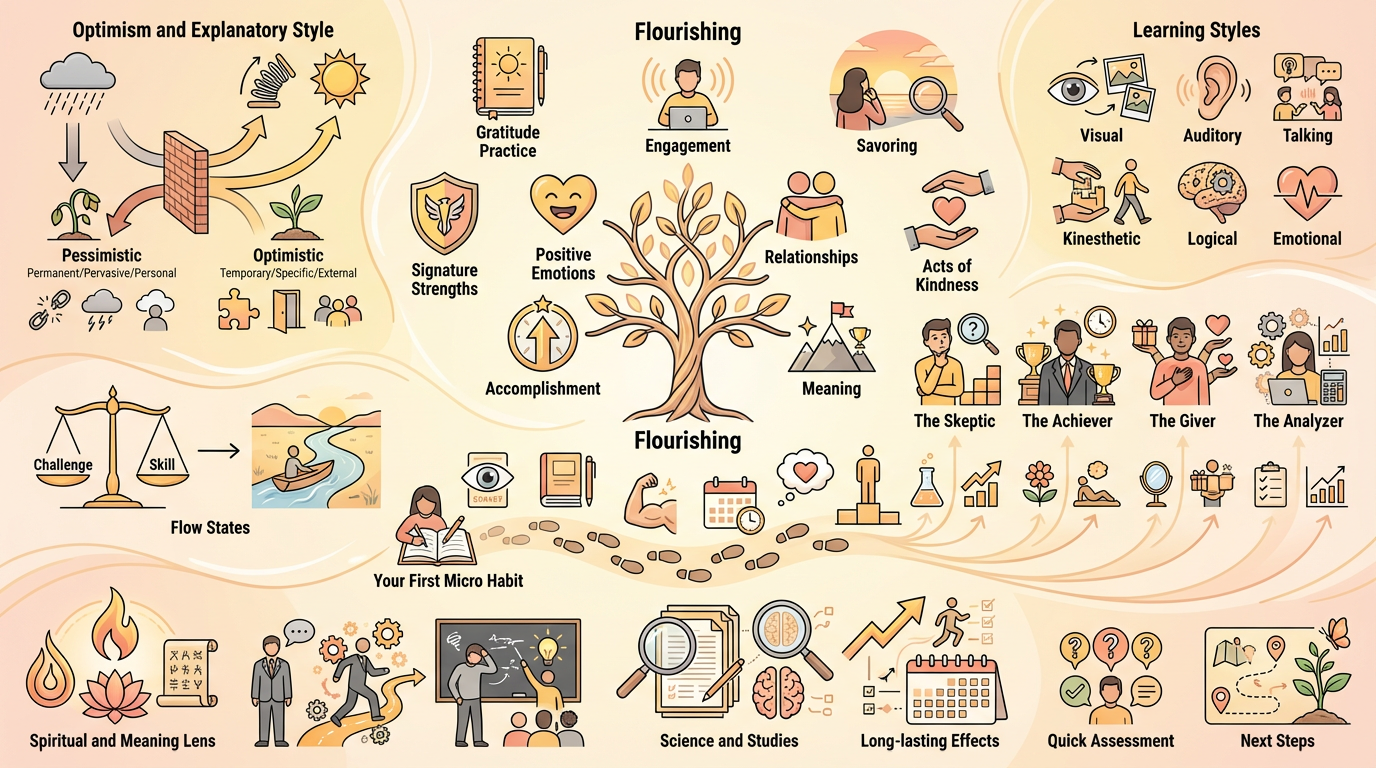
A January 2025 Nature Human Behaviour network meta-analysis of 183 trials with 22,811 participants found that positive psychology interventions significantly improve wellbeing. The science is clear. Flourishing can be cultivated through specific, learnable practices.
This guide covers the latest positive psychology research. You will learn the practices that 2024-2025 meta-analyses validate for increasing happiness. Later sections show how to apply these principles to your unique situation.
What Is Positive Psychology?
Surprising Insight: Surprising Insight: Shawn Achor's research shows that only ten percent of your long-term happiness is predicted by external circumstances. The remaining ninety percent depends on how your brain processes the world. Happiness is a skill, not a situation.
Not medical advice.
Positive psychology is the scientific study of what makes life worth living. Founded by Martin Seligman in 1998, it shifted psychology from fixing problems to building wellbeing. At the 2024 Institute of Coaching Conference, Seligman delivered a keynote presenting twenty-five years of progress and the future of AI in positive coaching.
The field studies positive emotions, engagement, relationships, meaning, and accomplishment. It develops and tests interventions that increase these elements. A 2024-2025 workplace meta-analysis of 24 studies found positive psychology interventions produce significant improvements in subjective wellbeing with moderate effect sizes.
Positive psychology does not ignore suffering. It complements clinical psychology. Both are needed. But reducing misery does not automatically create flourishing. That requires different skills and intentional practice.
The Happiness Advantage
Traditional thinking assumes success leads to happiness. Work hard, achieve goals, then be happy. Shawn Achor's research at Harvard reversed this formula. Happiness comes first. A positive brain performs better than a negative, neutral, or stressed brain.
When you are positive, dopamine floods your system. This makes you happier and turns on your learning centers. Your intelligence rises. Your creativity rises. Your energy levels rise. This is the happiness advantage that drives better performance.
The formula for happiness that we teach in schools and companies is fundamentally broken. We assume external success will make us happy. But each time we achieve a goal, the brain moves the goalposts. The happiness advantage reverses this by training the brain to be positive first.
The PERMA+4 Model
Seligman's PERMA model identified five elements of wellbeing. A 2025 longitudinal study tested PERMA+4, an expanded framework, with 576 full-time employees over 15 months. Results showed PERMA+4 at baseline significantly predicted lower job stress, lower negative affect, and lower turnover intentions at follow-up.
| Element | Definition | Key Practice |
|---|---|---|
| Positive Emotions | Joy, gratitude, hope, love | Gratitude journaling |
| Engagement | Flow states, absorption | Using signature strengths |
| Relationships | Connection, belonging | Active constructive responding |
| Meaning | Purpose, contribution | Values clarification |
| Accomplishment | Achievement, mastery | Goal setting and progress |
| Physical Health | Exercise, sleep, nutrition | Daily movement habit |
| Mindset | Growth orientation, optimism | Reframing challenges |
| Environment | Supportive surroundings | Space optimization |
| Economic Security | Financial stability | Budget and savings practices |
The PERMA+4 Model
Nine pathways to comprehensive wellbeing
🔍 Click to enlarge
2025 Meta-Analysis Findings
The January 2025 Nature Human Behaviour network meta-analysis is the most comprehensive review of wellbeing interventions to date. Examining 183 randomized controlled trials, it found that yoga, mindfulness, compassion, exercise, and positive psychology all improved adult wellbeing compared to inactive controls.
Combined exercise and psychological approaches showed the largest effects. This validates what practitioners have intuited: wellbeing benefits from multiple pathways simultaneously. A gratitude practice works. Adding exercise amplifies the effect.
| Intervention Type | Effect on Wellbeing | Evidence Quality |
|---|---|---|
| Combined Exercise + Psychology | Largest effect | High |
| Positive Psychology Interventions | Moderate effect (g=0.50) | High |
| Mindfulness-Based Interventions | Significant effect | High |
| Exercise Alone | Significant effect | Moderate |
| Compassion Training | Significant effect | Moderate |
Key Positive Psychology Practices
The Three Good Things Exercise
The most researched positive psychology intervention. Write three good things that happened today and why they happened. A 2024 JMIR Mental Health review of digital interventions found this practice benefits young people's wellbeing and mitigates ill-being symptoms.
Signature Strengths
Everyone has character strengths like curiosity, kindness, or perseverance. The VIA Character Strengths survey identifies your top strengths. Using one signature strength in a new way each day increases engagement and satisfaction for weeks afterward.
Acts of Kindness
Performing acts of kindness increases wellbeing for the giver. Research shows variety matters more than quantity. Five different kind acts in one day produces more happiness than one act daily for five days.
Savoring
Savoring means deliberately focusing on and appreciating positive experiences. Most people let good moments pass too quickly. Extending attention to positive experiences multiplies their wellbeing benefit.
Optimism and Explanatory Style
How you explain events affects wellbeing. Pessimists see bad events as permanent, pervasive, and personal. Optimists see them as temporary, specific, and external. This explanatory style predicts health outcomes, job performance, and life satisfaction.
Optimism can be learned. When negative events occur, challenge automatic interpretations. Is this really permanent or temporary? Is it everything or this specific situation? Is it entirely personal or did external factors contribute?
Explanatory Style Comparison
How optimists and pessimists interpret events differently
🔍 Click to enlarge
Flow States
Flow is complete absorption in an activity. Time seems to stop. Self-consciousness disappears. The activity is intrinsically rewarding. Flow experiences contribute significantly to life satisfaction and the engagement element of PERMA.
Flow occurs when challenge matches skill. Too easy creates boredom. Too hard creates anxiety. Finding activities at the edge of your abilities creates flow. Work can be a major source if it provides challenge, clear goals, and immediate feedback.
How to Apply Positive Psychology
- Step 1: Take the VIA Character Strengths survey at viacharacter.org
- Step 2: Start a daily gratitude practice with three good things each evening
- Step 3: Use one signature strength in a new way each day for a week
- Step 4: Identify activities that produce flow for you
- Step 5: Schedule more flow activities into your week
- Step 6: Practice active constructive responding when others share good news
- Step 7: Clarify your core values and connect daily actions to meaning
- Step 8: Set meaningful goals aligned with your values
- Step 9: Perform variety of kind acts weekly
- Step 10: Add physical activity to amplify psychological benefits
Practice Playbook by Level
Beginner: Foundation
Start with gratitude. Write three good things each evening for two weeks. Take the VIA survey to know your strengths. Pick one additional practice to try. Research shows even beginners see mood improvements within days.
Intermediate: Expanding Application
Apply strengths deliberately at work and home. Build more flow activities into life. Develop optimistic explanatory style by challenging pessimistic interpretations. Add physical exercise to amplify psychological gains.
Advanced: Full Integration
Positive psychology principles are woven into daily life. You naturally notice good things. You use strengths automatically. You might explore the PERMA+4 framework to address all nine dimensions of wellbeing systematically.
AI and the Future of Positive Psychology
At his 2024 keynote, Seligman discussed emerging AI applications in positive psychology. He introduced Ask Martin, an AI chatbot programmed with his research, as an example of how technology can make positive psychology coaching more accessible.
AI coaching tools can provide personalized positive psychology interventions at scale. They track patterns, suggest practices matched to individual needs, and provide accountability. The democratization of coaching is one of the most exciting developments in the field.
Profiles and Personalization
The Skeptic
- Research evidence for practices
- Small experiments to test personally
- Understanding mechanisms
Common pitfall: Dismissing practices as too simple
Best move: Run a two-week gratitude experiment and track mood changes
The Achiever
- Balance accomplishment with other PERMA elements
- Savoring practices to enjoy achievements
- Meaning beyond achievement
Common pitfall: Over-focusing on accomplishment at expense of engagement and relationships
Best move: Add intentional engagement and relationship focus alongside goals
The Giver
- Self-compassion practices
- Receiving as well as giving
- Own positive emotions matter
Common pitfall: Neglecting own wellbeing while helping others
Best move: Apply practices to self first, then extend to others
The Analyzer
- Structured approaches
- Measurable outcomes
- Logical frameworks like PERMA+4
Common pitfall: Analysis without action
Best move: Track metrics while doing practices, not instead of doing them
Learning Styles
Visual Learners
- Vision boards for goals
- Gratitude photos
- Progress charts
Auditory Learners
- Gratitude discussions with others
- Strengths conversations
- Podcasts on positive psychology
Kinesthetic Learners
- Physical acts of kindness
- Flow through sports or crafts
- Walking gratitude practice
Logical Learners
- Study the meta-analyses
- Track metrics systematically
- Experiment with variables
Emotional Learners
- Heart-centered gratitude
- Strengths that feel meaningful
- Connection-based practices
Science and Studies (2024-2025)
PERMA+4 predicts employee wellbeing over 15 months
Longitudinal study of 576 employees found PERMA+4 at baseline predicted lower job stress and turnover intentions at follow-up
Source →Combined interventions show largest wellbeing effects
Nature Human Behaviour network meta-analysis of 183 trials found exercise plus psychology produces largest wellbeing improvements
Source →Workplace positive psychology interventions produce moderate effect sizes
Meta-analysis of 24 workplace studies found subjective wellbeing effect size of g=0.50 and psychological wellbeing of g=0.46
Source →Digital positive psychology benefits young people
JMIR Mental Health systematic review found digital positive psychology interventions benefit young people's wellbeing and mitigate ill-being symptoms
Source →Spiritual and Meaning Lens
Positive psychology shares ground with wisdom traditions. Gratitude appears in every major religion. Buddhism emphasizes joy and compassion. Stoicism taught savoring present moments. The science validates what traditions intuited for millennia.
You do not need religious belief to practice. But religious frameworks can enrich positive psychology for those so inclined. Meaning, the M in PERMA, connects to ultimate questions of purpose that spiritual traditions address.
The integration of mindfulness research with positive psychology represents one of the strongest trends in the field. Contemplative practices from multiple traditions are now validated by neuroscience and randomized trials.
Positive Stories
The Lawyer Who Found Flow
Setup: David excelled at law but felt empty. High achievement brought no satisfaction. He had accomplishment but wondered why it was not enough.
Turning point: A positive psychology course introduced him to PERMA. He realized he had accomplishment but lacked engagement and meaning. His work had no flow.
Result: He found a specialty aligned with his values. He restructured cases to create challenge matching his skills. Flow returned. Satisfaction increased without changing careers.
Takeaway: Achievement without engagement and meaning leaves you empty. All PERMA elements matter.
The Teacher Who Spread Gratitude
Setup: Lisa was burning out after twenty years teaching. Every day felt the same. She dreaded work and counted years to retirement.
Turning point: She started a gratitude practice reluctantly. Three good things each evening, even when she did not feel grateful.
Result: Within weeks, she noticed students differently. She saw moments of connection she had missed before. She started gratitude circles in class. Students responded. She fell back in love with teaching.
Takeaway: Gratitude transforms how you see everything. The practice rewires your attention.
Tu primer micro hábito
Trigger:
Action:
Reward:
Frequency:
Fallback plan:
Evaluación rápida
What currently brings you the most joy in daily life?
Your joy sources reveal which happiness strategies will resonate most deeply with you.
What tends to hold you back from feeling happier?
Identifying your happiness blockers helps target the most impactful changes.
How would you describe your current life satisfaction?
Your satisfaction level helps determine whether you need foundational changes or refinements.
Take our full assessment to discover which approach matches your personality and goals.
Discover Your Style →Preguntas frecuentes
Próximos pasos
You understand the science of positive psychology backed by 2024-2025 research. Start with three good things tonight. Take the VIA survey this week. Add one kindness practice. Build from there.
Explore related topics like gratitude practice, self-compassion, optimism building, and life satisfaction to deepen your positive psychology toolkit.
Get personalized positive psychology guidance and track your wellbeing journey with AI coaching.
Start Flourishing →Research Sources
This article is based on peer-reviewed research and authoritative sources. Below are the key references we consulted:
Related Glossary Articles
Frequently Asked Questions
Is positive psychology just positive thinking?
No. Positive psychology is evidence-based science with thousands of peer-reviewed studies. It does not deny problems or advocate false optimism. The 2025 Nature meta-analysis reviewed 183 randomized trials.
Can positive psychology help with depression?
Research shows positive interventions help with mild to moderate depression. The 2024 JMIR review found benefits for ill-being symptoms. Severe depression needs professional treatment. Positive psychology complements but does not replace clinical care.
How long until I see results?
Some practices produce immediate mood boosts. Shawn Achor's research shows two minutes of gratitude practice for 21 days can rewire the brain. Lasting changes typically take two to four weeks of consistent practice.
Where can I take the VIA Strengths survey?
The free VIA Character Strengths survey is available at viacharacter.org. It takes about fifteen minutes and identifies your top 24 character strengths.
What is the happiness advantage?
When your brain is positive, dopamine floods your system. This turns on learning centers, increases intelligence and creativity, and raises energy. A positive brain performs better than a negative, neutral, or stressed brain.
Do I need to ignore negative emotions?
No. Positive psychology does not suppress negative emotions. It builds positive capacities alongside processing difficult feelings. Both matter for complete wellbeing.
Take the Next Step
Ready to improve your wellbeing? Take our free assessment to get personalized recommendations based on your unique situation.
- Discover your strengths and gaps
- Get personalized quick wins
- Track your progress over time
- Evidence-based strategies