Self Confidence
Self confidence is your belief in your ability to succeed and handle challenges. It's the foundation of taking action despite uncertainty, speaking up in difficult situations, and pursuing goals that matter to you. High self-confidence enables resilience when facing setbacks, improves decision-making clarity, and enhances relationships through authentic presence. Unlike arrogance, genuine self-confidence combines realistic self-assessment with the courage to try, grow, and learn from failure.
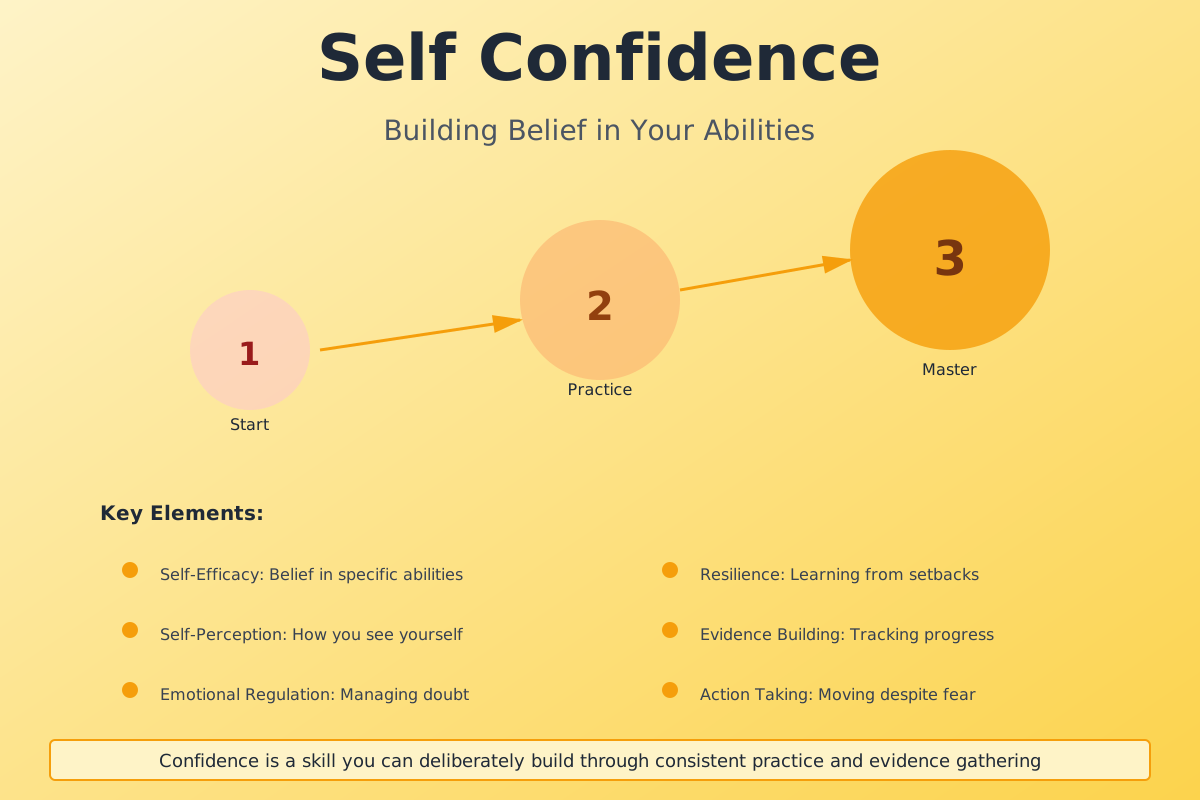
Research shows self-confidence directly impacts mental health, life satisfaction, and success across personal and professional domains. When you believe in yourself, you naturally take more action, which creates more wins, which reinforces your belief—creating an upward spiral.
The exciting news: self-confidence isn't something you're born with or without. It's a skill you can deliberately build through consistent practice, strategic mental work, and behavioral experiments that prove your capability.
What Is Self Confidence?
Self confidence is a psychological state where you genuinely believe in your capacity to accomplish tasks, navigate challenges, and achieve your goals. It's the inner voice saying 'I can handle this' rather than 'I hope this works out.' This belief isn't based on unrealistic positivity but on accumulated evidence from past successes, skill development, and proven resilience through difficulties.
Not medical advice.
Self-confidence differs from self-esteem and self-efficacy, though these concepts overlap. Self-esteem refers to your overall sense of worth as a person (you matter, regardless of performance). Self-efficacy is your belief in your ability to succeed at specific tasks. Self-confidence is the broader conviction that you can navigate life effectively and achieve what matters to you. Together, these three dimensions create psychological strength.
Surprising Insight: Surprising Insight: Studies show that 72% of people admit to lacking self-confidence in specific situations, yet those who practice deliberate confidence-building techniques increased their confidence scores by 34% in just 8 weeks. This means confidence is trainable, not fixed.
The Self-Confidence Cycle
How belief in your abilities creates action, which generates evidence of capability, reinforcing your confidence
🔍 Click to enlarge
Why Self Confidence Matters in 2026
In a world of constant change, remote work, AI acceleration, and increased personal responsibility for career development, self-confidence has become non-negotiable. The people who thrive in 2026 are those who believe enough in themselves to speak up in virtual meetings, pitch ideas confidently, adapt to new tools and roles, and maintain psychological resilience through uncertainty.
Mental health researchers report that low self-confidence directly contributes to anxiety, depression, and procrastination. Conversely, those with healthy self-confidence experience better sleep, lower stress hormones, and stronger immune function. Your belief in yourself literally affects your physical health through nervous system regulation.
Socially and professionally, self-confidence enables authentic connection, better boundary-setting, and increased influence. People naturally follow those who believe in themselves. This creates career acceleration, stronger relationships, and greater life satisfaction—all measurable, practical benefits that compound over time.
The Science Behind Self Confidence
Neuroscience reveals that confidence activates specific brain regions: the prefrontal cortex (decision-making), anterior cingulate cortex (attention and focus), and areas associated with positive emotion. When you feel confident, your brain literally functions differently—you see more opportunities, remember solutions more easily, and make faster decisions. Conversely, lack of confidence triggers your threat detection system (amygdala), narrowing focus and impairing judgment.
Harvard psychologist Amy Cuddy's research showed that specific body postures actually change hormone levels: standing in an open, confident pose increases testosterone (associated with confidence and risk-taking) while decreasing cortisol (the stress hormone). This means your body and mind work together—changing one changes the other. This finding alone revolutionized confidence coaching and explains why simple postural changes produce measurable confidence improvements.
Confidence-Building Pathways in Your Brain
Multiple neural routes reinforce self-belief through mental, physical, and behavioral practice
🔍 Click to enlarge
Key Components of Self Confidence
Self-Efficacy: Believing in Specific Capabilities
Self-efficacy is your belief that you can succeed at particular tasks or skills. You might have high self-efficacy in public speaking but low self-efficacy in mathematics. Building self-efficacy requires mastery experiences (actually succeeding at tasks), observing role models (seeing others like you succeed), receiving encouragement, and managing your emotional state. The most powerful builder is direct success—each small win rewires your neural pathways around that specific skill.
Self-Perception: How You See Yourself
Your self-perception is the story you tell yourself about who you are and what you're capable of. Interestingly, this story is largely constructed—it's based on past experiences, feedback from others, and choices you've made. The remarkable part: you can consciously revise this story. By collecting evidence (completing challenges, receiving authentic praise, identifying strengths), you gradually update your self-perception from 'I'm not good at this' to 'I'm developing competence here' to 'I'm skilled at this.' This is neuroplasticity in action.
Emotional Regulation: Managing Internal Resistance
Confidence requires managing the anxiety, doubt, and fear that naturally arise when attempting something challenging. Emotional regulation means you can feel these emotions without them stopping you. Techniques like slow breathing (extending exhales), grounding exercises, and self-compassion language help your nervous system calm while you take action anyway. This isn't about eliminating doubt—it's about moving forward despite it.
Resilience: Learning from Setbacks
Confident people fail more, not less, because they attempt more. The difference: they don't interpret failure as evidence of incapability. Instead, they extract learning, adjust strategy, and try again. Resilience is built by actually experiencing challenges and discovering you can handle them. Each setback you navigate successfully becomes evidence that you're more capable than you thought, which paradoxically strengthens confidence.
| Confidence Level | Behavioral Pattern | Internal Experience |
|---|---|---|
| Low | Avoids challenges, rarely speaks up, procrastinates, seeks excessive reassurance | Persistent self-doubt, fear of judgment, anxiety about capability |
| Moderate | Attempts challenging tasks, speaks up selectively, learns from failures, sets boundaries | Realistic self-assessment, manageable anxiety, growth-oriented mindset |
| High | Seeks meaningful challenges, speaks authentically, views failure as learning, influences others | Stable self-belief, adaptive anxiety, purpose-driven actions |
How to Apply Self Confidence: Step by Step
- Step 1: Audit Your Confidence Landscape: Honestly assess where you have high and low confidence. Make a list of 5 situations where you feel confident and 5 where you feel doubtful. Notice patterns—are you avoiding certain situations? This awareness is your starting point.
- Step 2: Choose Your First Small Challenge: Pick one specific, achievable goal that slightly stretches your current ability. Not huge—just 15-20% beyond comfortable. Completing it creates evidence. Example: speaking once in a meeting you usually stay silent in.
- Step 3: Practice Confident Body Language: Stand with shoulders back, chin level, feet grounded. Open your posture in private before situations where you feel anxious. Research shows you'll feel more confident. This isn't fake-it-till-you-make-it; it's using your body to influence your mind.
- Step 4: Develop Empowering Self-Talk: Replace 'I can't do this' with 'I'm learning this' or use second-person language: 'You've got this!' Research shows second-person self-talk reduces stress response and improves outcomes dramatically compared to 'I' statements.
- Step 5: Visualize Success Vividly: Spend 2-3 minutes daily visualizing yourself handling the situation confidently. Not fantasy—realistic success where you manage challenges skillfully. Your brain's neural pathways strengthen through visualization as much as actual practice.
- Step 6: Take the Action Despite Fear: Anxiety doesn't mean you're not ready—it means you're attempting something meaningful. Move forward with the anxiety present. Each time you do this, your brain learns: 'I can handle this feeling and succeed anyway.'
- Step 7: Collect Evidence Deliberately: After each attempt, write down what went well and what you learned. This isn't about perfection—it's about finding what worked. Over weeks, this evidence becomes undeniable proof of your capability.
- Step 8: Engage Role Models and Mentors: Observe people who handle similar situations confidently. Ask them how they built confidence. Social proof (seeing people like you succeed) significantly increases your belief in your own possibility.
- Step 9: Practice Self-Compassion When You Struggle: Setbacks are part of confidence-building. Instead of harsh self-criticism, treat yourself as you would a friend struggling with the same challenge. Compassion maintains psychological safety to try again.
- Step 10: Build a Confidence Portfolio: Create a visible record of achievements—saved positive feedback, completed projects, skills developed. When doubt arises (it will), review this evidence. It's concrete proof your self-doubt is lying to you.
Self Confidence Across Life Stages
Young Adulthood (18-35)
This stage involves massive identity formation: first jobs, relationships, independent living. Confidence challenges here typically center on 'Am I doing this right?' The gift of this phase: you have time and energy for deliberate skill-building. Focus on accumulating competence in core life skills (communication, decision-making, relationships) because these compound over decades. Social proof and peer influence are strongest now—surround yourself with confident people who challenge you to grow.
Middle Adulthood (35-55)
This phase brings established expertise in your field but often increased self-doubt in other domains (parenting, health, evolving career changes). Your advantage: you have a decade of evidence proving you can learn and succeed. Use that. The confidence challenge here is imposter syndrome—feeling undeserving despite clear competence. Combat it by mentoring others (teaching reinforces your expertise) and taking on strategic new challenges in areas you want to master, using your proven learning ability.
Later Adulthood (55+)
This stage offers a profound advantage: perspective. You've survived multiple challenges and learned what really matters. Confidence here means giving yourself permission to be authentically yourself rather than meeting others' expectations. The opportunities: mentoring younger people, pursuing deferred passions, and deepening expertise in areas you love. Physical changes may challenge confidence; counter this by finding physical activities you actually enjoy and building competence there.
Profiles: Your Self Confidence Approach
The Hesitant Explorer
- Small, achievable challenges to build evidence gradually
- Celebrating tiny wins and making progress visible
- Compassionate accountability from trusted people
Common pitfall: Staying in comfort zone indefinitely, interpreting caution as wisdom
Best move: Commit to one specific micro-challenge this week. Not big—just noticeably beyond comfortable. Do it, document the win, repeat.
The Analytical Questioner
- Data and research validating confidence-building methods
- Understanding the 'why' behind techniques before trying
- Permission to plan thoroughly before action
Common pitfall: Analysis paralysis—endless research without implementation
Best move: Set a research deadline. Study for 2 weeks, then commit to 30 days of practice. Your data will become real-world evidence.
The Perfectionist Performer
- Redefining success as growth rather than flawlessness
- Permission to attempt things imperfectly
- Feedback focused on improvement, not judgment
Common pitfall: Avoiding anything you might not excel at immediately
Best move: Deliberately practice something you're bad at for 21 days. Track learning, not performance. Notice how discomfort decreases.
The Independent Doer
- Recognizing that seeking help signals strength, not weakness
- Understanding that mentorship accelerates confidence-building
- Permission to be vulnerable about areas of doubt
Common pitfall: Isolating when struggling, believing you should figure everything out alone
Best move: Identify one area where you want to grow and find one mentor or trusted friend who excels there. Have monthly check-ins.
Common Self Confidence Mistakes
Mistaking confidence for the absence of anxiety. Real confidence is taking action despite anxiety. If you wait until you're completely comfortable, you'll never grow. Comfortable people don't build confidence—people who attempt challenging things do. Anxiety isn't the problem; avoidance is.
Comparing your beginning to someone else's middle. The confident person you admire has years of evidence behind their belief. You're looking at their current state, not their journey. This is one of the fastest confidence-killers. Counter it: follow people's full stories, understand their struggles, and focus exclusively on your own progress.
Building confidence only in your strengths. Yes, develop your talents. But genuine confidence requires competence across core life domains—relationships, communication, decision-making, resilience. Someone brilliant at their job but terrible at relationships is missing crucial confidence foundations. Develop broad competence, then deepen it in areas you love.
Confidence Pitfalls and Escape Routes
Common traps that undermine confidence and the strategies to overcome them
🔍 Click to enlarge
Science and Studies
Extensive research across psychology, neuroscience, and organizational behavior confirms that self-confidence is learnable, measurable, and directly impacts life outcomes. The studies below represent current evidence-based understanding of how confidence develops and benefits those who cultivate it.
- Zell & Johansson (2025) meta-analysis across 40 studies found self-esteem correlates with overall well-being at r=0.42 for mental health and r=0.29 for psychological adjustment, showing strong evidence for confidence's life impact.
- Cuddy (2015) power posing research demonstrated that adopting high-power poses for just 2 minutes increased confidence and risk-taking willingness while decreasing cortisol, linking body posture directly to psychological state.
- Cognitive-behavioral therapy interventions show medium to large effects on enhancing self-esteem and confidence in adults, with benefits lasting at least 3 months post-intervention according to multiple meta-analyses.
- Research on self-efficacy shows that mastery experiences (successfully completing tasks) are the strongest predictor of future self-belief, far more powerful than verbal encouragement or observing others.
- A 31-country study of 13,000+ college students found self-esteem correlated with life satisfaction at r=0.44, meaning higher confidence predicts substantially greater life satisfaction across diverse cultures.
Your First Micro Habit
Start Small Today
Today's action: Speak up once with a confident statement today—in a meeting, conversation, or social situation. One sentence, delivered clearly, about something you actually believe or know. Notice you survived it. That's the data point that starts rewiring your confidence.
Your brain learns through experience. One micro-action of confidence-in-practice proves your nervous system can handle it. Repeated daily for 21 days, this tiny habit rewires your neural pathways. You're not faking confidence; you're building genuine evidence of capability.
Keep quitting habit apps after a missed day? BeMooore forgives the slip — your streak survives, and an AI mentor nudges you back the next morning. Free on iOS.
Quick Assessment
When facing a challenging situation, what's your typical first response?
Your answer reveals your confidence baseline and readiness for growth. There's no 'right' answer—each reveals where you are and where you can develop.
How often do you pursue goals that excite you but feel just beyond your current ability?
Genuine confidence builds through attempting challenges. Regular but manageable stretch goals create steady growth. This pattern predicts long-term confidence development.
When something doesn't go as planned, what's your default interpretation?
How you interpret setbacks determines whether they build or damage confidence. The ability to see failure as information rather than identity is confidence's foundation.
Take our full assessment to get personalized recommendations.
Discover Your Style →Next Steps
Your confidence journey starts with one tiny action. Not enormous change. Not perfection. Just one decision to trust yourself enough to try something slightly challenging. Pick the micro-habit above, commit to 21 days, and watch what happens. Your brain learns through doing, not thinking. The theory helps, but the growth comes from practice.
Remember: confidence isn't a personality trait you're born with. It's a skill developed through accumulated evidence that you can handle challenges and learn from setbacks. Every person you admire for their confidence built it the same way—by attempting things despite doubt, surviving the experience, and repeating.
Get personalized guidance with AI coaching.
Start Your Journey →A goal you see every morning gets acted on more often than one that lives in a note app. Build a vision board free in your browser, no account, and export a phone wallpaper you can set tonight.
Build a free vision board →Research Sources
This article is based on peer-reviewed research and authoritative sources. Below are the key references we consulted:
Related Glossary Articles
Frequently Asked Questions
Is self-confidence the same as self-esteem?
No. Self-esteem is your overall sense of worth as a person (you matter regardless of performance). Self-confidence is your belief in your ability to accomplish specific things. High self-esteem without confidence means you value yourself but doubt your capabilities. Healthy confidence combines realistic self-esteem with proven ability. Both matter, and you can develop each independently.
Can you have too much confidence?
Yes—excessive, unfounded confidence (without competence) is arrogance. It leads to poor decisions, damaged relationships, and spectacular failures. Genuine confidence is calibrated: you believe in yourself while staying open to feedback, aware of areas needing development, and realistic about challenges. It's confidence grounded in actual capability, not fantasy.
How long does it take to build real confidence?
Real confidence begins building immediately—each micro-challenge completed adds evidence. Noticeable personal change typically appears within 4-8 weeks of consistent practice. Deep, unshakeable confidence develops over months and years. The good news: you start benefiting psychologically within days of taking confidence-building actions, even before others notice the change.
What if I fail at my confidence-building challenge?
Failure is the primary confidence-builder. It proves you're alive and trying. Extract the learning ('What would I do differently?'), dust off, and try again. People with high confidence failed more frequently than people with low confidence—they just didn't let failure stop them. Document your learning and move forward.
Can therapy or coaching accelerate confidence-building?
Yes significantly. A skilled therapist or coach helps you identify confidence-blocking beliefs, creates accountability for practice, and provides expert feedback. Cognitive-behavioral therapy specifically shows strong evidence for confidence development. Even brief coaching dramatically accelerates the process by providing clarity and perspective you might miss alone.
Take the Next Step
Ready to improve your wellbeing? Take our free assessment to get personalized recommendations based on your unique situation.
- Discover your strengths and gaps
- Get personalized quick wins
- Track your progress over time
- Evidence-based strategies