Micro-SaaS
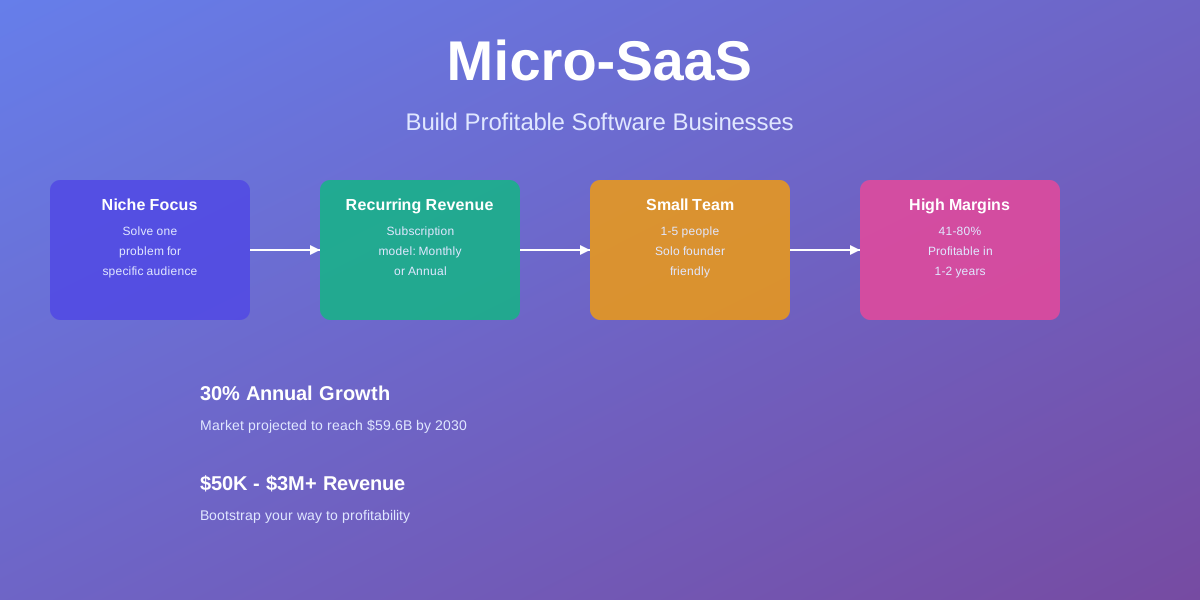
Imagine building a profitable software business while working from anywhere, with minimal startup costs and a small, dedicated team—that's the reality of micro-SaaS. In 2026, the micro-SaaS market is growing at roughly 30% annually, projected to reach $59.60 billion by 2030. Unlike traditional SaaS platforms targeting broad markets, micro-SaaS succeeds by doing one thing exceptionally well for a highly specific audience. Whether you're a solo founder seeking wealth independence or an entrepreneur looking to validate a business idea quickly, micro-SaaS offers a pathway to recurring revenue with manageable risk and overhead.
Real micro-SaaS founders are already winning: Pieter Levels generates over $3 million annually from Nomad List, while Leave Me Alone reached $93,000 in annual revenue with just two founders working from a boat.
The beauty of micro-SaaS lies in its simplicity—solve one specific problem, charge subscribers monthly or annually, and reinvest profits into growth. No venture capital required, no diluted ownership, and no pressure to scale at all costs.
What Is Micro-SaaS?
Micro-SaaS is a small, niche-focused software product that solves a specific problem for a well-defined audience and generates recurring revenue through subscription pricing. Typically managed by one to five people, micro-SaaS businesses generate $50,000 to $3 million+ annually and reach profitability within one to two years. Unlike enterprise SaaS platforms targeting multiple industries and use cases, micro-SaaS thrives by focusing intensely on solving one or two key problems for a tiny, specific market segment.
Not investment advice.
The subscription model is central to micro-SaaS success. Monthly or annual plans create predictable, recurring cash flow that makes financial planning and scaling more manageable. Examples include FormBackend (helps developers handle form submissions for $19/month), Carrd (one-page website builder with $360K+ ARR), and Bannerbear (automated image generation with $991K ARR). Each solves a narrow problem so well that customers willingly pay because no one else cares enough to build it.
Surprising Insight: Surprising Insight: The micro-SaaS segment is growing 30% annually, with market projections hitting $59.60 billion by 2030—yet most micro-SaaS founders remain invisible because they deliberately target small, underserved niches.
The Micro-SaaS Business Model
Shows the core components: niche market identification, MVP development, subscription pricing, recurring revenue (MRR), and profitability cycle
🔍 Click to enlarge
Why Micro-SaaS Matters in 2026
Micro-SaaS represents a fundamental shift in how wealth is built. Traditional entrepreneurship required significant capital, long development timelines, and outside investment. Micro-SaaS democratizes wealth creation by enabling solo founders to launch profitable businesses with less than $1,000 upfront. This is particularly relevant in 2026 as remote work normalizes, digital distribution reaches global audiences instantly, and AI tools accelerate software development.
The financial advantages are compelling. Micro-SaaS businesses average 41% profit margins in 2024, with many exceeding 80% margins for business-focused tools. Compare that to traditional SaaS (typically 20-30% margins) or product-based businesses (5-15% margins). The reason: low overhead costs when you're a solo founder or small team, minimal customer support requirements due to niche focus, and high willingness-to-pay from customers solving painful problems.
Beyond personal wealth, micro-SaaS offers lifestyle benefits aligned with modern values. You maintain 100% ownership and decision-making authority, avoid investor pressure to scale at all costs, work on your own schedule, and generate $50,000 to $500,000+ annually while investing only 20-40 hours per week once established. For many entrepreneurs, this trade-off—smaller absolute revenue but greater autonomy and profitability—is far more attractive than raising venture capital.
The Science Behind Micro-SaaS
The economics of micro-SaaS are rooted in network effects and market efficiency. Traditional SaaS companies compete on feature breadth and market size, requiring massive development investment and marketing spend. Micro-SaaS succeeds through focus: by serving one specific customer segment with one or two best-in-class features, you eliminate the overhead of competing on every dimension. Research from Rob Walling's MicroConf shows that micro-SaaS founders evaluate ideas across five science-backed criteria: product (can you build it?), price (will customers pay enough?), market (does demand exist?), marketing channels (can you reach them?), and monetization (is profitability sustainable?).
Retention becomes your biggest growth driver. While SaaS companies focus on customer acquisition, micro-SaaS founders prioritize reducing churn because a small customer base compounds quickly. If you maintain a 3-7% monthly growth rate from existing customer retention and upsells, you're performing at a healthy level. Even small customer wins push revenue significantly when your base is 10-100 customers paying $20-200/month each. This retention-first mindset also makes marketing more efficient: satisfied customers refer others, reducing customer acquisition costs from $200-500 per customer in traditional SaaS to $50-150 in micro-SaaS serving passionate niches.
MRR Growth Mechanics in Micro-SaaS
Illustrates how Monthly Recurring Revenue (MRR) compounds through retention, upselling, and expansion revenue
🔍 Click to enlarge
Key Components of Micro-SaaS
Niche Selection and Market Validation
The foundation of micro-SaaS is identifying an underserved niche where customers face a painful problem and are willing to pay. Validation begins with market research to understand your target audience's pain points and confirm demand exists. Practical validation timelines span: Weeks 1-2 (create landing page, drive traffic, collect 20+ qualified email signups indicating genuine interest); Weeks 2-3 (conduct 10-20 problem validation interviews focusing on past behavior); Weeks 3-4 (offer beta access at discount, measure who actually commits payment). No-code platforms like Relay.app provide templates for validation workflows, and resources like MicroSaaSHQ offer 1,200+ validated ideas with market research, accelerating your discovery phase.
Minimum Viable Product (MVP) Development
An MVP has just enough features to attract early adopters and gather feedback. The goal is testing critical assumptions about product-market fit while conserving time, costs, and resources. Micro-SaaS MVPs typically launch in 4-12 weeks—compared to 6-24 months for traditional SaaS—because of this narrow focus. No-code tools like Zapier, Webflow, and Make.com enable solo founders to build and launch without traditional software development expertise. Your MVP should solve your core problem beautifully and ignore secondary features. Nomad List started as a simple spreadsheet; Carrd began as a personal one-page portfolio tool; both iterated based on user feedback rather than building feature-complete products upfront.
Subscription Pricing Model
Recurring revenue is the engine of micro-SaaS profitability. Pricing strategies include fixed plans (e.g., $19/month, $199/year) targeting specific customer segments, usage-based pricing scaling with customer value, and tiered plans enabling upsells (free tier → starter $19 → professional $99 → enterprise). Expansion MRR—revenue from upsells, add-ons, and higher-tier upgrades—becomes significant once you reach 50+ customers. Hybrid billing models combine fixed seats with consumption-based pricing, balancing predictability and customer flexibility. Profitability typically arrives around $1,000 to $20,000 MRR, depending on your expenses and team size.
Low Startup Costs and Lean Operations
Most micro-SaaS businesses launch with $500-$5,000 covering domain registration, no-code hosting, payment processing, and initial marketing. Cloud infrastructure and no-code tools eliminate capital-intensive infrastructure costs. Your main recurring costs are hosting ($25-300/month), payment processing (2.9% + $0.30 per transaction), and marketing ($100-500/month initially). Customer support can be minimized through self-serve documentation and community forums, especially if you're serving a niche of technically sophisticated users. This low-cost structure means you can reach profitability with just 10-50 paying customers, compared to traditional SaaS requiring 100+ enterprise customers to break even.
| Factor | Micro-SaaS | Traditional SaaS |
|---|---|---|
| Team Size | 1-5 people | 10-50+ people |
| Startup Cost | $500-$5,000 | $50,000-$500,000 |
| Time to Launch | 4-12 weeks | 6-24 months |
| Annual Revenue Target | $50K-$3M | $1M-$100M+ |
| Profit Margins | 41-80% | 20-30% |
| Customers Needed | 10-100 | 100-1,000+ |
| Profitability Timeline | 1-2 years | 3-5 years |
How to Apply Micro-SaaS: Step by Step
- Step 1: Identify a niche problem you've personally experienced or understand deeply. Brainstorm 10-20 specific customer segments and their pain points.
- Step 2: Research competitor solutions and gaps. Check Nomad List, Carrd, Leave Me Alone, and other micro-SaaS examples to understand pricing, positioning, and feature scope.
- Step 3: Validate market demand without building anything. Create a landing page explaining your solution and drive traffic to collect 20+ email signups from your target audience.
- Step 4: Conduct problem interviews with 10-20 potential customers. Ask about their current solutions, pain levels (1-10), and willingness to pay. Focus on past behavior, not hypothetical futures.
- Step 5: Build a minimal MVP using no-code tools (Make.com, Webflow, Airtable, Zapier). Your goal is proving core functionality in 4-8 weeks with <$500 investment.
- Step 6: Launch to a small cohort of early adopters. Offer beta access at 50% discount and ask for detailed feedback. Track retention and usage patterns.
- Step 7: Define your pricing model. Start with fixed plans ($19-99/month) targeting a specific customer segment. Test pricing through conversations and willingness-to-pay surveys.
- Step 8: Set up payment processing (Stripe, Paddle) and deliver your solution. Establish customer support channels (email, community, docs) that scale without hiring.
- Step 9: Track key metrics: Monthly Recurring Revenue (MRR), customer acquisition cost (CAC), churn rate, and lifetime value (LTV). Target 3-7% monthly growth and <5% monthly churn.
- Step 10: Reinvest profits into product improvements and marketing. Consider adjacent markets, new customer segments, or upsell features after reaching $5K MRR profitably.
Micro-SaaS Across Life Stages
Young Adulthood (18-35)
In your 20s and 30s, micro-SaaS offers an ideal wealth-building vehicle. Low startup costs mean you can launch while maintaining a job, testing ideas on nights and weekends. The 4-12 week development timeline aligns with rapid experimentation cycles. Real-world examples like Pieter Levels (Nomad List) and AJ (Carrd) built their products as solo projects before they generated substantial revenue. At this life stage, risk tolerance is typically higher, career flexibility is possible, and you're building skills (coding, marketing, sales) that compound over decades. The goal isn't necessarily to build a $10M business—it's to generate $1-5K/month in passive revenue, proving the model works before deciding whether to scale further.
Middle Adulthood (35-55)
In your 40s and 50s, micro-SaaS becomes an exit strategy from traditional employment. If you've built expertise in a specific domain (marketing, software development, finance), a micro-SaaS targeting that industry leverages accumulated knowledge without requiring you to learn a new field. Revenue targets shift from exploration ($1-5K/month) to income replacement ($5-20K/month), providing financial independence and flexibility. At this stage, you may have capital to invest or co-founders to partner with, accelerating development. Micro-SaaS also offers an alternative to consulting or freelancing—similar expertise generates recurring revenue at higher multiples. The time commitment becomes more strategic: you can build systems and hire part-time help, freeing yourself from day-to-day operations while maintaining profitability.
Later Adulthood (55+)
In your late 50s and beyond, micro-SaaS transitions into a legacy income stream. If built sustainably, a micro-SaaS business generating $20-50K/month can fund retirement while requiring minimal active management. The business becomes increasingly passive: customer acquisition slows (your niche saturates), but retention remains high and satisfied customers refer others organically. At this stage, consider: selling the business (3-5x annual revenue multiple is typical for micro-SaaS), hiring someone to manage it while you remain as advisor, or maintaining it as a personal income source with 5-10 hours/week of involvement. Micro-SaaS also enables meaningful work beyond retirement—many founders describe the satisfaction of having created something valuable for a specific community, independent of financial need.
Profiles: Your Micro-SaaS Approach
The Employed Experimenter
- Idea validation framework to test assumptions before quitting their job
- No-code tools enabling MVP development in 20 hours/week on nights and weekends
- Clear metrics (MRR, churn, CAC) to know when revenue justifies full-time focus
Common pitfall: Building in stealth mode too long, missing critical customer feedback that could reshape the product
Best move: Launch early and get real customer feedback within 8 weeks. Sell beta access at 50% discount to fund further development and validate revenue potential before leaving employment.
The Industry Expert
- Confidence that domain expertise translates to customer willingness-to-pay
- Distribution channels leveraging existing professional networks
- Product-market fit validation through 10-20 conversations with peers facing the same pain
Common pitfall: Overbuilding features based on personal preferences rather than customer priorities. Experts often think about edge cases that don't matter to the market.
Best move: Build ruthlessly simple first. Document customer feedback in a simple spreadsheet. After 50+ conversations and 20+ paying customers, add features. Resist complexity until forced by customer demand.
The Bootstrapped Founder
- Startup cost minimization—every dollar matters when you have limited capital
- Profitability timeline clarity: when does this break even and generate income?
- Organic growth strategies: referrals, content, communities—not paid acquisition
Common pitfall: Underpricing out of fear or lack of pricing data, leaving money on the table and making profitability harder to achieve
Best move: Talk to 50+ potential customers about pricing before launching. Most people underestimate what they can charge. Test prices 2-3x higher than your initial instinct. Revenue per customer matters more than absolute customer count when bootstrapped.
The Passive Income Seeker
- Time-to-automation clarity: when can you reduce to 5-10 hours/week involvement?
- Sustainable systems for customer onboarding, support, and retention without hiring
- Long-term profitability over rapid growth
Common pitfall: Chasing growth metrics that require constant work, defeating the passive income goal. Saying yes to every customer need rather than maintaining laser focus.
Best move: Define your 'done state' upfront: What level of MRR lets you stop actively marketing? What processes must be automated or delegated? Build toward that target, then maintain and harvest rather than chase growth.
Common Micro-SaaS Mistakes
The biggest micro-SaaS mistake is building before validating. Founders spend 3-6 months developing a product, then discover their target customers don't face the problem they're solving or won't pay for the solution. Validation takes 2-4 weeks and costs ~$0. Building without validation wastes months and thousands of dollars. Solution: sell beta access before building fully. Collect 20+ paying customers at 50% discount, proving revenue potential before committing to a polished product.
The second mistake is feature creep and loss of focus. Micro-SaaS succeeds through clarity: one core problem, best-in-class solution. As early customers request features, the temptation to say yes grows. Suddenly your simple tool becomes a complicated platform with 100 features, none of them excellent. High churn follows. Solution: maintain a 'no' list. Write down features you won't build. Every new feature request gets evaluated against your core mission. If it doesn't serve your primary customer segment's primary problem, it's a 'maybe later'—which means probably never.
The third mistake is underpricing. Many founders fear customers will reject higher prices, so they charge $9/month instead of $39/month. This is often wrong. Micro-SaaS customers choose your tool specifically because you solve their problem better than anything else. They'll pay if the price aligns with the value you deliver. Solution: research competitor pricing in your space. Talk to customers about willingness-to-pay. Test prices 2-3x higher than your initial instinct. If nobody complains, you're too cheap. Raise prices quarterly in year one until you hit a price ceiling.
Micro-SaaS Failure Points and Solutions
Common pitfalls at each stage of micro-SaaS development and corresponding corrective actions
🔍 Click to enlarge
Science and Studies
Micro-SaaS research comes from industry data, founder case studies, and business model research compiled by entrepreneurs who've scaled profitably from zero. The research emphasizes validation, retention, and sustainable growth over rapid scaling.
- Micro-SaaS market growing 30% annually, projected $59.60 billion by 2030 (from $15.70 billion in 2024)—source: Lovable.dev SaaS Trends 2026
- Average profit margins: 41% (2024), with many exceeding 80% for B2B tools—source: SaaS profitability research by RightLeft Agency
- Typical startup cost: $500-$5,000; profitability timeline: 1-2 years with 10-50 paying customers—source: Indie Hackers micro-SaaS benchmarks
- Founders reaching $1K-$20K MRR profitably generate $50K-$500K+ annually on 20-40 hours/week—source: MicroConf founder data and Nomad List case study
- Key validation metrics: 20+ email signups (proof of interest), 10-20 problem interviews, beta customers paying 50% discount (proof of payment intent)—source: MicroSaaSHQ and Upstack Studio validation frameworks
Your First Micro Habit
Start Small Today
Today's action: Write down 5 specific problems you've experienced or observed in your industry. For each problem, research whether others face it (Google Trends, Reddit, Twitter). Identify which problem affects 100+ people willing to pay $20+/month. That's your micro-SaaS idea.
This 30-minute exercise shortcircuits months of uncertainty. Most micro-SaaS failures start with the wrong problem. By grounding your idea in observed frustration and market signals, you're filtering for viability before investing time or money.
Keep quitting habit apps after a missed day? BeMooore forgives the slip — your streak survives, and an AI mentor nudges you back the next morning. Free on iOS.
Quick Assessment
How clear is your understanding of a specific niche problem you want to solve?
Problem clarity is foundational. Successful micro-SaaS founders deeply understand their niche because they either experienced the pain personally or spent weeks interviewing customers. If you scored 'very clear,' you're ready to validate. If not, invest 2-4 weeks in customer interviews before building.
How would you describe your comfort level with building and launching with minimal resources?
Micro-SaaS is built for resource-constrained founders. No-code tools and online communities lower barriers dramatically. If you scored 'uncertain' or 'not comfortable,' your first move is exploring free resources (Indie Hackers, MicroSaASHQ, no-code tool tutorials) rather than seeking capital. Many successful founders had zero coding skills initially.
What motivates you most: building a $100M+ company, generating $5K/month passive income, or solving a specific problem for a niche community?
Your motivation shapes your strategy. Micro-SaaS is ideal for founders motivated by income (#2) or community (#3). If your primary goal is building a $100M+ company (#1), venture-backed SaaS or other models may serve you better. Understanding your true motivation prevents building the wrong business.
Take our full assessment to get personalized recommendations.
Discover Your Style →Next Steps
If micro-SaaS resonates with you, your next move is problem identification and validation. Spend this week writing down 10 problems you've experienced or observed in your industry. Research each problem using Google Trends, Reddit, Twitter, and relevant forums to confirm others face it. Pick the top problem affecting 100+ people willing to pay $20+/month. That's your validated starting point.
After identifying your problem, invest 2-4 weeks in customer validation. Create a simple landing page describing your solution. Drive traffic using relevant communities, social media, or email lists. Your goal: collect 20+ email signups from people in your target market. This signal proves customer interest before you build anything. Then, interview 10-20 of those signups to understand their pain points, current solutions, and willingness-to-pay. These insights shape your MVP, preventing months of wasted development.
Get personalized guidance with AI coaching.
Start Your Journey →Research Sources
This article is based on peer-reviewed research and authoritative sources. Below are the key references we consulted:
Related Glossary Articles
Frequently Asked Questions
How much money do I need to start a micro-SaaS?
Most micro-SaaS businesses launch with $500-$5,000 covering domain registration, hosting, no-code tools, and initial marketing. Cloud infrastructure eliminates costly server setup. If you use free or low-cost no-code platforms initially, you could start with <$500. The key is validating market demand before investing heavily in development.
Can I build a micro-SaaS without coding skills?
Yes. No-code platforms like Make.com, Zapier, Webflow, Airtable, and others enable non-technical founders to build functional software. Many successful micro-SaaS businesses were created by founders with no programming background. Your competitive advantage is understanding your customer's problem, not writing perfect code.
How long does it take to build and launch a micro-SaaS?
Typical timelines: 2-4 weeks for market validation, 4-8 weeks for MVP development, 1-2 weeks for launch. Total: 8-14 weeks from idea to first paying customers. This is significantly faster than traditional SaaS (6-24 months) because of the narrow focus on one specific problem.
What's a realistic revenue target for a micro-SaaS?
Conservative target: $1,000-$5,000 MRR within 12 months (10-50 paying customers at $20-100/month). Aggressive target: $5,000-$20,000 MRR within 18 months. Top performers reach $50,000-$500,000+ annually. These multiples assume consistent customer acquisition and <5% monthly churn. Your actual results depend on product-market fit, pricing, and marketing effectiveness.
Is micro-SaaS a sustainable long-term business model?
Yes. Micro-SaaS sustainability depends on retention and profitability rather than constant growth. Many micro-SaaS founders run profitable businesses for 5+ years with 5-10 hours/week involvement after the first 18 months. The business remains healthy as long as churn stays low and you reinvest profits into gradual improvements. Some founders sell their micro-SaaS businesses at 3-5x annual revenue multiples, creating capital events.
Take the Next Step
Ready to improve your wellbeing? Take our free assessment to get personalized recommendations based on your unique situation.
- Discover your strengths and gaps
- Get personalized quick wins
- Track your progress over time
- Evidence-based strategies