Ideation
Have you ever felt stuck when facing a problem, unsure which direction to turn? Ideation is the creative force that breaks through that paralysis. Es the systematic process of generating, developing, and sharing new ideas—transforming vague possibilities into concrete solutions. Whether you're launching a business, solving a personal challenge, or simply looking to enrich your daily life, ideation skills unlock potential you didn't know you possessed. The ability to ideate isn't just for artists or entrepreneurs; es a fundamental skill that boosts felicidad, resiliencia, and your capacity to thrive in an unpredictable world.
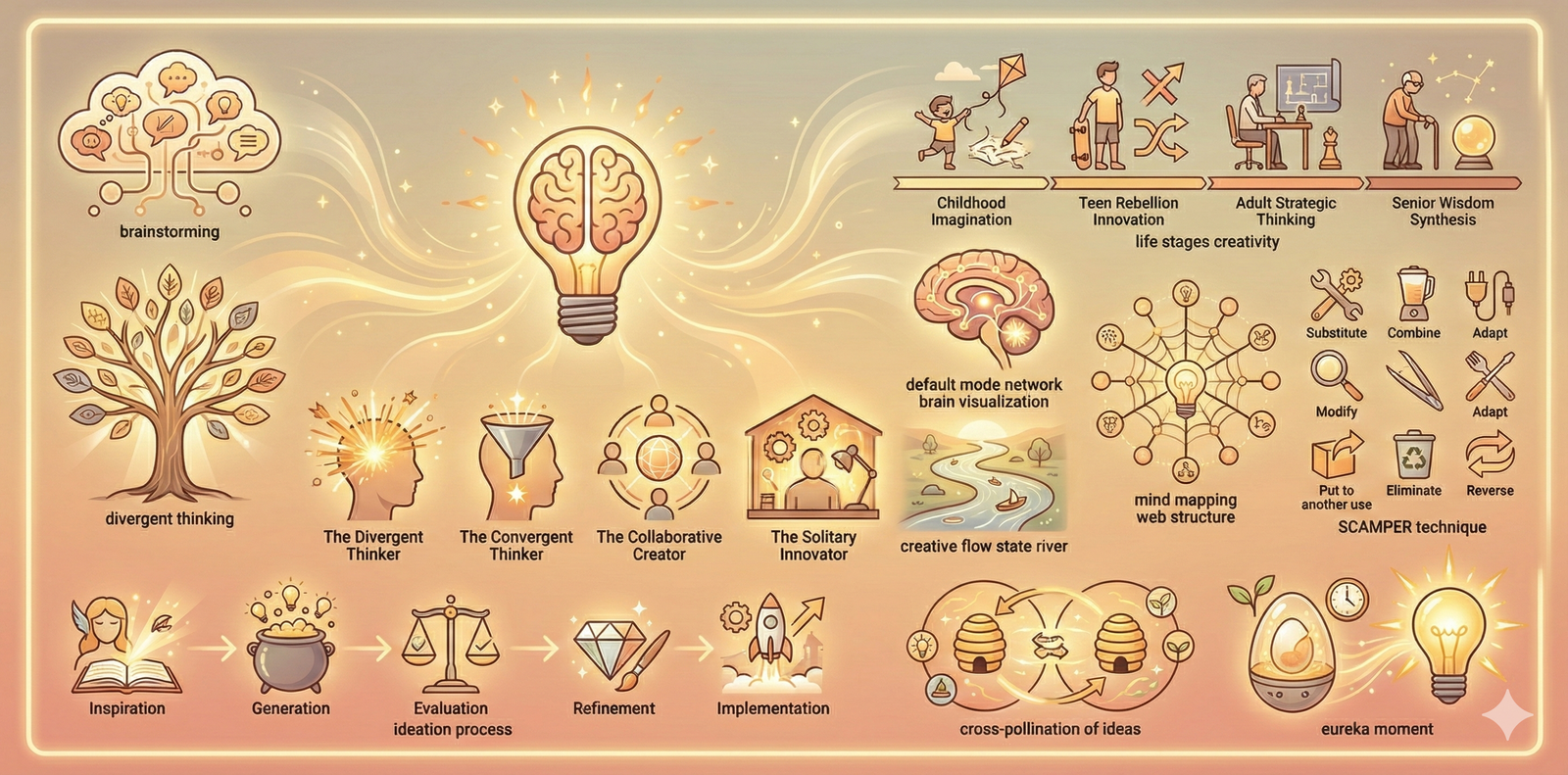
Imagine spending just 15 minutes a day generating ideas about your life, your work, your relaciones. Small shifts in how you think create profound shifts in what you experience.
This guide reveals the science behind ideation, proven techniques used by innovators worldwide, and practical steps to unleash your creative potential today.
What Is Ideation?
Ideation is the creative and systematic process of generating, developing, and communicating new ideas. Es a core component of how humans innovate, solve problems, and imagine better futures. An idea, in this context, is any basic unit of thought—whether visual, concrete, or abstract—that forms the foundation of innovation and progress.
Not medical advice.
Ideation comprises all stages of a thought cycle: from initial innovation and exploration, through desarrollo and refinement, to final actualization and implementation. Es not a single moment of inspiration but rather a structured journey that transforms raw creative energía into actionable solutions. The process combines divergent thinking (generating many ideas without judgment) with convergent thinking (refining and selecting the best ideas).
Surprising Insight: Surprising Insight: La investigación muestra that groups alternating between individual and collective ideation generate 40% more ideas than groups using only one approach—hybrid ideation is the most effective strategy.
The Ideation Cycle
Ideation moves through distinct phases from exploration to execution
🔍 Click to enlarge
Why Ideation Matters in 2026
In our rapidly evolving world, the ability to generate and evaluate ideas has become a superpower. Organizations report that companies with strong ideation cultures show 40% higher innovation rates and better employee engagement. For individuals, ideation skill directly supports mental well-being by providing a sense of agency, purpose, and creative expression. In an era of uncertainty—economic volatility, technological disruption, climate challenges—the people who thrive are those who can imagine alternatives and work toward them. Ideation is fundamentally an optimism skill: es the practice of believing that better futures are possible and that you can contribute to creating them.
The pace of change means yesterday's solutions no fit today's problems. Whether facing workplace challenges, relationship difficulties, or personal crecimiento objetivos, your capacity to ideate determines how quickly you can adapt and thrive. A manager facing declining team morale might ideate ways to rebuild connection. A person in a difficult relationship might ideate approaches to communication or conflict. An entrepreneur facing market changes might ideate new business models or customer approaches. Ideation connects directly to felicidad because it gives you control—the feeling that you can shape your circumstances rather than be shaped by them. This sense of agency is one of the strongest predictors of psychological well-being.
Beyond individual benefits, ideation creates communities. When you develop strong ideation skills, people seek you out for creative problem-solving. You become a resource others trust, which strengthens your sense of belonging and social connection—core pillars of well-being. At work, you become someone people want on their team. In friendships, you become the person people call when they're stuck. These contributions to others' lives boost your own sense of purpose and value.
Research in positive psychology shows that creative engagement is directly associated with flow states—those moments of complete absorption where time dissolves and felicidad naturally emerges. Ideation, when practiced in the right environment, reliably produces flow. Unlike passive consumption (watching television, scrolling social media), ideation actively engages your highest cognitive capacities. This engagement itself is rewarding and contributes to long-term life satisfaction.
The Science Behind Ideation
Neuroscience reveals that creative ideation activates multiple brain networks simultaneously. The default mode network (DMN) handles spontaneous thought and idea generation, while the executive network (EN) manages critical evaluation and refinement. The most creative individuals show strong activity in both networks, plus seamless switching between them. Brain imaging studies show that during ideation, different regions light up depending on the phase: divergent thinking activates areas associated with free association and loose thinking, while convergent thinking activates areas associated with focused attention and logic. The key is flexibilidad—the ability to shift between these modes smoothly.
Creative thinking relies on a delicate balance: spontaneous exploration balanced with focused evaluation. During the divergent phase (idea generation), your brain relaxes constraints and makes novel connections. This is why walking, showering, or daydreaming often produce good ideas—your prefrontal cortex (the critical evaluator) is quiet. During the convergent phase (idea refinement), your prefrontal cortex engages, applying judgment and strategic thinking. This is why brainstorming works best when initial divergence is protected from immediate critique.
Neurotransmitters play crucial roles in ideation. Dopamine increases during ideation, which is associated with motivation, reward, and the drive to explore. This explains why creative work can feel energizing even when es challenging. Serotonin, associated with mood and well-being, also increases during creative engagement. This neurochemical reality explains why ideation directly supports salud mental—es not just psychological benefit but actual brain chemistry supporting well-being. The experience of a good idea arriving—that moment of insight—triggers a dopamine release similar to other rewarding experiences. Over time, practicing ideation trains your brain to expect reward from creative thinking, making it self-reinforcing.
Sueño plays a critical role in ideation, particularly in the incubation phase. During sueño, the brain consolidates information, makes new connections, and reorganizes memories. REM sueño—the dreaming phase—appears particularly important for creative insights. This is why sleeping on a problem truly works. The advice to take a break after brainstorming isn't just psychology; es neuroscience. Your brain is literally processing information and making creative connections while you rest. Many famous insights occurred immediately after sueño or upon waking, when the mind emerges from this consolidation process with fresh connections.
Brain Networks in Ideation
Creative ideation engages multiple interconnected brain regions and networks
🔍 Click to enlarge
Key Components of Ideation
Divergent Thinking
Divergent thinking is the ability to generate multiple possible solutions from a single problem. Es about quantity over quality—the maxim that quantity breeds quality. Research supports this: the greater the number of ideas generated, the higher the probability of discovering a truly innovative solution. During divergent thinking, you suspend judgment, encourage wild ideas, and make unusual connections.
Convergent Thinking
Convergent thinking is the flip side: the ability to evaluate, combine, and refine ideas toward a single best solution. This phase requires critical analysis, logical evaluation, and the courage to discard ideas that no serve your goal. The best ideators move fluidly between divergence and convergence rather than getting stuck in either mode. In convergent thinking, you apply criteria: Does this align with our objetivos? Is it feasible with available resources? Does it address the root problem or just symptoms? Which ideas can combine to create something stronger? Does this idea represent a genuine innovation or a minor variation? This rigorous analysis prevents mediocre ideas from advancing while ensuring that the most promising concepts get developed fully.
Psychological Safety
Ideation thrives in environments where people feel safe to share unconventional ideas without fear of ridicule or punishment. Psychological safety—the belief that you can take interpersonal risks—is essential for honest brainstorming. When fear is present, people self-censor, and genuinely novel ideas never surface.
Incubation and Insight
Some of your best ideas arrive when you're not actively thinking about a problem—in the shower, during a walk, or just before sueño. This is incubation: your unconscious mind continues working on problems while your conscious mind rests. Many breakthrough ideas require this period of non-directed thinking to emerge.
| Technique | Best For | Group Size |
|---|---|---|
| Brainstorming | Quantity of ideas, team building | 4-8 people |
| Brainwriting | Introversion, avoiding dominance | 3-6 people |
| Mind Mapping | Visual thinkers, exploring connections | 1-4 people |
| Worst Possible Idea | Breaking mental blocks, humor | 3-8 people |
| SCAMPER | Product innovation, feature analysis | 2-6 people |
| Six Thinking Hats | Systematic evaluation, perspective shifts | 3-8 people |
How to Apply Ideation: Step by Step
- Step 1: Define the Challenge Clearly: Write your problem in one sentence. What exactly are you trying to solve, create, or improve? Specificity matters—vague problems generate vague ideas.
- Step 2: Set Time Boundaries: Allocate a fixed period (15-30 minutes for divergence, 10-15 for convergence). Time constraints focus creative energía.
- Step 3: Gather Your Team or Materials: Ideation works best with diverse perspectives. Gather people from different backgrounds or bring multiple reference materials.
- Step 4: Begin with Divergence: Generate ideas freely without critique. Aim for volume. Encourage wild, silly, impossible ideas—they often spark practical innovations.
- Step 5: Use Proven Techniques: Apply brainstorming, mind mapping, SCAMPER, worst possible idea, or six thinking hats based on your style and group size.
- Step 6: Document Everything: Write down all ideas, no matter how rough. Don't edit in real-time—capture raw creative output for later refinement.
- Step 7: Take a Break: Step away for 15-30 minutes. Your unconscious mind continues working on the problem, leading to sudden insights and connections.
- Step 8: Shift to Convergence: Review your ideas with fresh eyes. Which ones align with your objetivos? Which could combine or evolve? Which show the most promise?
- Step 9: Evaluate Rigorously: Apply criteria like feasibility, impact, novelty, and resources required. Score ideas systematically rather than by gut feeling alone.
- Step 10: Create a Next Step Plan: Select your top 1-3 ideas and define concrete actions. What's the smallest step forward? Who needs to be involved? What's the timeline?
Ideation Across Life Stages
Adultez joven (18-35)
Young adults often have the advantage of fewer constraints and greater openness to risk. This is the ideal time to develop strong ideation habits. Career choices, lifestyle design, and relationship patterns all benefit from deliberate creative thinking at this stage. Many young adults discover that ideation helps them clarify values and objetivos, moving beyond the "supposed to" toward authentic choices.
Edad media (35-55)
Middle adulthood brings deeper expertise combined with significant responsibility. Ideation at this stage often focuses on optimizing existing systems, mentoring others, and pivoting toward greater purpose. Middle-aged ideators frequently report that creative problem-solving reignites passion in careers and relaciones that may have grown stale.
Adultez tardía (55+)
Later adulthood offers accumulated wisdom and perspective. Ideation at this stage often shifts toward legacy, contribution, and meaning-making. Many people report that their most creative and generative ideas emerge in later years when external pressures ease and internal clarity deepens.
Profiles: Your Ideation Approach
People bring different styles to ideation. Understanding your natural style helps you leverage strengths and compensate for blind spots. Most people are strongest in one or two approaches but can develop capability across all styles. The goal isn't to change who you are but to work with your wiring while building flexibilidad.
The Divergent Thinker
- Permission to think wildly and freely
- Diverse input and perspectives
- Low-pressure environments for exploration
Common pitfall: Generating endless ideas without refinement or action—excellent at possibility, weak at execution
Best move: Pair with a convergent thinker, build in evaluation phases, set hard deadlines for decisions, use frameworks to move from ideation to action
The Convergent Thinker
- Clear criteria for evaluation
- Structured processes for comparison
- Confidence in their decision-making ability
Common pitfall: Prematurely cutting off idea generation with too-harsh criticism, defaulting to safe, established solutions
Best move: Intentionally extend divergence phases, defer judgment until you have a robust idea pool, practice saying "yes, and..." instead of "no, but...", value quantity before quality
The Collaborative Creator
- Group settings and team dynamics
- Opportunities to build on others' ideas
- Social connection and shared purpose
Common pitfall: Groupthink and tendency to follow dominant voices, difficulty pushing back on popular ideas even when better alternatives exist
Best move: Mix individual ideation with group sessions, ensure psychological safety through explicit norms, explicitly invite dissenting views, sometimes use anonymous input to avoid social pressure
The Solitary Innovator
- Quiet space and uninterrupted time
- Access to research and reference materials
- Freedom from social pressure or consensus-building
Common pitfall: Missing valuable perspectives and valuable input from diverse viewpoints, ideas that seem brilliant in isolation proving impractical in reality
Best move: Periodically share ideas with trusted others for feedback, actively seek out contrarian views and criticism, test assumptions with diverse audiences, move from individual ideation to collaborative refinement
Most people combine elements of multiple profiles. You might be primarily a solitary innovator who becomes collaborative once ideas reach a certain maturity. Or a divergent thinker who pairs with a convergent partner to bring ideas to completion. Recognizing these patterns in yourself and others—and building teams that combine different styles—is key to consistent innovation. When teams are too homogeneous in ideation style, they repeatedly make similar mistakes. A team of all divergent thinkers never decides. A team of all convergent thinkers never dreams big. Diversity of ideation style is as valuable as diversity of background.
Common Ideation Mistakes
The most common ideation mistake is premature judgment. When you critique ideas too early—during divergence—you shut down creative flow and miss novel possibilities. Many people self-censor their best ideas before speaking them aloud. The antidote is explicit permission: "No judgment in this phase. All ideas welcome." La investigación muestra that groups explicitly instructed to defer judgment generate 25-35% more ideas than groups with no such instruction.
The second mistake is confusing ideation with execution. Ideation is about possibility; execution is about feasibility. Mixing these during the creative phase stifles innovation. Keep them separate: first generate possibilities, then evaluate what's feasible. The best innovators maintain this distinction rigorously—expanding possibilities first, then narrowing to what's viable. This mental separation is critical because the skills needed are different: divergent thinking requires relaxation of constraints, while convergent thinking requires rigorous analysis.
A third mistake is ignoring the incubation phase. After intensive brainstorming, people often keep pushing, trying to solve immediately. But your best ideas may require time in the background. Your unconscious mind continues processing while you rest. Many breakthrough ideas occur to people hours or days after a brainstorming session. Build rest and incubation into your process. Some studies suggest that the best ideas arrive 24-48 hours after an intensive ideation session.
A fourth mistake is homogeneous thinking. When ideation groups lack diversity—of background, perspective, experience, age, culture—they generate fewer novel ideas. Diversity isn't just ethical; es a creative advantage. Teams with cognitive diversity (different ways of thinking) consistently outperform homogeneous teams on complex problem-solving. If your ideation group includes only similar thinkers, actively recruit diverse perspectives.
A fifth mistake is confusing brainstorming with ideation. Brainstorming is one technique within ideation, not the whole process. Some problems benefit from brainstorming; others respond better to mind mapping, SCAMPER, analogical thinking, or the worst possible idea technique. If brainstorming isn't working, the solution isn't to try harder—es to change techniques. Flexibilidad in methodology matters as much as rigor in execution.
The Ideation Maturity Curve
Quality of ideas improves through structured phases and honest feedback
🔍 Click to enlarge
Building Psychological Safety for Ideation
Psychological safety is the foundation of productive ideation. Without it, people hold back their best ideas. Building safety requires deliberate action: explicitly state that all ideas are welcome, thank people for unusual suggestions, avoid dismissing ideas immediately, ask clarifying questions rather than critical ones, and demonstrate openness to different perspectives. Leaders and facilitators set the tone. When the most senior person in the room aggressively critiques ideas, psychological safety collapses—even if everyone else has been supportive.
One practical technique: separate the person from the idea. "I appreciate the thought behind this—help me understand your reasoning" is very different from "That won't work." The first invites deeper engagement; the second shuts conversation down. In cultures where face-saving matters, this distinction becomes even more important. When people know their ideas will be respected even if not adopted, they contribute more creatively.
Ciencia y estudios
Research into ideation spans creativity psychology, organizational behavior, neuroscience, and design thinking. Key findings show that hybrid ideation (mixing individual and group work) produces superior results compared to either approach alone. Studies at Stanford d.school and IDEO demonstrate that structured processes increase both idea quantity and quality. Neuroscience research reveals that the most creative individuals show distinct patterns of brain connectivity and emotional regulation. The scientific evidence overwhelmingly supports that ideation is learnable, improvable, and directly linked to better outcomes across career, relaciones, and personal desarrollo. When you develop ideation skills, you're not just becoming more creative—you're improving your problem-solving ability, your resiliencia, your sense of agency, and ultimately your felicidad.
- Alternating Individual and Group Ideation: Research published in Thinking Skills and Creativity (2018) found that groups alternating between individual brainstorming and collective sharing generated 40% more ideas than groups using only group brainstorming. This hybrid approach appears optimal because individual ideation avoids production blocking (where one person dominates) while group ideation provides perspective-shifting and idea building.
- Default Mode Network Activation: Studies using fMRI show that creative idea generation activates the default mode network, while idea evaluation activates executive networks, with optimal rendimiento requiring dynamic switching. This explains why ideation works best in phases rather than trying to generate and evaluate simultaneously.
- Emotion Induction and Ideation Quality: Research in Neuroscience Letters (2025) demonstrates that positive emotional states enhance the originality of ideas during the divergence phase while maintaining quality during evaluation. This has practical implications: creating pleasant, safe environments for ideation literally increases creative output.
- Design Thinking Effectiveness: A meta-analysis of design thinking interventions shows significant improvements in problem-solving, innovation, and self-efficacy across diverse domains from education to business. People who go through ideation training report not just better outcomes but greater confidence in their ability to handle complex problems.
- Brainstorming Rules and Psychological Safety: IDEO research confirms that deferring judgment, encouraging wild ideas, and building psychological safety consistently increase both idea quantity and radical innovation. The specific rules of brainstorming—no criticism, build on others' ideas, quantity over quality—no son arbitrary; they're based on decades of research about how humans generate ideas most effectively.
Tu primer micro hábito
Comienza pequeño hoy
Today's action: Spend 5 minutes each morning listing 10 ideas—on any topic, solving any problem, imagining any possibility. No editing, just quantity. This trains your divergent thinking muscle and fills your creative reservoir.
Daily ideation builds neural pathways for creative thinking and trains your brain to notice possibilities. Small, consistent practice compounds. Within weeks, idea generation becomes natural and effortless. Your subconscious mind also processes problems overnight, so morning ideation captures these overnight insights.
Track your daily ideation sessions and get AI coaching on developing your creative confidence with our app.
Evaluación rápida
How do you typically respond when facing a problem with no clear solution?
Your approach reveals whether ideation is a natural strength or an area for desarrollo. Either way, structured practice builds confidence.
In group settings, what role do you naturally take when generating ideas?
Your group style shows whether you need more psychological safety, permission to speak, or structured processes to thrive.
How important is ideation skill to your felicidad and éxito?
Your answer guides how much to invest in developing this skill. Small gains create ripple effects across life.
Take our full assessment to get personalized recommendations.
Discover Your Style →Preguntas frecuentes
Próximos pasos
Start with your 5-minute daily ideation habit. Pick a single area of your life where a fresh perspective would matter—work, relaciones, salud, or personal crecimiento. Spend this week generating possibilities without evaluating them. Let ideas accumulate. By week's end, you'll have dozens of options to explore. The second step is to try a group ideation session. Invite 3-4 people you trust, explain the process, set ground rules (defer judgment, encourage wild ideas, build on others' ideas), and spend 30 minutes generating solutions to a real problem you're facing. Notice the difference between individual and group ideation.
Over the next month, experiment with different ideation techniques. Try mind mapping, SCAMPER, worst possible idea, and six thinking hats. Notice which resonates with your style. Combine techniques. Some people love brainstorming but benefit from individual reflection time. Others thrive in groups but need structured processes. Your ideation practice will be most effective when tailored to your personality and circumstances.
Get personalized guidance with AI coaching.
Start Your Journey →Research Sources
This article is based on peer-reviewed research and authoritative sources. Below are the key references we consulted:
Related Glossary Articles
Frequently Asked Questions
Is ideation different from creativity?
Yes. Creativity is the capacity to produce novel ideas; ideation is the structured process of generating, developing, and sharing those ideas. Ideation is the methodology that channels creativity productively. You can be creative but poor at ideation if your ideas never become concrete or shared. Strong ideation skill makes creativity actionable. A brilliant idea that never leaves your head changes nothing. Ideation bridges the gap between creative potential and real-world impact.
Can anyone learn to ideate, or is it a talent?
Anyone can learn ideation. While some people have innate creative confidence, ideation is fundamentally a skill that improves with practice. Studies show that even two hours of ideation training significantly improves performance. The key is removing fear, building psychological safety, and practicing structured techniques. Talent matters less than environment and willingness to practice. Many people raised in families or cultures that discourage questioning and imagination assume they're 'not creative.' These are environmental constraints, not fixed traits.
What if I'm not a 'creative person'?
This belief limits you. Neuroscience shows that creative potential exists in all brains. What varies is exposure to ideation techniques and permission to think divergently. Many 'non-creative' people excel at ideation once they understand the process. The belief that creativity is a trait rather than a skill is itself the problem. Treat ideation like any skill: identify your current level, find good instruction, practice consistently, seek feedback, and refine. Within weeks, you'll notice improvement.
How much time should ideation take?
This depends on your goal. Daily micro-ideation takes 5-15 minutes. Structured brainstorming sessions for a specific problem typically run 30-90 minutes (beyond 90 minutes, fatigue usually reduces quality). Innovation projects may involve weeks or months of ideation across phases. The key is consistency and allowing adequate time for both divergence and convergence. Time isn't wasted on ideation; it's invested in creating possibilities that execution can then pursue.
Why don't my ideas lead to results?
Common reasons: mixing ideation with execution (stifling creativity), not building in incubation time, jumping to implementation before convergence/refinement, or lacking clear next-step action. Strengthen this by separating ideation phases clearly, allowing rest between phases, fully developing your top ideas before deciding, and assigning specific actions with owners and timelines. The bridge between ideation and results is having a clear, concrete next step and accountability for it.
Take the Next Step
Ready to improve your wellbeing? Take our free assessment to get personalized recommendations based on your unique situation.
- Discover your strengths and gaps
- Get personalized quick wins
- Track your progress over time
- Evidence-based strategies