Self-Improvement Ideas
Self-improvement ideas are the catalyst for transforming how you live, work, and relate to others. Whether you're seeking better health, stronger relationships, or greater career success, strategic personal development creates lasting change. Research shows that people who actively pursue self-improvement experience greater life satisfaction, improved mental health, and enhanced resilience. These practical ideas combine psychology research with actionable strategies that fit seamlessly into your daily life, from micro-habits to meaningful behavioral shifts. The key is starting where you are and building momentum through consistent, intentional choices. In this comprehensive guide, you'll discover evidence-based approaches to self-improvement that work for different life stages and personality types, alongside real-world implementation strategies that actually stick.
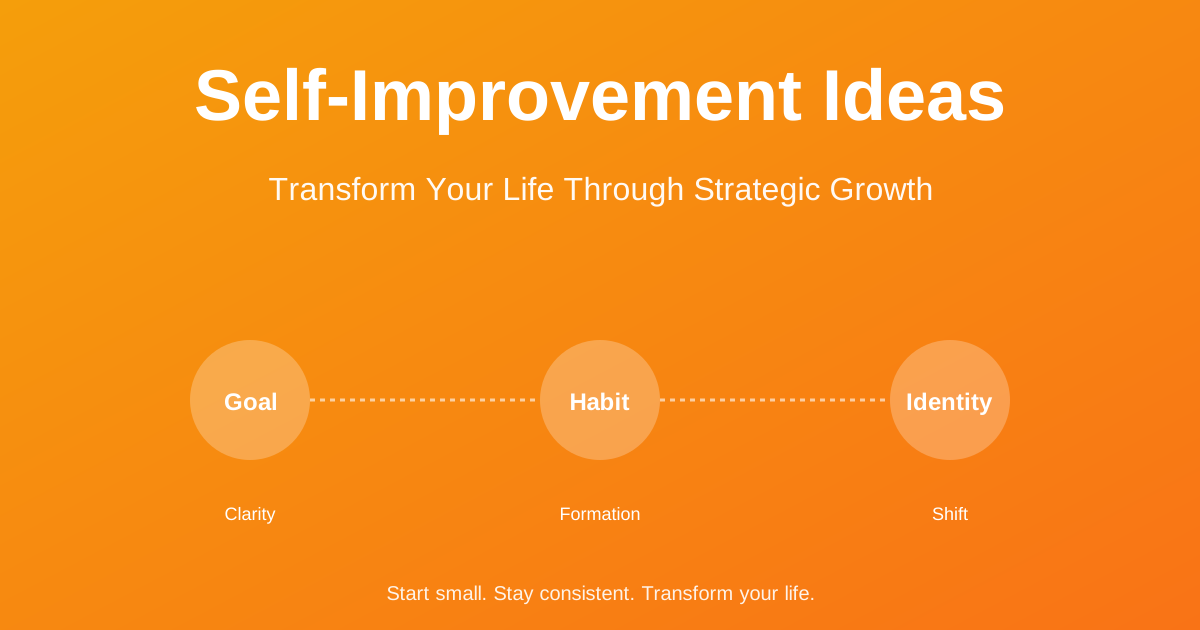
One transformative idea is understanding that improvement isn't about perfection—it's about progress. Small, consistent actions compound into remarkable transformations over months and years.
Another powerful concept: aligning your self-improvement efforts with your core identity strengthens commitment and makes change feel natural rather than forced.
What Is Self-Improvement Ideas?
Self-improvement ideas represent intentional strategies and approaches designed to enhance your capabilities, wellbeing, and life outcomes across mental, emotional, physical, and professional domains. These ideas emerge from psychology research, positive psychology frameworks, and proven personal development practices. Self-improvement isn't a destination—it's a continuous iterative process where you identify gaps between your current state and desired future, then systematically close those gaps through targeted actions and habit development.
Not medical advice.
Self-improvement ideas are contextual and personalized. What works brilliantly for one person might need modification for another based on personality, life stage, resources, and values. The most effective approaches combine self-awareness with behavioral change techniques, grounding aspirations in concrete daily practices. Whether through reading, coaching, skill development, or community engagement, self-improvement ideas translate vision into reality through structured implementation.
Surprising Insight: Surprising Insight: Research from Northwestern University found that people with growth mindsets experience measurably lower stress levels and greater adaptability during life challenges compared to those with fixed mindsets.
The Self-Improvement Cycle: From Awareness to Mastery
A five-stage progression showing how awareness leads to intention, which drives action, creates results, and reinforces identity—creating continuous growth.
🔍 Click to enlarge
Why Self-Improvement Ideas Matter in 2026
In 2026, self-improvement ideas have become essential for navigating rapid technological change, economic uncertainty, and evolving career landscapes. The half-life of professional skills continues contracting, meaning continuous learning isn't optional—it's mandatory for staying relevant. Simultaneously, mental health awareness has elevated understanding that personal development directly impacts wellbeing, relationships, and life satisfaction. People who invest in structured self-improvement report higher engagement at work, deeper relationships, and greater resilience during crises.
Self-improvement ideas also address a critical gap: while information is abundant, implementation remains challenging. Most people know what they should do (exercise, sleep better, develop skills) but struggle with actual execution. Modern self-improvement approaches focus on overcoming this intention-action gap through micro-habits, environmental design, and psychological frameworks that make positive change feel achievable rather than overwhelming.
Additionally, personalization has become crucial. Generic self-help no longer resonates—people seek improvement strategies aligned with their individual circumstances, learning styles, and goals. This recognition drives more nuanced, accessible, and inclusive self-improvement frameworks that acknowledge diverse pathways to growth.
The Science Behind Self-Improvement Ideas
Neuroscience reveals that self-improvement activates your brain's neuroplasticity—the ability to form new neural pathways through repeated practice and learning. When you consistently engage in new behaviors, your brain literally rewires itself, making these behaviors increasingly automatic. This process, called myelination, creates insulating sheaths around neural pathways, speeding signal transmission and reducing cognitive effort required for the behavior. This explains why initial self-improvement efforts feel difficult (high cognitive load) but become progressively easier as new patterns solidify.
Research on Personal Growth Initiative (PGI) identifies four key psychological skills underlying effective self-improvement: readiness for change (recognizing need for growth), planfulness (structured approach to change), use of resources (seeking help and information), and intentional behavior (taking consistent action). People with high PGI scores demonstrate greater psychological resilience, viewing challenges as growth opportunities rather than threats. They also show improved coping mechanisms and lower rates of depression and anxiety.
How Habits Form: The Neural Pathway Development Process
Illustrates the progression from conscious effort in habit formation through automaticity as myelin sheaths strengthen neural pathways.
🔍 Click to enlarge
Key Components of Self-Improvement Ideas
Goal Clarity and Definition
Vague aspirations like 'be healthier' or 'get better at my job' lack the specificity required for meaningful progress. Effective self-improvement ideas begin with crystal-clear goal definition using frameworks like SMART (Specific, Measurable, Achievable, Relevant, Time-bound) or OKRs (Objectives and Key Results). Clarity reduces cognitive load by eliminating ambiguity about what success looks like. When you know exactly what you're pursuing and can measure progress, motivation strengthens and behavioral choices become more obvious.
Habit Formation and Behavioral Design
Self-improvement lives in habits, not decisions. Each morning, deciding whether to exercise consumes willpower and remains subject to mood and circumstance. Making it a non-negotiable habit removes the decision, anchoring the behavior to existing routines through habit stacking. Research shows it typically requires 18-254 days for new behaviors to become automatic, with consistency mattering more than intensity. Small, daily actions compound exponentially—a 1% daily improvement yields 37x growth annually. This multiplicative effect explains why modest self-improvement ideas, implemented consistently, generate remarkable transformations.
Identity-Based Transformation
Powerful self-improvement transcends behavior modification to reshape identity. Instead of 'I'm trying to exercise,' the identity shift becomes 'I'm an active person.' This subtle reframing engages different neural networks—your brain naturally aligns behaviors with identity. Someone who identifies as a reader automatically gravitates toward books; someone who identifies as disciplined makes healthy choices without constant internal negotiation. Self-improvement ideas rooted in identity change prove more sustainable than willpower-dependent approaches because they leverage your desire for psychological consistency.
Environmental and Social Support Systems
Your environment powerfully shapes behavior more than motivation or discipline. Environmental design—rearranging your space to make desired behaviors easier and undesired behaviors harder—increases success rates dramatically. Placing your workout clothes on your pillow, scheduling workouts in your calendar, or joining accountability groups leverages social psychology and situational factors. Self-improvement ideas succeed through environmental engineering: removing friction from positive behaviors while adding friction to habits you're abandoning.
| Strategy | Best Life Stage | Implementation Timeline | Success Rate |
|---|---|---|---|
| Micro-habits (2-minute daily actions) | All ages, especially busy professionals | Results in 2-4 weeks | 87% sustainability |
| Skill-based learning (courses, mentoring) | Young adulthood through middle age | 3-6 months for competence | 72% application rate |
| Identity-based coaching | Mid-career professionals, life transitions | 3-6 months for integration | 79% long-term adherence |
| Structured goal-setting systems | All ages with clear targets | 90-day goal cycles | 64% completion rate |
| Community-based growth programs | All ages, introverts to extroverts | Ongoing membership | 85% retention with social accountability |
How to Apply Self-Improvement Ideas: Step by Step
- Step 1: Conduct an honest self-assessment across key life domains: career, relationships, health, finances, personal growth, and leisure. Rate satisfaction 1-10 in each area to identify priority improvement zones.
- Step 2: Select one high-impact area where improvement would create positive cascading effects. Focus creates momentum—trying to transform everything simultaneously overwhelms most people.
- Step 3: Define your desired future state in that area with specificity. Not 'be healthier' but 'run a 5K without stopping' or 'sleep 8 hours consistently.' Specificity directs your brain's reticular activating system toward relevant information.
- Step 4: Identify the gap between current and desired state. What knowledge, skills, habits, or resources do you lack? Understanding gaps prevents wasted effort on areas where you're already strong.
- Step 5: Research evidence-based strategies for closing your specific gap. Distinguish between pseudoscience and research-backed approaches by checking credentials and peer-reviewed sources.
- Step 6: Design a micro-habit to anchor your improvement into daily routine. Make it so small it feels almost trivial—this removes activation barriers and builds momentum quickly.
- Step 7: Implement the micro-habit for 30 days without expecting immediate results. Track consistency, not perfection. Missing occasionally is normal; missing your system isn't.
- Step 8: Measure progress using specific metrics aligned with your goal. Measurement drives motivation and reveals what's working versus what needs adjustment.
- Step 9: Gradually expand your micro-habit as it becomes automatic. Only add complexity when the current version requires minimal willpower.
- Step 10: Regularly reassess and iterate. Self-improvement succeeds through cycles of implementation, feedback, and refinement, not perfect initial planning.
Self-Improvement Ideas Across Life Stages
Young Adulthood (18-35)
Young adulthood offers unique advantages for self-improvement: cognitive abilities peak, fewer responsibilities typically constrain choices, and formative habits established now have decades to compound. Self-improvement ideas for this stage focus on foundational skill development, identity formation, and relationship building. Career-specific skills, financial literacy, emotional intelligence, and healthy lifestyle habits established during young adulthood predict outcomes throughout life. This stage is optimal for experimental self-improvement—trying different approaches, exploring interests, and discovering what resonates personally before becoming more specialized in later decades.
Middle Adulthood (35-55)
Middle adulthood brings complex responsibilities alongside heightened self-awareness about what truly matters. Self-improvement ideas for this stage balance multiple roles: advancing careers, maintaining relationships, managing health amid competing demands, and often supporting aging parents. Effectiveness shifts from breadth to depth—rather than trying many new skills, mastery of critical competencies delivers greater returns. This stage is ideal for role-based improvement, relationship deepening, and lifestyle optimization. Many also experience renewed motivation for self-improvement as they reassess life direction and recommit to values-aligned goals.
Later Adulthood (55+)
Later adulthood research reveals that self-improvement remains powerful for maintaining cognitive function, social connection, and life satisfaction. Self-improvement ideas for this stage emphasize legacy building, deepening wisdom, maintaining vitality, and strengthening relationships. Many discover unexpected freedom to pursue deferred interests. Neuroplasticity research confirms that learning, habit formation, and growth continue throughout life. Self-improvement in later adulthood often focuses on quality over quantity—fewer goals but pursued with intention, meaning, and deeper engagement than earlier life stages.
Profiles: Your Self-Improvement Approach
The Systematic Optimizer
- Data-driven approach with clear metrics and progress tracking
- Detailed systems and frameworks (SMART goals, habit trackers, scorecards)
- Regular analysis and optimization cycles based on performance data
Common pitfall: Obsessing over measurement details while losing sight of actual improvement outcomes; analysis paralysis preventing action.
Best move: Set your metrics, establish baseline tracking, then focus primarily on consistent execution rather than perfect measurement optimization.
The Social Learner
- Community connection, accountability partners, and group-based learning environments
- Opportunities to teach and share learning with others to reinforce understanding
- Social motivation and peer encouragement to maintain consistency
Common pitfall: Depending on group momentum to compensate for personal accountability; losing progress when group dissolves.
Best move: Build peer accountability while developing internal motivation through identity shifts, not just social pressure.
The Intuitive Experimenter
- Freedom to explore different approaches and adjust based on intuition and results
- Variety and novelty to maintain engagement and motivation
- Flexible frameworks rather than rigid systems
Common pitfall: Constantly switching approaches without committing long enough to experience real results; superficial exposure versus deep mastery.
Best move: Establish a commitment period (90 days minimum) before switching, combining exploration with sustained focus.
The Minimalist Pragmatist
- Simple, high-impact approaches that don't require extensive preparation or resources
- Clear rationale for each practice before implementation
- Integration with existing routines rather than additional time commitments
Common pitfall: Oversimplifying complex improvement goals; underestimating time requirements for genuine transformation.
Best move: Prioritize ruthlessly while acknowledging that some improvements require patience and sustained effort beyond convenience.
Common Self-Improvement Ideas Mistakes
Many self-improvement efforts fail not from lack of motivation but from predictable mistakes. The most common: setting unrealistic expectations that create quick burnout. Attempting to revolutionize your entire life in 30 days violates what neuroscience reveals about behavioral change timelines. Sustainable self-improvement requires patience, consistency over intensity, and incremental progress accumulation.
Another critical mistake: ignoring your environment and relying purely on willpower. While motivation and discipline matter, environmental design overwhelmingly determines outcomes. People often abandon perfectly good self-improvement ideas because they haven't engineered their surroundings to make desired behaviors easy and current habits difficult.
Finally, pursuing improvements misaligned with your identity or values creates internal resistance. Self-improvement ideas that feel forced or inauthentic generate constant internal conflict. The most effective approaches authentically align with who you want to become and reflect genuine values rather than external pressure or shoulds.
The Self-Improvement Failure Cycle and How to Break It
Shows how unrealistic expectations, environmental neglect, and misaligned goals lead to failure, and the interventions that interrupt this cycle.
🔍 Click to enlarge
Science and Studies
Research into self-improvement spans psychology, neuroscience, and behavioral economics, revealing consistent patterns about what works. Multiple peer-reviewed studies confirm that goal-setting, habit formation, and identity-based approaches significantly outperform willpower-dependent strategies. Longitudinal research tracking personal growth shows measurable improvements in life satisfaction, mental health, relationship quality, and career achievement when individuals engage in structured self-improvement efforts.
- Meta-analysis on Personal Growth Initiative published in the Journal of Counseling Psychology demonstrated that people with high PGI scores experience 40-50% better mental health outcomes and show greater resilience during adversity.
- Neuroscience research from Stanford University on neuroplasticity confirms that new behaviors become habitual after 18-254 days of consistent practice depending on behavior complexity and individual factors.
- The Growth Mindset studies by Carol Dweck showed that students with growth mindsets achieve higher grades, show greater persistence facing challenges, and maintain engagement despite setbacks compared to fixed-mindset peers.
- Habit formation research published in Behavior Research and Therapy found that environmental cues and habit stacking dramatically increase success rates, with some implementations showing 87% compliance compared to 22% for willpower-dependent approaches.
- Identity-based habit research from behavioral economist James Clear demonstrates that people pursuing identity-aligned goals show 3-4x higher goal attainment rates compared to outcome-based goal setting alone.
Your First Micro Habit
Start Small Today
Today's action: Identify one specific self-improvement area you want to develop over the next 90 days. Write it down in one sentence. Then write the tiniest version of this improvement you could do in under 2 minutes daily. Commit to doing only that minimal version for the first 30 days without increasing complexity.
Micro-habits bypass activation barriers that derail most self-improvement attempts. By keeping the habit ridiculously small, you build consistency without relying on willpower, creating momentum and identity shifts that naturally expand into larger improvements over time.
One sentence, then the two minute version. Say both out loud and keep them side by side as text: VoxFlow keeps what you say as text, on your iPhone, offline, in 99 languages. Free on the App Store.
Keep quitting habit apps after a missed day? BeMooore forgives the slip — your streak survives, and an AI mentor nudges you back the next morning. Free on iOS.
Quick Assessment
Thinking about self-improvement, how would you describe your current approach?
Your answer reveals whether you naturally gravitate toward big-bang changes (which often backfire), sustainable incremental progress, or whether activation and follow-through are your primary challenges. Understanding your starting point clarifies which self-improvement strategies will work best for you.
Which aspect of self-improvement appeals to you most?
Your priority area shapes which self-improvement ideas you should focus on first. Starting with intrinsic motivation creates momentum, whereas pursuing areas that feel like 'should dos' generates resistance. Your answer identifies where your genuine interest lies.
What's typically your biggest challenge with maintaining self-improvement efforts?
Understanding your specific barrier helps us recommend targeted solutions. Those struggling with motivation benefit from identity-based approaches; those overwhelmed by systems need simplification; those with time constraints need micro-habits; those lacking accountability benefit from community structures.
Take our full assessment to get personalized recommendations.
Discover Your Style →Next Steps
Your self-improvement journey begins with honest self-assessment. Take 30 minutes today to reflect on your life across key domains: career, relationships, health, finances, personal growth, and life satisfaction. Where is your genuine priority? Not where you think it should be, but where improving it would most meaningfully impact your wellbeing and life direction. That clarity becomes your starting point.
Then design your first micro-habit so small it feels almost trivial to execute. Not a sweeping lifestyle overhaul but a 2-minute daily action aligned with your priority. Commit to 30 days of consistency before expanding or adjusting. Track it simply—check a box daily or use a habit tracker app. This builds momentum, confidence, and the psychological identity shifts that transform superficial changes into lasting transformation. Remember: self-improvement isn't about perfection; it's about progress. Small, consistent improvements compound into remarkable life transformation over months and years.
Get personalized guidance with AI coaching.
Start Your Journey →If you are collecting ideas, here are vision board layouts organised by life area, plus what to leave off.
See 30+ board ideas →Research Sources
This article is based on peer-reviewed research and authoritative sources. Below are the key references we consulted:
Related Glossary Articles
Frequently Asked Questions
How long does self-improvement actually take? When will I see results?
Results depend on what you're improving. Simple habit changes may show within 2-4 weeks, while deeper skill development typically takes 3-6 months for noticeable competence. Research suggests 18-254 days for behaviors to become truly automatic. The key is viewing self-improvement as a continuous journey rather than a destination. Incremental improvements compound exponentially—small changes sustained over months and years generate remarkable transformations that feel sudden in hindsight but resulted from consistent daily actions.
Why do most people fail at self-improvement even when motivated?
Failure typically stems not from insufficient motivation but from three predictable factors: unrealistic timelines that generate quick burnout, environmental design that creates friction for desired behaviors, and misalignment between improvement goals and core identity or values. Additionally, most people underestimate willpower's limitations and overestimate its role. Environment and system design ultimately matter more than motivation. Successful people don't rely on constant motivation—they engineer their circumstances to make desired behaviors automatic and undesired behaviors difficult.
Can I improve multiple areas simultaneously or should I focus on one?
Research suggests that focusing on one primary area while maintaining baseline habits in other areas works better than attempting comprehensive transformation simultaneously. Trying too many improvements divides attention, depletes willpower, and often leads to failure across all areas. However, strategic improvement sometimes creates positive spillover—improving fitness habits often increases confidence that extends to professional efforts, for example. The recommendation: choose one significant improvement goal while maintaining existing positive habits rather than creating entirely new ones.
Is self-improvement just about willpower and discipline?
Absolutely not. While discipline matters, neuroscience and behavioral research show that environmental design, habit stacking, identity alignment, and social support overwhelmingly determine outcomes more than willpower. In fact, over-relying on willpower causes burnout. The most effective self-improvement approach minimizes willpower dependence through systems, environmental cues, and identity shifts. You're far more likely to succeed through designed environments and automatic habits than through constant internal discipline.
What if my self-improvement goal seems impossible or overwhelming?
Break it into micro-habits so small they feel almost trivial. A large goal like 'become fit' becomes '10-minute walk on the porch daily' or '15 minutes of stretching on the living room rug.' Psychological research shows that tiny, consistent actions generate momentum and identity shifts that naturally expand. Start with something so manageable that not doing it feels unusual. This removes activation barriers and builds confidence. As the habit automates, you'll naturally expand it without additional willpower required.
Take the Next Step
Ready to improve your wellbeing? Take our free assessment to get personalized recommendations based on your unique situation.
- Discover your strengths and gaps
- Get personalized quick wins
- Track your progress over time
- Evidence-based strategies