Relationship Anxiety
That knot in your stomach when your partner doesn't text back. The fear that creeps in when they're quiet at dinner. The constant checking—are they still interested? Do they really love me? If you've felt these patterns, you're experiencing relationship anxiety, a form of attachment anxiety where fear of abandonment and rejection shapes how you connect. This isn't weakness; it's a pattern rooted in how your nervous system learned to relate to others. The good news: attachment patterns can shift. Understanding what's happening beneath these feelings is the first step toward building the secure, confident relationships you deserve.
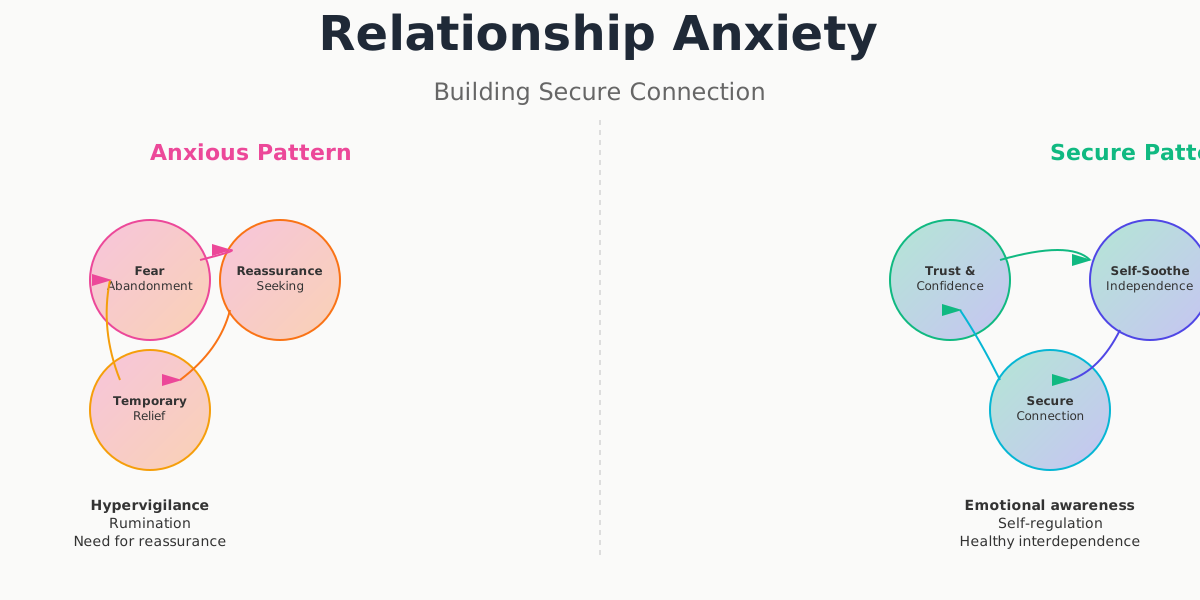
Relationship anxiety affects how you communicate, how you handle conflict, and whether you feel truly safe with your partner.
By learning to recognize your triggers and rewire your responses, you can transform anxious patterns into secure connection.
What Is Relationship Anxiety?
Relationship anxiety is a persistent worry, fear, and preoccupation with your romantic relationship that creates emotional distress. It's rooted in attachment anxiety—a core fear that your partner may abandon or reject you, combined with underlying beliefs about your own worthiness of love. People with relationship anxiety tend to interpret ambiguous partner behavior as rejection, seek excessive reassurance, and worry intensely about the future of the relationship. It differs from general anxiety because it specifically targets the safety and stability of intimate connection.
Not medical advice.
Relationship anxiety exists on a spectrum. Some people experience mild worry during stressful periods, while others live with constant fear that their relationship is failing. The underlying pattern involves an overactive threat-detection system focused on relational cues—you notice every small sign of distance, interpret neutral events as rejection, and struggle to feel secure even when your partner is present and reassuring. This doesn't mean you're broken; it means your nervous system learned early on that love might be inconsistent, and it's trying to protect you.
Surprising Insight: Surprising Insight: Anxiously attached individuals show elevated cortisol (stress hormone) responses that last longer than securely attached people, even during the same stressful event—suggesting that relationship anxiety isn't just psychological but involves measurable physiological dysregulation.
The Relationship Anxiety Cycle
Shows how triggers (partner distance, uncertainty) activate anxious thoughts (Am I not good enough?), leading to behaviors (reassurance-seeking, checking), which temporarily relieve anxiety but reinforce the anxious pattern.
🔍 Click to enlarge
Why Relationship Anxiety Matters in 2026
In our hyper-connected world, relationship anxiety has intensified. Social media enables constant comparison (Is their partner posting more than mine?), instant messaging creates pressure for immediate responses, and digital surveillance (checking location, reading receipts) amplifies suspicion. When your partner doesn't respond to a text within an hour, you spiral. When they like someone else's photo, you question the relationship. The technology meant to connect us has become a feedback loop for anxious attachment.
Relationship anxiety also affects your mental and physical health. Chronic worry about your relationship triggers sustained stress responses, elevates cortisol, and can lead to sleep disruption, reduced immune function, and increased anxiety disorders. Beyond individual health, anxious patterns erode relationship satisfaction for both partners—your constant need for reassurance can exhaust your partner, and their natural desire for autonomy triggers your fears, creating a cycle of misunderstanding and hurt.
Modern dating culture adds another layer: frequent ghosting, ambiguous commitment timelines, and the paradox of choice mean even secure people face genuine uncertainty. But for those with attachment anxiety, this uncertainty becomes unbearable. Understanding your relationship anxiety in 2026 means learning to distinguish between real threats and perceived ones, building tolerance for ambiguity, and finding genuine security within yourself rather than endlessly seeking it from your partner.
The Science Behind Relationship Anxiety
Relationship anxiety is grounded in neurobiology and attachment history. Early experiences with caregivers—whether they were consistently responsive or emotionally unpredictable—shaped how your developing brain learned to regulate emotions and relate to others. If your caregivers were sometimes available and sometimes withdrawn or if love felt conditional, your nervous system learned to stay hypervigilant for signs of withdrawal. This hypervigilance gets encoded into your neurocircuitry and repeats in adult relationships.
At the brain level, anxious attachment involves several key systems: The amygdala (your threat detector) becomes hypersensitive to negative social cues. A partner's raised eyebrow or long pause gets processed as rejection. The HPA axis (hypothalamic-pituitary-adrenal system that manages stress) becomes dysregulated, meaning you produce excess cortisol and take longer to recover from perceived threats. Research shows that anxiously attached individuals exposed to the same stressor produce higher cortisol and remain elevated significantly longer than securely attached people. The prefrontal cortex (your rational, thinking brain) gets less active during stress, so you can't calm yourself with logic—you're operating from pure emotion and threat-detection.
How Attachment Anxiety Affects the Brain
Illustrates the interplay between the amygdala (threat detection), HPA axis (stress response), and prefrontal cortex (rational thinking) in relationship anxiety. Shows how early attachment experiences create neural patterns that activate quickly during relationship stress.
🔍 Click to enlarge
Key Components of Relationship Anxiety
Fear of Abandonment
The core of relationship anxiety is fear of abandonment—a deep belief that your partner will leave you, that love is fragile, and that your core self is unlovable. This fear isn't rational; it exists alongside evidence that your partner is present and committed. When triggered, you might constantly ask for reassurance, interpret normal partner autonomy (time with friends, solo projects) as rejection, or check their phone for proof they're still interested. Fear of abandonment stems from early experiences where caregivers were emotionally or physically unavailable, teaching your nervous system that love isn't safe.
Intrusive Thoughts and Rumination
People with relationship anxiety experience persistent, unwanted thoughts about the relationship: 'They're going to leave me,' 'I'm not good enough,' 'This won't work out,' 'They don't really love me.' These thoughts feel like facts, not interpretations. You ruminate—replay conversations, analyze partner behavior for hidden meanings, imagine worst-case scenarios. For some people, this develops into relationship OCD (ROCD), where intrusive doubts about the relationship create significant distress and compulsive reassurance-seeking or checking behaviors.
Hypervigilance to Partner Behavior
Your attention becomes laser-focused on your partner's words, tone, facial expressions, and availability. A subtle shift in their energy feels significant. You notice when they're less affectionate, when they don't ask about your day the way they used to, when they're scrolling their phone instead of talking to you. This hypervigilance isn't a choice—it's your nervous system's attempt to stay safe by predicting abandonment. The problem is that even healthy partners have days when they're distant, distracted, or preoccupied, and your nervous system interprets this as danger.
Reassurance-Seeking and Self-Silencing
To manage the anxiety, you develop coping behaviors. Reassurance-seeking means constantly asking your partner for proof of love: 'Do you still love me?' 'You're not thinking about breaking up, right?' 'Did I upset you?' While temporary relief comes, it reinforces the anxiety—your nervous system learns that worry followed by reassurance is the pattern. Self-silencing is the opposite response: suppressing your needs, opinions, and feelings to avoid rocking the boat. You don't express desires because you fear rejection, so you become who you think your partner wants, losing yourself in the process.
| Pattern | Anxious Attachment | Secure Attachment |
|---|---|---|
| Response to Partner Distance | Increased pursuit, reassurance-seeking, panic | Comfortable independence, maintains connection without desperation |
| Conflict Resolution | Becomes emotional, seeks immediate reassurance, hard to calm | Can discuss disagreements calmly, finds compromise |
| Autonomy | Interprets partner's solo time as rejection | Supports partner's independent interests |
| Trust | Assumes negative interpretations, monitors partner | Trusts partner, comfortable with ambiguity |
| Emotional Regulation | Difficulty self-soothing, relies on partner reassurance | Can calm themselves, uses healthy coping |
| Relationship Satisfaction | Lower satisfaction, higher conflict | Higher satisfaction, collaborative problem-solving |
How to Apply Relationship Anxiety: Step by Step
- Step 1: Recognize your anxiety triggers: Notice what situations activate your worry—partner being late, not responding to texts, them spending time with friends. Write these down to see patterns.
- Step 2: Pause before reacting: When anxiety spikes, take three slow breaths before acting. This activates your parasympathetic nervous system and gives your prefrontal cortex time to engage.
- Step 3: Challenge anxious thoughts: When you think 'They don't love me anymore,' ask: What's the evidence? Am I catastrophizing? Is there an alternative explanation? Your thoughts aren't facts.
- Step 4: Practice self-soothing: Learn to calm yourself without seeking reassurance. Techniques include 4-7-8 breathing, self-compassion statements, or grounding exercises like naming five things you see.
- Step 5: Communicate directly with your partner: Instead of seeking reassurance indirectly, express vulnerability clearly: 'I'm feeling anxious right now. It's not about you—it's an old pattern I'm working on. Can we just be together?'
- Step 6: Build your own security: Invest in your own life. Spend time with friends, pursue hobbies, accomplish goals. A strong sense of self outside the relationship reduces relationship dependency.
- Step 7: Try Exposure and Response Prevention (ERP): Gradually tolerate uncertainty without seeking reassurance. If you normally text when anxious, wait 20 minutes. Build your anxiety tolerance.
- Step 8: Practice secure attachment behaviors: Even if they feel uncomfortable, do what secure people do—give your partner space, trust when they say they need alone time, celebrate their autonomy.
- Step 9: Consider couples therapy or individual therapy: A therapist trained in attachment theory or ERP can accelerate your healing. Emotionally Focused Therapy (EFT) specifically targets attachment patterns.
- Step 10: Track your progress: Notice small wins—times you didn't seek reassurance, moments of calm, periods of trust. Progress isn't linear, but awareness builds momentum.
Relationship Anxiety Across Life Stages
Young Adulthood (18-35)
In young adulthood, relationship anxiety often peaks because this is when you're navigating early romantic relationships, attachment patterns are most active, and uncertainty feels highest. You're still discovering yourself while trying to build connection. Social media intensifies anxiety—comparing relationships, fearing you're behind peers, worrying you'll miss out. The challenge: developing secure attachment while managing identity formation. Young adults benefit from recognizing these patterns early, using therapy to understand their origins, and building self-awareness about triggers before patterns calcify.
Middle Adulthood (35-55)
By midlife, relationship anxiety either has transformed into secure attachment through work and experience, or it has deepened into entrenched patterns. People in established relationships may experience anxiety flare-ups during transitions (career changes, children, aging parents), when old fears resurface. The advantage: you have relationship history and self-knowledge. The work here involves recognizing that anxiety is a signal, not a truth, and using your accumulated wisdom to respond differently. Couples who address attachment patterns in midlife often report their most satisfying relationship periods.
Later Adulthood (55+)
In later adulthood, relationship anxiety often decreases due to decades of relationship stability and acceptance. However, major life transitions—retirement, health crises, death of peers—can reactivate old anxieties. The work here is different: integrating a lifetime of relationship experience, appreciating that love deepens with time, and addressing anxieties about mortality and legacy. Secure attachment in later years brings profound peace and resilience.
Profiles: Your Relationship Anxiety Approach
The Constant Reassurance-Seeker
- Permission to feel anxious without acting on it immediately
- A partner who understands that seeking reassurance is a pattern, not a character flaw
- Concrete self-soothing techniques that work faster than texting for reassurance
Common pitfall: Burning out your partner with constant questions—eventually they withdraw, confirming your fears and deepening the anxiety cycle
Best move: Build a 'pause toolkit': when anxiety hits, try a 10-minute walk, call a friend, or use a grounding exercise before reaching out to your partner. This breaks the reassurance-seeking habit and builds self-trust.
The Emotional Analyzer
- Intellectual understanding that emotions aren't facts
- Permission to feel without needing to solve or explain every feeling
- Validation that analyzing your relationship constantly is exhausting
Common pitfall: Using analysis as an anxiety control mechanism—the more you analyze, the more anxious you become, but you can't stop because it feels like control
Best move: Practice 'analysis fasting'—set specific times (not all day) when you allow yourself to think about the relationship. Outside those times, redirect to presence. This creates mental space and reduces rumination.
The Silent Sufferer
- Courage to express vulnerability instead of managing alone
- A safe experience of sharing worries without judgment
- Reconnection with your own needs and desires
Common pitfall: Self-silencing creates emotional distance, which triggers your partner's withdrawal, confirming your fears that the relationship is failing—but it was your silence causing distance
Best move: Start small: express one small truth per week that you usually hide. 'I'm feeling insecure today' or 'I miss you.' Notice how your partner often responds with warmth, not rejection. Gradually expand vulnerability.
The Monitoring Controller
- Recognition that monitoring creates false security while eroding trust
- Compassion for the fear underneath the controlling behavior
- Different strategies for managing uncertainty that don't involve surveillance
Common pitfall: Checking your partner's phone, tracking their location, or demanding they account for their time feels like it reduces anxiety, but it actually increases it—and damages the relationship
Best move: Name the fear directly: 'I'm afraid you'll leave me, so I've been controlling. I want to try a different way.' Commit to not checking for 30 days. Notice how relationships actually improve when you let go of surveillance.
Common Relationship Anxiety Mistakes
The biggest mistake is believing your anxious thoughts are facts. Your brain generates terrifying scenarios—'They're definitely going to leave,' 'I'm too much,' 'This will never work'—and you treat these as prophecies. In reality, these are your threat-detection system misfiring, not actual information. You can acknowledge the thought without believing it: 'My anxiety is telling me they don't love me. That's not true. They do. I'm safe.'
Another critical mistake is relying on reassurance as your primary coping strategy. Getting reassurance feels amazing in the moment, but it teaches your nervous system that anxiety requires external soothing. This makes you increasingly dependent on your partner and more anxious when they're unavailable. Instead, learn to generate your own calm. This builds genuine confidence and reduces relationship dependency.
The third major mistake is avoiding communication. You hide your feelings, don't express needs, and pretend everything's fine to keep the peace. Your partner doesn't understand what's happening inside you, so their normal behavior gets misinterpreted as rejection. Secure relationships require vulnerability and direct communication, even when it's uncomfortable.
From Anxious to Secure: The Transformation Path
Shows the journey from relationship anxiety patterns through awareness, new behaviors, and eventually toward secure attachment. Includes key milestones and setbacks as normal parts of the process.
🔍 Click to enlarge
Science and Studies
Relationship anxiety is grounded in decades of attachment theory research and neuroscience studies. Key findings show that anxious attachment stems from inconsistent early caregiving, creates measurable physiological stress responses, and responds well to evidence-based psychological interventions. Understanding the science validates that this isn't a character flaw—it's a pattern your nervous system learned to survive, and it can be rewired.
- Anxious attachment predicts enhanced cortisol responses to psychosocial stress (tandfonline.com, 2015) - individuals with anxious attachment show elevated and prolonged cortisol elevation
- Attachment insecurity contributes to maladaptive personality traits through the DSM-5 Alternative Model, particularly negative affectivity (Current Psychology, 2025)
- Relationship OCD fear of abandonment responds to Exposure and Response Prevention (ERP), a specialized CBT approach that helps individuals tolerate uncertainty without compulsive reassurance-seeking
- Attachment anxiety in the digital era is amplified by social media jealousy and electronic partner surveillance behaviors (PMC, 2024)
- Emotionally Focused Therapy (EFT) effectively targets attachment-based relationship anxiety by building secure emotional connection (APA handbook on family psychology)
Your First Micro Habit
Start Small Today
Today's action: The 'Pause and Breathe' practice: When you feel the urge to seek reassurance or check your partner's phone, pause for 30 seconds and take three intentional breaths. This single action interrupts the anxiety-driven behavior pattern and strengthens your ability to self-regulate.
Your nervous system is primed for quick reactions when anxious. A 30-second pause activates your thinking brain, giving you a moment of choice. Breathing signals safety to your body. Repeated 5-10 times daily, this micro habit rewires your default response from 'seek reassurance' to 'I can handle this calm.'
Keep quitting habit apps after a missed day? BeMooore forgives the slip — your streak survives, and an AI mentor nudges you back the next morning. Free on iOS.
Quick Assessment
How often do you worry that your partner might leave you or stop loving you?
Your answer indicates your baseline level of abandonment fear. If you chose 'often' or 'constantly,' relationship anxiety is a significant pattern for you, and building awareness is the first step toward change.
When your partner is distant or quiet, what's your first instinct?
This shows your immediate nervous system response. Options 1-2 indicate secure responses. Options 3-4 indicate anxiety-driven reactions. This is where your rewiring work begins.
When you feel anxious in your relationship, how do you typically respond?
This reveals your coping strategy. Self-soothing is most sustainable long-term. Seeking reassurance reinforces anxiety. Withdrawal damages connection. Choose strategies that build security within you, not just temporary relief.
Take our full assessment to get personalized recommendations.
Discover Your Style →Next Steps
Your next step is to move from awareness to action. Start tracking your anxiety triggers this week. Notice situations, partner behaviors, or thoughts that activate your worry. Write them down. This creates the first layer of awareness—you can't change patterns you don't recognize. Then pick one micro habit from this article and practice it daily for 30 days. Consistency matters more than perfection.
Consider seeking professional support. A therapist trained in attachment theory, CBT, or Emotionally Focused Therapy can help you understand your specific attachment history and build secure patterns more efficiently than working alone. If your anxiety is severe or creating significant relationship distress, this is worth prioritizing. Your relationship is worth the investment. Many people report that therapy for relationship anxiety dramatically improves not just their romantic relationships but their self-worth and overall peace.
Get personalized guidance with AI coaching.
Start Your Journey →Research Sources
This article is based on peer-reviewed research and authoritative sources. Below are the key references we consulted:
Related Glossary Articles
Frequently Asked Questions
Is relationship anxiety the same as Relationship OCD (ROCD)?
Not exactly. Relationship anxiety is a pattern of worry about your relationship rooted in attachment anxiety. Relationship OCD (ROCD) is a specific subtype where intrusive doubts about the relationship become obsessive and create significant distress, often accompanied by compulsive reassurance-seeking or checking behaviors. ROCD is more severe and typically requires professional treatment with ERP therapy, while relationship anxiety responds to awareness, behavioral change, and sometimes therapy.
Can my partner help me feel more secure, or do I have to fix this alone?
Both. You must do your own internal work—building self-worth, learning to self-soothe, examining your thought patterns. No amount of your partner's reassurance will create genuine security if you don't believe it yourself. However, a supportive partner can help by understanding your pattern, being patient while you work on it, and practicing secure behaviors together. Couples therapy can accelerate this process by helping you both communicate about attachment and build new patterns together.
Why does my anxiety spike when things are going well?
This is called 'anxious avoidance' or 'fear of intimacy.' When things feel good and close, your nervous system feels vulnerable. It unconsciously creates conflict or worry to regain a sense of control and emotional distance. This is a protective mechanism from early experiences where closeness was unsafe. The solution: recognize this pattern, use grounding techniques, and consciously practice staying present with goodness. Therapy can help you rewire these defenses.
How long does it take to develop secure attachment?
There's no fixed timeline. Some people shift within months of consistent practice, while others take years. What matters isn't speed—it's consistency. Neuroplasticity (your brain's ability to rewire) happens through repetition. If you practice secure behaviors daily, you'll notice changes within 8-12 weeks. Deeper transformation takes longer. Working with a therapist accelerates the process significantly.
What if my partner is also anxiously attached?
This creates a pursuer-pursuer dynamic where both people are seeking reassurance and fear abandonment. Neither person can provide the calm stability the other needs, so anxiety escalates. The solution: both partners must work on developing their own internal security and self-soothing capacity. Couples therapy specifically designed for anxious-anxious pairs is highly recommended. Learning to calm yourselves independently actually allows you to be more available to each other.
Take the Next Step
Ready to improve your wellbeing? Take our free assessment to get personalized recommendations based on your unique situation.
- Discover your strengths and gaps
- Get personalized quick wins
- Track your progress over time
- Evidence-based strategies