Anxious Attachment
You check your phone for the third time in five minutes. Your partner said they would call after work, and now it is twenty minutes past their usual time. Your mind races through every possible explanation, most of them ending in rejection or abandonment. If this pattern sounds familiar, you may be experiencing the hallmarks of an <a href="/g/attachment-styles.html">anxious attachment style</a>. The good news is that understanding this pattern is the first step toward transforming your relationships and finding lasting <a href="/g/emotional-connection.html">emotional connection</a>.
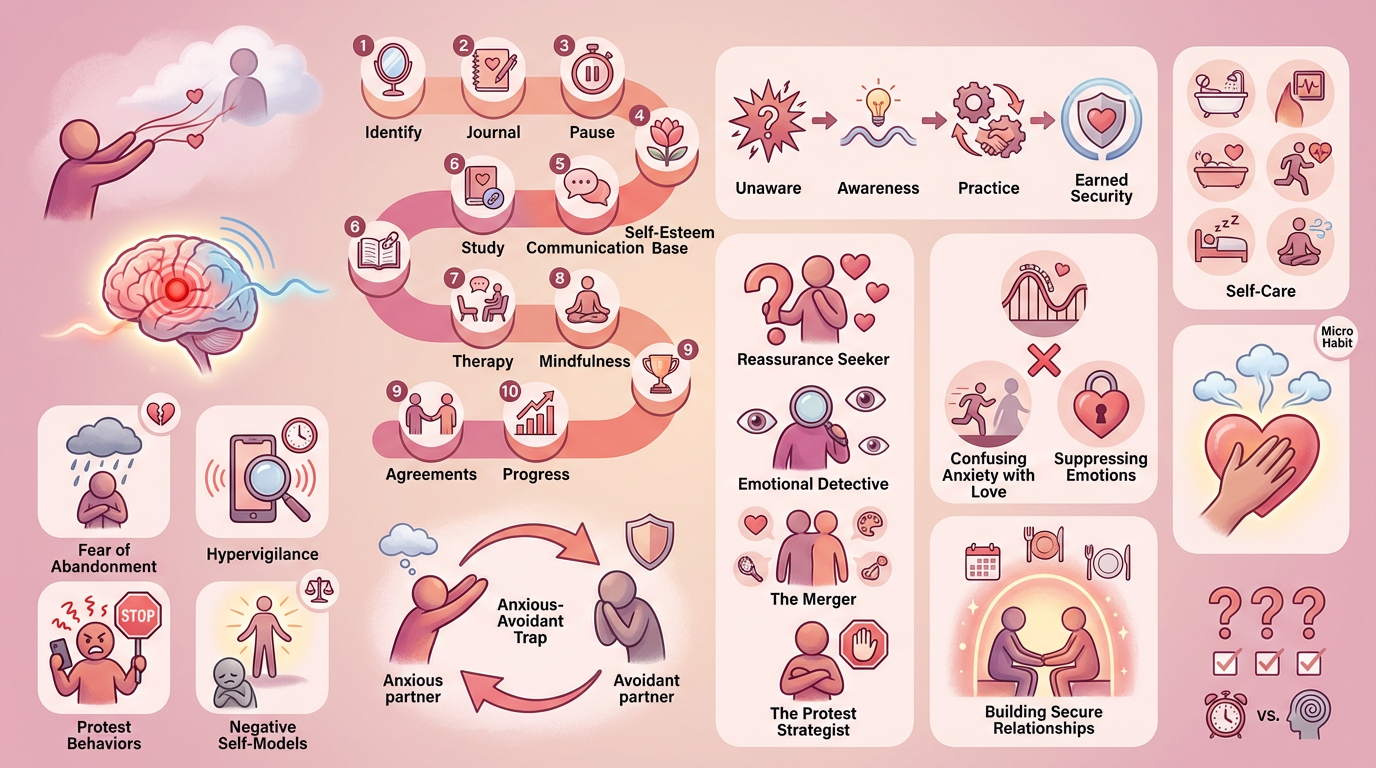
In this guide, you will discover exactly what anxious attachment is, where it comes from, and how leading researchers have mapped the path from insecurity to secure <a href="/g/attachment-and-bonding.html">attachment and bonding</a>.
You will also learn practical, step-by-step strategies to manage your anxiety, build stronger communication in relationships, and develop the emotional resilience needed for healthier partnerships.
What Is Anxious Attachment?
Anxious attachment is one of four primary attachment styles identified by developmental psychology research. People with an anxious attachment style tend to crave closeness and reassurance from their partners while simultaneously fearing rejection and abandonment. This creates a push-pull dynamic where the need for emotional intimacy is matched by persistent worry about whether that intimacy will last.
Not medical advice.
The concept originates from John Bowlby's foundational attachment theory, developed in the 1950s and 1960s, which proposed that early bonds between children and caregivers shape relational patterns throughout life. Mary Ainsworth's Strange Situation experiments in the 1970s identified the anxious-ambivalent pattern in infants, and later researchers Cindy Hazan and Phillip Shaver extended these findings to adult romantic relationships in 1987. Today, anxious attachment is also called anxious-preoccupied attachment, and research suggests it may affect roughly 20 percent of the adult population. Understanding your attachment patterns is essential for building healthier connections with the people you care about most.
Surprising Insight: Surprising Insight: Research from the University of Illinois shows that attachment styles are not permanent personality traits. With conscious effort, therapy, and secure relationship experiences, anxious attachment can shift toward earned security over time.
The Four Adult Attachment Styles
A quadrant model showing how attachment styles relate to anxiety and avoidance dimensions.
🔍 Click to enlarge
Why Anxious Attachment Matters in 2026
In an era of digital communication and social media, anxious attachment patterns are becoming more visible and, in many cases, more intense. The constant availability of messaging apps means that anxious individuals can monitor response times, online status, and social interactions in ways that amplify their core fears. Understanding how anxiety disorders intersect with attachment patterns has never been more relevant for maintaining mental health.
Modern relationship research increasingly recognizes that attachment security is a foundational pillar of overall emotional wellbeing. Studies published in journals like the Journal of Personality and Social Psychology demonstrate that attachment anxiety correlates with higher rates of relationship dissatisfaction, depression, and chronic stress. By addressing anxious attachment, individuals can improve not just their romantic lives but their entire psychological landscape, including self-worth and self-esteem.
The growing popularity of attachment-informed therapy approaches, including Emotionally Focused Therapy (EFT) and schema therapy, reflects a cultural shift toward understanding relationships through the lens of attachment science. More people than ever are seeking to understand their emotional awareness and develop coping strategies that address the root causes of relational distress rather than just managing symptoms.
The Science Behind Anxious Attachment
Neuroscience research reveals that anxious attachment is associated with heightened activity in the amygdala, the brain's threat detection center. When an anxiously attached person perceives a potential threat to their relationship, such as a delayed text message or a partner's distracted behavior, their amygdala fires more intensely than it would in a securely attached person. This triggers a cascade of stress hormones including cortisol and adrenaline, creating the familiar feelings of panic, dread, and hypervigilance that characterize anxious attachment activation. Building emotional regulation skills can help manage this neurological response.
Studies using functional MRI imaging have shown that securely attached individuals can more effectively engage their prefrontal cortex to regulate emotional responses, while anxiously attached individuals show less connectivity between these regulatory brain regions and the emotional centers. This helps explain why someone with anxious attachment may intellectually know that their partner is probably just stuck in traffic, yet feel an overwhelming wave of fear and sadness nonetheless. The good news from neuroplasticity research is that these neural pathways can be reshaped through practices like mindfulness, meditation, and consistent experiences of secure relating. Emotional intelligence development plays a key role in this rewiring process.
Anxious Attachment Activation Cycle
Shows the cyclical pattern of triggers, emotional responses, and behaviors in anxious attachment.
🔍 Click to enlarge
Key Components of Anxious Attachment
Fear of Abandonment
At the core of anxious attachment lies a deep, often unconscious fear that the people you love will leave. This fear does not always look dramatic. It can show up as a subtle tension when your partner mentions spending time with friends, a sinking feeling when a text goes unanswered, or persistent thoughts about whether your relationship is really safe. This fear often drives people to seek constant emotional bonding experiences as reassurance. Learning to manage this fear is a crucial part of developing resilience in relationships. Many people find that strengthening their self-compassion practice helps reduce the intensity of abandonment fears.
Hypervigilance to Relationship Cues
People with anxious attachment become highly attuned to their partner's emotional state, tone of voice, body language, and behavioral patterns. While this sensitivity can make them wonderfully empathic partners, it also means they may interpret neutral cues as signs of rejection. A partner's tired sigh becomes evidence of dissatisfaction. A brief response becomes proof of waning interest. This hypervigilance exhausts both the anxious person and their partner, making conflict resolution more challenging. Developing stronger communication skills can help individuals check their interpretations against reality.
Protest Behaviors
When the attachment system is activated, anxiously attached individuals often engage in what researchers call protest behaviors. These are actions designed to re-establish closeness with the attachment figure. Common protest behaviors include excessive calling or texting, trying to make a partner jealous, withdrawing affection to get a reaction, keeping score of perceived slights, or threatening to leave the relationship as a test of the partner's commitment. Recognizing these patterns is the first step toward replacing them with healthier boundary setting and active listening practices.
Negative Self-Models
Anxious attachment typically involves holding a negative view of oneself and a positive but uncertain view of others. This means the anxiously attached person may believe they are less worthy of love than other people, while simultaneously idealizing their partner. This imbalance creates dependency and makes it difficult to maintain healthy emotional boundaries. Rebuilding self-worth through personal development work, therapy, and personal growth practices is essential for moving toward security.
| Situation | Anxious Response | Secure Response |
|---|---|---|
| Partner does not reply to text for 2 hours | Feels panic, sends multiple follow-up messages, imagines worst-case scenarios | Notices the delay, assumes partner is busy, continues with their day |
| Partner wants a night out with friends | Feels threatened, may try to discourage the outing or feel resentful | Supports partner's independence, uses the time for their own interests |
| Disagreement about household tasks | Fears the conflict means the relationship is failing, seeks immediate resolution at any cost | Addresses the issue calmly, trusts the relationship can handle disagreement |
| Partner seems quiet or distracted | Assumes something is wrong with the relationship, asks repeatedly what is wrong | Checks in once, accepts the answer, gives space if needed |
| New relationship milestone approaching | Worries about partner's commitment level, pushes for verbal reassurance | Feels excited, discusses expectations openly without pressure |
How to Heal Anxious Attachment: Step by Step
- Step 1: Identify your attachment style by reflecting on your typical reactions when you feel disconnected from your partner. Notice patterns of <a href="/g/anxiety-relief.html">anxiety</a> that arise when closeness is threatened.
- Step 2: Start a daily journaling practice to track your emotional triggers. Write down the situation, your initial thought, the emotion you felt, and what you did in response. This builds <a href="/g/emotional-awareness.html">emotional awareness</a> over time.
- Step 3: Practice the pause. When you feel the urge to engage in protest behavior like sending multiple texts or making accusations, commit to waiting at least ten minutes before acting. Use this time for <a href="/g/deep-connection.html">deep breathing</a> or grounding exercises.
- Step 4: Develop a secure base within yourself by building routines that reinforce your <a href="/g/self-esteem.html">self-esteem</a> independent of your relationship. This might include exercise, creative hobbies, career development, or time with supportive <a href="/g/friendship.html">friendships</a>.
- Step 5: Learn to communicate your needs directly rather than through protest behaviors. Instead of withdrawing to test your partner, say clearly what you need, such as more quality time or verbal reassurance about the relationship.
- Step 6: Study <a href="/g/attachment-styles.html">attachment theory</a> so you can recognize when your attachment system is activated versus when there is a genuine relationship problem. Not every feeling of anxiety signals a real threat.
- Step 7: Work with a therapist trained in attachment-based approaches such as Emotionally Focused Therapy or psychodynamic therapy. Professional guidance can help you explore the childhood roots of your patterns in a safe environment.
- Step 8: Practice <a href="/g/mindfulness.html">mindfulness meditation</a> for at least ten minutes daily. Research shows that mindfulness strengthens the prefrontal cortex's ability to regulate the amygdala, reducing the intensity of anxious activation.
- Step 9: Create relationship agreements with your partner about communication expectations, such as response times and check-in routines, so both of you have clarity about what to expect. This reduces ambiguity, which is a major trigger for anxious attachment.
- Step 10: Track your progress over months, not days. Attachment pattern change is a gradual process that happens through consistent practice and repeated experiences of secure relating. Celebrate small wins along the way and build your <a href="/g/psychological-flexibility.html">psychological flexibility</a>.
Anxious Attachment Across Life Stages
Young Adulthood (18-35)
This is often when anxious attachment patterns become most visible, as young adults navigate their first serious romantic relationships. The intensity of early romantic love can amplify anxious tendencies, leading to rapid bonding, fear of abandonment after minor disagreements, and difficulty maintaining independence within partnerships. Young adults with anxious attachment may find themselves in a cycle of intense relationships followed by painful breakups. This is also the stage where many people first discover dating advice through attachment theory and begin their healing journey. Building strong communication skills early can significantly improve relationship outcomes during this critical developmental period.
Middle Adulthood (35-55)
By middle adulthood, many anxiously attached individuals have accumulated enough relationship experience to begin recognizing their patterns, even if they have not yet named them as attachment-related. This stage often brings challenges related to long-term partnership dynamics, parenting stress, and family dynamics that can reactivate early attachment wounds. However, it is also a period of opportunity. The emotional maturity that comes with life experience, combined with the stability that many people achieve in their careers and social lives, can provide a strong foundation for attachment healing work. Many people in this stage benefit enormously from couples therapy and developing deeper emotional healing practices.
Later Adulthood (55+)
Later adulthood presents unique attachment challenges, including loss of long-term partners, changes in social networks, and the potential for increased dependency on others. For anxiously attached individuals, these transitions can trigger intense fear and grief. However, research on attachment in older adults also reveals remarkable potential for growth. Many people report becoming more secure in their attachment orientation as they age, particularly those who have engaged in reflective practices, maintained close connections, and developed a strong sense of acceptance about life's impermanence. This stage highlights the importance of belonging and community for emotional wellbeing.
Origins of Anxious Attachment in Childhood
Anxious attachment typically develops when a child's primary caregiver is inconsistent in their responsiveness. Sometimes the parent is warm, attentive, and nurturing. Other times they are preoccupied, emotionally unavailable, or intrusive. The child cannot predict when their needs will be met, so they develop a strategy of heightened emotional signaling, crying louder, clinging more tightly, and monitoring the caregiver's every mood. This strategy makes perfect sense in childhood because it maximizes the chances of getting the caregiver's attention. The problem is that this same strategy, carried into adult relationships, creates the very disconnection it is trying to prevent.
It is important to note that inconsistent caregiving does not necessarily mean bad parenting. Parents dealing with their own stress, depression, work demands, or relationship difficulties may be genuinely loving yet unable to provide the consistent attunement that builds secure attachment. Understanding this can help adults with anxious attachment move from blame toward compassion, both for their parents and for themselves. This shift in perspective is often a turning point in the healing process and opens the door to deeper forgiveness.
The Anxious-Avoidant Trap
One of the most painful relationship dynamics occurs when an anxiously attached person pairs with a dismissive-avoidant partner. This combination, sometimes called the anxious-avoidant trap or the pursuit-withdrawal cycle, creates a self-reinforcing pattern of distress. The anxious partner's need for closeness triggers the avoidant partner's need for space, and the avoidant partner's withdrawal triggers the anxious partner's fear of abandonment. Each person's coping strategy amplifies the other person's worst fears.
Breaking free from this cycle requires both partners to recognize their roles in the pattern. The anxious partner needs to develop the capacity to self-soothe and tolerate temporary distance without interpreting it as rejection. The avoidant partner needs to learn that closeness is safe and that responding to a partner's emotional needs does not mean losing autonomy. Professional help through conflict resolution frameworks and healthy relationship habits can make this process more manageable. When both partners commit to growth, this dynamic can transform into a deeply secure bond.
Profiles: Your Anxious Attachment Approach
The Reassurance Seeker
- Regular verbal affirmation from partner
- Clear communication about relationship status
- Predictable routines for connection
Common pitfall: Asking for reassurance so frequently that it exhausts the partner and paradoxically creates distance.
Best move: Build internal reassurance through daily affirmations, journaling, and self-compassion practices to reduce dependency on external validation.
The Emotional Detective
- Understanding of partner's emotional patterns
- Tools to distinguish real threats from perceived ones
- Practice in checking assumptions before reacting
Common pitfall: Over-analyzing every word, tone, and gesture from a partner, leading to exhaustion and false alarms.
Best move: Adopt a reality-testing habit by asking your partner directly about their emotional state instead of interpreting signals.
The Merger
- Strong sense of individual identity outside the relationship
- Independent hobbies and friendships
- Comfort with healthy separateness
Common pitfall: Losing personal identity by making the relationship the sole source of meaning and fulfillment.
Best move: Invest in at least two personal interests or relationships that exist entirely outside of your romantic partnership.
The Protest Strategist
- Awareness of protest behavior patterns
- Alternative ways to express unmet needs
- Skills for direct, non-manipulative communication
Common pitfall: Using indirect strategies like jealousy, withdrawal, or ultimatums to test a partner's commitment.
Best move: Replace protest behaviors with clear I-statements that express needs without blame, such as I feel disconnected and would love to spend quality time together tonight.
Common Anxious Attachment Mistakes
One of the most common mistakes is confusing attachment activation with love. When your attachment system is triggered, the resulting flood of emotions can feel indistinguishable from passion. Many anxiously attached people mistake the rollercoaster of anxiety, relief, anxiety, relief for deep romantic connection. In reality, this cycle is driven by fear, not love. Genuine deep connection feels calmer, safer, and more stable. Learning the difference between anxious activation and genuine intimacy is one of the most important distinctions you can make.
Another frequent mistake is choosing partners who reinforce insecurity. Anxiously attached individuals are often drawn to emotionally unavailable partners because the unpredictability of these relationships feels familiar, echoing the inconsistent caregiving of childhood. Breaking this pattern requires conscious awareness when selecting partners and prioritizing emotional availability and consistency over excitement and intensity. Building better dating strategies grounded in attachment awareness can help redirect these choices.
A third mistake is trying to heal anxious attachment by suppressing emotions entirely. Some people, after learning about their attachment style, attempt to become avoidant, shutting down their emotional needs and pretending they do not care. This approach backfires because the underlying attachment system remains unchanged. True healing involves learning to honor your emotional needs while developing healthier ways to meet them. This requires building emotional regulation skills rather than emotional suppression, and cultivating genuine vulnerability within safe relationships.
Path from Anxious to Earned Secure Attachment
Shows the progressive stages of healing from anxious attachment toward earned security.
🔍 Click to enlarge
Building Secure Relationships with Anxious Attachment
Having an anxious attachment style does not mean you are destined for unhappy relationships. Research consistently shows that anxiously attached individuals can build deeply satisfying, secure partnerships. The key lies in choosing a partner who is willing to understand attachment dynamics and in developing your own emotional healing practices. A securely attached partner can serve as what therapists call a corrective emotional experience, gradually teaching your nervous system that closeness is safe and reliable.
Practical strategies for building security include establishing regular relationship rituals such as daily check-ins, weekly date nights, and clear agreements about communication expectations. These predictable points of connection reduce the ambiguity that fuels anxious activation. It also helps to develop a shared language for attachment needs. When both partners can say I am feeling activated right now and I need some reassurance without judgment, the relationship becomes a laboratory for healing rather than a battlefield. Developing these practices strengthens emotional bonding and creates a foundation of trust.
Another powerful approach is co-regulation, the process of using a partner's calm presence to soothe your own nervous system. When an anxiously attached person is activated and their partner responds with warmth, patience, and consistency, the anxious person's nervous system gradually learns a new pattern. Over time, the brain creates new neural pathways that associate relationships with safety rather than threat. This is why attachment and bonding researchers emphasize that healing happens within relationships, not in isolation.
Science and Studies
Decades of research across developmental psychology, neuroscience, and clinical practice have established anxious attachment as a well-documented pattern with clear origins, mechanisms, and pathways to change. The following studies represent key contributions to our understanding of anxious attachment and its implications for emotional well-being and behavioral change.
- Bowlby, J. (1969). Attachment and Loss, Vol. 1: Attachment. Established the foundational theory that early caregiver bonds shape lifelong relational patterns and emotional security.
- Ainsworth, M. D. S., Blehar, M. C., Waters, E., and Wall, S. (1978). Patterns of Attachment. Identified the anxious-ambivalent attachment pattern in infants using the Strange Situation procedure.
- Hazan, C., and Shaver, P. (1987). Romantic love conceptualized as an attachment process. Journal of Personality and Social Psychology. Extended attachment theory to adult romantic relationships, showing parallel patterns between infant-caregiver and adult romantic bonds.
- Fraley, R. C., and Shaver, P. R. (2000). Adult romantic attachment: Theoretical developments, emerging controversies, and unanswered questions. Review of General Psychology. Provided a comprehensive framework for understanding individual differences in adult attachment.
- Johnson, S. M. (2008). Hold Me Tight: Seven Conversations for a Lifetime of Love. Demonstrated how Emotionally Focused Therapy can help anxiously attached individuals develop more secure relationship patterns.
Anxious Attachment and Self-Care
Self-care for anxiously attached individuals goes beyond bubble baths and spa days. It requires building a relationship with yourself that mirrors the secure attachment you are seeking from others. This means learning to comfort yourself when you are distressed, validating your own emotions without needing external confirmation, and maintaining a stable sense of identity regardless of your relationship status. Practices like self-compassion meditation, body-based grounding techniques, and reflective journaling can all strengthen your internal secure base.
Physical self-care also plays an important role. Anxious attachment activation floods the body with stress hormones, so regular exercise, adequate sleep, and stress management practices directly support attachment healing by keeping the nervous system regulated. When your body feels safe and calm, your attachment system is less likely to go into overdrive at the first sign of perceived threat. This connection between physical wellbeing and emotional security underscores the importance of a holistic approach to self-improvement and emotional wellness.
Your First Micro Habit
Start Small Today
Today's action: When you notice anxious activation, such as the urge to check your phone or seek reassurance, place one hand on your chest, take three slow breaths, and say silently: I am safe right now. Practice this once daily for two weeks.
This simple practice engages the vagus nerve and activates the parasympathetic nervous system, interrupting the fight-or-flight response that drives anxious attachment behaviors. Over time, it builds a neural pathway between noticing anxiety and self-soothing instead of externally seeking reassurance.
Keep quitting habit apps after a missed day? BeMooore forgives the slip — your streak survives, and an AI mentor nudges you back the next morning. Free on iOS.
Quick Assessment
When your partner does not respond to a message within an hour, what is your typical first reaction?
Your response reveals how strongly your attachment system activates in response to perceived unavailability. Higher anxiety responses suggest more anxious attachment activation patterns.
In relationships, what is your biggest goal for emotional growth?
Each goal reflects a different aspect of anxious attachment healing. Identifying your primary growth area helps you focus your energy where it will have the greatest impact.
Which description best matches how you feel about conflict in relationships?
Your relationship to conflict reveals your core attachment beliefs. Anxious attachment often links disagreement with relationship survival, making conflict feel existentially threatening rather than a normal part of partnership.
Take our full assessment to get personalized recommendations for your relationship wellbeing.
Discover Your Attachment Style →Next Steps
Understanding your anxious attachment style is not a label that limits you. It is a map that shows you where you have been and where you can go. Every person who has moved from anxious to earned secure attachment started exactly where you are now, by recognizing the pattern and committing to change. Start with the micro habit described above, explore the recommended resources, and consider working with a therapist who understands attachment theory. Your capacity for deep love and emotional connection is not a weakness. It is a strength waiting to be channeled into healthier patterns.
Remember that healing is not linear. There will be days when old patterns resurface, especially during times of stress or relationship transition. What changes with practice is not the complete absence of anxious feelings, but your relationship to those feelings. You learn to notice them without being controlled by them, to soothe yourself while also reaching out for appropriate support, and to trust that you are worthy of the secure love you have always wanted. Your journey toward emotional resilience and secure attachment starts with a single step today.
Get personalized guidance with AI coaching.
Start Your Journey →Research Sources
This article is based on peer-reviewed research and authoritative sources. Below are the key references we consulted:
Related Glossary Articles
Frequently Asked Questions
Can anxious attachment style be changed?
Yes. Research on earned security shows that people can shift from anxious to secure attachment through therapy, self-awareness practices, and consistent experiences within safe relationships. This process typically takes months to years of intentional work, but lasting change is well documented in attachment research.
What causes anxious attachment in adults?
Anxious attachment most commonly develops from inconsistent caregiving in childhood, where a parent was sometimes responsive and sometimes unavailable. It can also be shaped by traumatic relationship experiences in adulthood, such as betrayal or sudden loss. Genetic factors may also play a role in determining baseline sensitivity to attachment-related cues.
How do I know if I have an anxious attachment style?
Common signs include a strong fear of abandonment, a tendency to seek constant reassurance from partners, difficulty being alone, sensitivity to perceived rejection, and a pattern of becoming preoccupied with relationships to the exclusion of other life areas. A therapist or validated attachment questionnaire can provide a more accurate assessment.
Can two anxiously attached people have a healthy relationship?
Yes, though it requires extra awareness and communication. Two anxiously attached partners may actually understand each other's need for closeness well. The challenges arise when both partners are simultaneously activated and neither can provide the calm, secure presence the other needs. Learning individual self-soothing skills is especially important for this pairing.
What is the difference between anxious attachment and codependency?
While there is significant overlap, they are distinct concepts. Anxious attachment is a relational orientation rooted in early experiences that affects how you relate to closeness and separation. Codependency is a broader behavioral pattern involving excessive caretaking, people-pleasing, and difficulty with boundaries. A person can be anxiously attached without being codependent, though the two often co-occur.
Does anxious attachment affect friendships and family relationships?
Absolutely. While attachment research initially focused on romantic relationships, attachment patterns influence all close relationships including friendships, parent-child bonds, and sibling dynamics. An anxiously attached person may show similar patterns of reassurance-seeking and fear of abandonment across multiple relationship types.
What type of therapy is best for anxious attachment?
Emotionally Focused Therapy (EFT) has the strongest research base for attachment-related relationship issues. For individual work, psychodynamic therapy, schema therapy, and EMDR are all effective approaches. Cognitive behavioral therapy can help with managing anxious thoughts, while somatic experiencing addresses the body-based aspects of attachment activation.
Take the Next Step
Ready to improve your wellbeing? Take our free assessment to get personalized recommendations based on your unique situation.
- Discover your strengths and gaps
- Get personalized quick wins
- Track your progress over time
- Evidence-based strategies