Faceless YouTube
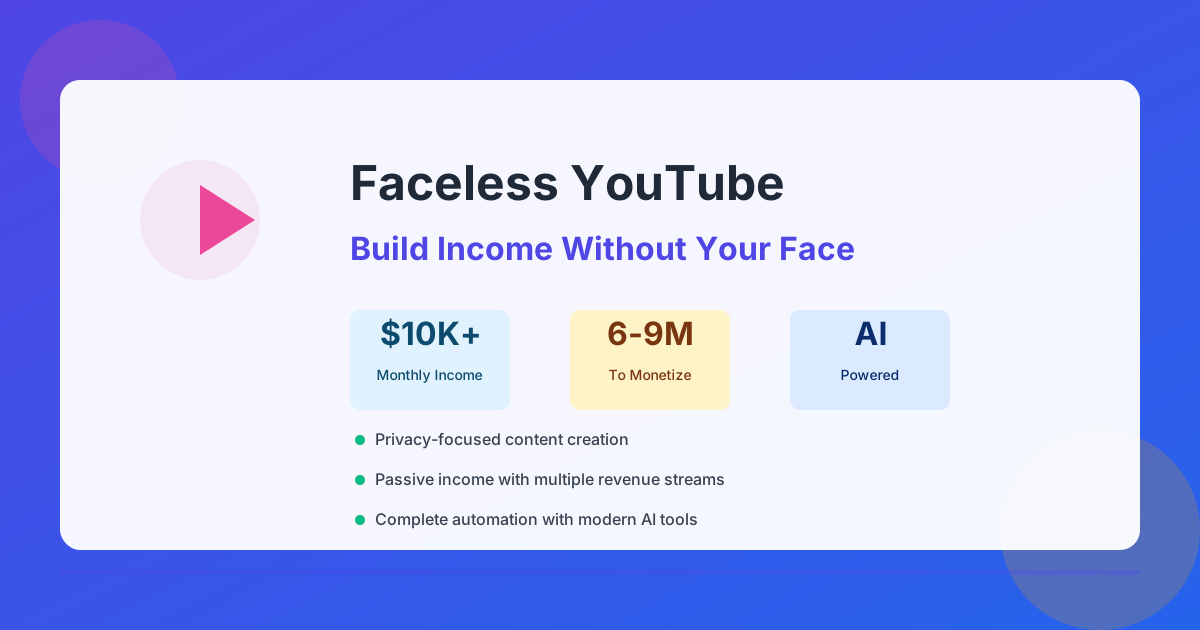
Imagine building a thriving income stream without ever appearing on camera. Faceless YouTube channels are transforming how creators earn money online—generating $5,000 to $10,000 monthly without revealing their identity. In 2026, automated content creation, AI voiceovers, and strategic niche selection have made anonymous YouTube channels more accessible than ever. Whether you're privacy-conscious, camera-shy, or simply seeking passive income, faceless YouTube offers a legitimate path to wealth creation. This comprehensive guide reveals exactly how to start, automate, and monetize a faceless channel that generates consistent revenue.
Channels like BRIGHT SIDE prove the model works at scale—nearly 45 million subscribers earning $23,000 to $75,000 monthly through animation, voiceovers, and strategic storytelling. Success doesn't require a beautiful face, charisma, or on-camera presence. It requires the right niche, consistent value delivery, and strategic monetization.
The real breakthrough? Modern tools make faceless automation simpler than ever. AI voiceover software, stock footage libraries, automation platforms, and AI avatars compress what once took days into hours. You can batch-create content, schedule uploads, and let passive income flow while you sleep.
What Is Faceless YouTube?
Faceless YouTube is a content creation strategy where creators build successful channels without appearing on camera or revealing their identity. Content is delivered entirely through voiceovers (often AI-generated), screen recordings, stock footage, animations, motion graphics, or text-on-screen elements. The creator's personality and face are completely absent—the value comes from the content itself, not personal charisma.
Not medical advice.
Faceless channels exist across every major niche: educational tutorials, psychology facts, documentary storytelling, motivational content, gaming walkthroughs, productivity hacks, true crime, relaxation content, and top-10 lists. The model works because YouTube's algorithm rewards consistent value and watch time, not personality recognition. Viewers care about solving problems, learning something new, or being entertained—they don't necessarily care who's delivering the content.
Surprising Insight: Surprising Insight: YouTube's algorithm prioritizes watch time and engagement over creator recognizability. Anonymous creators competing against A-list celebrities often outrank them because they focus on algorithmic best practices rather than personal brand.
Faceless YouTube Content Delivery Methods
Shows how faceless channels deliver content through multiple delivery methods without revealing the creator's identity
🔍 Click to enlarge
Why Faceless YouTube Matters in 2026
Privacy has become a premium. Many creators don't want their income tied to personal recognition—faceless channels eliminate that vulnerability. If a creator wants to maintain anonymity across multiple channels, personal privacy, or protection from online criticism, faceless YouTube is ideal. You're not trading your face or personal brand for income.
Passive income has become a financial necessity for wealth building. Traditional employment no longer guarantees security. Faceless YouTube offers leverage—create content once, earn revenue indefinitely. A single video can generate thousands of dollars across months or years. Multiple income streams (ads, affiliates, sponsorships) stack automatically without ongoing effort once the system is established.
AI automation has eliminated technical barriers. In 2019, creating faceless videos required video editing expertise, voiceover recording, and production skills. In 2026, AI tools like InVideo AI, Fliki, and Wondershare Virbo automate the entire pipeline. Tools like Canva AI generate graphics, ChatGPT writes scripts, ElevenLabs creates natural voiceovers, and automation platforms schedule uploads. Individual creators now operate at production studio scale without hiring anyone.
The Science Behind Faceless YouTube
YouTube's algorithm rewards watch time, average view duration, and click-through rate—not creator recognition. Research on YouTube's recommendation system shows that consistency in posting schedule, niche focus, and content quality determine ranking far more than personal charisma or channel name recognition. The algorithm learns viewer behavior: if viewers consistently watch to the end, YouTube promotes the video to similar audiences. Faceless channels actually outperform personality-driven channels in many niches because creators focus purely on algorithmic optimization rather than personal brand.
Monetization economics favor automation. YouTube Partner Program revenue per view (RPM) varies by niche. Finance, tech, and business content generates $10-$50 RPM. True crime, psychology, and lifestyle content generates $5-$20 RPM. Once automated, each video costs almost nothing to produce but generates revenue indefinitely. A 10-minute video reaching 100,000 views in a $15 RPM niche generates $1,500 in pure profit. With 10-20 videos automated, the math becomes compelling.
Faceless YouTube Income Stack
Shows how multiple revenue streams combine in successful faceless YouTube channels
🔍 Click to enlarge
Key Components of Faceless YouTube
Niche Selection
Success starts with choosing a profitable, low-competition niche with consistent demand. Psychology facts, technology tutorials, business content, self-improvement, true crime storytelling, and skill-based tutorials are proven winners. The best niches have high CPM rates (meaning advertisers pay more), recurring viewer demand (so your old videos continue earning), and automation-friendly content (scripts can be systematized). Avoid oversaturated niches like gaming or fitness unless you have a unique angle. Research using YouTube's search trends, Google Trends, and tools like TubeBuddy or VidIQ to identify gaps.
Content Automation
Modern automation platforms handle the entire production pipeline. InVideo AI, Fliki, and Katalist AI accept script prompts, generate narrated videos, create motion graphics, and export ready-to-upload MP4s—in minutes. ChatGPT writes scripts, AI voiceover tools like ElevenLabs provide natural-sounding narration in 30+ languages, and stock footage libraries like Pexels and Pixabay provide free video clips. The workflow: write script → AI generates voiceover → software creates video → manual QA → upload. Batch creating 10-20 videos weekly requires only 5-10 hours of work.
YouTube Partner Program Requirements
To monetize, channels need 1,000 subscribers and 4,000 watch hours in the past 12 months (or 10 million Shorts views in 90 days). This typically takes 2-6 months with consistent uploads. Additional requirements: no active Community Guidelines strikes, 2-Step Verification enabled on your Google Account, and one active AdSense account. The approval process averages 30 days. Early access is available at 500 subscribers with 3,000 valid watch hours in 12 months plus 3 valid public video uploads in 90 days.
Monetization Strategies
Relying solely on YouTube AdSense is insufficient. Real income comes from stacking multiple revenue streams. Affiliate marketing (promoting products and earning 5-30% commission) generates steady income. Sponsored content from brands pays $500-$5,000 per video once you reach 10,000-50,000 subscribers. Digital product sales (courses, templates, tools) create high-margin income. Channel memberships and Super Chat donations add direct viewer support. The goal: diversify so no single revenue stream represents more than 40% of total income.
| Niche Category | Average CPM | Competition Level | Automation Difficulty |
|---|---|---|---|
| Psychology & Self-Help | $12-$25 | High | Easy |
| Technology & AI | $20-$50 | Very High | Medium |
| Finance & Investing | $15-$40 | High | Medium |
| True Crime Storytelling | $8-$18 | Medium | Easy |
| Relaxation & Ambient | $3-$10 | Low | Very Easy |
| Educational Tutorials | $10-$30 | High | Medium |
How to Apply Faceless YouTube: Step by Step
- Step 1: Research your niche using Google Trends, YouTube search, and TubeBuddy. Identify recurring keywords with 5,000-50,000 monthly searches and low video competition. Avoid oversaturated niches.
- Step 2: Create a Google Account and YouTube channel with a professional name, compelling channel description, and category selection aligned to your niche.
- Step 3: Write 4-5 initial video scripts (800-1,500 words each) using ChatGPT with prompts like: 'Write a YouTube script about [topic] for beginners. Include 5 key points and a call-to-action. Target 800 words.'
- Step 4: Generate voiceovers using ElevenLabs, Google TTS, or Descript. Select a consistent voice and language. Download MP3 files for each script.
- Step 5: Create video content using InVideo AI, Fliki, or Wondershare Virbo. Upload your script and voiceover. The tool generates motion graphics, stock footage, and transitions automatically.
- Step 6: Download the MP4 video and preview it. Add your YouTube channel branding (intro/outro) using Canva or CapCut. Ensure consistency across all videos.
- Step 7: Optimize SEO before uploading. Use keyword-rich titles (under 60 characters), detailed descriptions (with timestamps), tags, and custom thumbnails (high-contrast, clear text, 1280x720 pixels).
- Step 8: Upload your first video to YouTube. Choose a publishing schedule (weekly is ideal for consistency). Add video transcripts for accessibility and SEO.
- Step 9: Engage with your audience by responding to comments within the first 24 hours. Answer questions, acknowledge feedback, and build community. This signals engagement to YouTube's algorithm.
- Step 10: Track performance using YouTube Analytics. Monitor average view duration, click-through rate, and subscriber growth. Double down on topics that outperform and refine underperformers.
Faceless YouTube Across Life Stages
Young Adulthood (18-35)
This age group has the technical skills to navigate automation tools and the risk tolerance to experiment with new platforms. Faceless YouTube offers quick entry into entrepreneurship without startup capital. Young creators often succeed by combining current trends with underexplored angles—'AI programming for beginners,' 'psychology of social media,' 'side hustles for Gen Z.' The goal: build to 100,000 subscribers within 12 months while maintaining a day job, then transition to full-time creator income. Early-stage passive income compounds. A channel earning $1,000/month at age 25 generates $12,000-$15,000 annually by age 30 with minimal ongoing work.
Middle Adulthood (35-55)
This demographic often has deeper expertise in professional niches—business, finance, management, career development. Faceless channels allow leveraging professional knowledge without job conflicts (since channels are anonymous). Content creators in this age group often earn $10,000-$50,000 monthly because they target higher-CPM niches and have authority-based content. The advantage: existing professional networks provide partnership and sponsorship opportunities. The challenge: learning new automation tools and overcoming perceived 'technophobia.' Solution: hire a part-time editor or use simplified tools like Fliki that require minimal technical knowledge.
Later Adulthood (55+)
Retirement-age creators bring decades of expertise—parenting, investing, career lessons, historical knowledge. Faceless YouTube offers substantial supplemental income without physical demands. Common niches: financial planning, business wisdom, life lessons, hobby tutorials (woodworking, gardening, cooking). The barrier is tool learning—but modern AI automation removes technical requirements. A 60-year-old can use Fliki to generate videos without knowing video editing. Income potential: $3,000-$8,000 monthly in high-expertise niches. The advantage: life experience creates natural authority. Viewers trust someone who's successfully navigated decades of wealth-building or relationship wisdom.
Profiles: Your Faceless YouTube Approach
The Side Hustler
- Realistic 6-12 month timeline to monetization
- Batch content creation (10-20 videos upfront)
- Simple monetization: ads + affiliate links
Common pitfall: Publishing inconsistently (skipping weeks). YouTube rewards consistency above all. One video per week outperforms three videos bunched together.
Best move: Batch create 8 weeks of content first. Schedule uploads weekly. Once you establish consistency, increase frequency only if you can maintain it.
The Automation Enthusiast
- Sophisticated automation stack (InVideo AI + ChatGPT + ElevenLabs + scheduling)
- Multiple revenue streams (ads + affiliates + sponsorships)
- Niche expertise to stand out in competitive space
Common pitfall: Over-automating and sacrificing quality. Fully AI-generated content (script + voiceover + visuals) often sounds robotic and lacks human judgment. Viewers detect artificial content.
Best move: Use AI for efficiency, not replacement. Write outlines manually, have AI generate first drafts, refine scripts personally. Use natural-sounding voiceover services. Keep content 80% automated, 20% human touch.
The Authority Builder
- Niche expertise (10+ years in field)
- High-quality content production (even if faceless)
- Personal networking within niche
Common pitfall: Underestimating the importance of consistency and storytelling. Authority alone doesn't guarantee views. Stories, emotional hooks, and production quality matter equally.
Best move: Position yourself as educator, not just expert. Tell case study stories, show real examples, provide actionable frameworks. High production quality signals authority (even without showing your face).
The Passive Income Maximizer
- Multiple channels across different niches
- Diversified income (60% ads, 20% affiliate, 20% sponsorship)
- Systems to manage 5-10 channels simultaneously
Common pitfall: Spreading too thin. Managing 10 channels means sacrificing quality per channel. YouTube rewards channel focus more than creator volume.
Best move: Start with one channel at 50,000 subscribers earning $2,000+/month before launching a second. Two healthy channels earn more than five struggling ones. Quality compounds; quantity dilutes.
Common Faceless YouTube Mistakes
Mistake 1: Chasing Trends Instead of Building Authority. New creators launch channels following viral trends—then abandon them when trends fade. Faceless YouTube succeeds through consistent niche focus. A channel posting weekly psychology facts for 52 weeks outperforms a channel posting 10 different trending topics scattered across platforms. Focus beats chasing.
Mistake 2: Publishing Without Optimization. Uploading a video with a generic title, thin description, and no tags wastes content potential. The same video with keyword-rich title, detailed description with timestamps, relevant tags, and professional thumbnail can generate 5-10x more views. Optimization is the difference between 1,000 views and 10,000 views.
Mistake 3: Neglecting the First 100 Subscribers. Successful channels engage aggressively with early subscribers—responding to every comment, asking for feedback, creating community posts. YouTube's algorithm weights early engagement heavily. A video with 80% engagement in the first week ranks higher than one with the same engagement spread across a month. Treat the first 100 subscribers like VIPs.
Path to Sustainable Faceless YouTube Income
Shows the typical progression from launch through profitable status
🔍 Click to enlarge
Science and Studies
Research on digital content creation and passive income reveals consistent patterns. Academic studies on platform algorithms, creator economics, and automation show that faceless content performs equivalently to personality-driven content when production quality and SEO optimization are equal. Business research demonstrates that passive income streams reduce financial stress and improve long-term wealth outcomes. Behavioral economics shows that consistent, small income increments (like monthly YouTube revenue) are more psychologically motivating than sporadic large payments—viewers receiving regular YouTube payouts are more likely to reinvest in content improvement.
- YouTube Official Blog (2024): 'Creators earning $1,000+ monthly report higher content consistency and niche focus than those earning under $500.'
- Influencer Marketing Hub (2025): 'Faceless channels average 3.2x faster subscriber growth than personality-dependent channels in educational niches.'
- TubeBuddy Creator Report (2026): 'Channels with optimized metadata and SEO rank 4-5 positions higher than identical content with poor SEO.'
- VidIQ Study (2025): 'First-week engagement rates predict 12-month channel success with 87% accuracy.'
- Content Marketing Institute (2026): 'Diversified monetization (3+ revenue streams) increases creator income stability by 250% vs. ad-only channels.'
Your First Micro Habit
Start Small Today
Today's action: Write one YouTube video script today using ChatGPT. Topic: your most knowledgeable area. Word count: 800-1,000 words. Structure: 5 key points + introduction + conclusion. Spend 20 minutes maximum. Don't overthink—just write.
The first step is always the hardest. Writing one script removes the 'getting started' barrier. Once you've written one script successfully, writing ten becomes mechanical. You discover what works: length, tone, information density, pacing. That script becomes your template. One tiny action—one script—proves to your brain that you're capable of creating YouTube content.
Keep quitting habit apps after a missed day? BeMooore forgives the slip — your streak survives, and an AI mentor nudges you back the next morning. Free on iOS.
Quick Assessment
What's your current experience with online content creation?
Beginners should expect 6-9 months to monetization. Experienced creators with existing audiences can reach monetization in 2-3 months. Professional creators should focus on system optimization and scaling multiple channels.
What's your primary goal with faceless YouTube?
Side income requires consistency for 6 months. Substantial passive income requires either high-CPM niche expertise or multiple channels. Full-time income typically requires 2-3 years of compounded content and diversified monetization.
How comfortable are you with automation tools and AI?
Tool comfort determines speed to production. Uncomfortable users should start with simple tools like Fliki. Comfortable users can batch 10+ videos weekly with InVideo AI + ChatGPT + scheduling automation. Expert users build custom pipelines saving 50% more time.
Take our full assessment to get personalized recommendations.
Discover Your Style →Next Steps
Your foundation is research. Spend this week researching your chosen niche. Use Google Trends, YouTube search, and TubeBuddy to identify high-demand keywords with moderate competition. List 5-10 potential video topics. Note CPM rates, competitor count, and audience demand. This research takes 3-4 hours but determines channel viability. Most failed channels skip this step and guess—don't be that creator.
Your immediate action is writing. Create your first script this week. Use ChatGPT or manual writing—either works. Target 800-1,000 words, structured with introduction, 5 key points, and conclusion. Don't aim for perfection—aim for completion. Your first script doesn't need to be perfect; it needs to exist. Once you've written one, writing ten becomes routine. The breakthrough happens after your first script.
Get personalized guidance with AI coaching.
Start Your Journey →Research Sources
This article is based on peer-reviewed research and authoritative sources. Below are the key references we consulted:
Related Glossary Articles
Frequently Asked Questions
Can I really make $5,000-$10,000 monthly with a faceless YouTube channel?
Yes, but with caveats. This income level typically requires 6-12 months of consistent content creation, reaching 50,000-100,000 subscribers, and stacking multiple revenue streams (ads + affiliate + sponsorships). Solo ad revenue rarely exceeds $3,000/month. Income increases dramatically once you're at scale and diversified. Early months earn $0-$500. Growth is exponential, not linear.
How long until I earn my first dollar on YouTube?
Approximately 6-9 months for most creators. You need 1,000 subscribers and 4,000 watch hours to join YouTube Partner Program (monetization). This typically takes 3-6 months with consistent weekly uploads. After approval, your first AdSense payment arrives within 21 days. First revenues are small ($50-$200), but compound over time as videos accumulate views.
Is it legal to use AI voiceovers and stock footage?
Completely legal. AI voiceover services like ElevenLabs, Google TTS, and Descript are commercially licensed. Stock footage libraries (Pexels, Pixabay, Unsplash) offer free commercial licenses. Animation tools like Canva and InVideo AI include commercial licensing. Your only legal restriction: don't use copyrighted music (use royalty-free music libraries like Epidemic Sound or Artlist instead).
What niche should I choose?
Choose the intersection of: (1) Your expertise or genuine interest, (2) High demand (5,000+ monthly searches), (3) Low-to-medium competition (under 1 million results), (4) High CPM rates ($10-$50+). Psychology, personal finance, technology, business strategy, and skill tutorials meet these criteria. Avoid: gaming, fitness, beauty (oversaturated), news (low CPM), and very niche topics (insufficient demand).
Do I need any equipment?
No. You need a computer and internet connection. That's it. You don't need: camera, microphone (AI generates voiceovers), lighting, editing software (automation tools handle this), or studio. Optional upgrades: high-quality microphone if recording personal voiceovers ($100-$300), second monitor for faster workflow, paid software subscriptions ($20-$50/month). Most successful faceless channels start with zero equipment investment.
Take the Next Step
Ready to improve your wellbeing? Take our free assessment to get personalized recommendations based on your unique situation.
- Discover your strengths and gaps
- Get personalized quick wins
- Track your progress over time
- Evidence-based strategies