Career and Professional Growth
Career and professional growth represents your intentional journey toward greater responsibility, skills, satisfaction, and earning potential. It's not merely climbing the ladder—it's building the competencies, relationships, and mindset that define your professional identity. In 2026, the landscape has shifted fundamentally. Organizations no longer follow rigid hierarchies; careers are "squiggly" rather than linear. Success depends on strategic skill-building, continuous learning, effective mentorship, and genuine self-awareness about your strengths and aspirations. This guide shows you how to navigate that complexity with clarity, purpose, and actionable strategies.
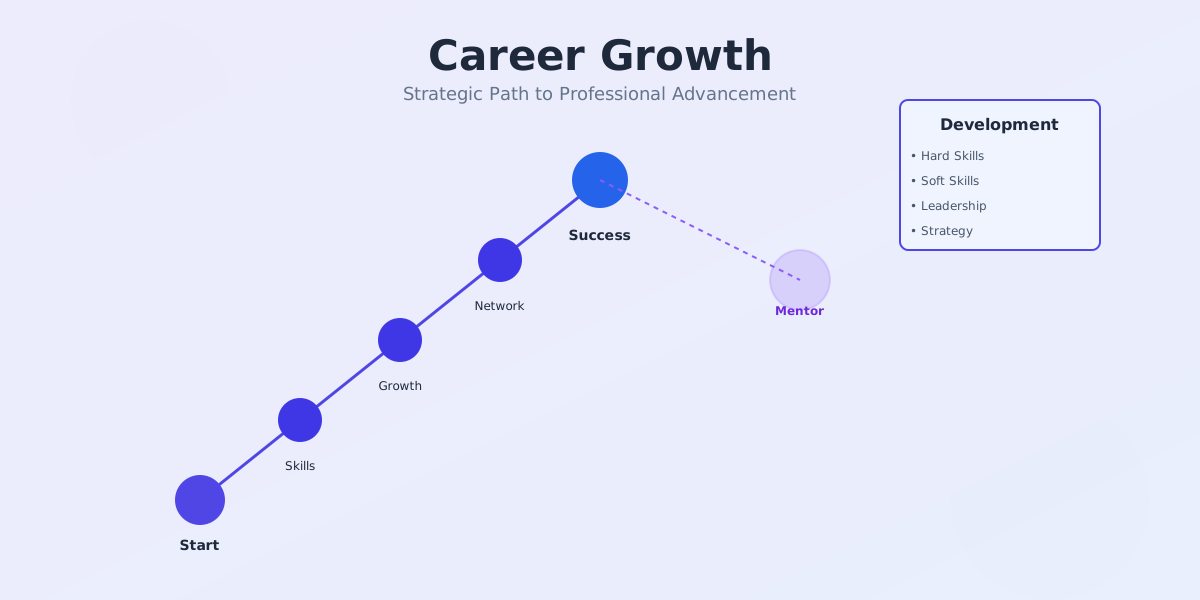
Whether you're a recent graduate charting your first career moves, a mid-level professional seeking advancement, or an experienced leader exploring new directions, the principles of professional growth remain consistent: know your strengths, develop intentionally, build meaningful networks, and align your work with your values.
The market for professional development is projected to grow $5.56 billion through 2029, reflecting the reality that organizations and individuals alike recognize growth as essential for competitive advantage.
What Is Career and Professional Growth?
Career and professional growth refers to the intentional development of your knowledge, skills, abilities, and professional relationships to advance your career trajectory, increase earning potential, and achieve greater job satisfaction. It encompasses both hard skills (technical competencies like coding, data analysis, or project management) and soft skills (communication, emotional intelligence, leadership). Professional growth is a continuous, proactive process where you assess opportunities, identify gaps, pursue learning, build networks, and strategically position yourself for advancement.
Not medical advice.
This concept goes beyond a single promotion or raise. It's about building career resilience—the ability to adapt, pivot, and thrive regardless of market changes. It includes exploring different roles, industries, and entrepreneurial paths. Modern professional growth integrates work-life harmony, personal values alignment, and sustainable advancement that doesn't sacrifice wellbeing.
Surprising Insight: Surprising Insight: Learners who set career goals engage with learning content 4x more than those without goals—highlighting the transformative power of intentional growth planning.
Career Growth Dimensions
Visual representation of the four interconnected dimensions that drive career advancement: skills, relationships, mindset, and alignment.
🔍 Click to enlarge
Why Career and Professional Growth Matters in 2026
The workplace has fundamentally transformed. Artificial intelligence and automation are reshaping which skills remain valuable. Organizations report that 40% now have mature career development initiatives—but that means 60% don't. This creates opportunity gaps where those who take control of their growth advance faster. The World Economic Forum reports that 50% of all employees need reskilling by 2025, making continuous learning non-negotiable.
Additionally, career longevity has shifted. Rather than one 40-year career with one employer, today's professional typically navigates 5-7 career chapters. Each transition requires intentional repositioning—updating skills, expanding networks, and clarifying your unique value. Without strategic professional growth, you become vulnerable to obsolescence. With it, you gain agency, resilience, and options.
Employees who lack career advancement opportunities are 35% more likely to leave their jobs, according to research on millennial retention. Organizations investing in your growth signal genuine commitment to your future—and that trust compounds into loyalty, engagement, and performance.
The Science Behind Career and Professional Growth
Career development theory, rooted in psychology and organizational research, shows that growth occurs at the intersection of self-knowledge, opportunity exploration, and goal-directed action. Industrial-organizational psychology identifies three core career competencies: reflective (understanding yourself, your values, your long-term aspirations), communicative (articulating your strengths and aspirations to others), and behavioral (taking action to build skills and expand networks). Research demonstrates that proactive career behavior—where individuals actively explore options, set goals, develop skills, and build networks—directly predicts career success, satisfaction, and advancement.
Neuroscience also reveals that setting specific career goals triggers dopamine and increases engagement with learning by 4x compared to those without clear goals. Your brain literally works harder and retains more when pursuing intentional outcomes. Additionally, mentorship relationships create psychological safety that accelerates learning and confidence-building. Employees with mentors are significantly more likely to be promoted, earn higher compensation, and report greater job satisfaction.
The Career Competencies Framework
Three interconnected domains of career competency that drive sustained professional growth and advancement.
🔍 Click to enlarge
Key Components of Career and Professional Growth
Hard Skills and Technical Competency
Hard skills are concrete, measurable abilities you can learn and demonstrate: programming languages, data analysis, project management, accounting, design tools, or industry-specific expertise. These are the technical foundations your role requires. Research shows that 70% of hiring managers cite technical skills as critical to advancement. However, hard skills have shelf lives. The World Economic Forum projects that 50% of professionals will need reskilling in their current roles by 2025 due to technological change. Building a habit of continuous technical learning—whether through certifications, online courses, or on-the-job projects—keeps you marketable and confident in your domain.
Soft Skills and Emotional Intelligence
Soft skills—communication, emotional intelligence, teamwork, adaptability, and leadership—are increasingly the differentiator for advancement. Unlike hard skills that become obsolete, soft skills transcend industries and roles. They enable you to influence, collaborate, inspire, and navigate complexity. Emotional intelligence specifically—self-awareness, self-regulation, empathy, and relationship management—predicts career success more strongly than IQ. Organizations prioritize developing soft skills, recognizing they enable hard skill application in real-world contexts. The ability to communicate a complex technical solution to non-technical stakeholders, to lead a diverse team, or to navigate organizational politics is what separates individual contributors from leaders.
Mentorship and Sponsorship Relationships
Mentors provide guidance, advice, and support; sponsors actively advocate for your advancement within their networks and organizations. The distinction is crucial. A mentor helps you develop; a sponsor opens doors. Research shows that 98% of Fortune 500 companies and 100% of the top 50 have formal mentoring programs. Employees with mentors experience visible results within 3-6 months: promotions, improved skills, greater clarity on direction, or successful interviews. A mentor relationship accelerates learning, provides role modeling, and builds confidence. Beyond the individual mentor, having a "network of mentors"—advisors in different areas—provides diverse perspectives and opportunities.
Strategic Goal-Setting and Planning
SMART goals (Specific, Measurable, Achievable, Relevant, Time-Bound) form the backbone of professional growth planning. Rather than vague aspirations like "get promoted," effective goals are: "Earn AWS Solutions Architect certification by June 2026 to qualify for senior engineer roles." Goals create direction, enable tracking, and trigger sustained effort. Research shows that professionals with written career development plans experience faster advancement and higher satisfaction. Your plan should span 3-5 years, with annual milestones and quarterly checkpoints. Crucially, plans should evolve as you learn, succeed, and discover new interests—rigidity kills growth.
| Skill Category | Examples | Career Impact |
|---|---|---|
| Hard Skills | Programming, data analysis, accounting, design, CAD, languages | Necessary for role entry; decreases in value over time; requires continuous updating |
| Soft Skills | Communication, leadership, emotional intelligence, problem-solving, adaptability | Increasingly critical for advancement; valuable across industries and roles; timeless |
| Hybrid Skills | Project management, change management, strategic thinking, customer empathy | Combine technical and interpersonal; highest market value; bridge individual contributor and leadership roles |
How to Apply Career and Professional Growth: Step by Step
- Step 1: Assess Your Current Reality: Inventory your hard and soft skills, education, certifications, and years of experience. List accomplishments you're proud of and roles that energized you. Identify technical areas where you lack knowledge and interpersonal areas for growth. Be brutally honest about your gaps.
- Step 2: Define Your Aspiration: What does success look like in 3 years? In 10? Is it a specific title, income level, industry, or lifestyle? Is it leading a team, launching a business, or becoming a recognized expert? Is it geographic flexibility or work-life integration? Your aspiration shapes everything that follows.
- Step 3: Identify the Gap: Compare current reality to aspiration. What skills must you develop? What experience do you need? What certifications or credentials? What network connections? This gap analysis becomes your development roadmap.
- Step 4: Create a Development Plan: Set SMART goals for closing gaps. Example: "Complete leadership certification by December 2026. Lead cross-functional project by Q3. Build 10-person advisory network in my industry." Build in quarterly reviews to track progress.
- Step 5: Develop Hard Skills Strategically: Pursue certifications, courses, or projects that build capabilities aligned with your aspiration. Prioritize skills that (a) advance your current role, (b) open new opportunities, and (c) remain valuable long-term. Dedicate 5-10 hours weekly to learning.
- Step 6: Invest in Soft Skills: Work with a coach on communication or leadership. Volunteer for high-visibility projects. Take on roles that stretch you—presenting to executives, managing conflict, leading diverse teams. Soft skills develop through practice and reflection, not just courses.
- Step 7: Seek and Nurture Mentorship: Identify potential mentors in your organization, industry, or adjacent fields. Start with informal coffee conversations. Be clear about what you're seeking guidance on. Check in quarterly. Maintain relationships even when not actively seeking something—mentors are long-term assets.
- Step 8: Expand Your Network Strategically: Attend industry conferences, join professional associations, participate in online communities. Network intentionally around topics that matter to your growth, not just anyone. Relationship quality matters more than quantity. Aim to deepen 5-10 meaningful professional relationships annually.
- Step 9: Seek Stretch Assignments: Request projects, roles, or responsibilities that require you to grow. These are powerful learning opportunities. They demonstrate your capability to leaders. They expand your resume and skill set. Navigate the risk—stretch assignments should be challenging but achievable with support.
- Step 10: Reflect and Adjust Quarterly: Review your development plan every three months. Are you on track? Have your aspirations shifted? Have you discovered new gaps or opportunities? Adjust your plan accordingly. Growth is iterative, not linear. This quarter-review habit keeps your strategy aligned with reality and learning.
Career and Professional Growth Across Life Stages
Young Adulthood (18-35)
Early career is about exploration and foundation-building. Your primary focus: gain diverse experience, develop core competencies in your chosen field, and build your professional reputation. Prioritize learning over income. Seek roles and mentors that accelerate your growth, even if the title or salary isn't ideal. Build a strong professional network—peers you can learn from and who might become collaborators later. Consider lateral moves and different roles rather than only climbing one ladder. This phase is where you discover your strengths, preferences, and long-term direction. Mistakes here are tuition in professional education; they're investments in self-knowledge that inform your next decade.
Middle Adulthood (35-55)
This is your peak earning and impact decade. You likely have deep expertise in your domain, established networks, and credibility. Professional growth shifts from "building foundation" to "expanding scope" and "building others." Consider: Are you still challenged? Are you developing future skills or resting on current ones? Is your compensation and title reflecting your market value? This is when many professionals pivot—moving into leadership, consulting, entrepreneurship, or adjacent fields. Mentoring others becomes central; helping junior professionals grow is both generative and keeps you relevant through their perspectives. If you're not feeling challenged, proactively seek growth rather than waiting for offers. This phase sets the trajectory for the final chapter of your career.
Later Adulthood (55+)
Professional growth here is often about legacy, optionality, and mastery. Some professionals accelerate toward retirement; others launch second acts. Both paths benefit from intentional growth. If you're moving toward retirement, deepening expertise, completing major projects, and formalizing knowledge you've accumulated offers satisfaction and value. If you're launching a second act—consulting, board service, entrepreneurship, or entirely new fields—this requires vulnerable learning. Your age and experience are assets, not liabilities. Many second-act careers are more fulfilling because you know yourself better and can be more selective about where you invest your energy. Mentoring becomes even more valuable; the wisdom you've built is increasingly rare and sought-after.
Profiles: Your Career and Professional Growth Approach
The Technical Expert
- Deep skill development in domain expertise
- Recognition and advancement that doesn't require management
- Connection to the evolving landscape of your field
Common pitfall: Assuming technical skills alone will drive advancement; missing the soft-skill and political dimensions of career progression
Best move: Develop a hybrid career path where you're recognized as expert AND cultivate coaching/mentoring skills that build your influence without requiring traditional management roles
The Rising Leader
- Exposure to decision-making at higher levels
- Feedback on leadership style and effectiveness
- Clarity on which leadership models align with your values
Common pitfall: Chasing leadership for status/income rather than genuine interest; burning out because leadership requires different skills than individual contribution
Best move: Secure a mentor or executive coach who can guide your leadership development and help you evaluate whether management roles authentically fit your strengths and values
The Career Pivot Seeker
- Skills translation—identifying how current competencies apply to new fields
- Network building in the new domain
- Tolerance for temporary setback in title/salary to build credibility in new area
Common pitfall: Dismissing previous experience as irrelevant; trying to transition without bridging projects; expecting to enter new fields at the same level
Best move: Identify 2-3 transferable skills from your background that are valuable in your target field. Build credibility through projects, certifications, or volunteer roles before making the full leap
The Serial Entrepreneur
- Business development and financial acumen beyond technical skills
- Networks with investors, customers, and operational expertise
- Resilience and learning from failures
Common pitfall: Underestimating the business, operational, and fundraising skills required; overestimating how quickly ideas scale
Best move: Build a diverse advisory network including someone experienced in your market, someone with operational expertise, and someone who's built successful ventures. Learn ruthlessly from each failure
Common Career and Professional Growth Mistakes
One pervasive mistake is confusing busyness with growth. You can be incredibly busy in your current role—managing crises, delivering projects—while developing zero new capabilities. Growth requires deliberate practice, reflection, and often time carved out from your current workload. Another mistake is waiting for your organization to develop you. While organizational investment matters, your career is ultimately your responsibility. Professionals who take ownership of their growth—seeking mentors, pursuing learning, asking for stretch assignments—advance faster and have more options than those waiting for their employer to invest in them.
A third mistake is developing only hard skills while neglecting soft skills and relationships. You can be technically brilliant and professionally stuck if you can't communicate, collaborate, or navigate organizational dynamics. Conversely, excellent soft skills without ongoing technical development becomes increasingly limiting. The strongest career growth integrates both. Finally, many professionals narrow too quickly—specializing so deeply that they become vulnerable if their niche changes. A portfolio approach—deep expertise plus adjacent skills—provides resilience and options.
The biggest mistake overall: failing to clarify your aspiration. Without knowing what success looks like for you, it's easy to chase someone else's definition—status, money, title—and wake up unfulfilled. Professional growth is most sustainable when aligned with your values, strengths, and genuine interests.
Growth Pitfalls and Adjustments
Common career development mistakes and how to reframe them for sustained advancement.
🔍 Click to enlarge
Science and Studies
Research in organizational psychology, career development theory, and workplace learning documents the powerful impact of intentional professional growth on both individual success and organizational performance. The evidence consistently shows that structured development, mentorship, continuous learning, and proactive career management drive advancement, satisfaction, and resilience.
- LinkedIn Learning (2024): "Workplace Learning Report" demonstrates that organizations investing in continuous learning see 5x higher employee engagement and retain talent at rates 41% higher than peers.
- Technavio (2024): Professional Development Market projected to grow $5.56 billion through 2029, driven by organizational recognition that skill development directly impacts competitive advantage.
- Darden University Executive Education (2024): "Six Ways Professional Development Boosts Your Career" identifies mentorship, goal-setting, skill diversification, network expansion, resilience building, and values alignment as primary growth drivers.
- SIOP Guidelines (2024): Society for Industrial-Organizational Psychology emphasizes that career competencies—reflective, communicative, and behavioral—are learnable and measurable dimensions of professional readiness.
- PMC/NIH Research (2023): "Cultivating Proactive Career Behavior" demonstrates that proactive career management predicts career success, mobility, and psychological wellbeing more strongly than demographic factors.
Your First Micro Habit
Start Small Today
Today's action: Schedule 30 minutes this week to write down: (1) your current skills/accomplishments, (2) your 3-year aspiration, and (3) the gap between them. This single reflection exercise creates clarity that guides all other growth decisions.
Clarity precedes action. When you can articulate your current state and desired future, every learning opportunity, networking conversation, and job decision becomes easier to evaluate. You move from reactive to intentional.
Keep quitting habit apps after a missed day? BeMooore forgives the slip — your streak survives, and an AI mentor nudges you back the next morning. Free on iOS.
Quick Assessment
How intentional is your current approach to professional growth?
Your clarity level determines your velocity. The most successful professionals have written plans they review and adjust quarterly. Consider moving toward intentional planning.
What dimension of professional growth feels most underdeveloped in your career?
Your gap tells you where to focus first. Most professionals benefit from addressing at least two dimensions simultaneously: one that uses existing strengths and one that stretches you.
How aligned is your current work with your genuine aspirations and values?
Sustained growth requires values alignment. If you're misaligned, growth in your current role may feel hollow. Consider whether strategic growth means developing where you are, or moving to a context that better fits your values.
Take our full assessment to get personalized recommendations.
Discover Your Style →Next Steps
Professional growth doesn't happen by accident. It requires intention, reflection, action, and courage. Start this week by clarifying where you are, where you want to go, and what gap exists between them. That single exercise creates clarity that transforms every subsequent choice about learning, networking, and opportunity-seeking.
Then build your development plan. Be specific: What skills will you develop? When? How? Who will mentor you? What network will you build? What stretch assignments will you seek? Review quarterly. Adjust as you learn. Progress may not be linear, but with intentional action, you'll find yourself increasingly capable, connected, and positioned for the opportunities you genuinely want.
Get personalized guidance with AI coaching.
Start Your Journey →If the growth you want is professional, this walks through a career specific vision board, from title and skills to the first concrete next step.
Career vision board →Research Sources
This article is based on peer-reviewed research and authoritative sources. Below are the key references we consulted:
Related Glossary Articles
Frequently Asked Questions
How long does professional growth typically take?
Timeline varies by goal, but visible results from a structured development plan typically appear within 3-6 months—new skills, improved confidence, expanded network. Meaningful advancement (promotion, significant salary increase) usually takes 1-3 years of focused development. Major career transitions (pivoting fields, launching entrepreneurship) often require 2-5 years of skill-building and network development.
Can I grow professionally while staying in the same role?
Absolutely. Professional growth doesn't require changing jobs or titles. You can develop new skills, lead projects, mentor others, and expand influence within your current role. However, organizations sometimes view growth differently than individuals do. If your organization doesn't recognize internal development, you may need to change employers to see that growth reflected in title and compensation.
How do I balance professional growth with work-life balance?
Sustainable growth integrates both. The most fulfilled professionals develop in ways that align with their values and lifestyle. Some people grow through 20-hour certification programs; others grow through mentoring others or volunteering in their field. The key is intentional choice—growth that energizes rather than depletes you. Also, many growth activities (networking, reading industry trends, mentoring) can integrate into your existing life rather than add to it.
What if my organization doesn't support professional development?
Your organization's level of support matters but shouldn't stop you. Seek mentorship informally—coffee conversations, online communities, professional associations. Pursue learning through low-cost means—podcasts, blogs, YouTube, free courses from platforms like Coursera or edX. Use your own time strategically. If your organization actively blocks growth—retaliation for education, refusing reasonable development requests—that's a warning sign that you may need to find an organization more aligned with your ambitions.
How do I know if I'm advancing fast enough?
Avoid comparing your timeline to others; focus on your plan. Are you progressing toward your defined aspirations? Are you building skills aligned with your goals? Is your compensation growing with your capabilities? Are you more energized or increasingly unfulfilled? If you're on plan and feeling energized, pace is right. If you feel stuck despite consistent effort, you may need to accelerate learning, expand your network, seek a new role, or reconsider your aspirations.
Take the Next Step
Ready to improve your wellbeing? Take our free assessment to get personalized recommendations based on your unique situation.
- Discover your strengths and gaps
- Get personalized quick wins
- Track your progress over time
- Evidence-based strategies