Wisdom
You've faced difficult moments where you didn't know what to do. Then, slowly, clarity emerged. That shift from confusion to understanding is wisdom awakening. Wisdom isn't about being older or smarter than others. It's about integrating your experiences into a clear, compassionate perspective on life. People with genuine wisdom make better decisions, handle stress more easily, and find deeper happiness even when circumstances are challenging. They see beyond immediate problems to understand what truly matters.
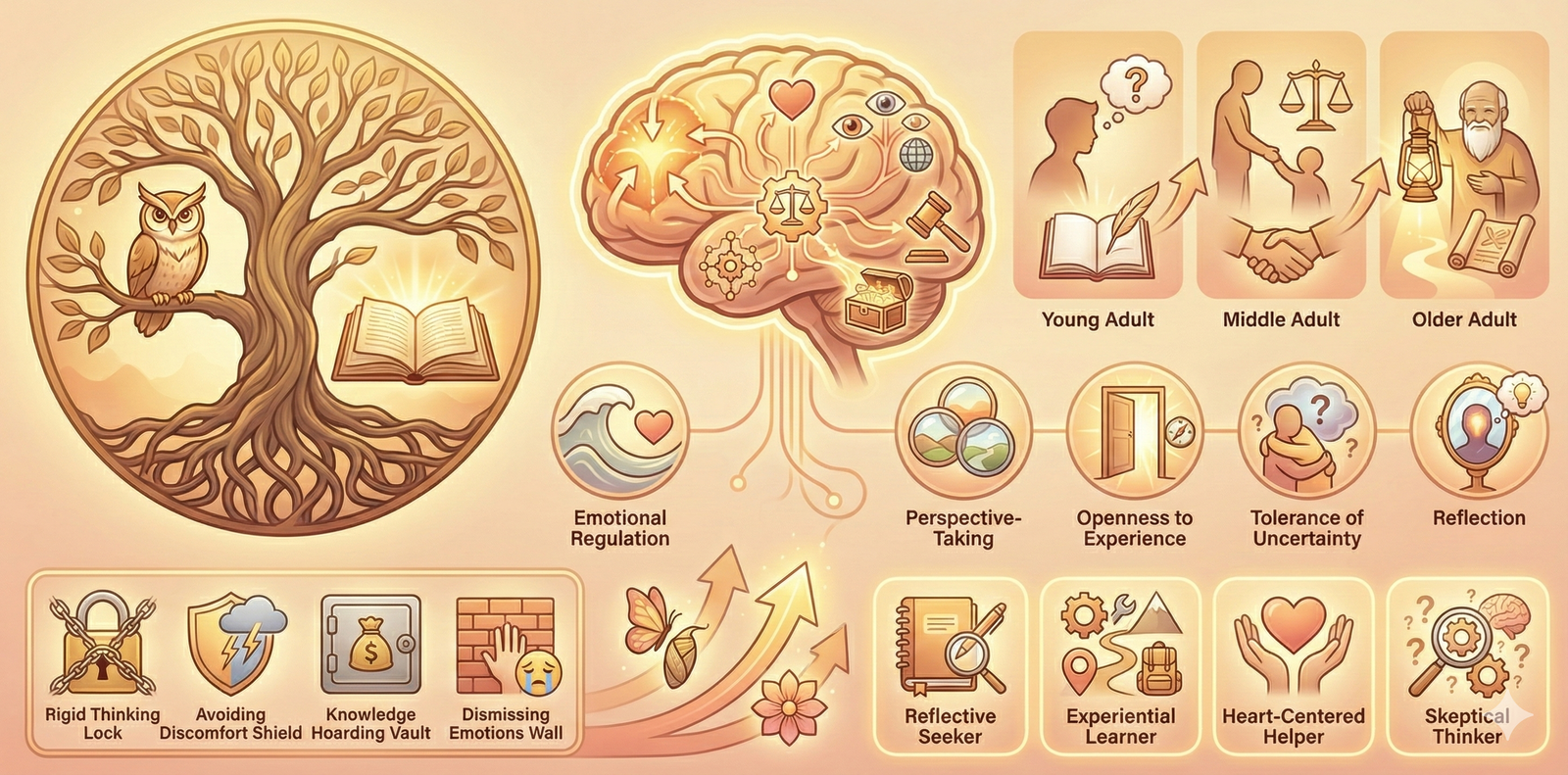
Wisdom is the bridge between knowledge and meaningful living.
Unlike intelligence, which peaks in your 20s, wisdom grows throughout your entire life.
What Is Wisdom?
Wisdom is the integrated ability to understand yourself, others, and the world with clarity and compassion. It combines knowledge with perspective, experience with humility, and understanding with action. Wise people recognize life's complexities, accept uncertainty, and respond thoughtfully rather than react impulsively. Wisdom includes knowing when you don't know something and remaining open to new understanding.
No es consejo médico.
Psychologists define wisdom as having several key dimensions. It involves reflective thinking, where you examine situations from multiple angles. It includes emotional regulation, staying calm in difficult moments. Wisdom encompasses social awareness, understanding others' perspectives and needs. It also means valuing growth over being right, and recognizing that different people need different approaches.
Surprising Insight: Surprising Insight: Wisdom is more strongly linked to happiness in older adults than wealth, health, or life circumstances. People with higher wisdom scores consistently report greater life satisfaction regardless of their material conditions.
The Dimensions of Wisdom
Five interconnected dimensions that comprise true wisdom: reflection, emotional balance, social awareness, humility, and perspective-taking
🔍 Click to enlarge
Why Wisdom Matters in 2026
In 2026, we face unprecedented choice and information. Every day brings conflicting advice, complex decisions, and rapid change. Wisdom cuts through noise. It helps you distinguish what's truly important from what only feels urgent. Research from behavioral psychology shows that people who develop wisdom experience less anxiety, make sounder choices, and recover faster from setbacks.
Wisdom creates resilience. When you understand how challenges fit into a larger life narrative, they become less overwhelming. You see hardship as temporary and meaningful, not as failure. This perspective shift protects your mental health and actually strengthens your relationships because you respond with compassion rather than defensiveness.
Wisdom is also linked to longevity research showing that psychosocial factors like wisdom, resilience, and positive connections significantly impact whole health and lifespan. People who cultivate wisdom tend to maintain stronger social bonds, engage in more purposeful activities, and make healthier lifestyle choices.
The Science Behind Wisdom
Neuroscience has revealed that wisdom involves optimal coordination between your prefrontal cortex and limbic system. The prefrontal cortex handles reasoning, judgment, and decision-making. The limbic system processes emotions and social bonding. Wise brains show balanced activation in these regions, meaning you can think clearly while staying emotionally aware.
Research identified that specific brain networks activate during wise decision-making. The default mode network, which activates during self-reflection and perspective-taking, plays a central role. Scientists also found that dopamine, serotonin, and oxytocin support the prosocial components of wisdom. Understanding this brain basis shows that wisdom is cultivable, not fixed.
Brain Regions Supporting Wisdom
How different brain areas work together: prefrontal cortex for reasoning, anterior cingulate for emotional regulation, and insula for self-awareness
🔍 Click to enlarge
Key Components of Wisdom
Perspective-Taking
Wisdom begins with seeing situations from multiple viewpoints. This isn't about abandoning your own perspective but expanding it. Perspective-taking allows you to understand why people act differently, predict outcomes more accurately, and respond with less judgment. When you can genuinely see through another person's eyes, your defensiveness naturally decreases.
Emotional Homeostasis
Wise people feel emotions fully but don't get swept away by them. They recognize emotions as information, not commands. This emotional balance means you can acknowledge anger without being controlled by it, sit with sadness without sinking into despair, and feel joy without becoming reckless. This regulation develops through practice and self-observation.
Self-Reflection
The ability to examine your own thoughts, beliefs, and motivations is central to wisdom. Self-reflection means asking yourself why you believe what you believe, recognizing your blind spots, and being willing to change your mind. This honest internal dialogue prevents you from repeating patterns and allows genuine growth.
Value Acceptance
Wisdom recognizes that different people prioritize different values. What's right for one person may not be right for another. This doesn't mean having no values yourself. Rather, it means understanding that values are relative and contextual. You hold your values firmly while respecting others' different values.
| Component | What It Involves | Life Benefit |
|---|---|---|
| Perspective-Taking | Understanding others' viewpoints | Stronger relationships, fewer conflicts |
| Emotional Homeostasis | Balanced emotional responses | Resilience, better decision-making |
| Self-Reflection | Examining your own patterns | Personal growth, reduced reactivity |
| Value Acceptance | Respecting diverse priorities | Compassion, reduced judgment |
| Intellectual Humility | Knowing limits of knowledge | Openness to learning, reduced ego |
How to Apply Wisdom: Step by Step
- Step 1: Pause before responding to triggers. When you feel reactive emotions, take three conscious breaths. This activates your prefrontal cortex and creates space for wise response instead of automatic reaction.
- Step 2: Ask perspective questions. When you disagree with someone, genuinely ask: 'Why do you see it that way?' and listen to understand, not to rebut. This develops perspective-taking capacity.
- Step 3: Examine your assumptions. Notice when you assume you know why someone did something. Question whether your assumption is fact or story. This reduces misunderstanding and increases accuracy.
- Step 4: Track patterns in your thinking. Keep a simple journal noting situations where you handled things well and situations where you reacted poorly. Look for patterns in what influences your responses.
- Step 5: Practice emotional naming. Instead of 'I'm upset,' try 'I notice anger arising' or 'I feel disappointment and some hurt.' Naming separates you from emotions, creating wise distance.
- Step 6: Seek diverse perspectives. Actively listen to people different from you. Read viewpoints that challenge your beliefs. Exposure to different thinking expands your capacity for perspective.
- Step 7: Reflect on your values regularly. Every month or quarter, ask yourself: What truly matters to me? Are my daily choices aligned with these values? This keeps wisdom grounded in action.
- Step 8: Accept uncertainty explicitly. When facing unclear situations, practice saying 'I don't know yet' instead of pretending to know. Comfort with uncertainty is core to wisdom.
- Step 9: Notice what creates meaning. Pay attention to moments when life feels purposeful. Wisdom grows by understanding what gives your life meaning and prioritizing those elements.
- Step 10: Serve others intentionally. Wisdom develops when you help beyond your direct circle. Volunteering, mentoring, or supporting others stretches your perspective and connects you to larger purpose.
Wisdom Across Life Stages
Adultez joven (18-35)
Your main wisdom task is gathering diverse experiences and perspectives. Young adulthood is the time to travel, read widely, try different paths, and listen to different people. At this stage, you're building the foundation of experience that later becomes wisdom. Don't rush to conclusions about how life works. Instead, remain curious and collect different viewpoints.
Edad media (35-55)
In middle adulthood, wisdom develops through integration. You've now lived long enough to see patterns repeat. You've experienced consequences of your choices. This is the ideal time to develop perspective-taking and emotional regulation skills. Many people in this stage begin mentoring younger people, which deepens their wisdom by articulating what they've learned.
Adultez tardía (55+)
Later adulthood is when accumulated experience becomes authentic wisdom. You've weathered multiple challenges and can offer perspective others can't access. Research shows wisdom often increases with age even when physical health declines. This stage is ideal for consolidating your life lessons and sharing them. Paradoxically, the 'wiser but sadder' phenomenon develops here, where wisdom to see complexity brings some sadness, but also deep peace.
Profiles: Your Wisdom Approach
The Reflective Seeker
- Safe space for deep thinking
- Permission to question beliefs
- Access to diverse viewpoints
Common pitfall: Getting lost in analysis without action, becoming detached from life
Best move: Balance reflection with engagement. Practice wisdom in relationships and decisions. Move from thinking about life to actively living it.
The Experiential Learner
- Real-world challenges to navigate
- Reflection time after experiences
- Mentors to help interpret experiences
Common pitfall: Repeating patterns because you don't pause to extract lessons
Best move: Add structured reflection to your experience. Journal after key events. Intentionally seek diverse experiences, not just comfortable ones.
The Heart-Centered Helper
- Boundaries to protect yourself
- Understanding of when helping becomes enabling
- Integration of wisdom with compassion
Common pitfall: Becoming overwhelmed by others' problems, losing perspective on your own needs
Best move: Develop emotional homeostasis. Wisdom for you means compassion plus healthy limits. You can care deeply and still say no.
The Skeptical Thinker
- Evidence for what you accept
- Respect for rational analysis
- Permission to remain uncertain
Common pitfall: Dismissing wisdom as soft thinking, valuing logic alone over emotional understanding
Best move: Recognize that wisdom integrates logic with emotional and social intelligence. Your skepticism is valuable—use it to question both others and yourself.
Common Wisdom Mistakes
The biggest mistake is confusing wisdom with knowing all the answers. Truly wise people know the limits of their knowledge. They're comfortable saying 'I don't know' and genuinely curious about other perspectives. False wisdom appears as certainty and judgment. Real wisdom appears as thoughtful reflection and compassion.
Another common error is assuming wisdom comes from age alone. Age brings experience but not automatically wisdom. Some people live decades without growing in wisdom because they don't reflect on their experiences. Others develop significant wisdom in their 20s because they actively learn from everything they face. Reflection, not time, creates wisdom.
Finally, people often believe wisdom means becoming less emotional or more detached. Actually, wisdom includes greater emotional awareness and deeper feeling. Wise people feel more deeply because they're less defended. What changes isn't the intensity of emotion but your relationship with emotion. You feel it fully and respond thoughtfully rather than react blindly.
Wisdom Development Pathway
How wisdom develops from experience through reflection to integrated understanding and wise action
🔍 Click to enlarge
Ciencia y estudios
Research on wisdom has expanded dramatically in the past two decades. The University of Chicago established the Center for Practical Wisdom specifically to study how wisdom develops and how it impacts well-being. Harvard's longitudinal Study of Adult Development, now in its 85th year, shows that wisdom and strong relationships are the primary predictors of long life and happiness. Multiple studies confirm that wisdom is learnable and developable at any age.
- Ardelt, M. (2003). Empirical assessment of a three-dimensional wisdom scale. Research on Aging, 25(3), examining how wisdom relates to well-being across life stages
- Thomas, M. et al. (2019). Individual differences in wisdom are associated with brain activation during moral decision-making, published in Brain and Behavior
- Grossmann, I. et al. (2010). Reasoning about social conflicts improves into old age, demonstrating that perspective-taking ability increases with cognitive development
- Waldinger, R. & Schulz, M. (2023). The good life and its discontents, showing longitudinal data on what creates lasting happiness and meaningful living
- Jeste, D. et al. (2019). Emerging empirical science of wisdom: Definition, measurement, neurobiology, longevity, and interventions, PMC comprehensive review
Tu primer micro hábito
Comienza pequeño hoy
Today's action: When you feel triggered or want to react quickly, pause and ask yourself: 'What would a wise person do right now?' Then wait 10 seconds before responding. This single pause activates wisdom.
This micro habit works because it interrupts automatic reactions and activates your reflective brain regions. Over time, the pause becomes natural. You literally train your brain to respond wisely instead of reactively. Wisdom grows through repeated practice of pausing, not through big dramatic changes.
Track your wisdom pauses with our AI mentor app. Your Bemooore app helps you build this habit consistently and gives you personalized coaching when you face real decision-making moments.
Evaluación rápida
When facing a difficult decision, what's your natural approach?
Your instinctive response shows where your wisdom strength already is. People who pause naturally have developed reflective wisdom. Those who act quickly have decisive wisdom but might develop reflection. The goal is integrating all approaches.
When someone disagrees with you, what typically happens?
Your response pattern reveals your perspective-taking capacity. True wisdom includes genuine curiosity about different viewpoints. The more you can understand why someone thinks differently, the wiser you become.
What's your biggest challenge in developing wisdom?
Identifying your challenge is the first step. Each obstacle has a specific practice that addresses it. Wisdom develops by working with exactly the area that feels hardest for you.
Take our full assessment to get personalized recommendations.
Descubre Tu Estilo →Preguntas frecuentes
Próximos pasos
Begin with a single practice from the steps outlined above. Choose one that resonates with you, not the one that feels most impressive. The most important wisdom habit is the one you'll actually do consistently. Start this week with your micro habit of pausing before responding.
Beyond individual practice, wisdom grows in relationship. Find someone you admire for their wisdom and notice what they do. Read biographies of wise people across different cultures and traditions. Join a discussion group focused on philosophy, spirituality, or psychology. Wisdom develops not in isolation but through connection with others who are also seeking deeper understanding.
Get personalized guidance with AI coaching.
Comienza Tu Viaje →Research Sources
This article is based on peer-reviewed research and authoritative sources. Below are the key references we consulted:
Related Glossary Articles
Frequently Asked Questions
Is wisdom the same as intelligence?
No. Intelligence is the ability to learn and process information quickly. Wisdom is the ability to understand what matters and respond appropriately. Intelligence peaks in your 20s, while wisdom often increases throughout life. You can be highly intelligent but unwise, or develop real wisdom without exceptional intelligence.
Can you develop wisdom if you haven't lived through major hardship?
Yes, though hardship accelerates wisdom development. You can develop wisdom through diverse experiences, wide reading, deep relationships, and intentional reflection. People who actively learn from all experiences develop wisdom faster than those who avoid reflection or only learn from crisis.
How long does it take to develop wisdom?
Wisdom develops gradually through consistent practice. Some foundational shifts happen in months of intentional work. Deeper wisdom develops over years and decades. However, beginning to practice wisdom is immediate. You can apply wise principles today, even while continuing to grow.
What's the relationship between wisdom and happiness?
Research shows wisdom is one of the strongest predictors of happiness and life satisfaction. Wisdom helps you navigate challenges with perspective, make aligned choices, maintain meaningful relationships, and find purpose. These directly create happiness. Wisdom is one of the foundational elements of lasting well-being.
Does wisdom mean having all the answers?
Exactly the opposite. True wisdom includes knowing the limits of what you know. Wise people are comfortable with uncertainty and remain genuinely curious. They hold their knowledge lightly, staying open to new information. Intellectual humility is a core component of wisdom.
Take the Next Step
Ready to improve your wellbeing? Take our free assessment to get personalized recommendations based on your unique situation.
- Discover your strengths and gaps
- Get personalized quick wins
- Track your progress over time
- Evidence-based strategies