Performance
Performance is your ability to consistently execute at your highest level—physically and mentally—under pressure and fatigue. It's the difference between going through the motions and achieving excellence. Whether you're entrenamiento for athletic competition, managing a demanding career, or pushing through creative work, rendimiento optimization determines your results. Most people operate at 40-60% of their true capacity, leaving enormous untapped potential. The science of rendimiento reveals that small, systematic improvements in entrenamiento, recuperación, mental focus, and physiological management can unlock dramatic gains. Elite atletas, high-performing profesionales, and exceptional students don't rely on talent alone—they master the principles of peak rendimiento: understanding their body's adaptación processes, managing arousal and focus states, recovering strategically, and developing unshakeable mental resilience.
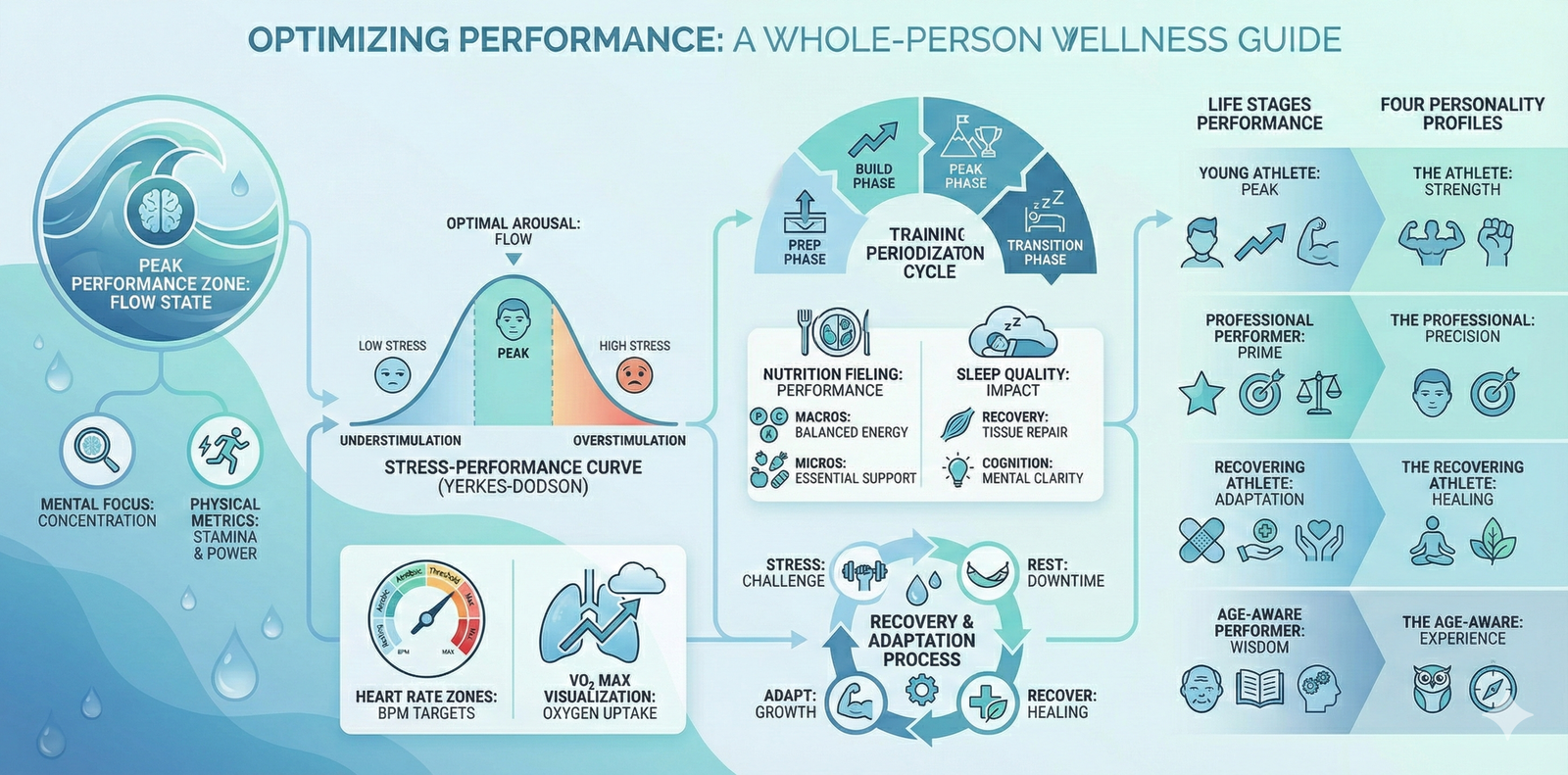
Peak rendimiento isn't a mystical state reserved for the genetically gifted. It's a learnable skill built on proven entrenamiento principles, recuperación science, and psychological techniques.
This guide explores the full science of rendimiento optimization, from muscle adaptación and recuperación protocols to estado de flujo psychology and competition readiness.
What Is Performance?
Performance is the consistent, measurable execution of physical and cognitive abilities at high levels, particularly under challenging conditions like fatigue, time pressure, or high stakes. It encompasses physical capacity (speed, strength, endurance, power), cognitive function (focus, decision-making, problem-solving), and emotional regulation (resilience, confidence, composure). True rendimiento isn't a single explosive moment—it's the ability to deliver repeatedly, sustainably, and under adverse conditions.
No es consejo médico.
Performance science integrates exercise physiology, psicología del deporte, neurobiology, and biomechanics to create systematic approaches to improvement. The field has transformed how elite atletas, military special operations units, executives, and performers achieve results. Research shows that 80-90% of peak rendimiento success comes from mental and psychological factors, not physical talent alone. This means the limiting factor for most people isn't genetics or ability—it's the psychological and strategic systems they've built.
Surprising Insight: Perspectiva Sorprendente: During estado de flujos, parts of the brain actually downregulate—your prefrontal cortex (the critical voice) quiets down while rendimiento-enhancing neurochemicals flood your system. Top executives report being 500% more productive during estado de flujos than normal work.
The Performance Triangle
The three pillars supporting peak performance: physical capacity, mental resilience, and strategic recovery. Each pillar must be developed systematically.
🔍 Click to enlarge
Why Performance Matters in 2026
Competition has never been fiercer. Global connectivity means you're competing against the best talent worldwide—in sports, business, creative fields, and academics. The marginal gains that separate elite performers from good ones are shrinking. This creates urgency: systematic rendimiento optimization is no longer optional for anyone seeking to excel. The atletas breaking world records aren't just more talented; they're using better entrenamiento science, recuperación protocols, and mental techniques.
In the workplace, remote work and burnout are epidemic. Professionals who maintain consistent high rendimiento while protecting their health are becoming rare. Learning to sustain peak output without burning out is a competitive advantage worth significant career returns. Companies now measure employee engagement, productivity, and wellness—and they invest in rendimiento science entrenamiento.
Neuroscience breakthroughs are revealing exactly how to build estado de flujos, manage stress, enhance focus, and accelerate skill development. We now understand the neurochemistry of peak rendimiento, the recuperación signals that trigger adaptación, and the entrenamiento mental protocols that create resilience. This knowledge is no longer locked behind elite coaching fees; it's accessible to anyone willing to apply it.
The Science Behind Performance
Human rendimiento is constrained by multiple biological and psychological systems: the neuromuscular system (which develops through progressive overload), the cardiovascular system (which adapts to entrenamiento stress), the endocrine system (which manages recuperación and adaptación hormones), and the neurological system (which governs focus, decision-making, and emotional control). Understanding these systems reveals why generic entrenamiento fails and why personalized, science-based approaches work.
The adaptación process follows a specific pattern: entrenamiento stress creates micro-damage, recuperación triggers cellular repair and growth, and repeated cycles of stress plus recuperación build capacity. This is called the General Adaptation Syndrome. Most rendimiento plateaus happen not because people train too hard, but because they don't recover hard enough. The body doesn't improve during entrenamiento—it improves during recuperación. Sleep, nutrition, and active recuperación are where rendimiento gains actually happen.
The Training Adaptation Cycle
Performance improves through repeated cycles of stress (training), recovery, and adaptation. Incomplete recovery prevents progress; excessive stress without recovery causes deterioration.
🔍 Click to enlarge
Key Components of Performance
1. Neuromuscular Adaptation & Muscle Memory
When you practice a skill or train a movement pattern, your sistema nervioso encodes the blueprint. Muscle memory isn't actually stored in muscles—it's encoded in neural pathways that connect your brain to your muscles. Recent research from the University of Jyväskylä discovered that muscles also store entrenamiento memory at the protein level, with the trace persisting for months after a entrenamiento block. This explains why returning to entrenamiento after time off happens much faster than initial learning. The neuromuscular system responds to progressive overload: gradually increasing weight, resistance, speed, or complexity. Without progressive overload, adaptación plateaus. The most effective entrenamiento programs systematically increase demands over weeks and months.
2. Flow State & Peak Mental Performance
Flow is a neurological state of complete absorption where self-consciousness vanishes and peak rendimiento emerges effortlessly. During flow, the prefrontal cortex (your inner critic) downregulates, while rendimiento-enhancing neurochemicals flood the system: dopamine (motivation, focus), noradrenaline (alertness), serotonin (mood), endorphins (pain tolerance), and anandamide (bliss). Research by Mihály Csíkszentmihályi, who first systematically studied flow, shows individuals perform 200-500% better in estado de flujos compared to normal functioning. Flow requires a challenge-skill balance: the task must be difficult enough to demand full engagement but within your current capability range. If the challenge exceeds your skill, you feel anxiety. If your skill exceeds the challenge, you feel boredom. The sweet spot is where both are high and matched.
3. Arousal & Stress Management
Arousal is your sistema nervioso's activation level, ranging from sleep to panic. Peak rendimiento doesn't occur at maximum arousal—it occurs at optimal arousal, which differs by task. Routine tasks like running steady-state cardio require lower arousal. Complex, precision tasks like shooting a free throw or performing surgery require moderate arousal. Power-based tasks like sprinting require higher arousal. Most rendimiento breakdowns happen at the arousal extremes: too low (lethargy, lack of focus) or too high (panic, overthinking, loss of fine motor control). Elite performers learn to self-regulate arousal through breathing techniques, self-talk, visualization, and pre-competition routines. The sistema nervioso has two branches: the sympathetic branch (fight-or-flight, increases arousal) and the parasympathetic branch (rest-and-digest, decreases arousal). Training the ability to shift between them is a core skill for consistent rendimiento.
4. Recovery & Adaptation Protocols
Recovery isn't laziness—it's when your body rebuilds stronger. The primary recuperación mechanisms are sleep (where hormonal rebalancing and cellular repair occur), nutrition (which provides raw materials for adaptación and replenishes energy), active recuperación (light movement that promotes blood flow and waste clearance), and strategic rest days (which prevent overentrenamiento syndrome). Sleep is non-negotiable: during deep sleep, growth hormone peaks, glymphatic clearance removes metabolic waste from the brain, and memory consolidation encodes learning. Sleep deprivation impairs decision-making, focus, and immune function while increasing injury risk by 40-60%. Research from the Sports Medicine Review consensus statement shows there's no single recuperación method that works universally—atletas must experiment to find individual protocols. Common effective strategies include cold water immersion for endurance atletas, compression garments for some, and active recuperación for others.
| Component | Development Timeline | Key Stimulus |
|---|---|---|
| Neurological Skill Encoding | Days to Weeks | Consistent, focused practice |
| Muscle Protein Adaptation | Weeks to Months | Progressive resistance entrenamiento |
| Cardiovascular Capacity | 2-6 Weeks | Aerobic and interval entrenamiento |
| Hormonal Adaptation | Weeks to Months | Training stress + recuperación |
| Mental Resilience & Confidence | Weeks to Months | Progressive challenge + success |
| Flow State Accessibility | Weeks to Months | Deliberate practice + skill development |
How to Apply Performance: Step by Step
- Step 1: Establish your baseline: Measure current rendimiento in your domain (time for a mile, reps at max weight, accuracy on a task, reaction time). Quantified baseline enables tracking progress and motivation.
- Step 2: Define progressive overload: Determine what 'slightly harder' looks like for your goal—more weight, more reps, faster pace, longer duration, or increased complexity. Plan 2-4 week cycles where you systematically increase one variable.
- Step 3: Build a sleep protocol: Prioritize 7-9 hours nightly. Go to bed and wake at consistent times (even weekends). Dark, cool room (65-68°F). No screens 30 minutes before bed. Track sleep quality and adjust as needed.
- Step 4: Implement structured recuperación: Include 1-2 complete rest days weekly. Include active recuperación sessions (light yoga, walking, swimming) on entrenamiento days to promote blood flow without creating new fatigue.
- Step 5: Develop pre-rendimiento routines: Create a consistent sequence of physical and mental actions before competition or high-stakes rendimiento. Examples: deep breathing, specific visualizations, power poses, or music. This signals your sistema nervioso to focus.
- Step 6: Practice arousal self-regulation: Learn to shift your sistema nervioso activation through box breathing (4-4-4-4 pattern), positive self-talk, or physical activation (jumping jacks, cold water). Practice in low-stakes situations before high-stakes moments.
- Step 7: Schedule deliberate practice: Enfoqueed, goal-directed practice on specific weak points builds skill fastest. 90-minute practice blocks with breaks perform better than long, unfocused sessions. Video analysis and feedback accelerate learning.
- Step 8: Master foundational nutrition: Eat protein at every meal (0.7-1g per lb bodyweight for atletas), carbs around entrenamiento, and fats throughout the day. Hydrate consistently. Avoid dramatic diet changes during important rendimiento periods.
- Step 9: Develop mental resilience through visualization: Spend 10 minutes daily mentally rehearsing successful rendimiento in detail—what you see, hear, feel, and your emotional state. This activates the same neural pathways as physical practice.
- Step 10: Track metrics and adjust: Weekly review your entrenamiento, sleep, nutrition, and rendimiento metrics. Identify what's working and what isn't. Every 4-8 weeks, assess progress against baseline and adjust your program accordingly.
Performance Across Life Stages
Adultez Joven (18-35)
This is your rendimiento peak window. Physical recuperación is fastest, neural adaptación is most rapid, and you have time for consistent entrenamiento. The focus should be building foundational fitness, movement quality, and mental skills that will pay dividends later. Young adults often make the mistake of prioritizing high volume and intensidad over consistency and technique. The goal is to develop a sustainable entrenamiento system you can maintain for decades. This is the ideal time to establish sleep habits, movement quality, and psychological resilience before life becomes more complex. High-intensidad interval entrenamiento, skill-building sports, and ambitious physical goals work well. Mental entrenamiento—visualization, goal-setting, arousal management—pays enormous dividends in this stage.
Edad Media (35-55)
Recovery becomes slower, hormonal patterns shift, and life complexity increases (career demands, family responsibilities). The focus shifts from maximizing volume to optimizing quality: fewer entrenamiento hours but higher intensidad and specificity, prioritized recuperación (sleep becomes non-negotiable), and sustainable periodization. Many high-performing profesionales in this stage sustain excellent rendimiento through 3-4 quality entrenamiento sessions weekly plus consistent nutrition and 7+ hours sleep. Work-related stress increases recuperación demands. Managing stress through exercise, meditation, or breathing becomes critical. Professional rendimiento peaks in this stage for many domains (leadership, expertise, decision-making). The investment in recuperación protocols (massage, sleep optimization, stress management) becomes worthwhile.
Adultez Tardía (55+)
Physical capacity naturally declines (muscle loss, slower recuperación, reduced neural efficiency), but consistent entrenamiento maintains much more than aging alone. The rendimiento focus shifts to maintaining capacity, preventing injury, and preserving quality of life. Resistance entrenamiento becomes more important (to counter muscle loss), recuperación is even more critical, and movement quality supersedes intensidad. Many older adults maintain excellent physical and professional rendimiento through smart entrenamiento: lower volume, higher recuperación, and excellent nutrition. Mental rendimiento can improve with age (wisdom, pattern recognition, emotional regulation), making this an opportunity for exceptional rendimiento in domains requiring experience and judgment.
Profiles: Your Performance Approach
The Athlete
- Progressive overload matched to sport-specific demands
- Sport-science training programming
- Competition-focused mental skills
Common pitfall: Training hard every session instead of respecting periodization and recovery cycles
Best move: Follow a structured periodization plan: base building (high volume, lower intensity), build (increasing intensity, maintaining volume), peak (maximum intensity, reduced volume), competition, recovery
The Professional Performer
- Stress management and emotional regulation for high-pressure contexts
- Cognitive optimization for decision-making and focus
- Sustainable training that fits demanding schedule
Common pitfall: Sacrificing sleep and recovery for work demands, creating a downward spiral of declining performance
Best move: Treat sleep and recovery as non-negotiable performance inputs, schedule 3-4 quality training sessions, use breathing and visualization for stress management
The Recovering Athlete
- Gradual return-to-performance progressions
- Rebuilding movement quality and confidence
- Mental preparation for return to full competition
Common pitfall: Returning to training too hard, too fast after injury, re-injuring or overtraining
Best move: Follow graduated return-to-sport protocols: movement quality first, then volume, then intensity. Include visualization during physical restrictions. Train movement, not just activity.
The Age-Aware Performer
- Movement quality and injury prevention protocols
- Adequate recovery and adaptation time
- Performance sustainability over intensity maximization
Common pitfall: Trying to train like their younger self, ignoring recovery needs, increasing injury risk
Best move: Shift to strength and movement quality training, prioritize sleep and nutrition, include more recovery work and flexibility. View performance as a marathon, not sprints.
Common Performance Mistakes
The biggest mistake is entrenamiento hard without recovering hard. Performance isn't built in the gym—it's built during sleep, nutrition, and rest days. Training creates the stimulus, but adaptación requires recuperación. Athletes and profesionales who plateau or get injured often have excellent entrenamiento programs but terrible recuperación. The fix is simple: prioritize sleep like your rendimiento depends on it (because it does), eat adequate protein, and include proper rest days.
The second major mistake is neglecting mental skills entrenamiento. Too many people invest years in physical entrenamiento but zero time in visualization, arousal management, focus entrenamiento, or psychological resilience. Mental factors account for 80-90% of peak rendimiento success at elite levels. Spending 10-15 minutes daily on visualization, breathing work, and goal rehearsal produces returns as substantial as months of physical entrenamiento.
The third mistake is insufficient progressive overload or excessive progressive overload. Some people repeat the same workout endlessly, never creating new adaptación stimulus. Others increase volume or intensidad so aggressively they get injured or burned out. The Goldilocks zona is gradual: increase one variable by 5-10% every 1-2 weeks. This challenges your system without shocking it.
The Performance Failure Cycle
How mistakes compound: insufficient recovery leads to fatigue, which impairs training quality and decision-making, which leads to overtraining, injury, and performance collapse.
🔍 Click to enlarge
Ciencia y Estudios
The science of human rendimiento has advanced dramatically in the past decade. Research from major universities and sports science institutes has quantified the mechanisms of adaptación, identified the neurochemistry of peak states, and validated entrenamiento and recuperación protocols. Here's the most important recent evidence:
- Flow State & Neurochemistry (Csíkszentmihályi & Flow Research Collective): Flow states activate specific neurochemical cascades (dopamine, noradrenaline, serotonin, endorphins, anandamide) that enhance rendimiento 200-500%. The research has identified the conditions that reliably trigger flow: challenge-skill balance, clear goals, and immediate feedback.
- Muscle Memory at Protein Level (University of Jyväskylä, 2024): A landmark study demonstrated that muscles store entrenamiento memory in protein structures, with the memory trace persisting for 8+ weeks after entrenamiento. This explains rapid return-to-rendimiento and validates the importance of consistency.
- Sleep & Recovery (Springer Nature & NIH): Sleep deprivation impairs decision-making, reaction time, and accuracy while increasing injury risk by 40-60%. Deep sleep triggers growth hormone release and glymphatic clearance (brain waste removal). 7-9 hours nightly is essential for adaptación and rendimiento.
- Training Stress & Adaptation (PMC/NIH): The General Adaptation Syndrome shows that rendimiento improves through repeated cycles of stress plus adequate recuperación. Training without recuperación doesn't improve rendimiento—it causes deterioration and overentrenamiento syndrome.
- Mental Skills Training (American Psychological Association): Psychological skills entrenamiento (visualization, self-talk, goal-setting, arousal management) produces rendimiento gains equivalent to months of physical entrenamiento. Mental factors account for 80-90% of elite rendimiento success.
Tu Primer Micro Hábito
Comienza pequeño hoy
Today's action: Tonight: Commit to one night of 8-hour sleep in a dark, cool (65-68°F) room. No screens 30 minutes before bed. This single night begins rewiring your recuperación system and signals your body that rendimiento is the priority. Repeat this tonight and tomorrow night. Track sleep quality for one week.
Sleep is where adaptation happens. Better sleep improves decision-making, focus, and physical recovery within 24-48 hours. This micro habit is immediately observable and creates momentum for other changes. Most people don't fully sleep, which bottlenecks all other performance work. Fixing sleep first creates a cascading improvement in everything else.
Track your sleep and rendimiento metrics with our app to see how sleep quality correlates with your daily rendimiento. Get personalized insights on what's working.
Evaluación Rápida
When I think about my current performance (in my sport, profession, or domain), how would I honestly rate my consistency?
Inconsistency usually signals poor recuperación, stress management, or pacing. Consistency is built through systems (sleep, nutrition, recuperación) not willpower.
How much intentional time do I spend on mental skills (visualization, arousal management, focus training) versus physical training?
The 80-90% rule: mental factors dominate elite rendimiento. If you're spending less than 30% of entrenamiento time on mental skills, this is your biggest rendimiento lever.
What's my typical sleep duration and quality on school/work nights?
Sleep is the foundation. Poor sleep cascades into every rendimiento domain. If sleep isn't excellent, optimize this first before adding anything else.
Take our full assessment to get personalized recommendations.
Descubre Tu Estilo →Preguntas Frecuentes
Próximos Pasos
Start with sleep. If you're not getting 7-9 hours of quality sleep nightly, nothing else matters. Sleep is the foundation that amplifies everything else. Commit to one week of excellent sleep: dark room, cool temperature (65-68°F), consistent bedtime, no screens 30 minutes before bed. Track how this single change affects your daytime rendimiento, focus, and mood. Then, add one rendimiento element: either progressive overload to your entrenamiento, a mental skills practice (visualization or breathing), or a recuperación protocol.
Measure something. Whatever you can't measure, you can't improve. Pick one metric in your domain: running time, maximum strength, accuracy, focus, mood, or energy. Establish your baseline this week. Then, implement one systematic change and measure the effect. You'll see progress within 2-4 weeks, which builds momentum for larger changes.
Get personalized guidance with AI coaching.
Comienza Tu Viaje →Research Sources
This article is based on peer-reviewed research and authoritative sources. Below are the key references we consulted:
Related Glossary Articles
Frequently Asked Questions
How quickly can I see rendimiento improvements?
Neural adaptacións (skill learning) appear within 1-2 weeks of consistent practice. Physical adaptacións (strength, endurance) typically require 3-4 weeks of consistent entrenamiento. Mental resilience and estado de flujo accessibility develop over 4-8 weeks. Psychological factors (confidence, focus) can shift within days if you apply the right techniques.
Is rendimiento optimization only for elite atletas?
No. Performance principles apply to any domain requiring consistent output: sports, music, academics, professional work, creative fields. Whether you're a student, business professional, artist, or weekend athlete, the principles of entrenamiento stimulus, recuperación, mental skills, and progressive overload apply equally.
Can I optimize rendimiento without expensive coaching?
Absolutely. The fundamentals—progressive entrenamiento, excellent sleep, adequate nutrition, mental skills practice, and recuperación protocols—are free or low-cost. Access to scientific information is easier than ever. Coaching becomes valuable for personalization and accountability, but the foundation is mastering the basics yourself.
¿Cómo sé si estoy entrenando en exceso?
Overentrenamiento signs include: persistent fatigue despite rest, declining rendimiento despite entrenamiento, elevated resting heart rate, mood disturbances, difficulty concentrating, frequent illness, and loss of motivation. If these appear, reduce entrenamiento volume by 30-50% and prioritize sleep and nutrition for 1-2 weeks.
What's the best time of day to train for peak rendimiento?
Most people perform best when body temperature is highest (late afternoon/early evening, 4-6 PM). However, the best time is when you can train consistently. A consistent morning routine beats an inconsistent afternoon one. Perform important rendimientos (competitions) at the time of day you've trained.
Take the Next Step
Ready to improve your wellbeing? Take our free assessment to get personalized recommendations based on your unique situation.
- Discover your strengths and gaps
- Get personalized quick wins
- Track your progress over time
- Evidence-based strategies