VO2 Max Training
Imagine discovering a single measure that could predict your health, longevity, and athletic performance with remarkable accuracy. That measure exists—it's your VO2 max. This number represents the maximum amount of oxygen your body can utilize during intense exercise, measured in milliliters of oxygen per kilogram of body weight per minute (ml/kg/min). Recent research shows that individuals with higher VO2 max values have significantly lower risk of mortality from all causes, living on average 5-15 years longer than those with low aerobic capacity. The best part? VO2 max isn't fixed—it's trainable, improvable, and within reach for anyone willing to challenge their cardiovascular system strategically.
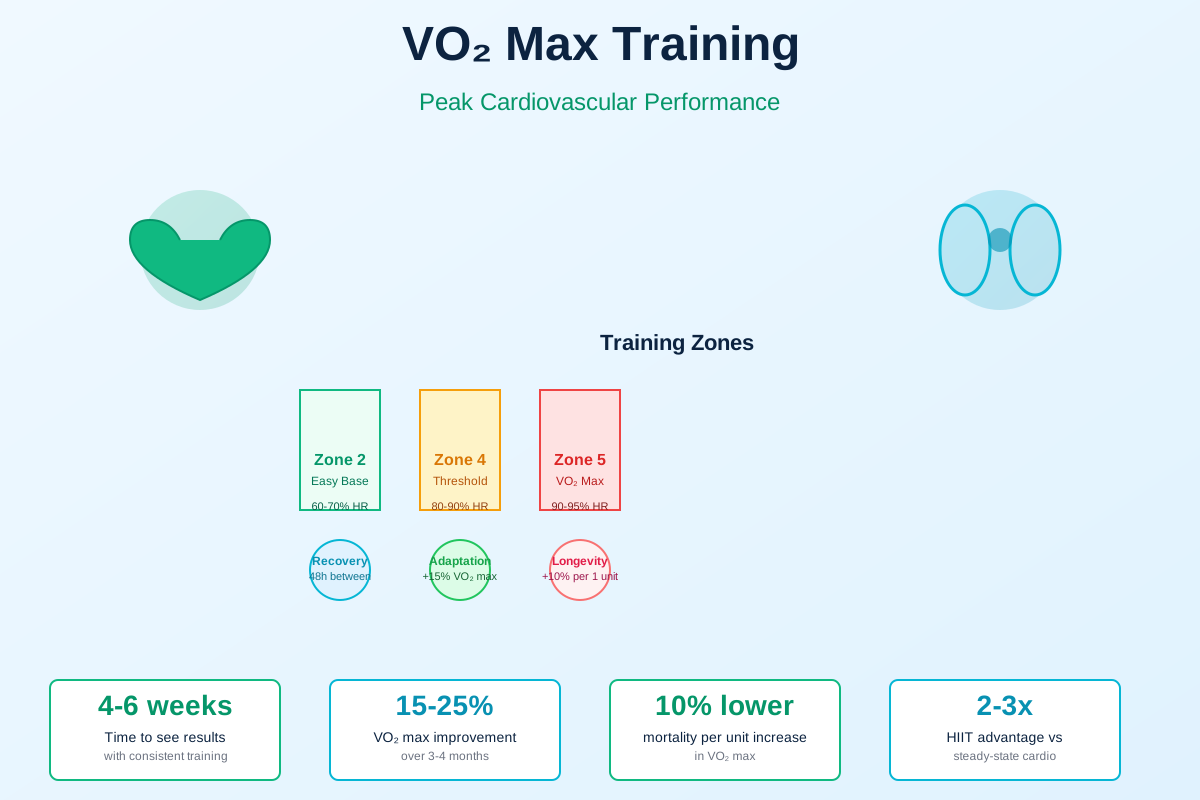
Here's what most people don't know: You can improve your VO2 max by 15-25% through consistent training, regardless of your current fitness level or age. This isn't about becoming an elite athlete—it's about unlocking better energy, resilience, and years of healthy life.
In this guide, you'll discover exactly how to build your aerobic capacity through science-backed protocols, understand why VO2 max matters more than you think, and implement a training plan that fits your life right now.
What Is VO2 Max Training?
VO2 max training is a strategic approach to cardiovascular exercise designed to increase your body's maximum oxygen uptake. The term 'VO2 max' refers to the maximum volume of oxygen your muscles can extract and utilize during intense aerobic activity. Training to improve this metric involves structured workouts that push your cardiovascular system to work at or near maximal capacity, triggering physiological adaptations that increase oxygen delivery to muscles and enhance mitochondrial function.
Not medical advice.
Unlike general cardio exercise, VO2 max training is specifically designed to improve aerobic capacity rather than simply burning calories or improving endurance. It combines high-intensity intervals with recovery periods, forcing your heart, lungs, and muscles to adapt by becoming more efficient at oxygen processing. When you engage in VO2 max training, your body responds by increasing stroke volume (the amount of blood your heart pumps per beat), boosting hemoglobin levels, and expanding the capillary network that delivers oxygen to muscle cells.
Surprising Insight: Surprising Insight: A single 1 ml/kg/min increase in VO2 max is associated with a 10% reduction in all-cause mortality risk. This means improving your aerobic capacity is one of the most powerful longevity interventions available.
How VO2 Max Training Improves Cardiorespiratory Fitness
A flowchart showing the cascade of physiological adaptations that occur during VO2 max training, from high-intensity exercise stimulus through oxygen utilization improvements
🔍 Click to enlarge
Why VO2 Max Training Matters in 2026
In an era where sedentary lifestyles and metabolic disease are epidemic, VO2 max training has emerged as one of the most researched and validated interventions for disease prevention and longevity. Studies from 2024-2025 demonstrate that aerobic capacity is a stronger predictor of future health outcomes than traditional markers like cholesterol or blood pressure. A landmark 2018 study published in JACC found that individuals with the lowest VO2 max values had a fourfold increased risk of mortality compared to those with the highest values, making aerobic capacity a critical health metric alongside blood sugar and blood pressure.
Beyond longevity, VO2 max training addresses modern health challenges including obesity, type 2 diabetes, cardiovascular disease, cognitive decline, and even depression. Research from NIH demonstrates that regular aerobic exercise can reduce coronary artery disease risk by 30-40%, diabetes risk by 50%, and cancer risk by 20-30%. The mechanism is clear: improved aerobic capacity means better blood sugar regulation, reduced inflammation, improved vascular function, and enhanced oxygen delivery to the brain.
For busy professionals and aging adults, VO2 max training offers exceptional time efficiency. High-intensity interval training (HIIT) can deliver the same aerobic benefits in 30 minutes per week that traditional steady-state cardio requires in 150 minutes. This makes cardiovascular fitness achievable regardless of schedule constraints, removing one of the most common barriers to health improvement.
The Science Behind VO2 Max Training
Your VO2 max is determined by three interconnected physiological systems: (1) the oxygen delivery system (heart, blood vessels, and hemoglobin), (2) the utilization system (muscle mitochondria and enzyme activity), and (3) the extraction capacity (capillary density and oxygen diffusion). VO2 max training triggers adaptations across all three systems simultaneously. When you exercise at 80-95% of your maximum heart rate, your body faces an oxygen deficit—muscles demand more oxygen than the current system can deliver. This stress triggers a cascade of adaptations: your heart becomes stronger and pumps more blood per beat, your arteries expand and develop new branches (angiogenesis), your muscles develop more mitochondria (the powerhouses of cells), and capillary density increases to facilitate oxygen exchange.
The training effect is dose-dependent: the intensity matters more than duration. Research shows that just 15-30 minutes of high-intensity interval training twice per week can produce significant VO2 max improvements within 4-6 weeks. The mechanism involves repeated bouts of intense effort (typically 2-4 minutes at 85-95% max heart rate) followed by shorter recovery periods (1-2 minutes at 50-70% max heart rate). Each interval pushes your aerobic system to its limit, forcing adaptations. Recovery intervals are crucial because they allow your heart rate to drop partially but remain elevated—this teaches your cardiovascular system to recover quickly, improving what's called your 'heart rate recovery' (a strong predictor of longevity).
VO2 Max Training Protocols: Comparing Effectiveness
A comparison table showing different VO2 max training methods, their effectiveness for aerobic improvement, time requirements, and sustainability for average adults
🔍 Click to enlarge
Key Components of VO2 Max Training
1. High-Intensity Interval Training (HIIT)
HIIT is the most efficient method for improving VO2 max. The protocol involves alternating between periods of intense effort (typically 2-4 minutes at 85-95% of maximum heart rate) and recovery periods (1-2 minutes at 50-70% max HR). Research shows that just 3-4 HIIT sessions per week can improve VO2 max by 15-20% within 4-8 weeks. HIIT works because it maximally stimulates the central and peripheral adaptations needed for aerobic improvement while requiring minimal time investment. The intense intervals force your heart to pump harder, your lungs to work maximally, and your muscles to extract oxygen more efficiently.
2. Aerobic Threshold Training
Also called 'tempo training' or 'lactate threshold training,' this involves sustained effort at 75-85% of maximum heart rate for 20-40 minutes. This intensity sits right at your aerobic threshold—the point where lactate begins accumulating in your bloodstream. Training at this intensity teaches your body to buffer lactate more efficiently, allowing you to maintain higher efforts for longer periods. While not as intense as HIIT, threshold training builds aerobic capacity and improves metabolic efficiency. Most athletes benefit from one threshold session per week combined with HIIT and easier recovery workouts.
3. Zone 2 Aerobic Base Building
Often overlooked, Zone 2 training (60-70% max HR) forms the foundation for higher-intensity work. These longer, easier sessions (90 minutes to 3+ hours) develop aerobic base, increase mitochondrial density, and improve fat oxidation. Zone 2 training is sustainable for most people and can be done daily. While it doesn't directly push VO2 max to new heights, it builds the foundational aerobic capacity necessary for tolerating high-intensity work without injury. Elite athletes typically build training pyramids with 80% of work at Zone 2 intensity and 20% at higher intensities.
4. Recovery and Adaptation
VO2 max training stimulus comes from hard workouts, but adaptations happen during recovery. Your body responds to training stress by rebuilding stronger—but only if given adequate rest, sleep, and nutrition. Research shows that most adaptation occurs within 48-72 hours after high-intensity work. This means you should never do hard VO2 max workouts on consecutive days. Instead, follow the pattern: hard workout → easy recovery days → hard workout. Sleep is critical because growth hormone (which drives adaptation) is released primarily during deep sleep. Most VO2 max gains require 7-9 hours nightly.
| Training Method | Intensity Level | Duration | Frequency/Week |
|---|---|---|---|
| Zone 2 (Easy Aerobic) | 60-70% max HR | 90+ minutes | 1-3 times |
| Tempo/Threshold | 75-85% max HR | 20-40 minutes | 1-2 times |
| VO2 Max Intervals | 85-95% max HR | 4-6 min efforts | 2-3 times |
| HIIT Sprints | 95%+ max HR | 30-60 sec efforts | 1-2 times |
How to Apply VO2 Max Training: Step by Step
- Step 1: Establish your baseline: Determine your current fitness level and maximum heart rate. Maximum heart rate = 220 - your age (approximate). For more accuracy, perform a graded exercise test or use a sports watch with built-in VO2 max estimation.
- Step 2: Calculate your training zones: Zone 2 (60-70% max HR) for easy aerobic work, Zone 3 (70-80%), Zone 4 (80-90% max HR), and Zone 5 (90-95%+ max HR) for high-intensity work. Use a heart rate monitor or sports watch to track zones accurately during training.
- Step 3: Choose your primary training method: Start with HIIT (most efficient) or steady-state Zone 2 (most sustainable). Beginners should start with Zone 2 base building for 2-4 weeks before introducing high-intensity work.
- Step 4: Perform baseline testing: Do a simple 12-minute run test—cover as much distance as possible at conversational pace. This establishes your starting point for measuring progress over 4-6 weeks.
- Step 5: Build your weekly structure: Create a training week pattern: one high-intensity session (HIIT or threshold), one moderate-intensity session (threshold or long Zone 2), and 2-3 easy recovery sessions. This distributes work and maximizes adaptation.
- Step 6: Start with HIIT: Complete one session per week of 4x4 minute intervals (4 minutes at 85-90% max HR, 3 minutes recovery at 50-60% max HR). Do this on a treadmill, stationary bike, rowing machine, or running route.
- Step 7: Progress gradually: Week 1-2: 4x4 minute intervals. Week 3-4: 5x4 minute intervals. Week 5-6: 4-6x3 minute intervals at 90-95% max HR. Never add more than one interval per week.
- Step 8: Add threshold training: Once comfortable with HIIT, add one 20-30 minute threshold session per week at 80-85% max HR. This teaches your aerobic system to sustain higher efforts.
- Step 9: Include Zone 2 base: Perform 1-2 long, easy sessions weekly (60-120 minutes) at 60-70% max HR. These sessions feel sustainable—you could hold a conversation throughout.
- Step 10: Test and adapt every 4-6 weeks: Repeat your baseline test and measure improvements. Most people see 5-10% VO2 max improvement in 4-6 weeks, with continued gains up to 15-25% over 3-4 months.
VO2 Max Training Across Life Stages
Young Adulthood (18-35)
Young adults have significant advantages: high baseline aerobic capacity, fast recovery, and neurological plasticity. This is the ideal time to establish VO2 max baseline and build training habits. Young adults can tolerate 3-4 hard workouts per week if nutrition and sleep are adequate. Focus on building both high-intensity performance capacity and aerobic base. Young adults engaging in regular VO2 max training can achieve VO2 max values of 45-60 ml/kg/min (excellent fitness). The aerobic foundation built during this decade influences health outcomes for decades. Young adults should prioritize consistency over intensity—even moderate training efforts accumulated over years produce substantial longevity benefits.
Middle Adulthood (35-55)
This is when VO2 max typically begins declining (about 10% per decade without intervention) due to natural aging and reduced training volume. However, middle-aged adults who engage in regular VO2 max training can maintain or even improve aerobic capacity. The training approach shifts toward quality over quantity: 2-3 high-intensity sessions per week (rather than daily training) with sufficient recovery. Middle-aged adults benefit from combining HIIT (once weekly), threshold training (once weekly), and 1-2 Zone 2 sessions for base maintenance. Many middle-aged people discover unexpected fitness improvements when they commit to structured training, often achieving VO2 max levels equivalent to much younger sedentary individuals. This decade is critical for intervention—choices made now determine whether aging includes vitality or decline.
Later Adulthood (55+)
Older adults often assume aerobic capacity is lost forever. This is false. Research demonstrates that even 70+ year-olds can improve VO2 max significantly through consistent training. The approach becomes more conservative: prioritize one high-intensity session weekly plus 2-3 moderate-intensity or Zone 2 sessions. Recovery extends to 72-96 hours between hard efforts. Older adults benefit from varying training methods—mixing running, cycling, rowing, and swimming to reduce injury risk from repetitive stress. Falls, injury recovery, and joint health become considerations. However, many older adults discover that maintaining VO2 max through training helps them maintain independence, cognitive function, and quality of life. Research shows that a VO2 max of 25+ ml/kg/min in adults 60+ is associated with dramatically reduced mortality risk and retention of functional capacity.
Profiles: Your VO2 Max Training Approach
The Time-Crunched Professional
- Efficient workouts (30-45 minutes maximum)
- Flexible scheduling (workouts can shift based on commitments)
- Measurable results (clear progress tracking to justify time investment)
Common pitfall: Treating high-intensity training as optional or trying to maintain fitness through daily walks—which doesn't improve VO2 max significantly.
Best move: Commit to 2-3 HIIT sessions per week (30-35 minutes each) rather than daily moderate activity. This requires far less total time while producing superior results. One 30-minute HIIT session produces equivalent aerobic adaptation as one hour of Zone 2 training.
The Injury-Conscious Athlete
- Low-impact training modalities (cycling, rowing, swimming, elliptical)
- Gradual progression (avoiding sudden volume or intensity spikes)
- Complementary strength training (joint stability and muscular balance)
Common pitfall: Avoiding high-intensity work entirely due to injury history, settling for low-intensity exercise that doesn't adequately challenge the aerobic system.
Best move: Use stationary cycling or swimming for high-intensity work (both allow easier intensity modulation and reduce impact). Combine with 1-2 strength sessions weekly targeting lower body and core. Progress carefully: add one interval or 2-3 minutes duration per week rather than jumping volume.
The Age-Seeking Longevity Optimizer
- Evidence-based approach (training methods shown to extend healthspan/lifespan)
- Sustainability (programs that can continue for decades)
- Integration with other longevity practices (sleep, nutrition, strength training)
Common pitfall: Overtraining—pushing too hard too frequently in attempt to maximize adaptations, which increases injury risk and actually slows progress.
Best move: Adopt the 80/20 rule: 80% of training at Zone 2 (sustainable, builds foundation) and 20% at high intensity (drives VO2 max improvement). This produces steady, sustainable progress that can continue for decades. Add 1-2 strength sessions weekly and prioritize 7-9 hours nightly sleep.
The Complete Fitness Novice
- Education on how to monitor intensity (heart rate zones, perceived exertion)
- Gradual progression (avoiding overtraining and injury in first weeks)
- Motivation and encouragement (establishing the habit before seeing major results)
Common pitfall: Starting with high-intensity work immediately, burning out within weeks, or injuring themselves through rapid progression.
Best move: Spend weeks 1-4 building aerobic base at Zone 2 (easy effort where you can talk). Master heart rate monitoring. Starting week 5, introduce one 20-minute threshold session weekly. Add HIIT only after 6-8 weeks of base training. This approach produces steady progress and builds sustainable exercise habits.
Common VO2 Max Training Mistakes
The most common mistake is training at wrong intensities. Many people do everything at moderate intensity (Zone 3-4)—too hard to recover from quickly, too easy to maximally stimulate adaptation. This 'gray zone' training produces minimal results. Instead, follow the principle: either easy enough to recover within 24 hours (Zones 1-2) or hard enough to stimulate maximal adaptation (Zones 4-5). Most training volume should be easy; intensity comes from brief hard efforts. Research shows that 80% easy/20% hard produces better results than 50% easy/50% hard.
The second major mistake is insufficient recovery between hard efforts. Your body doesn't get stronger during workouts—it gets stronger during recovery. If you perform high-intensity VO2 max workouts on consecutive days, you accumulate fatigue faster than you can adapt, leading to plateau or regression. Recovery means not just days off, but also sleep quality. Growth hormone release (which drives aerobic adaptation) happens during deep sleep. Most people training hard need 8-9 hours nightly to adapt optimally. Cutting sleep to 6-7 hours cuts adaptation roughly in half.
The third mistake is ignoring individual variation. VO2 max trainability varies based on genetics, age, baseline fitness, and training history. Some people see 5% improvement in 6 weeks; others see 15%. Rather than comparing yourself to others, track your own progress using repeated testing. Do a 12-minute run test, a time trial at fixed intensity, or use a sports watch's VO2 max estimate monthly. Progress might be slower than expected initially, but consistency typically produces results within 4-12 weeks.
Training Mistakes That Block VO2 Max Improvement
A visualization showing common errors in VO2 max training and their consequences, helping readers identify and correct mistakes in their own programs
🔍 Click to enlarge
Science and Studies
The evidence for VO2 max training's effectiveness and importance comes from decades of rigorous research across thousands of participants. Recent studies confirm that improvements in aerobic capacity translate directly to longevity and disease prevention benefits. The strongest evidence shows that each 1 ml/kg/min increase in VO2 max reduces all-cause mortality by approximately 10%. This makes VO2 max improvements one of the highest-impact health interventions available.
- Peixoto et al. (2024, PMC11250687): Greater VO2 max in older adults is associated with increased integrity of brain regions critical for attention and cognitive function—suggesting aerobic fitness preserves cognitive health.
- Effectiveness of High-Intensity Interval Training (2024, PMC12044783): Meta-analysis of university students showed HIIT produces superior VO2 max gains (12-15% improvement) compared to moderate continuous training (6-8% improvement) in equivalent time.
- Effects of High-Intensity vs. Moderate-Intensity Training (2018, PMC7357372): Randomized controlled trial found that HIIT significantly improves both VO2 max and blood pressure reduction in healthy men within 8 weeks.
- Assessment of VO2 Max in Athletes and Non-athletes (2024, PMC11197041): Direct testing confirms that VO2 max ranges from 25-35 ml/kg/min in sedentary adults to 45-65+ ml/kg/min in endurance-trained individuals, with training capacity demonstrated across all fitness levels.
- Historical Landmark Study - Midlife Cardiorespiratory Fitness & Mortality (JACC 2018): 46-year follow-up of 4,678 participants found that individuals with the lowest VO2 max quartile had 4x higher mortality than highest quartile—establishing VO2 max as major health marker.
Your First Micro Habit
Start Small Today
Today's action: Do a 10-minute Zone 2 walk or easy jog at a pace where you could comfortably hold a conversation. Track your resting heart rate the next morning (it often drops 1-2 bpm within weeks of consistent training).
This establishes the exercise habit and teaches you what Zone 2 feels like physiologically. Consistency matters more than intensity initially. Daily 10-minute Zone 2 sessions build aerobic base and require minimal willpower. Within 2 weeks, you'll notice improved energy. This creates momentum for adding structured VO2 max workouts.
Keep quitting habit apps after a missed day? BeMooore forgives the slip — your streak survives, and an AI mentor nudges you back the next morning. Free on iOS.
Quick Assessment
How would you describe your current cardiovascular fitness level?
Your baseline fitness determines your starting point. Sedentary individuals should begin with Zone 2 base building (4 weeks) before adding intensity. Moderately fit people can introduce one HIIT session per week immediately. Very fit individuals can sustain 2-3 high-intensity sessions weekly.
What is your primary goal for VO2 max training?
Longevity-focused training emphasizes consistency and sustainability—80% Zone 2 base with weekly high-intensity work. Performance training requires aggressive progression and periodization. General fitness needs balance across all intensities. Health recovery requires medical guidance and conservative progression.
How many minutes per week can you realistically commit to VO2 max training?
Time-crunched people should use HIIT (30-minute sessions, twice weekly = 60 min for optimal results). Moderate availability suits 2-3 sessions mixing intensities. Higher availability allows adding base building and variety. More volume allows comprehensive programming combining all training types.
Take our full assessment to get personalized recommendations.
Discover Your Style →Next Steps
Your first action is establishing your baseline. Perform a simple 12-minute run test this week: warm up for 3 minutes, then run (or jog) for 12 minutes at a pace you could sustain. Measure the distance covered. Record this baseline—you'll retest in 4 weeks to measure improvement. Simultaneously, start tracking your resting heart rate each morning by taking your pulse for 15 seconds after waking (before getting out of bed) and multiplying by 4. Resting heart rate typically drops 1-2 bpm per week during early training as your heart becomes more efficient.
Next, schedule your first structured VO2 max training week: one high-intensity session (HIIT or threshold training), one moderate session, and 2-3 easy Zone 2 sessions. Don't overthink it—start with one 20-minute HIIT session this week (4x4 minute intervals with 3-minute recovery). The session should feel hard but manageable. You should be breathing heavily during intervals, recovering during breaks. This single session begins triggering aerobic adaptations that cascade into improved fitness, energy, and longevity.
Get personalized guidance with AI coaching.
Start Your Journey →Research Sources
This article is based on peer-reviewed research and authoritative sources. Below are the key references we consulted:
Related Glossary Articles
Frequently Asked Questions
How quickly can I improve my VO2 max?
Beginners typically see 5-10% improvement within 4-6 weeks of consistent training, with continued gains to 15-25% improvement over 3-4 months. Elite athletes approaching genetic ceiling may improve 2-3% annually. Progress rate depends on baseline fitness, training consistency, recovery quality, and individual genetics. Most people see measurable improvement within 3-4 weeks if training frequency and intensity are adequate.
Do I need special equipment or a gym to train VO2 max?
No. VO2 max training works with any sustained aerobic activity: running, cycling, rowing, swimming, elliptical machines, jumping rope, or stair climbing. Outdoors or indoors, expensive equipment or budget options—the stimulus is high-intensity effort, not the equipment. A basic heart rate monitor (watch or chest strap) helps track intensity zones, but perceived exertion (breathing heavily, difficulty speaking) works as backup.
Is VO2 max training safe for older adults or those with health conditions?
VO2 max training is safe for most healthy adults over 65, but medical clearance is essential for anyone with cardiovascular disease, recent cardiac events, uncontrolled high blood pressure, or other serious conditions. Start conservatively with Zone 2 base building. Progress slowly. Many cardiologists now prescribe high-intensity training as part of cardiac rehabilitation. Always consult your healthcare provider before starting high-intensity training.
Can I improve VO2 max without high-intensity training?
Partially. Zone 2 training alone produces 5-8% VO2 max improvement over months. However, high-intensity training produces 2-3x greater improvement in equal time. Maximum results require both: Zone 2 base building (foundation) plus periodic high-intensity work (stimulus). Think of it as climbing stairs—Zone 2 is climbing steadily; HIIT is taking larger steps, covering more ground faster.
How do I know if I'm training at the right intensity?
Use a heart rate monitor to verify zones, but also learn perceived exertion. Zone 2 (60-70% max HR) feels easy—you could hold full conversations. Zone 4 (80-90% max HR) feels hard—you can speak only short phrases. Zone 5 (90-95%+ max HR) feels very hard—speaking is difficult. Most people benefit from heart rate monitoring initially to calibrate perceived exertion; experienced athletes can rely on feel.
Take the Next Step
Ready to improve your wellbeing? Take our free assessment to get personalized recommendations based on your unique situation.
- Discover your strengths and gaps
- Get personalized quick wins
- Track your progress over time
- Evidence-based strategies