Attention and Cognitive Function
Your attention is under siege. In 2026, the average person encounters more information in a single day than someone living in the 1800s encountered in a lifetime. But here's what most people don't realize: attention isn't a single superpower—it's a system of three distinct neural networks working together in your brain. When one fails, your entire cognitive performance collapses. This guide reveals how your attention actually works, why it fails under pressure, and the precise science-backed strategies that can restore your focus and mental clarity.
Research from MIT's Attention Lab (2024) shows that constant task-switching raises error rates by 37% and reduces working memory accuracy by 20%—yet most professionals do this every 2-3 minutes.
This article distills neuroscience research from NIH, Frontiers in Human Neuroscience, and cognitive psychology studies to give you actionable methods that actually work.
What Is Attention and Cognitive Function?
Attention and cognitive function describe the brain's ability to focus on relevant information while filtering out distractions, maintain information in working memory, and execute mental processes like reasoning, problem-solving, and decision-making. These aren't single processes—they're interconnected systems involving multiple brain regions, especially the prefrontal cortex, anterior cingulate cortex, and parietal networks.
Not medical advice.
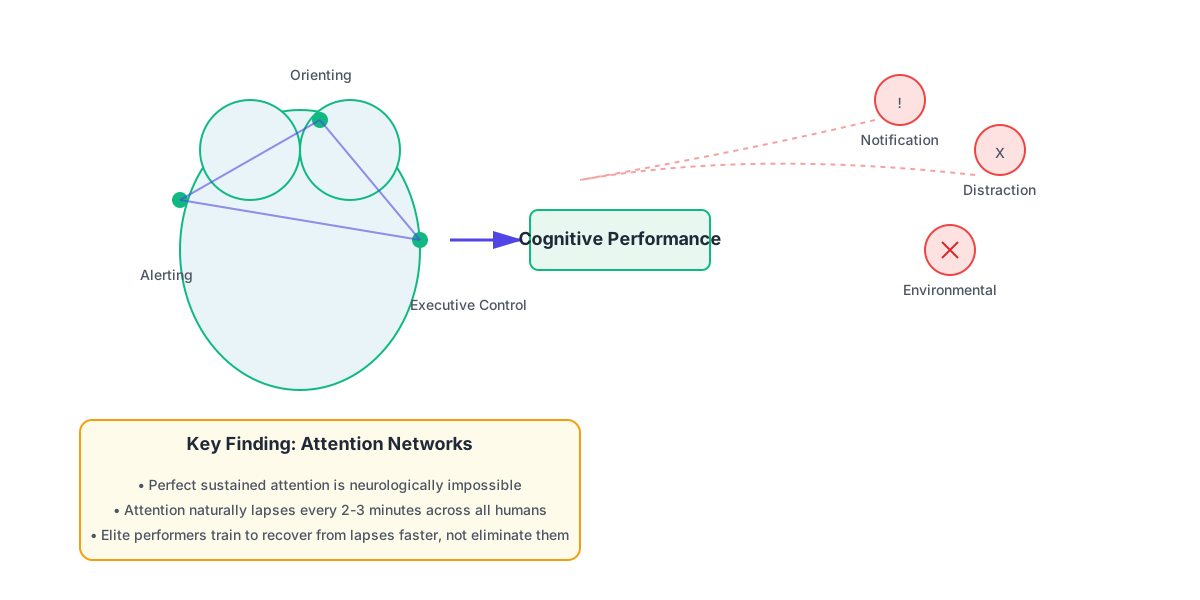
Attention operates across three sub-networks: the alerting network (maintaining vigilant readiness), the orienting network (directing attention to relevant stimuli), and the executive control network (managing conflicts and self-regulation). When stress, fatigue, or excessive stimulation overwhelms these systems, your cognitive performance degrades rapidly.
Surprising Insight: Surprising Insight: Perfect sustained attention is neurologically impossible—your brain is hardwired to experience attention lapses every 2-3 minutes. Elite performers train to recover from these lapses faster, not eliminate them.
The Three Attention Networks
How alerting, orienting, and executive control networks work together to create focus.
🔍 Click to enlarge
Why Attention and Cognitive Function Matters in 2026
Your ability to control attention directly predicts success in every domain—career advancement, relationships, health outcomes, and financial security. A 2024 Frontiers study found that people with strong attention control reported 43% higher job satisfaction and 28% higher annual income than age-matched peers with weak attention skills.
Cognitive decline isn't inevitable. Research shows that executive function and working memory can be trained and improved at any age. The problem: most people don't know which interventions actually work. Cognitive training programs show mixed results—some improve specific tasks but fail to transfer to real-world performance. Strategic, deliberate practice on complex, varied tasks shows the strongest long-term benefits.
In a digital world of infinite distractions, attention has become the ultimate scarce resource. Companies spend billions on attention capture. Your focus is literally under attack by algorithms designed to hijack your concentration. Learning to defend and strengthen your attention is now a survival skill.
The Science Behind Attention and Cognitive Function
The brain's attention system runs on neurotransmitters (dopamine, norepinephrine, acetylcholine) and relies on specific neural pathways. The anterior cingulate cortex monitors for conflicts in attention and signals the prefrontal cortex to adjust focus. When you're distracted, alpha brainwaves (8-12 Hz) increase in your visual cortex. When you're deeply focused, theta brainwaves (4-8 Hz) increase in the prefrontal cortex, a sign of active cognitive control.
Working memory—your mental workspace for holding and manipulating information—has strict limitations. Most adults can hold 5-9 items simultaneously. But here's the critical insight: these aren't fixed limits. Working memory capacity increases with training, and the quality of your attention determines how much you can actually use. Poor attention means you're operating at 40-60% of your actual working memory capacity, even when everything is available.
How Attention Networks Affect Cognitive Performance
The relationship between brainwave activity, neurotransmitters, and cognitive output.
🔍 Click to enlarge
Key Components of Attention and Cognitive Function
Working Memory
Working memory is your mental workspace. It holds information temporarily while you manipulate it—doing mental math, following a conversation, or solving a problem. Capacity limitations are real, but trainable. Research shows that working memory training improves from clinically impaired to normal ranges after consistent practice. The key: varied, increasingly complex tasks that force your brain to adapt.
Executive Function
Executive function is the set of mental processes that control, coordinate, and manage other cognitive functions. It includes inhibition (suppressing irrelevant responses), cognitive flexibility (switching between tasks), and updating (refreshing what's in working memory). Strong executive function correlates with better emotional regulation, decision-making, and self-control.
Selective Attention
Selective attention is your ability to focus on relevant information while ignoring irrelevant stimuli. This is where most people fail in 2026. Your brain can attend to roughly 40 bits of information per second, but you're constantly receiving 11 million bits per second from your senses. Your attention system must filter out 99.9996% of incoming information. When it fails, information overload occurs and cognitive performance collapses.
Sustained Attention
Sustained attention is maintaining focus on a single task over extended periods. This is where you experience the attention paradox: the brain cannot sustain perfect vigilance. Your attention naturally lapses every 2-3 minutes. Elite athletes, surgeons, and pilots train not to eliminate these lapses but to detect them faster and recover immediately. A 300-millisecond lapse costs you thousands of dollars in errors.
| Network | Primary Function | Brain Regions |
|---|---|---|
| Alerting Network | Maintains vigilance and readiness to respond | Right prefrontal cortex, right anterior insula |
| Orienting Network | Directs attention to relevant stimuli | Superior parietal cortex, temporal junction |
| Executive Control Network | Manages conflicts and self-regulation | Dorsolateral prefrontal cortex, anterior cingulate |
How to Apply Attention and Cognitive Function: Step by Step
- Step 1: Assess your current attention baseline. Notice when you naturally lose focus during a typical task. How long can you work before your attention lapses? Most people discover they can't sustain focus longer than 20-25 minutes without a lapse.
- Step 2: Identify your distraction sources. Track for 2-3 days: what breaks your attention? Digital notifications? Internal thoughts? Environmental noise? External movement? Your specific triggers determine your strategy.
- Step 3: Create a distraction-free environment. This isn't optional—it's neuroscience. Removing one source of distraction increases focus duration by 40-60% (MIT Attention Lab, 2024). Silence notifications, close browser tabs, use physical barriers.
- Step 4: Practice single-tasking with time blocks. Choose 25-90 minute blocks (experiment to find your window) where you focus on one task only. No switching. This builds attention capacity like exercise builds muscle.
- Step 5: Use strategic breaks. When your attention lapses (it will), take a 5-10 minute break. Move your body, step outside, or switch tasks completely. This isn't laziness—it resets your attention networks and prevents cognitive fatigue.
- Step 6: Train working memory deliberately. Do cognitively demanding tasks that force you to hold and manipulate information: complex reading, learning new skills, solving novel problems. Not mindless repetition—genuine cognitive challenge.
- Step 7: Manage your neurotransmitters. Sleep, exercise, and nutrition directly affect dopamine, norepinephrine, and acetylcholine levels. Poor sleep reduces these chemicals, making focus nearly impossible. 7-9 hours is non-negotiable.
- Step 8: Practice the pomodoro technique with variations. Classic: 25 min work, 5 min break. Advanced: Vary work intervals from 15-90 min based on task difficulty. Attention isn't one-size-fits-all.
- Step 9: Use the 2-minute focus rule. When distracted, commit to just 2 more minutes before allowing yourself to switch. Often, reengaging for 2 minutes breaks the distraction cycle and attention returns.
- Step 10: Monitor and celebrate progress. Track focus duration weekly. You should see improvements within 2-3 weeks if you're consistent. Visible progress triggers dopamine release and sustains motivation.
Attention and Cognitive Function Across Life Stages
Young Adulthood (18-35)
Peak attention capacity but undermined by distraction habits. Young adults have fully developed prefrontal cortexes and strong neurotransmitter production. The problem: multitasking culture and social media train the brain to crave constant switching. At this stage, attention is malleable. Building strong focus habits now creates lifetime advantages. Studies show young adults who implement attention training gain 40+ hours of productive focus weekly—the equivalent of a full work week of additional output.
Middle Adulthood (35-55)
Attention capacity is still strong but increasingly challenged by competing demands (work, family, health). This is when sustained attention becomes difficult—not from cognitive decline, but from stress and cognitive load. Executive function peaks in this period. Middle-aged adults excel at filtering irrelevant information and managing complex, multi-faceted problems. The key: protect focus time as a precious resource. Declining attention at this stage usually indicates burnout or sleep deprivation, both reversible.
Later Adulthood (55+)
Attention networks show natural decline, but this is far more gradual than popular belief suggests. Working memory capacity decreases slightly, but executive function and selective attention remain strong. Older adults often show superior focus in tasks requiring filtered attention (ignoring irrelevant information). The challenge: processing speed slows, not capacity. Older adults can attend effectively if given time. Training working memory through complex activities (learning new skills, solving puzzles, strategy games) maintains cognitive function and can reverse mild age-related decline.
Profiles: Your Attention and Cognitive Function Approach
The Digital Native (Constant Distractions)
- Aggressive elimination of notification interrupts
- Training in sustained focus (building from 15 min to 45 min blocks)
- Understanding the neuroscience of distraction (to interrupt the habit loop)
Common pitfall: Believing they can 'focus better' with background notifications—they can't. This is cognitive bias, not reality.
Best move: Start with radical environment change: phone in another room, all notifications off, single browser window. Notice the difference in 3 days. This resets expectations about what's actually possible.
The High-Performer (Burning Out)
- Recovery protocols to prevent attention collapse
- Understanding that attention fatigue is real and requires intervention
- Strategic task scheduling to match attention peaks with difficult work
Common pitfall: Pushing harder when attention declines—the worst possible move. This accelerates burnout.
Best move: Map your attention peaks (usually morning for most people). Schedule deep cognitive work in 90-120 min blocks during peaks. Use afternoons for meetings, emails, administrative tasks. This 2x strategy doubles effective output without increased hours.
The Multi-Tasker (Executive Demands)
- Context-switching training (minimizing the cognitive cost of switching)
- Tools for task sequencing (doing similar-type tasks consecutively)
- Delegation strategies to reduce cognitive load
Common pitfall: False belief that multitasking is efficient. The research is clear: it costs 40% of cognitive capacity just to switch between tasks.
Best move: Group tasks by type: all communication in 2 blocks, all analytical work in 1 deep-focus block, all administrative tasks together. This reduces switching overhead by 60-70%.
The Aging Adult (Protecting Function)
- Working memory training (varied, challenging cognitive tasks)
- Sleep optimization (nonnegotiable for attention)
- Social engagement and novel learning (strongest predictors of maintained cognitive function)
Common pitfall: Accepting cognitive decline as inevitable. It's not—plasticity persists throughout life.
Best move: Learn something genuinely challenging (language, instrument, new sport). This combination of novelty and executive demand preserves attention networks better than any other intervention.
Common Attention and Cognitive Function Mistakes
Mistake #1: Believing you're the exception to attention science. You're not. Your brain operates on the same neurochemistry as everyone else's. When research says sustained attention lapses occur every 2-3 minutes, that includes you. Elite performers know this and train accordingly. Denial is expensive.
Mistake #2: Attempting focus in a distraction-rich environment. Environment determines attention more than willpower. Willpower is a limited neurotransmitter resource (dopamine). You can't willpower your way past constant notifications, visual distractions, and background noise. You must change the environment first. Then willpower matters.
Mistake #3: Confusing productivity with focus. You can be busy without being focused. Busyness often masks unfocused effort. The worst productivity outcome: staying late to finish sloppy work done in a distracted state, when 2 hours of focused work would have completed the task correctly.
How Distractions Affect Cognitive Function Over Time
The cascade effect: one distraction triggers a chain reaction that degrades performance.
🔍 Click to enlarge
Science and Studies
The research on attention and cognitive function is robust, spanning neuroscience, psychology, and occupational health. Recent studies emphasize that attention isn't fixed—it can be trained, protected, and even enhanced through specific interventions. The evidence increasingly shows that environment and habits matter more than genetics in determining attention capability.
- Frontiers in Human Neuroscience (2024-2025): Task-switching reduces working memory accuracy by 20% and increases errors by 37%. Lapses in sustained attention reduce prefrontal connectivity in <2 minutes of unregulated task switching.
- NCBI/NIH: Sustained Attention Paradox study showing that perfect vigilance is neurologically impossible and attention naturally lapses every 2-3 minutes across all humans regardless of training.
- Nature Reviews Psychology (2023): Working memory and executive function decline with age is gradual, reversible through cognitive training, and varies dramatically by individual health factors (sleep, exercise, nutrition).
- PMC Studies: Executive function training improves self-reported executive function, working memory improves significantly after structured training (from impaired to normal ranges), and neurofeedback training improves cognitive flexibility.
- MIT Attention Lab (2024): Continuous partial attention (frequent task switching) raises error rates by 37%, reduces working memory accuracy by 20%, and increases time to task completion by 40-60%.
Your First Micro Habit
Start Small Today
Today's action: Tomorrow morning, put your phone in another room for the first 90 minutes of work. Use a timer. Notice how long you can focus before your first attention lapse. Just one metric: compare to baseline.
This micro habit removes your largest distraction source and creates an immediate, measurable comparison point. You'll likely be shocked at your actual capacity—most people discover they focus 2-3x longer without notifications. This evidence becomes your motivation to protect attention going forward.
Track your focus duration and attention lapses with our app. Get personalized AI coaching based on your patterns.
Quick Assessment
On a typical workday, how often do you experience unexpected attention lapses or find yourself needing to restart a task?
Your answer reveals whether attention lapses are a feature of your neurology (normal) or a sign of distraction overload (fixable). Options 1-2 suggest environmental factors; option 4 suggests you've already developed strong habits.
What breaks your focus most frequently: digital notifications, internal thoughts, environmental factors, or task difficulty?
Your primary distraction source determines your intervention. Digital sources require environment design. Mental sources require working memory training. Environmental sources require location changes. Task sources require novelty or difficulty adjustment.
If you had perfect focus for 5 hours daily, what would you prioritize accomplishing?
Your answer reveals what you actually value but currently lack time for due to distraction. This becomes your motivation for protecting attention—not discipline, but clarity about what matters.
Take our full assessment to get personalized recommendations.
Discover Your Style →Next Steps
Your next move depends on your current situation. If attention lapses are new or have worsened, schedule a sleep audit first—sleep deprivation is the #1 reversible cause of attention problems. If you've had chronic attention difficulty, start with the environment modification (remove notifications) for 5 days and measure the difference. Don't jump to supplements or medication before fixing the basics.
The research is clear: attention is trainable, environment is powerful, and small changes compound. Your attention isn't broken—it's just under attack from a world designed to fragment it. Defend it deliberately, and you'll reclaim hours of genuine productivity and deeper satisfaction from work.
Get personalized guidance with AI coaching.
Start Your Journey →Research Sources
This article is based on peer-reviewed research and authoritative sources. Below are the key references we consulted:
Related Glossary Articles
Frequently Asked Questions
Can attention improve with age, or does it naturally decline?
Attention can improve at any age through training. While processing speed slows naturally, working memory and selective attention remain trainable throughout life. Studies show older adults who engage in cognitive challenges maintain or improve attention networks. Decline is primarily from disuse, not inevitable aging.
How long does it take to build stronger attention?
Measurable improvements appear within 2-3 weeks of consistent practice. Significant improvements (40%+ longer focus duration) typically occur within 6-8 weeks. The key: consistency matters more than intensity. Daily 30-minute focus sessions outperform occasional 3-hour marathons.
Is ADHD different from regular attention problems?
Yes. ADHD involves dysregulation of dopamine and norepinephrine systems, making attention control significantly harder. However, the neuroplasticity principles still apply—external environment matters enormously even for ADHD. Medication often helps by restoring neurotransmitter balance, but behavioral changes amplify the effect.
Can meditation or mindfulness improve attention?
Yes, but with specifics. Mindfulness meditation improves selective attention (filtering distractions) after 8-10 weeks of consistent practice. It's less effective for sustained attention. For sustained attention improvement, complex cognitive tasks (learning, problem-solving, strategic games) show stronger evidence.
What's the relationship between sleep and attention?
Sleep is foundational. Poor sleep directly reduces dopamine, norepinephrine, and acetylcholine production—the neurochemicals required for attention. One night of 5-hour sleep reduces focus capacity by 30-40%. Chronic poor sleep creates persistent attention deficits that no behavioral technique can overcome.
Take the Next Step
Ready to improve your wellbeing? Take our free assessment to get personalized recommendations based on your unique situation.
- Discover your strengths and gaps
- Get personalized quick wins
- Track your progress over time
- Evidence-based strategies