Phantom Ex
Have you ever caught yourself comparing your current partner to an idealized version of an ex? Or found yourself replaying the best moments while conveniently forgetting why the relationship ended? You might be experiencing a phantom ex—a romanticized memory of a past partner that lives more powerfully in your mind than the real person ever did. This psychological phenomenon affects how we form new relationships, influences attachment patterns, and can trap us in cycles of comparison and dissatisfaction. Understanding phantom ex syndrome helps you recognize idealized thinking, release the ghost of who your ex used to be, and build authentic connections based on reality, not memory.
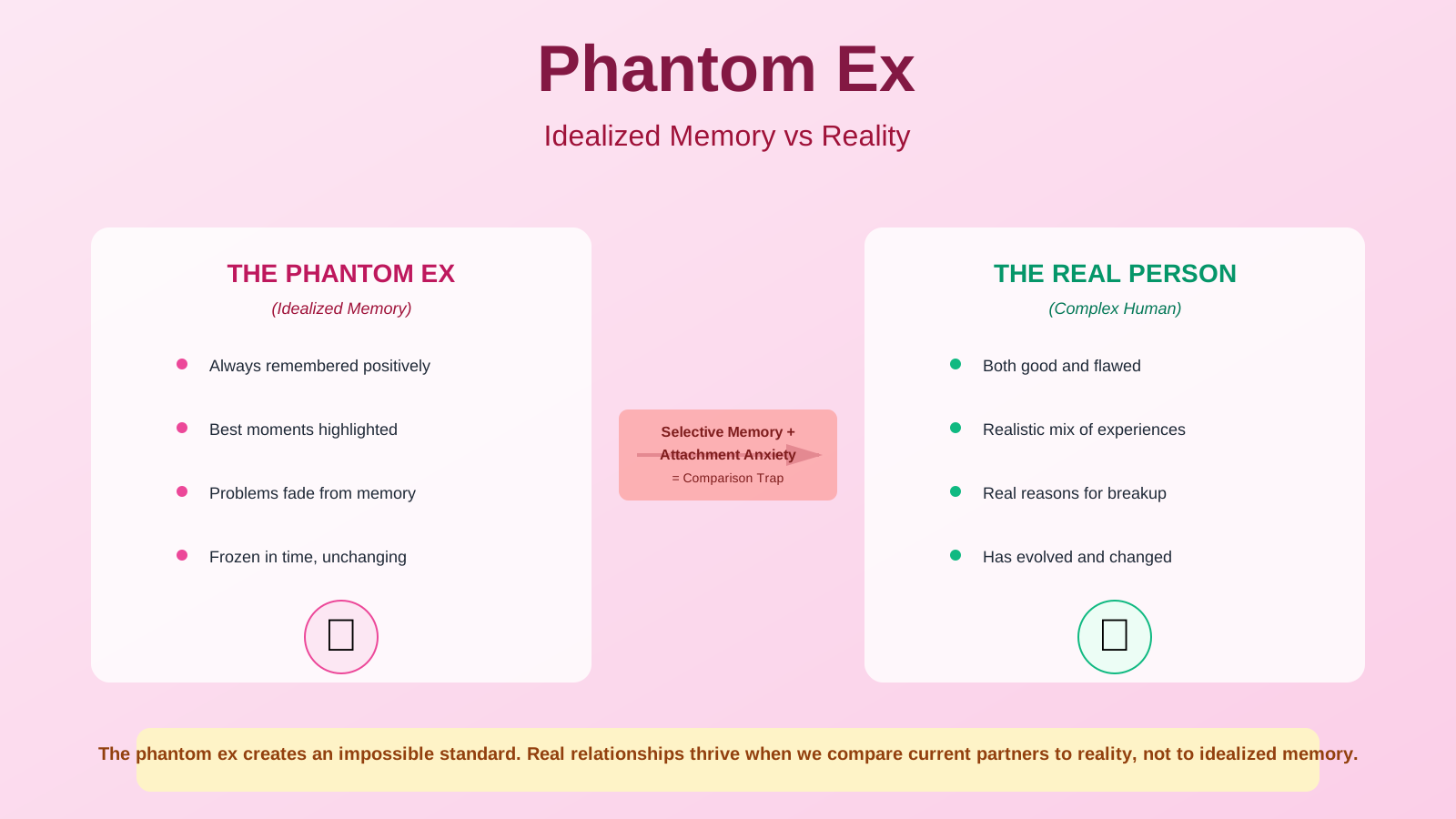
The phantom ex isn't actually your ex at all—it's the best parts of them preserved in amber, frozen in time, while the difficult moments fade into background noise.
This pattern shapes how you love, who you choose, and whether you can move forward with genuine acceptance of yourself and others.
What Is Phantom Ex?
A phantom ex is an idealized mental image of a previous partner that you compare current or potential partners to—whether consciously or unconsciously. This idealized version usually emphasizes positive qualities and memories while downplaying or completely erasing the negatives that caused the breakup. The term was coined by Dr. Amir Levine and Rachel S. F. Heller in their 2010 book Attached, which explores how attachment styles shape romantic relationships. Unlike memories of a real person, the phantom ex is a reconstructed version shaped by selective memory, nostalgia, and the psychological tendency to judge past experiences through a rose-tinted lens.
Not medical advice.
The phantom ex effect intensifies when there's emotional distance from the actual person. A partner you're no longer in daily contact with becomes a canvas for your imagination—you fill in the blanks with what you want to remember. Your brain doesn't store complete, objective recordings of relationships. Instead, it reconstructs memories based on your current emotional state, your attachment style, and what psychologists call the 'peak-end rule'—the tendency to judge an experience primarily by how it felt at its best moment and how it ended, rather than the average of all moments combined.
Surprising Insight: Surprising Insight: Recent neuroscience research shows that nostalgia—including yearning for past relationships—actually serves a psychological function: it reconstructs feelings of belonging and self-continuity. Your brain isn't trying to deceive you. It's trying to maintain your sense of identity and connection.
How Phantom Ex Formation Works
The process of selective memory, emotional distance, and attachment-based reconstruction that creates the idealized phantom ex
🔍 Click to enlarge
Why Phantom Ex Matters in 2026
In 2026, with constant digital connectivity and social media access to exes' lives, the phantom ex phenomenon has become more pronounced. You can scroll through an ex's Instagram feed at 2 AM, see curated highlight reels of their new life, and your brain conflates their filtered social media image with your idealized phantom. This creates a uniquely modern torture: you're comparing your new partner's unfiltered reality to your ex's highlighted performance online plus your rose-tinted memories. The comparison trap becomes almost insurmountable because you're not comparing your partner to a real person—you're comparing them to an impossible hybrid: the best of your ex plus the fantasy of what they could have been.
Understanding phantom ex matters because it directly affects relationship satisfaction, attachment security, and your ability to build trust. Research from Cambridge's Journal of Relationships Research shows that people high in attachment anxiety who maintain contact with exes experience lower satisfaction in new relationships, particularly when they're engaging in social comparisons. The phantom ex creates an invisible benchmark that no real human can meet. When you're unconsciously comparing your current partner to a phantom—a person who only contains the best 10% of your ex's qualities plus months of idealized memory—everyone fails the test.
Recognizing phantom ex patterns also helps you understand your own attachment style and the cycles you may repeat. If you consistently idealize exes and struggle to move on, the pattern might be rooted in attachment anxiety (fear of abandonment leading to idealization of what was lost) or avoidant attachment (using phantom ex fantasy to avoid real intimacy with current partners). Breaking this cycle requires honest self-assessment and practical strategies to anchor yourself in present-moment reality rather than past memory.
The Science Behind Phantom Ex
Neuroscience reveals that our memories aren't video recordings—they're reconstructive. Every time you remember something, your brain essentially re-files it, and in that process, it can alter details based on your current emotional state, beliefs, and desires. This is called 'hindsight bias' or 'reconstruction bias.' After a breakup, your brain tends to reorganize memories to align with your present feelings. If you're lonely, memories of companionship get emphasized. If you're hurt, you might suppress the painful reasons the relationship ended and highlight only the good times. A study published in the Journal of Experimental Social Psychology (2024) by researchers at Southampton University found that nostalgia—the sentimental longing for the past—creates narratives of personal meaning and belonging rather than objective truth. Your brain is prioritizing emotional continuity over accuracy.
Attachment theory explains individual differences in phantom ex intensity. Psychologist John Bowlby's framework shows that childhood experiences with caregivers create 'Internal Working Models'—templates for how you expect relationships to work. Adults with anxious attachment styles, often formed by inconsistent or unreliable caregiving, develop heightened fear of abandonment and tend to idealize partners as a defense mechanism. They remember exes through a positive lens to minimize the pain of loss. Avoidantly attached individuals, typically formed by emotionally distant caregiving, sometimes create phantom exes to maintain a sense of control and distance. They idealize the ex precisely because distance allows fantasy to flourish—real contact would puncture the illusion. Securely attached individuals, who experienced consistent, responsive caregiving, tend to remember relationships more accurately. They can acknowledge both positive and negative aspects without tipping into idealization.
How Different Attachment Styles Experience Phantom Ex
Attachment patterns influence the intensity, duration, and function of phantom ex idealization
🔍 Click to enlarge
Key Components of Phantom Ex
Selective Memory and the Peak-End Rule
Your brain uses cognitive shortcuts to judge experiences. The 'peak-end rule' is a psychological heuristic where you evaluate an entire experience based primarily on how it felt at its best moment (the peak) and how it ended (the end), rather than averaging all the moments together. A relationship might have been 60% neutral and 30% difficult, but if the remaining 10% was magical—amazing vacations, passionate intimacy, deep conversations—your brain weights that peak heavily. Similarly, if the relationship ended dramatically or painfully, that ending dominates your narrative. This explains why people remember exes so intensely right after breakups, even if the relationship had major issues. The memory isn't distorted—it's just compressed and weighted toward emotional extremes. Over months, as the acute pain fades and nostalgia increases, the negative ending recedes and the peak moments grow brighter in your mind.
Attachment Style Activation
Your Internal Working Model—the attachment template developed in childhood—activates when relationships end. If you have anxious attachment, separation from a partner triggers abandonment fears, and idealization becomes a defense mechanism. You subconsciously keep the ex 'alive' in your mind as a way of maintaining connection and hope for reunion. If you have avoidant attachment, ending a relationship can feel like a relief, but it also activates your fear of intimacy and dependency. The phantom ex becomes safer than a real current partner because it exists only in your mind—it can't demand vulnerability or closeness. If you have secure attachment, you can acknowledge both positive and negative qualities in exes without tipping into either idealization or demonization. This allows you to grieve the real relationship and move forward.
Nostalgia as Identity Maintenance
Recent research on nostalgia shows it serves a crucial psychological function: it reconstructs your sense of self and belonging. When you feel adrift, lonely, or questioning your identity, nostalgia for past relationships fills a gap. The phantom ex becomes part of your identity narrative—'I was someone's person,' 'I was loved,' 'I was different then.' This explains why phantom ex idealization often intensifies during periods of instability or low self-esteem. Your brain is trying to bolster your sense of continuity and worth by accessing memories of a time when you felt connected. Understanding this helps you compassionately address the underlying need (for belonging, for feeling valued) rather than just judging yourself for 'not getting over' the ex.
Digital Amplification and Social Comparison
In 2026, phantom ex creation is amplified by social media. You can see your ex's curated highlight reel indefinitely. Their filtered photos, their new partner, their achievements—all trigger what psychologists call 'upward social comparison' (comparing yourself to someone you perceive as doing better). Your brain combines this digital image with your idealized memories to create a phantom that's even more powerful than it would be without social media. Unlike previous generations who had to let exes fade from view, you have constant access to a partially-real, partially-curated version of who they are now. This makes releasing the phantom ex significantly harder because the external reminders keep triggering your idealized narratives.
| Attachment Style | Idealization Intensity | Duration & Trigger | Effect on New Relationships |
|---|---|---|---|
| Anxious Attachment | High - Romanticizes abandonment fears | Long-lasting, triggered by loneliness or new partner emotional distance | Constant comparison, waiting for new partner to 'prove' they won't leave |
| Avoidant Attachment | High but different - Romanticizes distance and fantasy | Variable, intensifies when real intimacy is demanded in current relationship | Uses phantom as escape hatch from vulnerability, sabotages closeness |
| Secure Attachment | Low - Realistic and compassionate recall | Short-term, resolves through normal grieving process | Can appreciate ex's positive qualities without comparing, builds healthy new bonds |
How to Apply Phantom Ex: Step by Step
- Step 1: Name the phantom: Write down the idealized qualities you remember about your ex. Be specific—not 'he was caring' but 'he remembered my coffee order and brought it to me on hard mornings.' This externalizes the phantom and makes it easier to examine.
- Step 2: List the reality: Honestly write down why the relationship ended, conflicts you had, needs that weren't met, values misalignment. Don't demonize them—just anchor yourself in actual facts that caused the breakup.
- Step 3: Identify your attachment pattern: Notice if you're idealizing due to anxiety (fear of loss making you romanticize what's gone) or avoidance (fantasy feeling safer than real intimacy). Understanding your pattern helps you respond to the underlying need rather than just fighting the idealization.
- Step 4: Reduce digital exposure: Unfollow, mute, or unfriend the ex on social media. Remove constant external triggers that feed the phantom. You don't need to be cruel—you're protecting your ability to heal and build new relationships.
- Step 5: Ground yourself in present reality: When phantom ex thoughts arise, describe your current partner or love interest in specific, real detail—both positive and challenging aspects. Anchor to 'what is' rather than 'what was.'
- Step 6: Notice the comparison: When you catch yourself comparing your current partner to the phantom ex, pause and ask: 'Am I comparing to a real person or to a memory? What need is this comparison meeting for me?'
- Step 7: Address the underlying need: If idealization spikes when you're lonely, lonely address loneliness through friendships and community, not through phantom ex fantasy. If it spikes when current relationships demand vulnerability, work on building that capacity.
- Step 8: Practice gratitude for what was real: Acknowledge that real positive things happened—the comfort, the joy, the growth. You don't have to erase those memories. You can honor them while also recognizing they don't define your worth or future.
- Step 9: Communicate if necessary: If phantom ex comparison is affecting your current relationship, consider talking to your partner (briefly, specifically) about your pattern. Many partners respond well to honesty and feel relieved when they understand it's not about them.
- Step 10: Invest in secure attachment: Whether through therapy, self-reflection, or new relationships, actively build secure attachment patterns. The more you experience consistency, responsive partners, and your own emotional regulation, the less phantom exes will have power over your romantic choices.
Phantom Ex Across Life Stages
Young Adulthood (18-35)
In young adulthood, phantom ex idealization is often most intense because attachment patterns are still actively forming, identity is still solidifying, and the stakes feel enormous. A first serious relationship that ends can feel identity-shattering, and the phantom ex becomes a way of preserving a version of yourself ('I was a person who was loved in a way I may never be again'). Young adults are also most prone to social media comparison—they're active online, their peers are in relationships, and scrolling an ex's life for validation is reflexive. The task here is building secure attachment patterns early: learning that relationships ending doesn't erase your worth, that new relationships can be different and better, and that idealization prevents you from seeing current partners clearly. Young adults who work through phantom ex patterns develop resilience and clearer relationship choices.
Middle Adulthood (35-55)
In middle adulthood, phantom ex idealization often takes a different form: regret and 'what-if' thinking. People sometimes romanticize exes from 15-20 years ago and wonder if they made the wrong choice by ending the relationship or choosing a different partner. Phantom exes at this stage are often less about ongoing comparison and more about existential questions—'Was my current relationship the right one? Could I have been happier with them?' This can be triggered by life stressors (job loss, marriage problems, health concerns), nostalgia for youth, or seeing an ex unexpectedly. The psychological work here is different: it's less about active idealization and more about integrating your actual choices with acceptance of the life you've built. Middle-aged adults have more perspective to see that 'the road not taken' would have had its own difficulties, and the phantom ex of 20 years ago is now a real person living a real life that includes challenges they never show you.
Later Adulthood (55+)
In later adulthood, phantom ex idealization usually appears as either wistful nostalgia or, if a spouse has passed away, a tendency to idealize the deceased partner's memory. The work here is different: it's about honoring what was real, integrating loss, and (if single) being open to new connections without comparing them to either phantom exes or deceased spouses. Some widowed individuals find it helpful to share stories of both the beautiful and challenging aspects of their marriage with new partners, which prevents idealization and allows grief to coexist with hope for new love. Older adults who've lived through multiple relationships and life stages often have more realistic perspectives on phantom exes—they can see that no relationship was perfect, that all involved real people with flaws, and that the phantom ex constructed in memory is fundamentally different from who that person actually was.
Profiles: Your Phantom Ex Approach
The Anxious Comparer
- Reassurance and security in current relationships (even when not needed externally)
- Regular connection and communication to prevent fantasies about absence
- Help identifying how abandonment fears drive idealization
Common pitfall: Constantly comparing current partner unfavorably to phantom ex; testing current partner's commitment; ruminating about exes
Best move: Build self-worth independent of romantic relationships. Notice when comparison urges spike and ask: 'What am I feeling right now that I'm trying to fix by thinking about the ex?' Develop friendships and community so your entire sense of belonging doesn't depend on one partner.
The Avoidant Escapist
- Safe environments to practice vulnerability without risk of immediate closeness demands
- Understanding that idealization of exes often protects against fear of intimacy
- Gradual, non-pressured exposure to real relationships
Common pitfall: Using phantom ex fantasy as excuse to avoid current relationships; finding reasons to end promising connections; staying 'connected' to exes to maintain emotional distance from current partner
Best move: Notice when idealization of exes spikes right before your current relationship gets deeper. This is usually a defense mechanism. Practice tolerating vulnerability in small doses. Unfollow exes on social media so fantasy has less fuel. When urges to escape emerge, name them: 'This is fear of intimacy, not a sign the relationship is wrong.'
The Secure Processor
- Occasional validation that healthy grieving includes bittersweet memories
- Permission to feel nostalgia without needing to act on it
- Frameworks to help friends or partners who struggle with phantom exes
Common pitfall: Being impatient with others' idealization; not fully honoring legitimate joy from past relationships; moving on too quickly without processing
Best move: Stay connected to both positive and negative memories of exes without tipping into either idealization or demonization. Model for others that you can appreciate someone as a real human while being glad the relationship ended. Help partners understand their phantom ex patterns without judgment.
The Digital Ruminator
- Boundaries around social media exposure to exes
- Strategies to resist the urge to check their updates, likes, follower count
- Awareness that social media images aren't reality
Common pitfall: Regularly checking ex's social media; spiraling into comparison traps (their new partner, their successes); feeding phantom ex idealization through filtered images
Best move: Delete or mute the ex immediately. Don't debate 'whether you're over them enough' to stay connected—just disconnect. Every scrolling session feeds the phantom. Redirect that checking energy into building your real current life. Notice what time of day/emotional state triggers the urge to look them up, and have alternate coping strategies ready.
Common Phantom Ex Mistakes
The first major mistake is confusing nostalgia with the desire to reconnect. You can miss the good times in a past relationship without wanting to return to that relationship. Idealization creates false clarity ('I was so happy then, I must have made a mistake ending it'). The reality is usually more complex: you were happy in some moments, there were real problems, and both you and the ex have changed. Mistaking nostalgia for a sign to reconnect often leads to breakup-makeup cycles where the initial joy of reunion quickly collides with the same fundamental incompatibilities that ended the relationship initially.
The second mistake is using phantom ex comparison as a reason to end good current relationships. Your current partner can never compete with a phantom because they're real—they have bad breath sometimes, they misunderstand you, they have their own needs that don't center on you. The phantom ex exists only in your mind in perfected form. Ending real relationships in pursuit of phantom-ex-level perfection is chasing an impossible standard and guarantees chronic dissatisfaction. The antidote is recognizing that comparison itself is the problem, not the current relationship.
The third mistake is expecting yourself to 'just stop' idealization through willpower. Phantom ex patterns are often attachment-based, not conscious choices. Shaming yourself ('I need to stop being so stupid') doesn't work. What works is understanding the attachment need underneath the idealization and addressing that. If you're idealizing due to abandonment anxiety, building secure relationships is the cure, not self-criticism.
The Phantom Ex Cycle and How to Break It
How idealization leads to comparison, dissatisfaction, and either rumination or reunion attempts—and the intervention points for breaking the cycle
🔍 Click to enlarge
Science and Studies
Psychological research on phantom ex, idealization, and attachment spans decades and continues to generate new insights. Recent studies from 2024-2026 provide updated understanding of how memory, attachment, and digital connection interact to create modern phantom ex challenges.
- Sedikides & Wildschut (2024), Southampton University - 'On the Nature of Nostalgia: A Psychological Perspective': Nostalgia serves psychological functions including self-continuity and belongingness restoration, explaining why phantom ex fantasies intensify during periods of isolation or identity uncertainty.
- Oliver et al. (2024), Journal of Experimental Social Psychology - Study on reconstructive memory in relationships: Shows how hindsight bias and emotional state reshape relationship memories over time, with more idealization occurring when emotional distance increases.
- Métellus et al. (2025), Journal of Marital and Family Therapy - 'Attachment Anxiety and Relationship Satisfaction in the Digital Era': Demonstrates that attachment anxiety combined with social media monitoring of exes predicts lower satisfaction in current relationships and longer idealization timelines.
- NIH/PMC Research on Contact with Ex-Partners: Studies show that more in-person contact with exes after breakup predicts higher psychological distress in adults without shared children, particularly when emotional attachment mismatches with behavioral contact patterns.
- Attachment Theory Research (Bowlby, Ainsworth, Levine & Heller): Decades of attachment science confirm that Internal Working Models developed in childhood shape adult relationship patterns, including tendencies toward idealization based on attachment security or insecurity.
Your First Micro Habit
Start Small Today
Today's action: When phantom ex thoughts arise today, pause for 10 seconds and ask yourself: 'What real problem am I trying to solve by thinking about my ex right now? What feeling am I avoiding?' Write the answer in one sentence. Do this once today.
This micro habit builds awareness of the pattern. Most phantom ex rumination is automatic—your brain defaults to it without you realizing why. By interrupting the automatic pattern and naming the underlying need (loneliness, fear, boredom, inadequacy), you shift from unconscious idealization to conscious choice. Over repeated micro habits, you'll notice patterns: 'I think about my ex when I feel rejected,' or 'I think about my ex when my current relationship gets close,' or 'I think about my ex when I'm tired and lonely.' Once you see the pattern, you can address the real need instead of feeding the phantom.
Keep quitting habit apps after a missed day? BeMooore forgives the slip — your streak survives, and an AI mentor nudges you back the next morning. Free on iOS.
Quick Assessment
When you think about a past relationship, do you mostly remember the positive moments, mostly remember conflicts and problems, or can you hold both perspectives?
Your answer reveals how your current emotional state influences memory. Most people drift toward idealization when lonely and toward criticism when hurt. Secure individuals maintain more balanced memory regardless of circumstances.
If your ex reached out today, how would you likely feel?
Excitement or anxiety about ex contact often signals high idealization and attachment anxiety. Curiosity without urgency suggests more realistic perspective. Conflicted responses suggest you're in transition toward seeing them realistically.
How often do you check your ex's social media, compare your current relationship to your past one, or catch yourself thinking 'they were better at [quality]'?
Frequency of idealization comparison indicates how much the phantom ex is affecting your current life. Frequent rumination suggests active attachment work is needed. Complete absence might indicate either secure processing or avoidant suppression (notice if you're 'moving on' while secretly checking up).
Take our full assessment to get personalized recommendations for your attachment style and relationship patterns.
Discover Your Style →Next Steps
Breaking free from phantom ex patterns begins with honest self-assessment. Name the phantom—what idealized qualities are you remembering? List the reality—why did the relationship actually end? Identify your attachment pattern—are you idealizing because of anxiety (fear of loss) or avoidance (fear of closeness)? Understanding the root attachment need behind the idealization transforms the pattern from something you judge yourself for into something you can compassionately address.
Take practical action: Reduce digital exposure to exes through unfollowing, muting, or unfriending. When phantom ex thoughts arise, ground yourself in present reality by describing current relationships (if in one) with honest specificity. Notice the comparison urges and ask what underlying need they're meeting. Build secure attachment through consistent relationships, therapy if possible, and repeated experiences of emotional safety. Most importantly, practice self-compassion—phantom ex idealization isn't a character flaw. It's a common psychological pattern rooted in attachment, memory, and the very human longing for connection. By understanding it, you reclaim your ability to choose present relationships based on who people actually are, not on who you've reconstructed them to be in memory.
Get personalized guidance with AI coaching. Our app tracks your micro habits and attachment patterns to help you build secure, realistic relationships.
Start Your Journey →Research Sources
This article is based on peer-reviewed research and authoritative sources. Below are the key references we consulted:
Related Glossary Articles
Frequently Asked Questions
Is it bad that I still have positive memories of my ex? Does that mean I'm not over them?
No. Healthy processing includes honoring what was real and good about a past relationship while also acknowledging why it ended. The difference between healthy integration and phantom ex idealization is this: Can you remember positively without minimizing the problems? Can you appreciate that person as a real human with flaws? Can you imagine them in their current life separate from your fantasy? If yes to all three, you're processing healthily, not idealizing. Phantom ex idealization typically involves exaggerating positives, minimizing negatives, and freezing them in time rather than recognizing how they've changed.
My current partner keeps asking why I compare them to my ex. How do I explain phantom ex idealization to them?
Honesty and specificity help. Try: 'I'm noticing a pattern where I compare you to an idealized memory of my ex, not to who they actually were. It's not about you—it's about my attachment anxiety [or avoidance] and how I process distance. I'm working on it.' Avoid: making it seem like your current partner is the problem, comparing them directly ('my ex was better at...'), or vague generalizations. Good partners want to understand. Share what you're doing to address it (limiting social media contact with ex, therapy, the micro habits, etc.) so they see you're aware and committed to change.
My ex and I have kids together. How do I work on phantom ex idealization when I have to stay connected?
Co-parenting contact is different from romantic idealization. The work here is compartmentalization: separating 'parenting communication' from 'romantic or nostalgic ideation.' Keep conversations about logistics and children. If phantom ex idealization arises during these communications, process it separately (with a therapist, journal, or trusted friend), not in the co-parenting dynamic. Some co-parents find it helpful to be very direct: 'I think I'm romanticizing our past. Let's keep this about what's best for the kids.' Setting this boundary paradoxically often makes communication clearer.
I'm single and not comparing to a current partner, but I keep thinking about exes and wondering if I made mistakes. Is that phantom ex too?
Yes, sometimes. Single idealization can be either healthy reflection ('What did I learn from that relationship?') or phantom ex rumination ('I was so happy then, I ruined it'). The distinction: Healthy reflection involves accepting the past, learning from it, and feeling ready for something new. Phantom ex rumination involves pining, wondering if you should contact them, or using them to avoid new connections. If you're single and ruminating about exes, ask: 'Am I learning, or am I stuck? Am I ready to move forward, or using them as a reason not to try?' The answer determines whether it's reflection or idealization.
Is the phantom ex concept the same as emotional unavailability or commitment issues?
Not exactly. Phantom ex idealization is one mechanism that can create the appearance of commitment issues, but the root causes are different. Someone with true commitment issues might avoid all serious relationships. Someone with phantom ex idealization often desperately wants commitment—they're just comparing every new partner to an impossible standard. The distinction matters for treatment: commitment issues often need couples counseling or individual work on fear of vulnerability. Phantom ex idealization needs attachment work, memory processing, and often social media boundaries. Someone might have both, but identifying which dynamic is operating helps you address the actual problem.
Take the Next Step
Ready to improve your wellbeing? Take our free assessment to get personalized recommendations based on your unique situation.
- Discover your strengths and gaps
- Get personalized quick wins
- Track your progress over time
- Evidence-based strategies