Avoidant Attachment
You pull away right when someone gets close. You tell yourself you simply need space, that independence is your strength. Yet there is a quiet ache in the background, a sense that something important keeps slipping through your fingers. If this sounds familiar, you may be dealing with an <a href='/g/attachment-styles.html'>attachment style</a> rooted in avoidance, one that shapes how you approach <a href='/g/connection.html'>connection</a>, <a href='/g/intimacy.html'>intimacy</a>, and <a href='/g/emotional-connection.html'>emotional connection</a> in every relationship you enter.
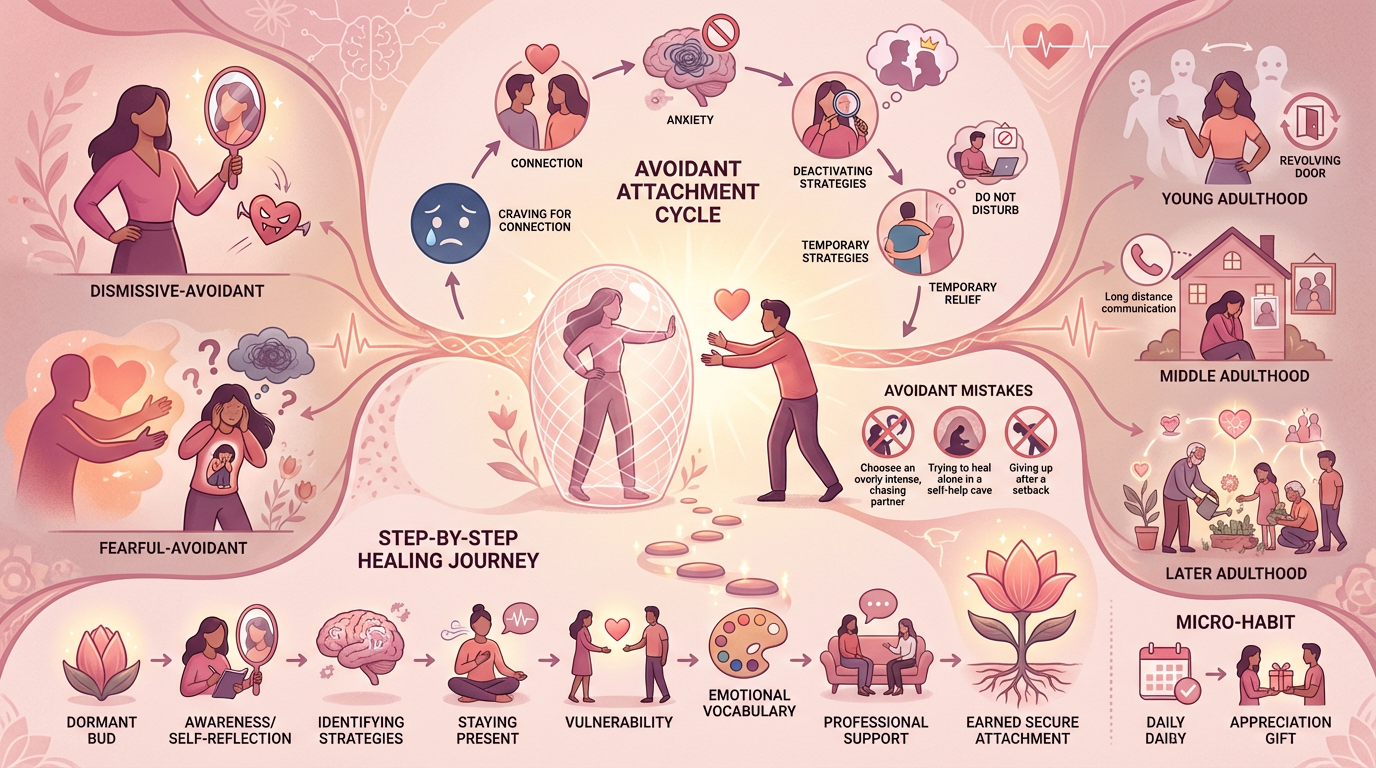
Research from developmental psychology shows that avoidant attachment affects roughly twenty to twenty-five percent of the adult population. Understanding this pattern is the first step toward transforming the way you relate to others and to yourself.
In this guide, you will learn the differences between dismissive-avoidant and fearful-avoidant patterns, discover the deactivating strategies that keep you stuck, and find evidence-based steps to move toward a more emotionally resilient and secure way of connecting.
What Is Avoidant Attachment?
Avoidant attachment is an insecure attachment pattern characterized by a strong preference for emotional independence, discomfort with closeness, and a tendency to suppress or minimize feelings in relationships. People with this style learned early in life that depending on others for emotional bonding was unreliable or even unsafe, so they adapted by becoming highly self-reliant. This adaptation once served as brilliant protection, but in adulthood it often creates barriers to the deep connection and belonging that humans need.
Not medical advice.
Attachment theory, first developed by John Bowlby and later expanded by Mary Ainsworth, identifies avoidant attachment as one of the core insecure styles. Bartholomew and Horowitz further distinguished between two subtypes: dismissive-avoidant, where individuals maintain a positive self-view while devaluing relationships, and fearful-avoidant, where individuals desire closeness but fear rejection so deeply that they oscillate between seeking and avoiding emotional intimacy. Both subtypes rely on deactivating strategies, defense mechanisms that suppress attachment needs and keep emotional distance from partners.
Surprising Insight: Surprising Insight: People with avoidant attachment often report feeling most relieved immediately after a breakup, yet research by Fraley and Shaver found that avoidant individuals show just as much physiological stress during separation as securely attached people. Their bodies respond even when their minds deny the need for connection.
Avoidant Attachment Cycle
How the avoidant pattern perpetuates itself through deactivating strategies
🔍 Click to enlarge
Why Avoidant Attachment Matters in 2026
Modern dating culture, with its emphasis on independence and self-sufficiency, can inadvertently reinforce avoidant patterns. Apps that encourage rapid cycling through potential partners make it easy for avoidant individuals to leave at the first sign of discomfort rather than developing communication skills and conflict resolution abilities. Understanding your attachment and bonding patterns has never been more important for building lasting healthy relationship habits.
The rise of remote work and digital communication has also created new challenges for people with avoidant tendencies. While physical distance can feel comfortable, it may mask deeper struggles with emotional awareness and vulnerability. Research published in the Journal of Social and Personal Relationships indicates that avoidant attachment is associated with lower relationship satisfaction, higher rates of divorce, and increased loneliness in middle age, outcomes that affect not just romantic partnerships but also friendship, family dynamics, and professional communication in relationships.
The good news is that attachment styles are not fixed traits. Neuroscience research confirms that the brain retains plasticity throughout life, meaning that with intentional effort, mindfulness, and often emotional healing work, avoidant patterns can shift toward what researchers call earned secure attachment. This transformation benefits every area of life, from mental health and emotional wellbeing to career success and physical stress management.
The Science Behind Avoidant Attachment
Avoidant attachment develops primarily through early interactions with caregivers who were consistently emotionally unavailable, dismissive of distress, or uncomfortable with physical and emotional closeness. When a child reaches out for comfort and repeatedly finds the caregiver unresponsive, the child adapts by suppressing attachment needs. This is not a conscious choice. It is a survival strategy wired into the nervous system. The child learns that expressing needs leads to rejection or indifference, so minimizing those needs becomes the safest approach. Over time, this creates deeply ingrained patterns of emotional regulation that persist into adulthood.
Neuroimaging studies reveal that avoidantly attached individuals show reduced activation in brain regions associated with emotional processing, particularly the anterior insula and the anterior cingulate cortex, when viewing emotionally charged stimuli. Their brains literally learn to dampen emotional signals. However, physiological measures such as cortisol levels and skin conductance tell a different story: the body still registers emotional distress even when conscious awareness does not. This gap between felt emotion and physiological response is at the heart of the avoidant experience. Understanding this disconnect is crucial for developing emotional intelligence and self-compassion around avoidant patterns.
Dismissive-Avoidant vs Fearful-Avoidant
Key differences between the two avoidant subtypes across major dimensions
🔍 Click to enlarge
Key Components of Avoidant Attachment
Deactivating Strategies
Deactivating strategies are the defense mechanisms avoidant individuals use to maintain emotional distance. These include mentally focusing on a partner's flaws, fantasizing about the ideal partner who does not exist, withdrawing when things get too close, keeping secrets, avoiding physical affection, and prioritizing work or hobbies over relationship time. These strategies are often automatic and unconscious, making them difficult to recognize without intentional self-awareness work. They serve a protective function, shielding the person from perceived threats to autonomy, but they also prevent the trust and emotional connection that relationships require to thrive.
Emotional Suppression
Avoidant individuals typically have limited access to their own emotional experience. They may struggle to identify what they feel, a phenomenon sometimes called alexithymia. Emotions that do surface are often quickly rationalized away or converted into physical symptoms like headaches, tension, or fatigue. Learning to develop emotional awareness and emotional expression is a cornerstone of healing. Practices such as meditation and body-scan exercises help bridge the gap between physiological sensation and conscious emotional experience.
Hyper-Independence
While healthy independence is a valuable trait, avoidant attachment takes it to an extreme. Hyper-independence means refusing help even when struggling, believing that needing others is weakness, and maintaining rigid emotional boundaries that prevent mutual support. This pattern often leads to burnout, isolation, and a diminished capacity for empathy. The shift from hyper-independence to healthy interdependence, where you can both give and receive support, is one of the most significant growth areas for avoidant individuals pursuing personal growth.
Intimacy Avoidance
Avoidant individuals may enjoy the early stages of dating when things feel exciting and low-pressure. However, as a relationship deepens and a partner seeks greater emotional intimacy, the avoidant person begins to feel trapped or suffocated. They may create distance through busyness, emotional stonewalling, or picking fights. Understanding this pattern through the lens of attachment styles removes the shame and blame, replacing it with a clear roadmap for change through behavioral change and coping strategies.
| Relationship Area | Common Avoidant Behavior | Secure Alternative |
|---|---|---|
| Romantic partnerships | Withdrawing when partner needs emotional support | Staying present and expressing your feelings honestly |
| Friendships | Keeping conversations surface-level and avoiding vulnerability | Sharing personal experiences and asking deeper questions |
| Family | Limiting contact and avoiding emotional discussions | Setting healthy boundaries while maintaining connection |
| Workplace | Resisting collaboration and preferring solo work | Building trust through consistent, reliable teamwork |
| Self-relationship | Dismissing your own emotional needs as weakness | Practicing self-compassion and recognizing needs as valid |
How to Heal Avoidant Attachment: Step by Step
- Step 1: Recognize your pattern. Start by learning the specific signs of avoidant attachment in your own behavior. Notice when you pull away, focus on flaws, or feel the urge to flee. Awareness is the foundation of all <a href='/g/self-improvement.html'>self-improvement</a>.
- Step 2: Identify your deactivating strategies. Keep a journal for two weeks tracking moments when you create distance. Write down what triggered it, what you told yourself, and what you actually felt in your body. This builds <a href='/g/emotional-awareness.html'>emotional awareness</a>.
- Step 3: Understand your origin story. Reflect on your childhood experiences with caregivers. How were your emotional needs responded to? Understanding the roots of your pattern reduces shame and increases <a href='/g/self-compassion.html'>self-compassion</a>.
- Step 4: Practice staying present during discomfort. When the urge to withdraw arises, try sitting with it for just five minutes before acting. Use <a href='/g/breathing-techniques.html'>breathing techniques</a> to regulate your nervous system. Gradually extend this window over time.
- Step 5: Communicate your experience to your partner. Use simple statements like 'I notice I want to pull away right now, and I am choosing to stay.' This builds <a href='/g/trust.html'>trust</a> and models <a href='/g/honest-conversations.html'>honest conversations</a>.
- Step 6: Start with small acts of vulnerability. Share one feeling per day with someone you trust. It does not need to be dramatic. Even saying 'I felt happy when you called' or 'I missed you today' begins rewiring your attachment system.
- Step 7: Build a vocabulary for emotions. Avoidant individuals often have a limited emotional vocabulary. Practice naming your feelings with specificity. Instead of 'fine,' try 'anxious,' 'relieved,' 'touched,' or 'overwhelmed.' This supports <a href='/g/emotional-regulation.html'>emotional regulation</a>.
- Step 8: Challenge the independence narrative. Question beliefs like 'I don't need anyone' or 'depending on others is weak.' Replace them with more balanced thoughts like 'healthy relationships involve both independence and interdependence.' This is core <a href='/g/psychological-flexibility.html'>psychological flexibility</a> work.
- Step 9: Seek professional support. A therapist trained in attachment theory can help you identify blind spots and practice new relational skills in a safe environment. Emotionally Focused Therapy and AEDP are particularly effective approaches for <a href='/g/emotional-healing.html'>emotional healing</a>.
- Step 10: Be patient with the process. Shifting attachment patterns takes time because you are literally rewiring neural pathways. Celebrate small wins, like staying in a difficult conversation or allowing someone to comfort you. Building <a href='/g/resilience.html'>resilience</a> in this area is a gradual journey.
Avoidant Attachment Across Life Stages
Young Adulthood (18-35)
In young adulthood, avoidant attachment often shows up as serial dating, difficulty committing, or choosing partners who are emotionally unavailable. The freedom of early adulthood can feel comfortable because it allows avoidant individuals to maintain distance without social pressure. However, as peers begin forming long-term partnerships, avoidant individuals may feel increasingly isolated or confused about why relationships never seem to work out. This is a critical period for developing self-esteem and self-worth independent of relationship status, and for beginning the work of understanding your attachment patterns.
Middle Adulthood (35-55)
By middle adulthood, the consequences of avoidant attachment often become harder to ignore. Patterns of failed relationships, emotional distance from children, or chronic loneliness may prompt a deeper reckoning. Many avoidant individuals first seek therapy during this period, driven by a divorce, a health scare, or the realization that their children are developing similar patterns. The good news is that emotional resilience and emotional intelligence can be developed at any age, and midlife often brings the motivation and maturity needed to do this challenging inner work. Learning active listening and practicing forgiveness become especially important during this stage.
Later Adulthood (55+)
In later adulthood, avoidant attachment can lead to significant social isolation, especially after retirement removes the structured social environment of work. The loss of a long-term partner through death or divorce can be particularly devastating for avoidant individuals who never developed close secondary relationships. However, research shows that older adults can and do develop more secure attachment patterns, often through grandparent relationships, community involvement, or spiritual practice. Cultivating compassion, acceptance, and gratitude helps avoidant individuals connect with others during this life stage.
Profiles: Your Avoidant Attachment Approach
The Dismissive Fortress Builder
- Practice identifying and naming one emotion each day
- Allow a trusted person to help with one small task each week
- Schedule regular relationship check-ins with your partner
Common pitfall: Believing you are simply more rational than emotional people and that relationships are unnecessary distractions.
Best move: Start journaling about moments when you felt a flicker of longing or warmth toward someone, even briefly.
The Fearful Pendulum Swinger
- Develop a calming routine for when anxiety spikes during closeness
- Communicate your mixed feelings to your partner using 'I feel' statements
- Work with a therapist on processing childhood relational wounds
Common pitfall: Alternating between intense pursuit and sudden withdrawal, leaving partners confused and exhausted.
Best move: Commit to consistent, moderate emotional engagement rather than swinging between extremes.
The Workaholic Distancer
- Set firm boundaries between work and personal time
- Schedule quality time with loved ones as non-negotiable calendar events
- Recognize busyness as a deactivating strategy rather than pure ambition
Common pitfall: Using career success as evidence that relationships are not your priority while secretly feeling empty.
Best move: Block one hour per week for a meaningful conversation with someone close to you, with phone off and full presence.
The Healing Explorer
- Maintain momentum in attachment work even when it feels uncomfortable
- Practice vulnerability in progressively larger circles of trust
- Celebrate each moment of authentic connection as genuine progress
Common pitfall: Using self-help knowledge as another form of emotional distancing, analyzing feelings instead of actually feeling them.
Best move: Move from intellectual understanding to embodied practice through somatic therapy, body-based mindfulness, or partner exercises.
Common Avoidant Attachment Mistakes
One of the most common mistakes is confusing avoidant attachment with healthy independence. True independence includes the capacity for interdependence, the ability to rely on others and let others rely on you. Avoidant patterns, by contrast, stem from fear rather than genuine self-sufficiency. Another frequent error is choosing partners who confirm avoidant beliefs. Avoidant individuals often feel most attracted to anxiously attached partners whose intensity reinforces the belief that emotions are overwhelming and relationships are exhausting. Developing boundary setting skills helps break this cycle.
A second major mistake is attempting to heal in isolation. Because avoidant individuals are already uncomfortable with dependency, they may try to fix their attachment style through books, podcasts, and solo journaling alone. While these resources are valuable, attachment patterns are relational wounds that require relational healing. Joining a therapy group, working with a couples therapist, or practicing authenticity and communication with a trusted friend creates the corrective emotional experiences needed for lasting change.
A third mistake is expecting linear progress. Healing avoidant attachment is not a straight line. There will be periods of regression, especially during times of stress or when encountering new levels of emotional intimacy. Understanding this through the lens of anxiety management and resilience helps normalize setbacks and maintain long-term commitment to growth. The key is recognizing that each cycle of retreat and reconnection can become shorter and less intense with consistent practice.
Avoidant Attachment Healing Journey
The progression from avoidant patterns to earned secure attachment
🔍 Click to enlarge
Avoidant Attachment in Romantic Relationships
Avoidant attachment profoundly shapes couple dynamics. The most common pairing in clinical practice is the anxious-avoidant trap, where an anxiously attached partner pursues closeness while the avoidant partner retreats. This creates a painful cycle that can persist for years without awareness. The anxious partner's need for reassurance triggers the avoidant partner's fear of engulfment, and the avoidant partner's withdrawal triggers the anxious partner's fear of abandonment. Breaking this cycle requires both partners to understand their respective patterns and work toward a more secure middle ground.
For avoidant individuals in relationships, learning to express needs directly is transformative. Instead of silently withdrawing when overwhelmed, saying something like 'I need thirty minutes alone to recharge, and then I would like to reconnect' honors both the avoidant person's need for space and the partner's need for reassurance. This kind of communication in relationships builds trust over time and demonstrates that closeness does not require the loss of self.
Partners of avoidant individuals also benefit from understanding attachment theory. When a partner recognizes that withdrawal is a protective mechanism rather than a personal rejection, they can respond with patience rather than pursuit. This reduces the pressure on the avoidant individual and creates space for them to move toward connection at their own pace. Couples who develop shared conflict resolution strategies and practice active listening consistently report stronger bonds regardless of their starting attachment styles.
Deactivating Strategies: A Closer Look
Deactivating strategies deserve special attention because they operate largely below conscious awareness. These strategies were identified by researchers Mikulincer and Shaver as the primary mechanism through which avoidant individuals manage attachment-related anxiety. They function like an emotional thermostat: when emotional temperature rises in a relationship, deactivating strategies kick in to cool things down. Common examples include focusing on a partner's minor imperfections to reduce attraction, mentally keeping one foot out the door, avoiding saying 'I love you,' suppressing memories of positive relationship moments, and flirting with others to maintain a sense of freedom.
Recognizing these strategies in real time is one of the most powerful steps toward self-improvement. Many avoidant individuals are genuinely surprised when they begin tracking their deactivating behaviors. What felt like rational evaluation of a partner turns out to be a predictable defensive pattern. Developing a practice of mindfulness and self-awareness helps catch these strategies as they arise, creating a choice point where the person can either default to old patterns or experiment with staying engaged.
Science and Studies
The scientific understanding of avoidant attachment has deepened considerably through decades of research spanning developmental psychology, neuroscience, and clinical practice. Studies consistently show that avoidant attachment is associated with specific physiological, cognitive, and relational patterns that can be measured and tracked over time.
- Fraley and Shaver (2000) demonstrated that avoidant individuals show suppressed conscious distress during separation but elevated physiological stress markers, revealing a gap between self-report and bodily experience.
- Mikulincer and Shaver (2007) published comprehensive research on deactivating strategies in their book 'Attachment in Adulthood,' documenting how these defenses maintain emotional distance in close relationships.
- Bartholomew and Horowitz (1991) established the four-category model of adult attachment distinguishing dismissive-avoidant from fearful-avoidant subtypes based on self-view and view of others.
- DeWall et al. (2012) used neuroimaging to show that avoidant individuals have reduced neural responses to social rejection cues in brain regions associated with emotional processing.
- Roisman et al. (2007) longitudinal research demonstrated that earned secure attachment is achievable, with individuals showing neural and behavioral patterns indistinguishable from those with lifelong secure attachment.
Building Secure Attachment as an Avoidant
The concept of earned secure attachment provides powerful hope for individuals with avoidant patterns. Research by Roisman and colleagues shows that adults who develop secure attachment through intentional work, typically involving therapy and safe relational experiences, demonstrate the same relationship outcomes as those who were securely attached from childhood. This means that your attachment style is not your destiny. Through consistent effort in building emotional intelligence, practicing vulnerability, and developing self-compassion, genuine transformation is possible.
Key practices for building secure attachment include developing consistent daily contact with important people in your life, even when it feels unnecessary. Avoidant individuals often believe that if they do not feel the urge to connect, there is no reason to reach out. Challenging this belief by scheduling regular contact, sending a brief text, or making a phone call builds new neural pathways that associate connection with safety rather than threat. Over time, reaching out begins to feel natural rather than forced, a clear sign that behavioral change is taking root.
Another essential practice is learning to receive care from others. Avoidant individuals are often generous givers but uncomfortable receivers. Allowing a friend to bring you soup when you are sick, letting a partner comfort you after a hard day, or accepting a colleague's help on a project are all opportunities to practice receiving. Each time you allow someone to care for you without deflecting, minimizing, or immediately reciprocating, you strengthen your capacity for emotional bonding and mutual deep connection.
Your First Micro Habit
Start Small Today
Today's action: Each evening, send one genuine appreciation message to someone in your life. It can be as simple as 'I appreciated you listening to me today.' This small act builds your comfort with emotional expression and strengthens your relational bonds.
Expressing appreciation activates the brain's social bonding circuits and gradually rewires the avoidant tendency to suppress positive relational feelings. Research shows that consistent small acts of vulnerability build trust faster than occasional grand gestures.
Keep quitting habit apps after a missed day? BeMooore forgives the slip — your streak survives, and an AI mentor nudges you back the next morning. Free on iOS.
Quick Assessment
When someone you care about wants to get closer emotionally, what is your most typical response?
Your comfort level with emotional closeness reflects your attachment pattern. Noticing your automatic responses without judgment is the first step toward creating new choices.
How do you handle conflict in your closest relationships?
Conflict avoidance is one of the strongest markers of avoidant attachment. The ability to stay present during disagreements is a core skill for building secure bonds.
When you think about depending on other people, what comes up for you?
Your relationship with dependency reveals important information about your attachment style. Healthy interdependence means being comfortable both giving and receiving support.
Take our full assessment to get personalized recommendations for building more secure relationships.
Discover Your Attachment Style →Next Steps
Understanding your avoidant attachment pattern is a courageous first step. The journey toward secure attachment is not about becoming a different person. It is about accessing parts of yourself that have been protected and hidden for years. Start with one small action today: send that appreciation message, stay in a conversation five minutes longer than feels comfortable, or simply notice the next time you feel the urge to withdraw. Each small choice to stay present rewires your nervous system toward safety in connection. Explore related topics like attachment styles, emotional healing, breakup recovery, and self-worth to deepen your understanding.
Remember that healing is not about perfection. It is about progress. Every time you choose connection over withdrawal, vulnerability over defense, and presence over escape, you are building the foundation for the relationships you truly want. Your avoidant pattern was a brilliant adaptation that kept you safe as a child. Now, as an adult, you have the power to choose a different path, one that includes both the independence you value and the deep emotional bonds that make life rich and meaningful.
Get personalized guidance with AI coaching.
Start Your Journey →Research Sources
This article is based on peer-reviewed research and authoritative sources. Below are the key references we consulted:
Related Glossary Articles
Frequently Asked Questions
Can avoidant attachment style be changed?
Yes. Research on earned secure attachment confirms that attachment styles can shift through therapy, safe relational experiences, and consistent practice of emotional vulnerability. The brain's neuroplasticity allows new relational patterns to form at any age.
What is the difference between dismissive-avoidant and fearful-avoidant?
Dismissive-avoidant individuals maintain a positive self-view while devaluing relationships and suppressing emotions. Fearful-avoidant individuals desire closeness but fear rejection, leading to oscillating behavior between pursuing and withdrawing from intimacy. Both use deactivating strategies but experience them differently.
How does avoidant attachment affect parenting?
Avoidant parents may struggle to respond to their children's emotional needs, inadvertently creating the same dynamic they experienced in childhood. However, awareness of this pattern combined with intentional parenting practices can break the intergenerational cycle of insecure attachment.
What is the best therapy for avoidant attachment?
Emotionally Focused Therapy, Accelerated Experiential Dynamic Psychotherapy, and psychodynamic approaches that focus on the therapeutic relationship itself are considered most effective. These modalities provide corrective emotional experiences that help rewire avoidant patterns.
How do I know if I have avoidant attachment?
Common signs include discomfort with emotional closeness, a strong preference for independence, difficulty identifying and expressing feelings, mentally finding fault with partners, and feeling relief rather than sadness when relationships end. A trained therapist can provide a formal assessment.
Can two avoidant people have a successful relationship?
Two avoidant individuals may initially feel comfortable together because neither pressures the other for closeness. However, without intentional effort, the relationship can become emotionally barren over time. Success requires both partners to consciously work toward greater vulnerability and emotional engagement.
How long does it take to develop earned secure attachment?
There is no fixed timeline. Some people experience significant shifts within months of consistent therapy and practice. For others, the process unfolds over years. The key is persistence and self-compassion rather than speed. Most people notice meaningful improvements within the first year of focused attachment work.
Take the Next Step
Ready to improve your wellbeing? Take our free assessment to get personalized recommendations based on your unique situation.
- Discover your strengths and gaps
- Get personalized quick wins
- Track your progress over time
- Evidence-based strategies