Movement Snacks
You have been sitting for three hours straight. Your back aches, your <a href="/g/energy-levels.html">energy levels</a> have crashed, and your mind feels foggy. You know you should move, but a full workout feels impossible right now. What if the solution was not a sixty-minute gym session but a two-minute burst of activity right where you are? Movement snacks are changing how millions of people think about <a href="/g/exercise.html">exercise</a>, and the research behind them is striking.
A 2022 study published in Nature Medicine found that people who engaged in just three short bouts of vigorous physical activity per day had a 48 to 49 percent lower risk of cardiovascular death compared to those who did none. Each bout lasted only one to two minutes. That is the power of movement snacks: small doses of <a href="/g/fitness.html">fitness</a> that deliver outsized results.
This guide covers the science, the strategies, and the step-by-step approach to weaving movement snacks into your daily routines. Whether you work from a desk, care for children, or simply want to feel more alive throughout the day, you will find a practical path forward here.
What Are Movement Snacks?
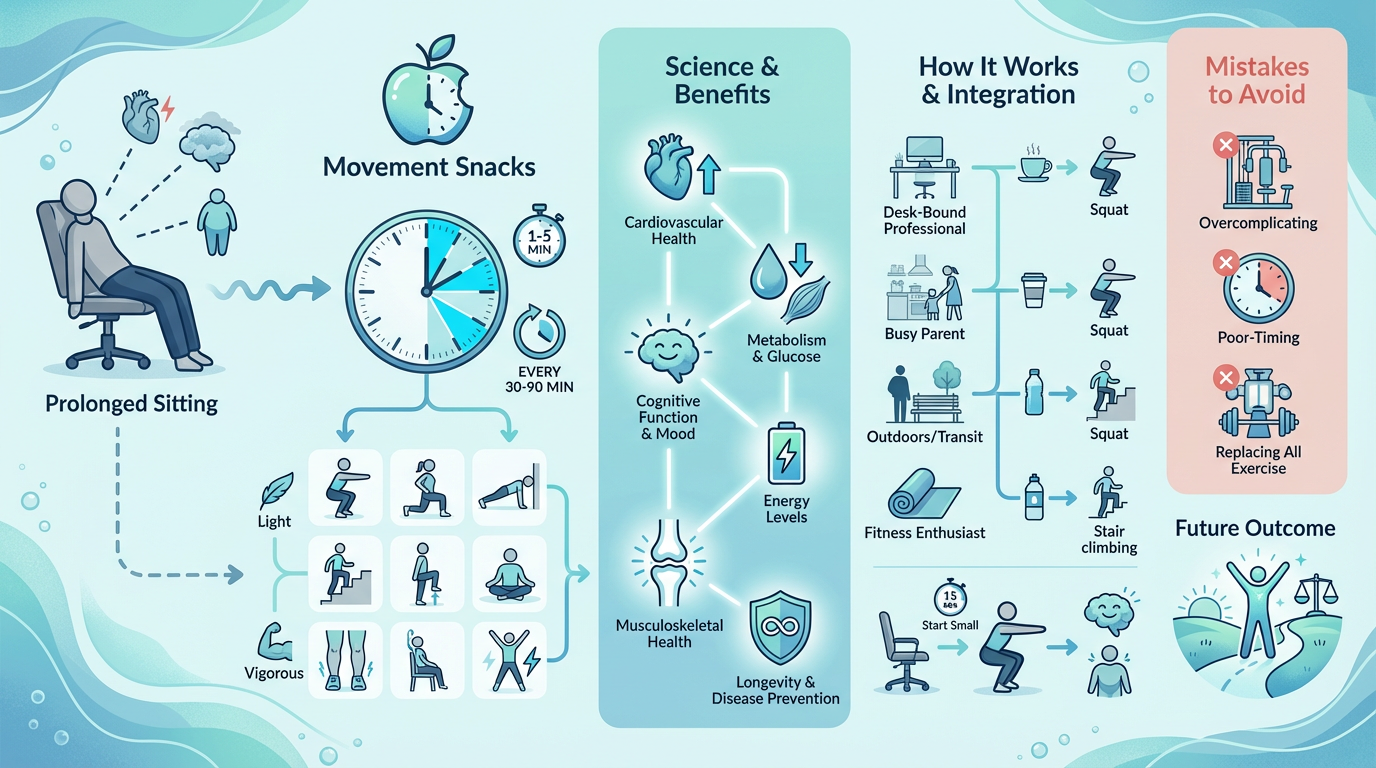
Movement snacks are short, intentional bursts of physical activity lasting between one and five minutes, sprinkled throughout the day at regular intervals. Unlike traditional fitness training sessions that require dedicated time, equipment, and preparation, movement snacks can be performed almost anywhere with no special gear. The concept draws on growing evidence that breaking up prolonged sedentary periods with brief bouts of activity delivers measurable exercise benefits for cardiovascular, metabolic, and cognitive health.
Not medical advice.
The term exercise snacking was first used in clinical research around 2014, but the idea gained mainstream attention after large-scale accelerometer studies showed that even incidental vigorous activity, captured through wearable devices, correlated with dramatically lower disease risk. Today movement snacks are recommended by organizations including the American Heart Association and the UK National Health Service as a practical strategy for adults who struggle to meet the World Health Organization guideline of 150 minutes of moderate cardio exercise per week.
Surprising Insight: Surprising Insight: A 2023 study in JAMA Oncology found that non-exercising adults who recorded just 3.4 to 3.6 minutes of intermittent vigorous activity per day had a 17 to 18 percent lower risk of cancer compared to those with no vigorous physical activity at all.
Movement Snacks vs Traditional Exercise
Comparing the structure and timing of movement snacks versus conventional workout sessions
🔍 Click to enlarge
Why Movement Snacks Matter in 2026
The average office worker now sits for more than nine hours per day, a figure that has increased steadily since remote work became widespread. Prolonged sitting is associated with endothelial dysfunction, insulin resistance, and elevated blood pressure, all of which raise the risk of cardiovascular disease and type 2 diabetes. Movement snacks offer a direct countermeasure. Research published in 2025 in Frontiers in Cardiovascular Medicine confirmed through systematic review that exercise snacking protocols significantly improve glucose control, blood lipid profiles, and blood pressure in sedentary adults.
Beyond metabolic health, movement snacks address the burnout prevention crisis. A 2025 randomized pilot trial called MOV'D demonstrated that workplace-integrated exercise snacks improved mood, reduced fatigue, and enhanced cognitive function among desk workers. Participants reported higher productivity and better focus on days when they used movement snacks compared to days when they sat continuously.
Movement snacks also solve the most common barrier to exercise: time. A systematic review of 26 studies found that adherence to exercise snacking was remarkably high because the time commitment felt manageable. When the barrier drops from sixty minutes to two minutes, more people start and more people stick with it. This makes movement snacks a powerful tool for habit formation and long-term health improvement.
The Science Behind Movement Snacks
The physiological mechanisms behind movement snacks center on several key pathways. First, brief muscular contractions activate glucose transporter proteins (GLUT4) in skeletal muscle, shuttling blood glucose into cells without requiring insulin. This is why even a 60-second set of bodyweight squats after a meal can meaningfully blunt the post-meal glucose spike, a finding replicated across multiple studies. Targeting large muscle groups in the legs and lower body is especially effective because these muscles have the greatest capacity for glucose uptake.
Second, movement snacks preserve endothelial function during prolonged sitting. A 2024 study in the British Journal of Sports Medicine demonstrated that endothelial function, measured by flow-mediated dilation, deteriorated significantly during three hours of uninterrupted sitting but was fully preserved when participants took brief walking breaks every 30 minutes. This vascular protection helps explain the large reductions in cardiovascular mortality observed in population-level studies. Maintaining healthy heart health depends not just on total activity volume but on how that activity is distributed throughout the day.
How Movement Snacks Affect Your Body
The cascade of physiological benefits triggered by a two-minute movement snack
🔍 Click to enlarge
Third, movement snacks stimulate the release of brain-derived neurotrophic factor (BDNF), a protein critical for brain health and neuroplasticity. A 2025 study in General Hospital Psychiatry found that older adults who participated in short exercise sessions lasting two to five minutes showed higher mental function scores than sedentary controls. Even brief bouts of moderate to vigorous activity can enhance working memory, processing speed, and inhibitory control, the executive functions most important for deep work and complex problem solving.
Fourth, movement snacks improve musculoskeletal health. Regular interruptions of sitting reduce the compressive load on spinal discs, decrease neck and shoulder tension, and improve joint lubrication through synovial fluid circulation. For anyone dealing with back pain from desk work, movement snacks offer a proactive alternative to reactive treatment. Combined with dedicated flexibility exercises and flexibility training, they form a comprehensive strategy for physical body wellness.
Key Components of Movement Snacks
Duration and Frequency
Research supports movement snacks lasting between 30 seconds and five minutes, performed every 30 to 90 minutes during waking hours. The sweet spot for most people is a two-minute burst every 60 minutes. This frequency balances physiological benefit with practical feasibility, especially in workplace settings. A day with eight movement snacks of two minutes each adds up to just 16 minutes of total activity, yet delivers substantial health returns that complement your morning rituals and evening routines.
Intensity Spectrum
Movement snacks can range from light activity like standing stretches and calf raises to vigorous efforts like stair sprints, jump squats, or burpees. The Nature Medicine study showing a 49 percent reduction in cardiovascular death focused on vigorous intermittent lifestyle physical activity, suggesting that higher intensity yields greater cardiovascular protection. However, even light movement snacks preserve endothelial function and improve glucose control, so the best intensity is the one you will actually do consistently. HIIT workouts principles can be scaled down into movement snack format for those seeking maximum benefit in minimum time.
Movement Selection
Effective movement snacks target large muscle groups to maximize metabolic impact. Squats, lunges, push-ups, and stair climbing are among the most studied and effective choices. Upper body movements like wall push-ups and desk push-ups also contribute, especially for strength training benefits. The key principle is compound movements that engage multiple joints and muscle groups simultaneously, similar to the approach used in functional training. Variety prevents repetitive strain and keeps the practice engaging over time.
Environmental Integration
Movement snacks work best when they are anchored to environmental cues or existing routines, a concept known as habit stacking. Examples include doing ten squats every time you refill your water glass, performing calf raises while waiting for the kettle to boil, or doing wall push-ups before every video call. This environmental anchoring removes the need for motivation or willpower, making the practice automatic. Your home workouts and home workout routines can easily incorporate these brief movement bursts between longer sessions.
| Setting | Light Intensity (1-3 RPE) | Vigorous Intensity (7-9 RPE) |
|---|---|---|
| Office or Desk | Seated leg lifts, neck rolls, shoulder shrugs, standing stretches | Desk push-ups, chair squats, jumping jacks, high knees |
| Home | Calf raises while cooking, gentle yoga flow, walking around the house | Stair sprints, burpees, jump squats, push-up variations |
| Outdoors or Transit | Brisk walking, standing balance holds, gentle lunges | Park bench push-ups, sprint intervals, step-ups on curbs |
How to Apply Movement Snacks: Step by Step
- Step 1: Audit your sitting patterns for one day. Note every period where you sit for more than 60 minutes without standing. Most people discover five to eight such periods, which represent your primary opportunities for movement snacks.
- Step 2: Choose three anchor points in your existing <a href="/g/daily-routines.html">daily routines</a> to attach movement snacks. Morning coffee, lunch preparation, and an afternoon break are common starting points that align with natural transitions in your day.
- Step 3: Select two to three simple movements you can do anywhere without equipment. Bodyweight squats, wall push-ups, and calf raises are excellent starting choices because they require zero setup and target the largest muscle groups for maximum <a href="/g/boost-metabolism.html">metabolic boost</a>.
- Step 4: Set a timer or use a smartwatch reminder every 60 to 90 minutes during your workday. External cues are essential during the first two weeks of building the <a href="/g/habit-formation.html">habit</a>, after which the behavior often becomes automatic.
- Step 5: Start with just 60 seconds per movement snack. Research shows that even this brief duration triggers meaningful glucose and vascular benefits. Resist the urge to do more initially, because consistency matters more than intensity in the first month.
- Step 6: Track your movement snacks using a simple tally on paper, a habit tracking app, or the <a href="/g/micro-habits.html">micro habits</a> feature in a wellness app. Visual tracking reinforces the behavior loop and provides motivation through visible progress.
- Step 7: Increase duration to two minutes per snack after the first week. Add one new movement to your repertoire each week to maintain variety and progressively challenge different muscle groups, building toward a well-rounded <a href="/g/body-composition.html">body composition</a> approach.
- Step 8: Introduce intensity progression by the third week. Replace some light movements with vigorous options like jump squats or stair sprints. The cardiovascular benefits scale with intensity, so gradually increasing effort amplifies your results.
- Step 9: Connect movement snacks to your <a href="/g/energy-management.html">energy management</a> strategy by scheduling higher-intensity snacks during your natural energy dips, typically mid-morning and mid-afternoon. This timing maximizes both the physiological benefit and the cognitive boost.
- Step 10: After 30 days, evaluate your pattern and expand. Most people find they naturally increase both frequency and intensity as the habit solidifies. Consider adding dedicated <a href="/g/flexibility.html">flexibility</a> or <a href="/g/strength-training.html">strength training</a> sessions alongside your movement snacks for comprehensive <a href="/g/fitness.html">fitness</a>.
Movement Snacks Across Life Stages
Young Adulthood (18-35)
Young adults often face the paradox of peak physical capacity combined with increasingly sedentary lifestyles due to desk-bound careers and digital entertainment. Movement snacks are particularly effective for this group because they require no gym membership, no commute, and no wardrobe change. For young professionals building their careers, movement snacks protect cardiovascular health during the critical decade when sedentary patterns become entrenched. Vigorous-intensity options like burpees, jump squats, and stair sprints align well with the higher recovery capacity of this age group. Pairing movement snacks with productivity goals, such as doing a two-minute burst before each deep work session, creates a powerful feedback loop where physical activity directly enhances mental performance.
Middle Adulthood (35-55)
The middle years bring compounding responsibilities and declining metabolism, making movement snacks a strategic tool for weight management and disease prevention. Adults in this stage often cite lack of time as the primary barrier to exercise, and movement snacks directly address this concern. The glucose regulation benefits are especially valuable as insulin sensitivity naturally decreases with age. For parents juggling childcare and careers, movement snacks can be done during commercial breaks, while supervising homework, or during brief breaks between meetings. This age group should emphasize variety to protect joint health, alternating between lower body movements, upper body exercises, and flexibility work throughout the day.
Later Adulthood (55+)
Older adults gain profound benefits from movement snacks, particularly in fall prevention, cognitive function, and maintenance of independence. A 2025 study confirmed that older adults who performed two-to-five-minute exercise sessions showed higher mental function scores. For this group, movement snacks should emphasize balance challenges like single-leg stands, gentle strength exercises like chair squats, and mobility work for major joints. The lower intensity threshold for benefit means that even standing and marching in place delivers meaningful results. Movement snacks also provide frequent opportunities for the muscle activation that preserves bone density and reduces sarcopenia risk, supporting long-term longevity and healthy weight maintenance.
Profiles: Your Movement Snacks Approach
The Desk-Bound Professional
- Silent movements that do not disturb colleagues or video calls
- Timer-based reminders to break sitting patterns every 60 minutes
- Quick transitions back to work without breaking mental flow
Common pitfall: Skipping movement snacks during busy periods and then trying to compensate with a single long session later, which does not provide the same vascular protection as distributed activity.
Best move: Set non-negotiable movement alarms and keep a resistance band at your desk for seated rows and pull-aparts that can be done silently during meetings.
The Busy Parent
- Movements that can include children or be done while supervising them
- No-equipment options that work in any room of the house
- Flexible timing that adapts to unpredictable schedules
Common pitfall: Waiting for the perfect quiet moment that never comes, instead of embracing imperfect movement snacks done alongside daily parenting tasks.
Best move: Stack movement snacks onto existing parenting routines: squats while loading the dishwasher, calf raises during story time, or a hallway lunge walk when putting laundry away.
The Fitness Enthusiast
- Movement snacks that complement rather than interfere with structured training
- Mobility and activation work that serves as pre-training preparation
- Strategies to avoid overtraining from adding too much volume
Common pitfall: Turning every movement snack into a mini workout and accumulating excessive training volume that impairs recovery from primary sessions.
Best move: Use movement snacks for mobility work, gentle activation drills, and light movement on rest days. Save high-intensity snacks for non-training days only.
The Recovering Sedentary Person
- Extremely low-barrier starting points that feel achievable regardless of fitness level
- Permission to start with just standing up and sitting down as a valid movement snack
- Gradual progression that builds confidence alongside physical capacity
Common pitfall: Comparing movement snacks to what fit people do on social media and feeling discouraged, rather than recognizing that any movement break from sitting delivers genuine benefit.
Best move: Begin with three standing-up-and-sitting-down repetitions every two hours. This is a scientifically validated movement snack that requires zero fitness and can be done anywhere.
Common Movement Snacks Mistakes
The first major mistake is treating movement snacks as a complete replacement for structured exercise. While movement snacks deliver impressive metabolic and cardiovascular benefits, the World Health Organization still recommends 150 minutes of moderate activity or 75 minutes of vigorous activity per week for comprehensive general health. Movement snacks are best understood as a complement to, not a substitute for, regular fitness training. The ideal approach integrates both: movement snacks break up sedentary time throughout the day, while dedicated sessions build the sustained cardiovascular and muscular adaptations needed for long-term holistic health.
The second mistake is making movement snacks too complicated. People who plan elaborate multi-exercise circuits for their movement breaks often abandon the practice within a week because the friction is too high. The most sustainable movement snacks are boringly simple: stand up, do ten squats, sit down. The goal is frequency and consistency, not variety or complexity. Complexity can be added later once the basic habit is automatic. Think of it like micro habits: the smaller the action, the more likely it sticks.
The third mistake is poor timing relative to meals and work demands. Movement snacks deliver their strongest glucose-regulating benefits when performed within 30 to 60 minutes after eating, yet many people schedule their movement breaks first thing in the morning on an empty stomach and then sit continuously through post-lunch hours when blood sugar is spiking. Aligning movement snacks with your eating schedule and your energy management patterns amplifies results. Similarly, performing a vigorous movement snack immediately before a task requiring sustained concentration leverages the BDNF-driven cognitive boost, improving both your focus and your stress management.
Common Mistakes and Corrections
Visual guide showing the three most common movement snack mistakes and their evidence-based corrections
🔍 Click to enlarge
Movement Snacks for the Workplace
The workplace is where movement snacks deliver their greatest practical impact because it is where most sedentary time accumulates. A 2025 randomized pilot study found that workplace-integrated exercise snacks not only improved physical health markers but also enhanced executive functions including working memory, processing speed, and inhibitory control. For corporate wellness programs, movement snacks represent a low-cost, high-return intervention. Unlike traditional wellness offerings that require gym facilities, class schedules, or external instructors, movement snacks can be implemented immediately with no infrastructure. Organizations that have adopted movement snack programs report adherence rates above 80 percent, even without direct supervision.
For individual employee wellness, the key is normalizing brief movement breaks in your work culture. Start by doing movement snacks visibly, which often inspires colleagues to join. Pair movement snacks with existing work transitions like switching between tasks, finishing a meeting, or returning from a break. The cognitive refresh from a two-minute movement snack often leads to better decision-making and clearer thinking in the subsequent work period, directly supporting your work-life balance and professional performance.
Movement Snacks and Mental Health
The mental health benefits of movement snacks extend beyond the well-known mood boost from exercise. Brief activity breaks interrupt the cognitive rumination patterns that drive anxiety and depressive thinking. When you stand up and perform 60 seconds of squats, your brain shifts from default mode network activity, which is associated with worry and self-referential thinking, to task-positive network activation. This neural switch provides immediate relief from anxious thoughts and a sense of agency that combats feelings of helplessness. For people managing stress or working through burnout prevention strategies, movement snacks offer accessible relief throughout the day.
Movement snacks also improve sleep quality when performed during daytime hours. Regular brief activity helps regulate the circadian rhythm by reinforcing the distinction between active daytime and restful nighttime. However, vigorous movement snacks should be avoided within two hours of bedtime, as the sympathetic nervous system activation can delay sleep onset. Pairing daytime movement snacks with good energy management practices and an appropriate wind-down routine creates a comprehensive approach to both daytime vitality and nighttime recovery.
Building a Sustainable Movement Snack Practice
Sustainability is the defining challenge of any habit formation effort, and movement snacks have a natural advantage: their brevity makes them easy to maintain even during stressful or busy periods. The key to long-term success is designing your practice around your identity rather than your willpower. Instead of telling yourself you should take movement breaks, adopt the identity of someone who moves regularly throughout the day. This identity-based approach, rooted in habit stacking principles, makes each movement snack an expression of who you are rather than a task on your to-do list.
Progressive overload applies to movement snacks just as it does to traditional strength training. Start with three movement snacks per day in week one, then add one additional snack per week until you reach six to eight daily. Within each snack, progress from 60 seconds to 120 seconds, then from light to moderate to vigorous intensity. This structured progression prevents plateaus and continues to challenge your cardiovascular system and musculature. Tracking your progression provides the visible evidence of growth that sustains motivation over months and years, supporting your broader body transformation goals.
Social accountability amplifies adherence. Share your movement snack practice with a colleague, partner, or friend. The MOV'D workplace study showed that peer-supported movement snack interventions achieved higher adherence than solo protocols. Even a simple text exchange confirming that you both completed your afternoon movement snack creates a lightweight accountability loop. For those who prefer digital support, numerous apps now include movement snack timers and reminders that integrate with your daily routines and health practices.
Science and Studies
The evidence base for movement snacks has grown rapidly since 2020, with multiple systematic reviews and large-scale epidemiological studies confirming their benefits. Below are key studies that inform the recommendations in this guide. Each study was published in a peer-reviewed journal and contributes to the emerging consensus that distributed brief activity is a viable and effective health strategy alongside traditional exercise programming.
- Stamatakis et al. (2022). Nature Medicine. Vigorous intermittent lifestyle physical activity and mortality: a prospective cohort study using UK Biobank accelerometer data. Found 48-49% lower cardiovascular mortality with just three daily bouts of 1-2 minute vigorous activity.
- Islam et al. (2022). Sports Medicine. Exercise snacks: a novel strategy to improve cardiometabolic health. Systematic review establishing that exercise snacking improves VO2max, blood glucose, and muscular function.
- Francois et al. (2025). Frontiers in Cardiovascular Medicine. The effectiveness of exercise snacks as a time-efficient treatment for improving cardiometabolic health in adults: systematic review and meta-analysis of 11 studies with 414 participants.
- Koutouvalis et al. (2025). JMIR Research Protocols. MOV'D: A work-based, fully remote, and peer-supported exercise snack behavior change intervention protocol showing high feasibility and adherence in workplace settings.
- Pinto et al. (2023). JAMA Oncology. Association between vigorous intermittent lifestyle physical activity and cancer incidence. Found 17-18% lower cancer risk with just 3.4-3.6 minutes of daily vigorous activity.
Your First Micro Habit
Start Small Today
Today's action: Every time you stand up from your desk or couch, do five bodyweight squats before walking away. This takes less than 15 seconds and requires zero equipment.
Anchoring a movement snack to an existing behavior (standing up) removes the need for motivation or reminders. Five squats activate the largest muscle group in your body, triggering glucose uptake and boosting circulation. Over a typical day, this adds 30-50 squats with zero perceived effort.
Keep quitting habit apps after a missed day? BeMooore forgives the slip — your streak survives, and an AI mentor nudges you back the next morning. Free on iOS.
Quick Assessment
How often do you currently break up long periods of sitting with brief movement?
Your current sitting pattern reveals your starting point. Even moving from 'rarely' to 'occasionally' delivers measurable cardiovascular benefits within the first week.
What is your primary goal for incorporating movement snacks into your day?
Your goal shapes your ideal movement snack protocol. Energy seekers benefit from vigorous snacks; focus seekers should time them before deep work sessions; metabolic goals call for post-meal timing.
What is your biggest barrier to taking regular movement breaks?
Each barrier has a specific solution: forgetting calls for timer reminders; self-consciousness is solved by subtle seated movements; not knowing what to do is addressed by a simple three-movement menu; and productivity concerns are resolved by the research showing movement breaks enhance rather than diminish cognitive performance.
Take our full assessment to get personalized recommendations for movement, health, and wellbeing.
Discover Your Style →Next Steps
You now have the science, the strategies, and the step-by-step framework to make movement snacks part of your daily life. Start today with the micro habit of five squats every time you stand up. Within a week, you will notice higher energy levels and better focus. Within a month, you will have built a sustainable practice that protects your cardiovascular health, sharpens your brain, and supports your long-term longevity. The beauty of movement snacks is that they meet you where you are, no gym required, no special clothes, no extra time.
To deepen your practice, explore related topics including at-home workouts for more structured sessions, flexibility training for mobility, cardio exercise for endurance, and chronic disease prevention strategies. Each of these builds on the foundation that movement snacks create. Remember that the goal is not perfection but consistent, small actions that compound into transformative results over time.
Get personalized guidance with AI coaching for movement, health, and wellbeing.
Start Your Journey →Research Sources
This article is based on peer-reviewed research and authoritative sources. Below are the key references we consulted:
Related Glossary Articles
Frequently Asked Questions
How long should a movement snack last?
Most research supports movement snacks lasting between 30 seconds and five minutes. The most commonly studied and practical duration is one to two minutes. Even 60 seconds of activity triggers meaningful glucose uptake and vascular benefits. Start with whatever duration feels easy and increase gradually over weeks.
Can movement snacks replace my regular workout?
Movement snacks complement but should not fully replace structured exercise. They excel at breaking up sedentary time and providing metabolic and cognitive boosts throughout the day. However, sustained cardiovascular and muscular adaptations require the higher cumulative loads achieved through dedicated training sessions. The best approach combines both movement snacks and regular workouts.
What are the best movement snack exercises for beginners?
Bodyweight squats, calf raises, wall push-ups, marching in place, and standing hip circles are excellent beginner-friendly options. These require no equipment, can be done in any clothing, and target large muscle groups for maximum benefit. The single most effective beginner movement snack is the bodyweight squat because it activates the largest muscles in your body.
How many movement snacks should I do per day?
Aim for four to eight movement snacks distributed throughout your waking hours. Starting with three per day in the first week and adding one per week is a sustainable progression. The key metric is breaking up every 60 to 90 minutes of sitting, which typically translates to five to seven snacks during a standard workday.
Do movement snacks help with weight loss?
Movement snacks contribute to weight management primarily through improved glucose regulation and increased non-exercise activity thermogenesis (NEAT), which is the energy you burn through daily movement outside of formal exercise. While a single two-minute movement snack burns relatively few calories, the cumulative effect of six to eight daily snacks, combined with improved metabolic function, supports healthy body composition over time.
Are movement snacks effective for older adults?
Yes, research specifically supports movement snacks for older adults. A 2025 study found that older adults who performed short exercise sessions of two to five minutes showed higher mental function scores. Movement snacks also help maintain muscle mass, improve balance for fall prevention, and support bone density. Older adults should start with chair-based movements and progress to standing exercises as confidence builds.
When is the best time of day for movement snacks?
Movement snacks are beneficial at any time, but strategic timing amplifies specific benefits. Post-meal movement snacks (within 30-60 minutes of eating) optimize glucose regulation. Pre-task movement snacks (before deep work) boost cognitive performance through BDNF release. Mid-afternoon movement snacks (2-3 PM) counter the natural circadian energy dip. Avoid vigorous movement snacks within two hours of bedtime.
Take the Next Step
Ready to improve your wellbeing? Take our free assessment to get personalized recommendations based on your unique situation.
- Discover your strengths and gaps
- Get personalized quick wins
- Track your progress over time
- Evidence-based strategies