Learning Mastery
Learning mastery is the art and science of developing expertise in any skill through deliberate, focused practice combined with continuous feedback and adaptation. It transforms the way your brain works, creates lasting happiness through achievement, and opens doors to opportunities you never imagined possible. The journey from novice to master follows predictable neurological patterns that you can understand and optimize, making the path to expertise faster, more enjoyable, and deeply satisfying.
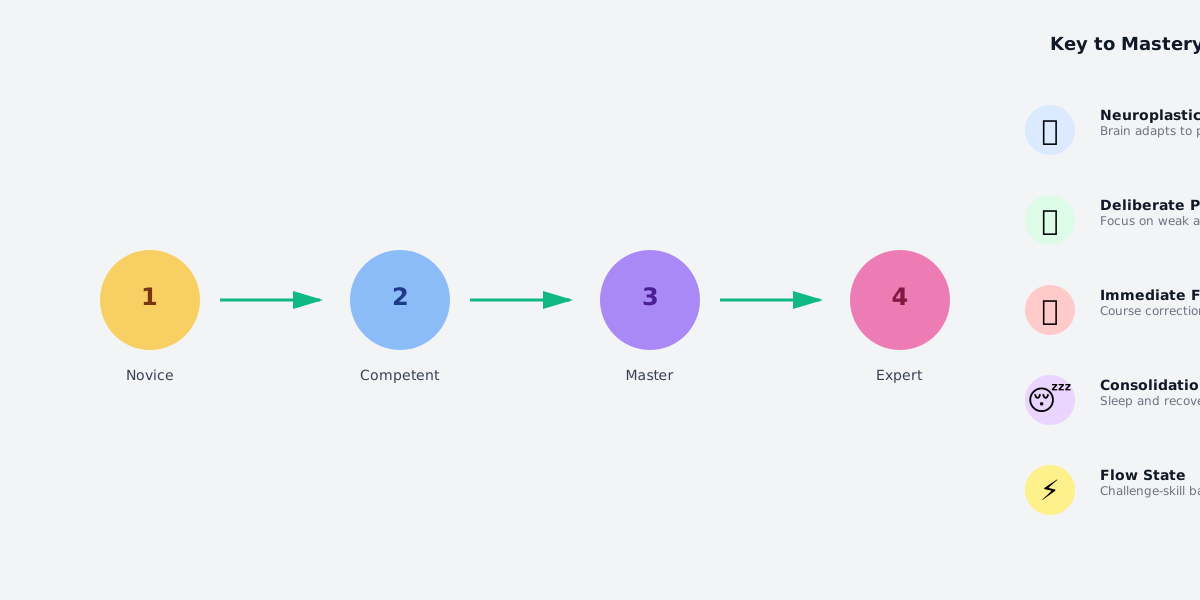
Mastery isn't reserved for the gifted few—it's a learnable process that anyone can access with the right approach to practice and mindset.
Whether you're learning a musical instrument, coding language, or professional skill, the principles of learning mastery remain consistent across domains.
What Is Learning Mastery?
Learning mastery is the systematic development of expertise through focused effort, deliberate practice, and continuous improvement. It combines behavioral skill-building with the brain's neuroplasticity—its remarkable ability to physically reorganize itself in response to learning demands. When you practice deliberately, your brain forms new neural connections, strengthening pathways that support the skill you're developing. This isn't passive learning; it's an active transformation of your brain's structure and function, resulting in genuine competence and confidence.
Not medical advice.
Mastery learning is an educational and personal development philosophy that ensures sustained progress toward a target level of proficiency. Rather than moving on once you "kind of know" something, mastery learning keeps you practicing until you achieve excellence. This approach has profound psychological benefits: as you see concrete progress over time, your self-efficacy grows exponentially, your confidence strengthens, and your sense of autonomy expands.
Surprising Insight: Surprising Insight: The first 20 hours of deliberate practice matters more than the next 10,000 hours. If you can push through the initial learning curve with focused effort and the right feedback, you can reach functional competence in nearly any skill remarkably quickly.
The Learning Mastery Journey
Three phases of skill development showing how practice and experience lead from novice to mastery
🔍 Click to enlarge
Why Learning Mastery Matters in 2026
In a rapidly changing world where skills become obsolete within years, the ability to master new competencies quickly is perhaps the most valuable skill you can develop. Learning mastery directly contributes to happiness because it activates intrinsic motivation—the most powerful and sustaining form of happiness. When you're working toward genuine mastery, you're not motivated by external rewards or validation; you're driven by the deep satisfaction of progressive improvement and growing capability.
The neuroscience of learning reveals that mastery activates your brain's reward systems differently than other achievements. Each small improvement triggers the release of dopamine, creating a feedback loop that makes learning itself inherently pleasurable. This means that investing in learning mastery isn't just about acquiring skills—it's about fundamentally rewiring your brain for sustained happiness and fulfillment.
Career advancement, personal fulfillment, and life satisfaction increasingly depend on your capacity to continuously learn and adapt. Mastery learning gives you a framework to remain relevant, confident, and engaged throughout your entire life, creating what researchers call a growth mindset—the belief that abilities can be developed through dedication and hard work.
The Science Behind Learning Mastery
Your brain is neuroplastic, meaning it physically changes in response to your learning efforts. Every time you practice deliberately—focusing intensely on areas just beyond your current capability and receiving immediate feedback—you strengthen neural pathways and create new connections between brain regions. This process, called long-term potentiation (LTP), is the neurological basis of learning. The more you activate these pathways, the more efficient and automatic they become, eventually allowing skilled performance to happen with minimal conscious effort.
Research from Stanford University and other leading institutions shows that understanding neuroplasticity itself enhances learning outcomes. Students who learn that their abilities can be developed through effort and practice show significantly improved grades and engagement compared to those who believe intelligence is fixed. This growth mindset is essential for sustained mastery development because you're more likely to persist through challenges when you understand that struggle is evidence of learning, not evidence of inadequacy.
Neuroplasticity and Learning Mastery
How focused practice activates brain plasticity and builds new neural pathways over time
🔍 Click to enlarge
Key Components of Learning Mastery
Deliberate Practice
Deliberate practice is focused, goal-directed effort targeting specific weaknesses in your current performance. It's fundamentally different from simply "putting in hours." Deliberate practice requires identifying exactly what you cannot yet do, practicing those specific skills, and using feedback to adjust your approach. Musicians practice difficult passages repeatedly; athletes film themselves to identify movement inefficiencies; programmers tackle problems slightly beyond their current level. This type of practice activates deeper learning than casual repetition.
Feedback Loops
Your brain learns through feedback—without knowing whether your attempts were correct or incorrect, improvement stalls. Immediate feedback is most powerful; the shorter the delay between attempt and correction, the faster learning occurs. This is why practicing with a teacher, coach, or mentor accelerates mastery, as they provide real-time guidance. Digital tools, video review, and peer feedback also create effective feedback loops that accelerate progress.
Progressive Challenge
Mastery requires continuously seeking challenges slightly beyond your current capability. If tasks are too easy, no learning occurs—your brain isn't being pushed to adapt. If tasks are too difficult, frustration and discouragement typically follow. The sweet spot is the edge of your capability, what researchers call the "zone of proximal development." This perfect balance between skill and challenge is exactly where flow states emerge, creating the happiness and engagement that makes mastery sustainable.
Spaced Repetition & Consolidation
Your brain consolidates learning during rest and sleep, not just during active practice. Research on mastery learning shows that spacing your practice sessions over time—rather than massed practice (cramming)—leads to dramatically better retention and transfer of skills. Studying the same material at intervals of increasing length (one day, three days, one week, one month) creates stronger, more durable memories and understanding compared to repeated practice in a single session.
| Factor | Traditional Learning | Mastery Learning |
|---|---|---|
| Retention Rate After 1 Month | 35-45% | 75-85% |
| Time to Functional Competence | Variable (months to years) | 20-100 hours focused practice |
| Student Self-Efficacy Growth | Modest | Exponential |
How to Apply Learning Mastery: Step by Step
- Step 1: Define your learning target with obsessive specificity. Instead of 'get better at public speaking,' define 'deliver a five-minute presentation with confident eye contact, natural pacing, and zero filler words.' Specificity activates your brain's learning systems more powerfully than vague aspirations.
- Step 2: Assess your current baseline honestly. Record yourself, take a skill inventory, or get external assessment from someone experienced. You cannot improve what you cannot measure. This baseline becomes your starting point for tracking progress.
- Step 3: Find a coach, mentor, or expert community. The fastest path to mastery includes guidance from someone further along the journey. They identify weaknesses you'd miss, provide course correction, and prevent wasted effort on ineffective techniques.
- Step 4: Break the skill into sub-components. Complex skills contain dozens of discrete sub-skills. Practice the piano? Work on finger independence, speed, expression, and sight-reading separately before integrating. Learning languages? Focus on pronunciation, grammar, listening, and speaking as distinct practice targets.
- Step 5: Implement daily deliberate practice sessions of 45-90 minutes maximum. Beyond 90 minutes, cognitive fatigue undermines learning quality. Consistency matters more than duration—practicing 60 minutes daily beats five-hour weekend sessions.
- Step 6: Create immediate feedback mechanisms. Set up video recording, use practice apps that track metrics, work with a partner who observes, or use software that evaluates your performance. The faster you know whether you succeeded, the faster you learn.
- Step 7: Practice the edge of your capability, not the comfort zone. Choose challenges slightly too difficult for your current level. If succeeding feels easy, raise the difficulty. If frustration exceeds engagement, simplify. The optimal challenge keeps you engaged and learning.
- Step 8: Implement spaced practice intervals. Rather than daily identical sessions, vary your practice focus and schedule. Practice Topic A on Monday, Topic B on Wednesday, return to Topic A on Friday with harder variations. This spacing dramatically improves retention.
- Step 9: Sleep is non-negotiable for mastery. During sleep, your brain consolidates learning, strengthens neural pathways, and prepares new brain tissue for tomorrow's practice. One all-nighter can undo a week of practice benefits. Protect your sleep like you protect your practice.
- Step 10: Track micro-progress and celebrate wins. Learning mastery is a marathon, not a sprint. Monthly progress tracking keeps you motivated and reveals whether your methods are working. If no progress appears in four weeks, your approach needs adjustment.
Learning Mastery Across Life Stages
Young Adulthood (18-35)
Your brain's neuroplasticity peaks during young adulthood, making this the ideal time to master foundational skills that will compound throughout your life. Whether developing professional expertise, athletic ability, artistic skills, or social competence, the learning speed and capacity you possess now won't return. The advantage isn't just neurological—you also have fewer competing responsibilities, more time, and higher motivation to invest in identity-defining skills. Young adulthood is your prime window for establishing mastery in multiple domains.
Middle Adulthood (35-55)
Middle adulthood brings competing demands—career, family, financial obligations—that can consume time and energy previously devoted to skill development. Yet this is also when you possess the judgment, patience, and realistic self-assessment necessary for deep mastery. You've accumulated experience that helps you learn smarter, not just harder. Many people achieve their deepest mastery during this phase because they're willing to embrace long-term practice over quick wins. Career transitions and new hobbies often flourish when mastery learning replaces dabbling.
Later Adulthood (55+)
While neuroplasticity slows with age, your brain remains capable of forming new connections and learning new skills throughout life. Older adults who engage in mastery learning report enhanced cognitive function, improved mental health, and greater life satisfaction. Learning mastery in later adulthood often carries deeper meaning—you're less interested in external validation and more focused on intrinsic fulfillment. Many people report that late-life mastery pursuits, whether artistic, intellectual, or physical, become among their greatest sources of happiness and purpose.
Profiles: Your Learning Mastery Approach
The Rapid Learner
- High challenge levels to stay engaged
- Variety in practice methods to prevent boredom
- Clear metrics and progress tracking
Common pitfall: Moving on to new skills before achieving true mastery; mistaking fast understanding for mastery
Best move: Set mastery thresholds before advancing. Commit to extended practice beyond initial competence to develop true expertise.
The Methodical Practitioner
- Clear step-by-step progression frameworks
- Detailed feedback and data on improvement
- Structured practice schedules and systems
Common pitfall: Becoming rigidly attached to methods even when they stop producing results; analysis paralysis
Best move: Schedule regular method reviews. If progress stalls after four weeks, experiment with different practice approaches while maintaining your systematic structure.
The Social Learner
- Community and peer support throughout the journey
- Group practice sessions and accountability partners
- Mentors and teachers to admire and learn from
Common pitfall: Relying entirely on external motivation and feedback; avoiding solo practice that demands self-reliance
Best move: Build peer accountability while developing independent practice skills. Use social motivation to sustain effort during the plateau phases where progress slows.
The Creative Experimenter
- Freedom to explore variations and unconventional approaches
- Balance between experimentation and focused fundamentals
- Permission to diverge from standard methods
Common pitfall: Skipping foundational skill-building in favor of immediate creative expression; inconsistent practice
Best move: Master fundamentals first through deliberate practice, then unleash creative variation. Your innovations will be stronger when built on solid technical foundations.
Common Learning Mastery Mistakes
The most common mistake is confusing familiarity with mastery. After 30 hours of practice, you feel comfortable with a skill, but true mastery requires pushing beyond comfortable competence into the refinement phase where you develop precision, speed, and the ability to apply knowledge in novel contexts. Stopping at comfortable competence guarantees you'll plateau and never experience the satisfaction and capability that genuine mastery creates.
Another pervasive error is practicing without feedback. You can play guitar for 10,000 hours and never improve past a certain level if you're practicing incorrect techniques without correction. Feedback isn't optional—it's the mechanism that tells your brain what adjustments create better outcomes. Without it, you're just repeating the same 100 hours of practice ten times rather than actually progressing.
Finally, many people sabotage mastery learning by ignoring the consolidation phase. You practice intensely all week, then sleep six hours and wonder why progress stalls. Your brain does its most important work during sleep, when it consolidates learning and prunes weak neural connections. Sacrifice sleep for practice, and you've sabotaged the entire learning system.
How Mistakes Derail Mastery
Common learning mistakes and how they prevent progression from novice to expert
🔍 Click to enlarge
Science and Studies
Research on mastery learning and skill development has flourished over the past decade, with fascinating discoveries about how our brains adapt, consolidate learning, and achieve expertise. The science consistently shows that deliberate practice, neuroplasticity, growth mindset, and strategic rest create a powerful formula for skill acquisition and lasting happiness.
- Bates, L.E., Myers, S.J., DeLosh, E.L., & Rhodes, M.G. (2025). The Learning Benefits of Mastery Quizzing Versus Other Quizzing Methods. Sage Journals shows that mastery-based quizzing produces superior long-term retention compared to traditional quizzing methods.
- Springer Education Research (2025). Impact of mastery learning instructional scheme on post-basic school students' engagement levels demonstrates that mastery learning significantly increases student engagement and psychological investment in learning.
- National Center for Biotechnology Information (2021). Neural plasticity of development and learning confirms that the brain's neuroplasticity continues throughout the lifespan, supporting lifelong skill acquisition and mastery.
- UNESCO Institute for Learning (2023). Neuroplasticity: How the brain changes with learning establishes that learning creates physical changes in brain structure, with repeated practice strengthening neural pathways through long-term potentiation.
- Psychology Today & Csikszentmihalyi Research (2024). Flow State and Happiness demonstrates that flow states—perfectly balanced challenge and skill—are among the most reliable predictors of happiness and fulfillment in daily life.
Your First Micro Habit
Start Small Today
Today's action: Identify one specific sub-skill within your learning target. Today, practice only that component deliberately for 15 minutes with full concentration, then record one specific improvement you noticed.
This micro-habit activates the core mechanism of mastery learning—focusing intensely on a specific weakness and receiving immediate feedback about improvement. One focused 15-minute session beats unfocused practice for hours, and tracking improvement builds the growth mindset that sustains long-term mastery.
Keep quitting habit apps after a missed day? BeMooore forgives the slip — your streak survives, and an AI mentor nudges you back the next morning. Free on iOS.
Quick Assessment
How do you typically approach learning something new?
Your learning approach reveals whether you naturally align with deliberate practice principles or whether you might benefit from adding structure, feedback, or community support to accelerate mastery.
What typically stops you from achieving mastery in skills you start learning?
Understanding what derails your learning efforts allows you to design systems and support structures that specifically address your particular obstacles to mastery.
When faced with a difficult challenge during learning, what's your instinct?
How you respond to difficulty during learning reveals whether you're likely to benefit from growth mindset training, coaching relationships, strategic rest, or refinement of your practice methods.
Take our full assessment to get personalized recommendations.
Discover Your Style →Next Steps
Your mastery journey begins not with grand plans but with specific commitment. Choose one skill you genuinely want to master—something that excites you and aligns with your identity and values. Don't choose based on external rewards or should-level thinking. Mastery is too demanding to sustain without genuine interest driving the effort.
Once you've chosen your skill, invest time finding a coach, mentor, or detailed instructional system that breaks the skill into learnable components and provides feedback. This investment upfront will compress your learning timeline and prevent years of wasted effort through ineffective practice. You're not just learning a skill—you're rewiring your brain for greater happiness, confidence, and capability.
Get personalized guidance with AI coaching.
Start Your Journey →Research Sources
This article is based on peer-reviewed research and authoritative sources. Below are the key references we consulted:
Related Glossary Articles
Frequently Asked Questions
How long does it actually take to achieve mastery?
The timeline depends on the complexity of the skill and your practice intensity. Simple skills (basic guitar songs, conversational language ability) typically take 20-100 hours of deliberate practice. Complex skills (professional music performance, technical expertise) may require 1,000-10,000 hours. However, the research shows that deliberate practice quality matters far more than raw hours—100 focused hours beats 1,000 hours of casual practice.
Can I master multiple skills simultaneously?
You can develop competence in multiple areas simultaneously, but true mastery typically requires concentrated focus. If you're pursuing multiple skills, dedicate specific time blocks to each rather than mixing them daily. Research on skill transfer shows that mastering related skills in sequence (fundamentals, then advanced techniques) produces stronger results than trying to master many unrelated skills at once.
Is learning mastery possible if I have limited time?
Absolutely. Even 30 minutes daily of deliberate, focused practice produces meaningful progress over time. Consistency matters more than duration. Ten focused minutes daily beats one two-hour session weekly. Use your limited time for high-quality deliberate practice rather than casual practice, and you'll still advance toward mastery.
What's the difference between flow state and mastery learning?
Mastery learning is the systematic development of expertise through deliberate practice and feedback. Flow state is the psychological experience that occurs when challenge and skill are perfectly balanced during that practice. Mastery learning creates the conditions for flow states, and flow states make mastery learning deeply pleasurable. They're complementary processes.
How does age affect my ability to achieve mastery?
While neuroplasticity peaks in young adulthood, your brain remains capable of learning and achieving mastery throughout life. Older adults often learn more strategically and patiently than younger learners, leading to deeper mastery in some domains. Age-related changes slow processing speed slightly but don't prevent expertise development. Start now, regardless of your age.
Take the Next Step
Ready to improve your wellbeing? Take our free assessment to get personalized recommendations based on your unique situation.
- Discover your strengths and gaps
- Get personalized quick wins
- Track your progress over time
- Evidence-based strategies