FIRE Calculator
Imagine knowing exactly how many years until you can stop working and live off your investments. A FIRE calculator is your financial compass, combining three powerful inputs—your current savings, annual expenses, and investment growth—to reveal when you'll achieve financial independence. The Financial Independence, Retire Early (FIRE) movement has transformed the way thousands approach wealth, shifting focus from climbing corporate ladders to building sustainable portfolios. Whether you dream of retiring at 40, traveling the world, or simply breaking free from the 9-to-5 grind, understanding how to use a FIRE calculator is your first concrete step toward that freedom.
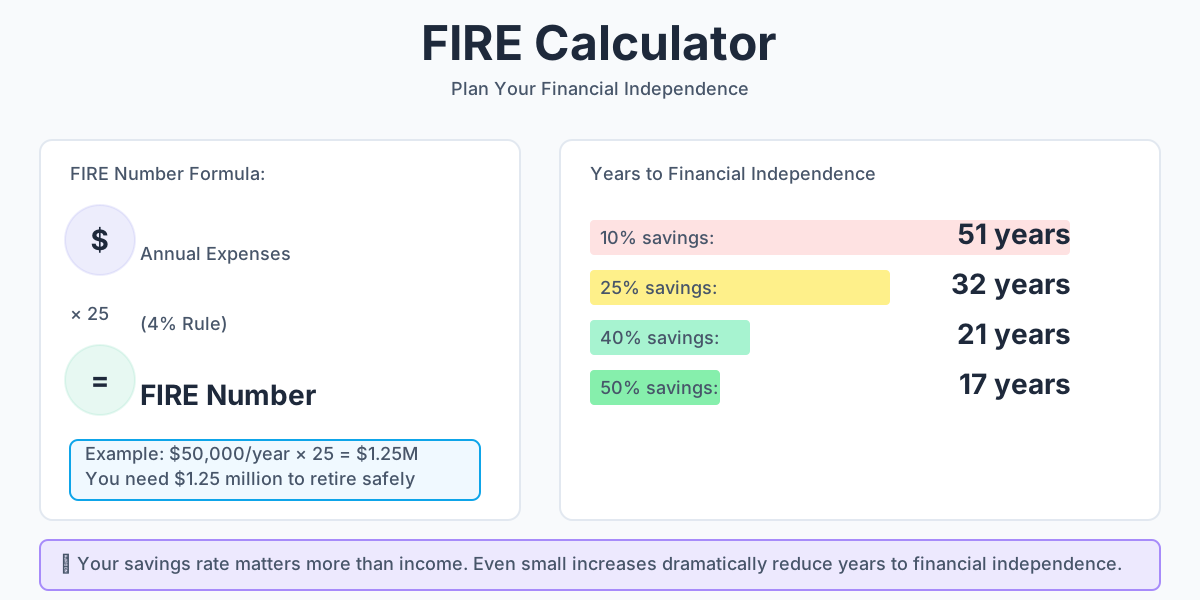
Most FIRE calculators use the 4% rule as their foundation—a principle suggesting you can withdraw 4% of your portfolio annually without running out of money across a 30+ year retirement. This simple yet powerful guideline has become the gold standard for early retirees worldwide.
The real power emerges when you plug in YOUR numbers and watch the timeline shift. Even small changes—increasing your savings rate from 30% to 40%, or adjusting your expected returns—can knock years off your path to freedom.
What Is FIRE Calculator?
A FIRE calculator is a digital tool that calculates how long until your invested wealth can sustain your lifestyle without active income. It combines your current net worth, annual expenses, monthly or annual savings contributions, and expected investment returns to project when you'll reach your FIRE number—the portfolio size needed to support your expenses indefinitely.
Not financial advice.
The calculator works by simulating portfolio growth using historical market data or your specified returns assumptions. It accounts for inflation, varying market conditions, and different asset allocations. Most modern calculators also include Monte Carlo simulations—statistical models that test whether your plan survives thousands of different market scenarios, including crashes and prolonged downturns. This goes beyond simple averages to show the probability of success.
Surprising Insight: Surprising Insight: Your savings rate matters more than your income. A person earning $50,000 who saves 50% reaches financial independence faster than someone earning $150,000 who saves only 20%—sometimes decades faster.
The FIRE Number Formula
Shows how annual expenses multiply by 25 to create your FIRE target, with real examples at different expense levels.
🔍 Click to enlarge
Why FIRE Calculator Matters in 2026
In 2026, the cost of living has risen significantly—housing, healthcare, and education now consume larger portions of income than ever. This makes precise financial planning essential. A FIRE calculator cuts through guesswork and shows you exactly what's achievable given current economic conditions. With inflation shifting from pandemic peaks to normalized levels, updated calculators now factor in realistic returns for 2026 market conditions where bonds yield higher returns than recent years past.
Career instability has increased many workers' interest in FIRE. Remote work flexibility and gig economy expansion mean more people can engineer their own financial timelines rather than following traditional retirement schedules. A FIRE calculator empowers you to ask: What if I work freelance part-time? What if I relocate to a lower-cost region? These scenario-testing capabilities help you build contingency plans.
Beyond personal finance, the FIRE movement has influenced policy discussions about pensions, early withdrawal penalties, and flexible work arrangements. Understanding your FIRE number means understanding your negotiating position—whether seeking that higher salary, a sabbatical, or career transition. For workers watching pension systems shrink, FIRE calculators represent taking personal control over retirement security.
The Science Behind FIRE Calculator
The foundation of FIRE calculators rests on the Trinity Study, groundbreaking research from Trinity University that analyzed historical market data from 1926-2009. Researchers tested whether a 4% initial withdrawal rate—adjusted annually for inflation—would allow a portfolio to survive 30-year retirement periods across various asset allocations. Their finding: a 75% stock / 25% bond portfolio succeeded in sustaining 4% withdrawals across 95% of historical periods tested. This wasn't theoretical—it was based on actual market history including the Great Depression.
Since 2010, researchers have updated and debated the 4% rule under new market conditions. Morningstar's 2025 research adjusted the safe withdrawal rate to 3.9% for 2026, accounting for current valuations where the Shiller CAPE ratio hovers around 27 compared to historical average of 17. Meanwhile, some researchers argue flexible withdrawal strategies—like the Guyton-Klinger guardrails approach—can safely support initial withdrawals of 5.2-5.6%, dynamically adjusting based on portfolio performance and market returns. The evolution reflects that one-size-fits-all rates deserve refinement.
Safe Withdrawal Rates: 2024-2026 Research
Comparison of different safe withdrawal rate recommendations from leading financial institutions.
🔍 Click to enlarge
Key Components of FIRE Calculator
Current Net Worth
Your starting point: the total value of all investments, savings, and assets you'll use to fund retirement. This includes stock portfolios, retirement accounts (401k, IRA, Roth), real estate equity, and cash reserves—but typically excludes your primary residence. An accurate net worth figure is crucial because you're starting the compounding clock from this baseline. Someone starting with $50,000 invested reaches financial independence roughly 5-7 years earlier than someone starting from zero, depending on other variables.
Annual Expenses & Savings Rate
The amount you need to live annually determines your FIRE number through the 25x multiplier. If you spend $50,000 yearly, you need $1.25 million. Savings rate—the percentage of income you invest—drives your timeline more than income itself. A 70% savings rate reaches financial independence in roughly 8.5 years at historical returns, while a 10% savings rate takes 51 years. The FIRE calculator visualizes how every percentage point of savings rate change accelerates or delays your timeline by months or years.
Expected Annual Returns
The growth rate your investments generate yearly, typically 6-8% for balanced portfolios based on historical stock market averages (long-term average ~10% for equities, ~2-3% for bonds). Higher expected returns compress timelines, but also introduce risk. Conservative estimates (5-6%) are safer planning assumptions. The calculator projects compound growth—where earnings generate their own earnings, exponentially accelerating wealth accumulation over decades.
Inflation Adjustment
The erosion of purchasing power over time. If inflation averages 2.5% yearly, $50,000 in expenses today requires about $58,000 annually 15 years from now. Good FIRE calculators account for this automatically, adjusting your withdrawals upward each year and stress-testing whether your portfolio survives inflation plus withdrawals simultaneously. This is essential for early retirements lasting 40-60 years or longer.
| Savings Rate | Annual Savings (on $75k income) | Years to FI |
|---|---|---|
| 10% | $7,500 | 51 years |
| 25% | $18,750 | 32 years |
| 40% | $30,000 | 21 years |
| 50% | $37,500 | 17 years |
| 70% | $52,500 | 8.5 years |
How to Apply FIRE Calculator: Step by Step
- Step 1: Calculate your annual expenses: Track or estimate what you actually spend yearly on housing, food, transportation, healthcare, entertainment, and other categories. Be honest—this number drives everything else.
- Step 2: Determine your FIRE number: Multiply annual expenses by 25 (based on the 4% rule). This is your target portfolio size. Example: $50,000 annual expenses × 25 = $1,250,000 FIRE number.
- Step 3: Assess current savings: Add up all investments, retirement accounts, and liquid savings you'll use for retirement. Exclude emergency funds and primary residence (typically).
- Step 4: Calculate monthly contributions: Determine how much you can consistently invest each month. Use your budget: income minus all expenses minus taxes equals available savings.
- Step 5: Choose your calculator: Visit tools like Engaging Data, The FIRE Calculator, Playing with FIRE, or OmniCalculator—all offer free versions with slightly different features and visualizations.
- Step 6: Input your data: Enter current savings, monthly contributions, annual expenses, expected annual returns (6-8% is standard), and inflation rate (2-3% is typical for 2026).
- Step 7: Review the results: The calculator projects your retirement date and FIRE milestone. Most show both a single-point estimate and success rate across different market scenarios.
- Step 8: Run sensitivity analysis: Adjust one variable at a time to see impact. What if you save 10% more? What if returns are 1% lower? This reveals which factors most control your timeline.
- Step 9: Test different FIRE types: Try scenarios for Lean FIRE (lower spending), Fat FIRE (higher spending), or Coast FIRE (letting investments grow without contributions). Understand trade-offs.
- Step 10: Create an action plan: Based on results, identify whether you need to increase income, reduce expenses, or extend your timeline. Set specific, measurable goals for the next 3-6 months.
FIRE Calculator Across Life Stages
Young Adulthood (18-35)
This is your advantage phase. Time compounds your money more powerfully than any other period. Someone who invests $10,000 at age 25 and earns 7% annually reaches $76,000 by age 60, but investing the same $10,000 at age 45 only reaches $29,000. Young adults often have flexibility to live frugally, pursue high-income skills, and establish investing habits. The FIRE calculator typically shows aggressive timelines here—reaching financial independence by 35-40 is possible with 50%+ savings rates. The mindset shift matters most: viewing FIRE as achievable rather than impossible dramatically increases follow-through.
Middle Adulthood (35-55)
This phase often balances higher earning potential with family obligations—mortgages, children's education, aging parent care. The FIRE calculator becomes more nuanced. Many pursue Coast FIRE (contributions stop, portfolio grows) or Barista FIRE (part-time work covers expenses). Mid-career professionals often have their highest income years, creating opportunities for accelerated savings. Market downturns matter more at this stage—a 30% market crash impacts a $500,000 portfolio far differently than a $100,000 one. Recalculating annually ensures plans adapt to life changes and market conditions.
Later Adulthood (55+)
Workers approaching traditional retirement age (55-70) use FIRE calculators differently, often assessing whether they've reached traditional retirement readiness rather than aggressive early targets. Some discover they've already achieved FIRE years earlier and didn't realize it—the psychological shift from 'must work' to 'choose to work' is powerful. Social Security planning integrates here: will you claim at 62 (reduced benefits), 67 (full retirement age), or 70 (maximum)? The FIRE calculator helps quantify this decision's impact on your portfolio withdrawal needs.
Profiles: Your FIRE Calculator Approach
The Aggressive Accumulator
- High savings rate focus (50-70%)
- Realistic return projections (not inflated estimates)
- Aggressive but diversified investment strategy
Common pitfall: Burnout from unsustainable frugality before reaching the target. Sacrificing health, relationships, or career development for speed.
Best move: Calculate your Lean FIRE number first—the minimum viable retirement. Then add 20-30% cushion for lifestyle flexibility. Sustainability beats speed.
The Coast FIRE Explorer
- Mid-range savings rate (30-40%)
- Flexibility to reduce or pause contributions later
- Long-term perspective (20-30 year horizon)
Common pitfall: Underestimating inflation's impact. A $1 million target today might need $1.6 million in 25 years depending on inflation.
Best move: Run the calculator with 3-4% inflation assumptions, not 2%. Build a buffer and monitor annually. Expect to adjust as life happens.
The Barista FIRE Seeker
- Moderate savings rate (25-40%)
- Portfolio sized to cover 60-80% of expenses
- Part-time work generating 20-40% of expenses
Common pitfall: Overestimating part-time income reliability. Market downturns coinciding with reduced work availability create stress.
Best move: Calculate your full FIRE number anyway. Size part-time income as bonus margin, not necessity. Gives true financial flexibility.
The Fat FIRE Planner
- Higher expense target ($75k-$150k+ annually)
- Significant current assets or high income
- Comfort with larger portfolio requirements
Common pitfall: Assuming 4% rule applies equally at higher withdrawals. Larger portfolios face concentration risk and tax complexity.
Best move: Work with a fee-only financial advisor on tax-optimized withdrawal strategies. Consider 3.5-3.75% withdrawal rates. Factor in estate planning.
Common FIRE Calculator Mistakes
Using inflated return expectations is the most dangerous error. Assuming 10-12% annual returns when planning because that's the long-term stock market average ignores sequence-of-returns risk. If you retire in a year when markets drop 30%, you're forced to sell investments at low prices to fund withdrawals. Most financial advisors recommend 6-8% in calculations—well below historical averages and more realistic for future conditions with current valuations.
Forgetting to account for large one-time expenses trips up planners. Most calculators project steady annual expenses, but retirement typically includes healthcare surprises, home repairs, aging parent support, or helping adult children. Smart users add 10-20% buffer to their FIRE number or create separate calculations for 'normal years' versus 'shock years.' This flexibility prevents plans from breaking under real-world pressure.
Ignoring tax implications leads to unpleasant surprises. Early retirees face special challenges: penalties for accessing traditional 401k/IRA funds before 59½ (mitigated by Roth conversions and Rule 72(t), but complex), plus figuring out where to live for tax efficiency. A FIRE calculator showing $1.2 million needed is misleading if you haven't considered whether you need pre-tax or after-tax dollars, location tax burden, or healthcare costs before Medicare at 65.
Common FIRE Planning Errors & Impact
Shows how common mistakes shift your actual years to financial independence.
🔍 Click to enlarge
Science and Studies
FIRE calculators are built on decades of financial research, primarily the foundational Trinity Study and its modern interpretations. These tools synthesize academic findings on sequence of returns risk, inflation effects, and portfolio sustainability into accessible planning software.
- Trinity Study (1998): The original research testing 4% rule across historical market periods from 1926-1995, finding 95% success rate for 30-year retirements—still influences calculator design today.
- Morningstar Safe Withdrawal Rate Research (2025): Updated analysis recommending 3.9% for 2026 based on current market valuations and forward-looking return models.
- FIRECalc Historical Simulations: Online tool that stress-tested FIRE plans against every historical market period since 1871, revealing vulnerabilities in certain starting periods.
- Big ERN's Safe Withdrawal Rate Research: Detailed academic analysis suggesting 3.25-3.5% for 50-60 year retirements, particularly valuable for early retirees.
- Guyton-Klinger Guardrails Study: Dynamic withdrawal strategy research showing flexible approaches can sustain 5.2-5.6% initial withdrawals with rules-based adjustments.
Your First Micro Habit
Start Small Today
Today's action: This week, track one day of actual spending across all categories. Write down what you spent on housing, food, transportation, entertainment, and other items. This real data feeds directly into your FIRE calculator and makes your target concrete rather than abstract.
Tracking reveals your actual spending versus estimated spending—usually shocking. Once you know your real number, the FIRE calculator suddenly becomes personal and motivating rather than theoretical. Many people discover they're closer to FI than they thought.
Track your spending and financial goals with our app's wealth module for personalized insights on your path to financial independence.
Quick Assessment
How would you describe your current relationship with money and financial planning?
Your answer reveals whether you need a FIRE calculator for optimization, motivation, or confidence-building. Each starting point needs different support.
What appeals most about the idea of financial independence?
Your primary motivation shapes which FIRE variant suits you best—early retirement, coast FIRE, barista FIRE, or traditional FI with career flexibility.
How would you rate your ability to maintain a high savings rate long-term?
This determines your realistic timeline. A 50% savings rate reaches FI in ~17 years; 25% rate takes ~32 years. Honesty here prevents burnout.
Take our full assessment to get personalized recommendations.
Discover Your Style →Next Steps
Armed with understanding of FIRE calculators and the 4% rule, your immediate action is identifying which calculator matches your style. Try Engaging Data for simplicity and visual clarity, Playing with FIRE for community features, or FIRECalc for historical stress-testing. Each offers slightly different insights. Spend 15 minutes plugging in your numbers—don't overthink it. Your first estimate will likely be humbling, either revealing you're closer to FI than expected or showing the distance ahead. Either way, having a concrete number transforms FIRE from abstract dream to measurable milestone.
Then, focus on the levers you can control: increasing savings rate and managing expenses. While you can't directly control market returns, you can direct them through asset allocation and tax-efficiency. The FIRE calculator becomes your personal accountability tool—watching your timeline shrink as savings rate increases is powerfully motivating. Many early retirees report the psychological shift happened when they first calculated their FI number, suddenly understanding that retirement wasn't distant luxury but achievable future.
Get personalized guidance with AI coaching.
Start Your Journey →Research Sources
This article is based on peer-reviewed research and authoritative sources. Below are the key references we consulted:
Related Glossary Articles
Frequently Asked Questions
Is the 4% rule still valid in 2026?
The 4% rule remains a useful starting point, but modern research suggests adjustments may be prudent. Morningstar recommends 3.9% for 2026, while researchers studying 50-60 year retirements suggest 3.25-3.5%. The original Trinity Study's 4% applied to 30-year retirements with specific asset allocations. For early retirees, being slightly more conservative—aiming for 3.5-3.75% instead—adds safety margin without dramatically extending work years.
What's the difference between FIRE, Lean FIRE, and Fat FIRE?
FIRE is the core concept: accumulating 25x your annual expenses. Lean FIRE targets lower spending (often $25k-$40k annually), reaching independence faster but with minimal lifestyle flexibility. Fat FIRE aims for $100k+ annual spending, enabling comfortable retirement with luxury and flexibility. Coast FIRE means saving enough by mid-career that you can stop contributing and let investments grow to full amount. Barista FIRE keeps working part-time to cover some expenses while living off portfolio growth.
How accurate are FIRE calculators?
FIRE calculators are models—useful frameworks, not crystal balls. They typically assume constant annual expenses, steady returns, and no major life changes (health crises, family support needs, career changes). Real retirement involves variability. Use calculators to understand relationships between variables: How much do expenses matter? How sensitive is timing to return assumptions? Most serious planners recalculate annually and stress-test against multiple scenarios rather than trusting a single projection.
Should I use average annual returns or be more conservative?
Conservatism in planning is prudent. Long-term stock market averages are around 10%, but this includes periods of recovery from severe crashes. Using 6-8% in calculations accounts for current market valuations being higher than historical averages and provides buffer. Some planners use 5% to add extra safety. The trade-off: more conservative assumptions extend timelines but reduce the chance of planning failure due to poor market timing.
What happens if markets crash right after I retire?
This is sequence-of-returns risk—the greatest threat to early retirement plans. If you retire and markets drop 30% immediately, you're forced to withdraw 4% from a portfolio now worth 30% less, depleting it faster. Mitigation strategies include holding 2-3 years of expenses in bonds/cash (a 'bucket strategy'), working part-time during downturns, or using flexible withdrawal rates that decrease when markets underperform. Most FIRE calculators now include Monte Carlo simulations testing thousands of market scenarios to show success probability.
Take the Next Step
Ready to improve your wellbeing? Take our free assessment to get personalized recommendations based on your unique situation.
- Discover your strengths and gaps
- Get personalized quick wins
- Track your progress over time
- Evidence-based strategies