Coast FIRE
Imagine reaching a point in your life where you never have to save another dollar for retirement. Your <a href="/g/investment-strategies.html">investments</a> are already planted, growing quietly in the background, and all you need to do is cover your current <a href="/g/expense-tracking.html">expenses</a>. That is the promise of Coast FIRE, a powerful variation of the <a href="/g/fire-movement.html">FIRE movement</a> that is changing how thousands of people think about work, money, and freedom. Instead of grinding for decades to build an enormous nest egg, Coast FIRE asks a simpler question: what if you saved aggressively now so you could coast later?
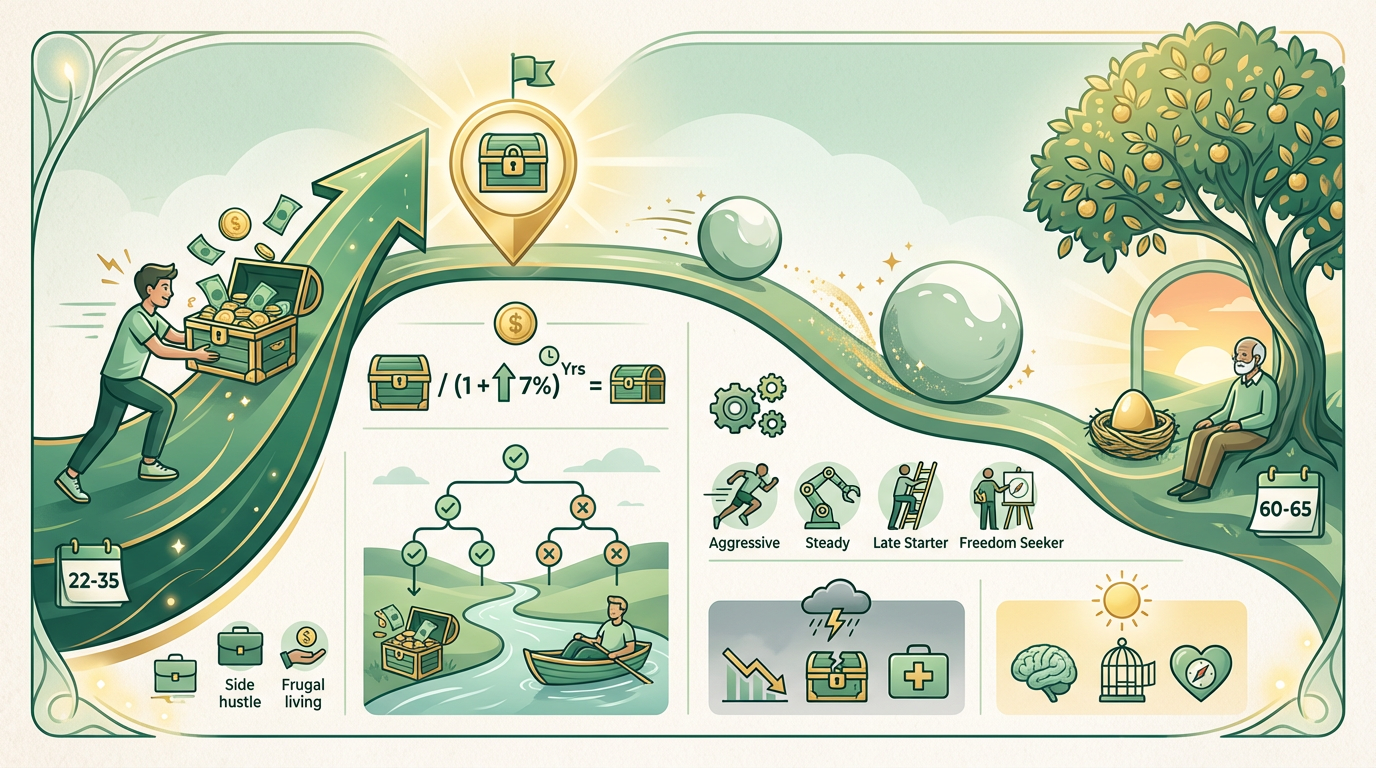
In this guide, you will discover exactly how Coast FIRE works, how to calculate your personal coast number, what separates it from <a href="/g/barista-fire-strategy.html">Barista FIRE</a> and traditional retirement planning, and why this approach may be the most realistic path to <a href="/g/financial-freedom.html">financial freedom</a> for everyday people.
Whether you are twenty-five and just starting your career or forty-five and feeling behind, Coast FIRE offers a framework that puts compound interest to work so you can reclaim your time, reduce your burnout, and design a life that actually feels worth living.
What Is Coast FIRE?
Coast FIRE is a milestone within the broader financial independence movement where you have saved enough money in your investment accounts that, without any additional contributions, your portfolio will grow to your target retirement amount by your chosen retirement age. The magic ingredient is compound interest: your money earns returns, those returns earn returns, and the snowball keeps rolling downhill without you pushing it.
Not medical advice.
Once you reach your Coast FIRE number, you no longer need to save for retirement. You still need to work, but only enough to cover your present-day living expenses. This means you could switch to a lower-paying job you love, go part-time, freelance, or pursue entrepreneurship without the pressure of funding a retirement account. Your future self is already taken care of by the investments you made earlier.
The concept draws its power from the mathematics of compounding. Historically, the U.S. stock market has returned roughly seven percent annually after inflation. At that rate, a portfolio doubles approximately every ten years. A thirty-year-old with two hundred thousand dollars invested would see that grow to roughly eight hundred thousand by age fifty and over one point six million by age sixty, all without adding a single dollar.
Surprising Insight: Surprising Insight: A twenty-five-year-old who invests just one hundred thousand dollars and never contributes again could have over one million dollars by age sixty, assuming a seven percent real return. That is the power of forty years of uninterrupted compounding.
Coast FIRE: How Your Money Grows Without New Contributions
This diagram shows how an initial investment grows through compound interest over decades without additional savings.
🔍 Click to enlarge
Why Coast FIRE Matters in 2026
Traditional retirement advice tells you to save fifteen percent of your income every year for forty years. For many people in 2026, that feels impossible. Housing costs have surged, student loan balances remain high, and wage growth has not kept pace with inflation in many sectors. Coast FIRE offers a realistic alternative: front-load your savings during your highest-earning years, then release the pressure once your financial security is mathematically guaranteed.
The mental health benefits are substantial. Research consistently shows that financial stress is one of the leading causes of anxiety and relationship conflict. By reaching your coast number, you remove the single biggest source of long-term financial worry. You still earn money to cover today, but the future is handled. That psychological shift transforms how you experience your career, your relationships, and your daily life balance.
Coast FIRE also aligns with a growing cultural shift toward intentional living. More people want work that is meaningful rather than merely profitable. They want to spend time with family, pursue creative projects, or travel while they are still young and healthy. Coast FIRE makes that possible without the extreme frugality or ultra-high income that traditional FIRE often demands. It is financial independence for the rest of us.
The Math Behind Coast FIRE
Understanding the Coast FIRE formula is essential for anyone serious about this strategy. Your coast number depends on three variables: your target retirement portfolio, your expected annual real return, and the number of years until you plan to retire. The formula is straightforward: Coast FIRE Number equals your Target Retirement Amount divided by the quantity of one plus your expected return raised to the power of years until retirement.
For example, if you want one point five million dollars by age sixty and you are currently thirty-five years old, with a seven percent real return over twenty-five years, your coast number is roughly two hundred seventy-six thousand dollars. Once your investment portfolio reaches that amount, you can stop contributing and let compounding do the rest.
The target retirement amount itself comes from the four percent rule, a widely used guideline in retirement planning. If you expect to spend sixty thousand dollars per year in retirement, you need twenty-five times that amount, or one point five million dollars. Some planners use a more conservative three point five percent withdrawal rate, which would require a larger portfolio but offers more safety margin.
Coast FIRE Number by Age and Target
This diagram shows how your required coast number decreases the earlier you start, because compound interest has more time to work.
🔍 Click to enlarge
Key Components of Coast FIRE
Aggressive Early Saving
The foundation of Coast FIRE is front-loading your savings. During your twenties and early thirties, you maximize contributions to tax-advantaged accounts like 401(k)s, IRAs, and Roth accounts. This requires disciplined budgeting, smart spending, and often side hustles to boost your savings rate. The goal is to reach your coast number as quickly as possible so compound interest has the maximum number of years to work.
Compound Interest as Your Engine
Albert Einstein allegedly called compound interest the eighth wonder of the world. Whether or not he actually said it, the math is undeniable. At seven percent real annual returns, your money doubles roughly every ten years. At ten percent nominal returns, it doubles every seven years. The longer your money compounds without withdrawal, the more powerful the effect becomes. This is why starting early is so critical to the Coast FIRE strategy and why financial literacy in your twenties pays enormous dividends.
Covering Current Expenses
Once you reach your coast number, your only financial obligation is covering your present-day living costs. This opens up enormous flexibility. You might keep your current job but stop stressing about promotions. You might switch to a career that pays less but brings more fulfillment. You might work three days a week instead of five. The key is that every dollar you earn goes toward today, not tomorrow. Your expense tracking becomes simpler because you only need to match income to current spending.
Investment Strategy and Asset Allocation
Coast FIRE works best with a growth-oriented investment strategy. Since your money needs decades to compound, you want exposure to assets with higher expected returns, typically broad stock market index funds. Diversification across domestic and international equities, along with appropriate bond allocation as you approach retirement, helps manage risk while maintaining growth potential. Many Coast FIRE adherents use simple three-fund portfolios and keep costs low with index funds.
| Current Age | Retire at 60 | Retire at 65 |
|---|---|---|
| 25 | $196,000 | $143,000 |
| 30 | $275,000 | $200,000 |
| 35 | $386,000 | $281,000 |
| 40 | $541,000 | $394,000 |
| 45 | $759,000 | $553,000 |
How to Calculate Your Coast FIRE Number
- Step 1: Determine your desired annual spending in retirement. Be realistic about your lifestyle expectations, including housing, healthcare, travel, and daily living costs. Most people need between forty and eighty thousand dollars per year in today's dollars.
- Step 2: Multiply your annual spending by twenty-five to find your target retirement portfolio using the four percent rule. For example, sixty thousand dollars times twenty-five equals one point five million dollars.
- Step 3: Choose your target retirement age. Traditional retirement at sixty-five gives your money more time to grow, while retiring at sixty requires a larger coast number today.
- Step 4: Select your expected real rate of return. Seven percent is a common assumption based on historical U.S. stock market data after inflation. Use six percent for more conservative projections.
- Step 5: Calculate years until retirement by subtracting your current age from your target retirement age.
- Step 6: Apply the Coast FIRE formula: divide your target retirement amount by one plus your return rate raised to the power of years remaining. Use an online Coast FIRE calculator to double-check your math.
- Step 7: Compare your current <a href="/g/investment-strategies.html">investment portfolio</a> balance to your coast number. If you have already reached it, congratulations: you are Coast FIRE.
- Step 8: If you have not reached your coast number yet, calculate your gap and determine how much you need to save each month to close it. Factor in employer <a href="/g/passive-income.html">matching contributions</a> and any expected windfalls.
- Step 9: Set up automatic contributions to your <a href="/g/financial-planning.html">investment accounts</a> and track your progress monthly. Use <a href="/g/budgeting-apps.html">budgeting apps</a> to stay on course.
- Step 10: Once you hit your coast number, celebrate the milestone and begin redesigning your work life. Gradually shift toward covering only current <a href="/g/expense-tracking.html">expenses</a> and enjoy the freedom you have earned.
Coast FIRE vs Barista FIRE
Coast FIRE and Barista FIRE are both variations of the FIRE movement, but they work differently and suit different personality types. Understanding the distinction helps you choose the path that matches your goals and risk tolerance.
With Coast FIRE, you reach a savings milestone and then stop contributing to retirement accounts. You continue working full-time or part-time, but only to cover current living expenses. Your invested money grows untouched until traditional retirement age. You never draw from your portfolio early.
Barista FIRE, by contrast, means you have saved enough to cover most of your retirement needs but plan to supplement with part-time work income during your early retirement years. You might actually begin withdrawing from your portfolio sooner, with part-time work filling the gap. The name comes from the idea of working a flexible job like a barista for benefits and supplemental income.
The key difference is timing and withdrawal. Coast FIRE keeps your portfolio completely untouched until traditional retirement. Barista FIRE may involve partial withdrawals earlier, paired with part-time income. Coast FIRE requires less total savings than full FIRE but more than Barista FIRE. However, Coast FIRE keeps you working longer before you can fully step away, while Barista FIRE offers more immediate lifestyle freedom at the cost of ongoing part-time employment.
Coast FIRE Across Life Stages
Young Adulthood (18-35)
This is the golden window for Coast FIRE. Every dollar invested in your twenties has thirty-five to forty years to compound, making it extraordinarily powerful. A twenty-two-year-old who saves aggressively for just ten years can potentially reach their coast number by thirty-two. The challenge at this stage is often low income, student debt, and competing financial priorities. Focus on maximizing your savings rate, even if it means living frugally and using multiple income sources. The sacrifices made now are temporary, but the compounding benefits are permanent.
Middle Adulthood (35-55)
If you are in your late thirties or forties and have been consistently saving, you may already be close to or past your coast number without realizing it. Check your portfolio against the coast formula. If you have not reached it, the good news is that mid-career earnings are typically at their peak, so you can accelerate savings. Many people in this stage also benefit from eliminating remaining debt, building an emergency fund, and streamlining expenses. Reaching Coast FIRE in your forties still gives your money fifteen to twenty-five years to compound.
Later Adulthood (55+)
At this stage, Coast FIRE becomes less about coasting and more about confirming that your existing portfolio will sustain you through retirement. With only five to ten years until traditional retirement, the compounding runway is shorter, and you may want to shift toward a more conservative asset allocation. However, if you reached your coast number earlier and let it compound, you may find yourself with significantly more than your target, giving you options for early retirement, generous giving, or generational wealth building.
Profiles: Your Coast FIRE Approach
The Aggressive Saver
- High savings rate of fifty percent or more during peak earning years
- Willingness to live below your means and delay gratification
- Strong understanding of <a href="/g/investment-strategies.html">investing</a> and compound growth
Common pitfall: Burnout from extreme frugality leading to emotional spending binges that derail progress
Best move: Set a realistic timeline of eight to twelve years to reach your coast number and allow occasional lifestyle spending to stay motivated
The Steady Builder
- Consistent twenty to thirty percent savings rate over fifteen to twenty years
- Automated <a href="/g/financial-management.html">financial systems</a> that require minimal willpower
- Patience to let compound interest work without checking balances obsessively
Common pitfall: Lifestyle inflation eroding your savings rate as income grows over your career
Best move: Automate savings increases with every raise and review your coast number annually to stay on track
The Late Starter
- Aggressive catch-up contributions using maximum 401(k) and IRA limits
- Immediate <a href="/g/debt-reduction.html">debt elimination</a> to free up cash flow for investing
- Realistic expectations about reaching Coast FIRE by your mid-to-late forties
Common pitfall: Feeling overwhelmed by the gap between current savings and the coast number, leading to paralysis
Best move: Focus on what you can control today, increase income through <a href="/g/side-hustles.html">side hustles</a> or <a href="/g/career-advancement.html">career advancement</a>, and celebrate each milestone along the way
The Freedom Seeker
- Clear vision of what post-coast life looks like, including passion projects and <a href="/g/simple-living.html">simple living</a>
- Willingness to accept a lower income after reaching the coast number
- Strong <a href="/g/financial-planning.html">financial planning</a> skills to manage expenses without retirement contributions
Common pitfall: Reaching the coast number but being afraid to actually reduce work hours or change careers
Best move: Start transitioning gradually by cutting one work day per week or taking a sabbatical to test your post-coast lifestyle before making permanent changes
Common Coast FIRE Mistakes
The most dangerous Coast FIRE mistake is using overly optimistic return assumptions. If you calculate your coast number using a ten percent nominal return but inflation runs at four percent, your real return is only six percent. Using seven percent real returns is reasonable based on historical data, but markets do not deliver smooth returns every year. A prolonged bear market in your early compounding years could significantly delay when your portfolio reaches your target. Always run your calculations with both optimistic and conservative scenarios, and consider having a buffer of ten to twenty percent above your coast number.
Another common error is ignoring healthcare costs. If you plan to reduce your work hours or leave full-time employment after reaching Coast FIRE, you may lose employer-sponsored health insurance. In the United States, individual health insurance premiums can cost thousands of dollars per year, and this expense must be factored into your current living costs. Failing to account for healthcare is one of the fastest ways to blow your financial stability after coasting.
A third mistake is reaching your coast number and then raiding your retirement accounts. Coast FIRE only works if you leave your investments completely untouched until retirement. Early withdrawals trigger penalties, taxes, and destroy the compounding effect that makes the entire strategy possible. Maintain a separate emergency fund and keep your retirement accounts locked away. Treat them as though they do not exist until you actually retire.
Coast FIRE Decision Framework
A decision tree to help you determine whether Coast FIRE is right for your situation.
🔍 Click to enlarge
Building Your Coast FIRE Strategy
A successful Coast FIRE strategy begins with clarity about your numbers and your values. Start by tracking every dollar you spend for at least three months using an expense tracking system. This gives you a realistic picture of your current lifestyle costs and helps you identify areas where you can redirect money toward wealth building. Many people discover they spend hundreds of dollars monthly on subscriptions, dining out, and impulse purchases that add little to their life satisfaction.
Next, establish your financial strategy hierarchy. Before aggressively saving for Coast FIRE, make sure you have eliminated high-interest debt, built a three to six month emergency fund, and are contributing enough to your employer plan to capture any matching funds. These foundational steps protect you from setbacks that could force you to withdraw from your Coast FIRE portfolio.
Consider using passive income strategies to accelerate your journey. Dividend-paying investments, rental income, or business income can all be reinvested to help you reach your coast number faster. The more income streams you develop now, the easier it becomes to cover your expenses once you stop saving for retirement.
The Psychology of Coasting
Reaching your Coast FIRE number is a mathematical achievement, but the psychological transition can be surprisingly difficult. After years of aggressive saving, many people struggle to actually stop. They feel guilty spending money they could be investing. They worry that their calculations might be wrong or that a market crash will erase their progress. This anxiety is normal, and it is rooted in the same financial psychology that drove them to save so intensely in the first place.
The solution is to build confidence through education and community. Run your Coast FIRE calculations using multiple tools and scenarios. Talk to others who have reached Coast FIRE in online communities and forums. Consider working with a fee-only financial advisor who can validate your plan. The more evidence you gather that your numbers work, the easier it becomes to trust the math and actually enjoy the freedom you have earned.
Identity is another challenge. If you have defined yourself as a hard-charging saver for a decade, who are you when you stop? Coast FIRE is an invitation to redefine your relationship with work and money. Instead of working for retirement, you work for meaning. Instead of measuring success by your savings rate, you measure it by your contentment, your relationships, and your impact. This shift requires intentional living and often involves exploring new interests, deepening connections, and finding fulfillment beyond your bank balance.
Science and Studies
The financial principles underlying Coast FIRE are well-established in academic research. The four percent rule originated from William Bengen's 1994 study of historical market returns and was later validated by the Trinity Study at Trinity University. Research on compound interest and long-term equity returns has been published extensively by leading financial economists. While Coast FIRE as a named strategy is relatively new, the mathematical foundations have been studied for decades.
- Bengen, W. (1994). Determining Withdrawal Rates Using Historical Data. Journal of Financial Planning. Established the four percent safe withdrawal rate that underpins Coast FIRE target calculations.
- Cooley, P., Hubbard, C., Walz, D. (1998). Retirement Savings: Choosing a Withdrawal Rate That Is Sustainable. Trinity University. The Trinity Study confirmed sustainable withdrawal rates across various market conditions.
- Ibbotson, R. & Sinquefield, R. (2023). Stocks, Bonds, Bills, and Inflation Yearbook. Morningstar. Documents long-term market returns of approximately seven percent real for U.S. equities.
- Lusardi, A. & Mitchell, O. (2014). The Economic Importance of Financial Literacy. Journal of Economic Literature. Research showing that financial literacy directly correlates with better retirement planning outcomes.
- Hershfield, H. et al. (2011). Increasing Saving Behavior Through Age-Progressed Renderings. Journal of Marketing Research. Demonstrates psychological techniques that help people connect with their future selves and save more effectively.
Your First Micro Habit
Start Small Today
Today's action: Spend five minutes this week using a free online Coast FIRE calculator to find your personal coast number based on your current age, savings, and retirement goals.
Calculating your specific number transforms Coast FIRE from an abstract concept into a concrete, motivating target. Research shows that specific financial goals increase savings behavior by up to forty percent compared to vague intentions.
Keep quitting habit apps after a missed day? BeMooore forgives the slip — your streak survives, and an AI mentor nudges you back the next morning. Free on iOS.
Quick Assessment
How would you describe your current approach to retirement savings?
Your current savings approach reveals whether Coast FIRE could reduce your financial stress. Even if you feel behind, calculating your coast number may show you are closer to freedom than you think.
What would you do if you no longer needed to save for retirement?
Your answer reveals your Coast FIRE motivation. Understanding what freedom looks like to you makes the saving phase more sustainable because you have a clear vision to work toward.
How comfortable are you with trusting compound interest to grow your retirement savings?
Your comfort with compound interest directly affects whether Coast FIRE is the right strategy for you. Those who struggle with trusting the math may benefit from a hybrid approach that includes small ongoing contributions for peace of mind.
Take our full assessment to get personalized recommendations for your financial independence journey.
Discover Your Financial Wellbeing Style →Next Steps
Coast FIRE is not about depriving yourself today or obsessing over spreadsheets. It is about making smart, front-loaded decisions with your money so that compound interest can carry you toward financial freedom. Start by calculating your coast number, assess where you stand today, and build a savings plan that bridges the gap. Every dollar you invest now is a brick in the foundation of your future independence. Explore related strategies like early retirement planning, passive income, and wealth building to strengthen your overall financial health.
Remember that Coast FIRE is a journey, not a destination. The real reward is not just the money growing in your accounts but the freedom, clarity, and peace of mind that come from knowing your future is secure. Whether you reach your coast number in five years or fifteen, every step you take toward it brings you closer to a life defined by choice rather than obligation. Take the first step today and let compound interest become your most powerful ally on the path to financial independence.
Get personalized guidance with AI coaching.
Start Your Financial Independence Journey →Research Sources
This article is based on peer-reviewed research and authoritative sources. Below are the key references we consulted:
Related Glossary Articles
Frequently Asked Questions
What is a good Coast FIRE number?
Your Coast FIRE number depends on your desired retirement spending, target retirement age, and expected investment returns. For someone wanting sixty thousand dollars per year in retirement at age sixty with a seven percent real return, a thirty-year-old would need approximately two hundred seventy-five thousand dollars. Use a Coast FIRE calculator with your specific numbers to find your personal target.
Is Coast FIRE realistic for average income earners?
Yes. Coast FIRE is often more achievable than traditional FIRE because it does not require you to accumulate your entire retirement portfolio before stopping work. By starting early and saving aggressively for ten to fifteen years, even average earners can reach their coast number. The strategy rewards time in the market more than income level.
What happens if the market crashes after I reach Coast FIRE?
Market downturns are a normal part of investing. If you have a long compounding runway of fifteen to twenty-five years, your portfolio has ample time to recover from even severe bear markets. Historically, the U.S. stock market has recovered from every crash. Building a ten to twenty percent buffer above your coast number provides additional protection.
Can I reach Coast FIRE with debt?
It is possible but not recommended. High-interest debt like credit cards should be eliminated before focusing on Coast FIRE, since the interest you pay likely exceeds your investment returns. Low-interest debt like a mortgage can coexist with Coast FIRE investing, but factor the payments into your current expense calculations.
How is Coast FIRE different from regular FIRE?
Traditional FIRE requires building a portfolio large enough to cover all living expenses indefinitely, allowing you to stop working entirely. Coast FIRE only requires saving enough for compound interest to reach your retirement target, meaning you still work to cover current expenses but stop saving for the future. Coast FIRE is a milestone on the way to full FIRE and is achievable much sooner.
Should I still invest after reaching Coast FIRE?
Technically, no. Once you hit your coast number, your retirement is mathematically handled. However, many people choose to continue investing at a reduced rate for extra security or to reach full financial independence sooner. Any additional investing after Coast FIRE is a bonus, not a requirement.
What accounts should I use for Coast FIRE?
Tax-advantaged retirement accounts are ideal for Coast FIRE because they grow tax-deferred or tax-free. Maximize your 401(k) or 403(b) employer match first, then contribute to a Roth IRA for tax-free growth. Additional savings can go into a taxable brokerage account for flexibility. The key is choosing low-cost, diversified index funds regardless of account type.
Take the Next Step
Ready to improve your wellbeing? Take our free assessment to get personalized recommendations based on your unique situation.
- Discover your strengths and gaps
- Get personalized quick wins
- Track your progress over time
- Evidence-based strategies