Compound Interest
Imagine your money working for you while you sleep. That's the transformative power of compound interest—the process where your initial investment generates returns, and those returns themselves generate additional returns. Albert Einstein allegedly called it the eighth wonder of the world, and for good reason. A person who invests $100 monthly at 8% annual return for 30 years ends up with over $150,000. The same contribution at simple interest yields only $36,000. That $114,000 difference? Pure compounding magic.
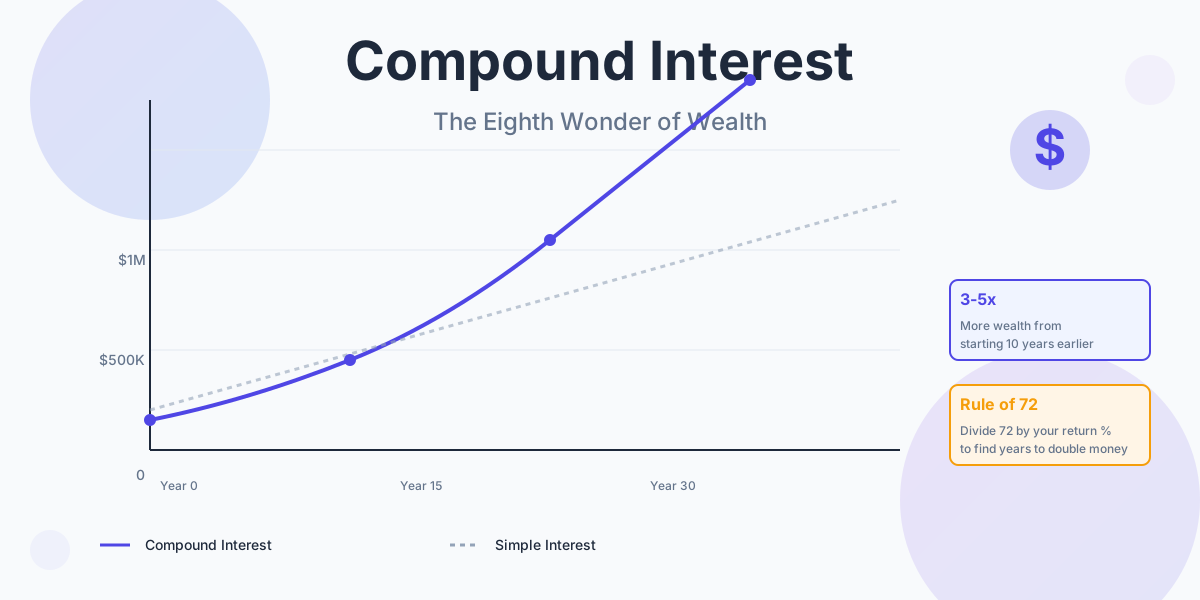
Compound interest is the secret weapon of patient wealth builders. It transforms modest, consistent savings into life-changing wealth through exponential growth rather than linear accumulation.
Understanding and harnessing compound interest is perhaps the most valuable financial skill you can develop. It shifts your mindset from earning money to making money grow exponentially.
What Is Compound Interest?
Compound interest is the process of earning interest on your principal investment, plus all the accumulated interest from previous periods. Unlike simple interest, which calculates returns only on your original amount, compound interest creates a snowball effect where your earnings generate their own earnings. This exponential growth accelerates the longer your money stays invested, making time your most powerful wealth-building asset.
Not financial advice.
The mathematics behind compound interest reveals why starting early matters so profoundly. With each compounding period (daily, monthly, quarterly, or annually), the interest calculation includes all previous accumulated interest. This creates exponential rather than linear growth. Over decades, this difference becomes staggering. A $10,000 investment at 7% annual returns grows to $76,122 in 30 years through compounding, but only $31,000 with simple interest.
Surprising Insight: Surprising Insight: Time is more powerful than money. Starting with $100 at age 25 often yields more wealth by retirement than starting with $10,000 at age 45, thanks to compound interest.
Compound vs Simple Interest Over 30 Years
Visualization comparing exponential growth of compound interest versus linear growth of simple interest on the same $10,000 investment at 7% annual return.
🔍 Click to enlarge
Why Compound Interest Matters in 2026
In 2026, with global inflation averaging 3-5% and traditional savings accounts offering minimal returns, understanding compound interest has become essential. The gap between inflation and savings rates means your money actually loses purchasing power if left idle. Strategic compound interest investing is no longer optional for financial security—it's fundamental.
Digital investment platforms have democratized access to compound interest. Fifteen years ago, meaningful investing required significant capital and expensive financial advisors. Today, apps and robo-advisors allow anyone to start with $50-100 and access diversified portfolios that compound continuously. This accessibility has shifted wealth-building from an elite advantage to a universal opportunity.
The behavioral psychology of compound interest has also become more relevant. Studies show that financial literacy alone explains only 0.1% of wealth-building success—behavior explains the rest. Knowing about compound interest doesn't help if you don't actually invest consistently. The real wealth comes from boring, disciplined monthly contributions that few people have the patience to maintain.
The Science Behind Compound Interest
The formula behind compound interest is deceptively simple: A = P(1 + r/n)^(nt), where A is final amount, P is principal, r is annual interest rate, n is compounding periods per year, and t is years. But this elegant equation produces exponential, not linear, results. Each compounding period multiplies the previous total, creating growth acceleration that mathematicians call exponential function.
The compounding frequency dramatically affects outcomes. Money compounded daily grows faster than monthly, which grows faster than annually. A $1,000 investment at 5% annual interest becomes: $1,050 with annual compounding, $1,050.73 with monthly compounding, and $1,050.79 with daily compounding after one year. The difference seems tiny until you extend it across 30 years—then daily compounding produces significantly more wealth than annual.
The Rule of 72: Doubling Your Money
Quick calculation method showing how long it takes to double investments at different annual return rates. Divide 72 by the percentage return to find years to double.
🔍 Click to enlarge
Key Components of Compound Interest
Principal Amount
The principal is your initial investment. Larger principal amounts create larger returns, but psychology research shows this shouldn't discourage small investors. A $1,000 starting principal with consistent $100 monthly additions often outperforms a $10,000 lump sum never touched again due to regular compounding contributions. Consistency matters more than size.
Interest Rate (Return Rate)
The annual percentage return dramatically affects long-term outcomes. Even small differences compound dramatically: a 6% return versus 8% return over 30 years on $10,000 creates a $12,000 wealth gap ($38,697 versus $76,122). This is why investors spend considerable effort optimizing returns—small percentage improvements compound into substantial differences.
Compounding Frequency
How often interest is calculated and added to your principal affects growth. Daily compounding (most investment accounts) produces more wealth than monthly, which produces more than quarterly or annual. Most modern investment accounts offer daily compounding, which is why digital platforms outperform traditional savings accounts offering annual compounding.
Time Horizon
Time is the most powerful variable in compound interest. A person investing $5,000 annually from age 25-35 (10 years, $50,000 total) often ends up wealthier than someone investing $5,000 annually from age 35-65 (30 years, $150,000 total) because of early compounding advantage. Each year of early investing compounds for 30+ additional years.
| Starting Age | Annual Investment | Years Invested | Total Contributed | Value at Age 65 (7% Return) |
|---|---|---|---|---|
| 25 | $5,000 | 40 years | $200,000 | $1,394,000 |
| 35 | $5,000 | 30 years | $150,000 | $536,000 |
| 45 | $5,000 | 20 years | $100,000 | $179,000 |
How to Apply Compound Interest: Step by Step
- Step 1: Clarify your financial goal. Are you building retirement savings, a down payment, or generational wealth? Different goals may warrant different investment strategies and time horizons.
- Step 2: Calculate your current and desired investment amount. Use online compound interest calculators (search 'compound interest calculator') to project outcomes of different contribution amounts.
- Step 3: Choose an investment vehicle with daily compounding. Options include index funds (average 7-10% annual returns), dividend-paying stocks, bonds, or savings accounts (though returns are lower). Target accounts that compound daily, not monthly or annually.
- Step 4: Set up automatic monthly investments. This removes emotion from investing and ensures consistency. Most investment platforms allow automatic transfers from checking accounts to investment accounts.
- Step 5: Understand the fee impact. Even 0.5% annual fees can reduce compound returns substantially across decades. Compare fee structures and prioritize low-cost index funds or ETF-based platforms.
- Step 6: Resist the urge to time the market. Research shows that staying invested through market cycles beats trying to buy low and sell high. Dollar-cost averaging (consistent monthly investing) naturally protects against market timing mistakes.
- Step 7: Reinvest all dividends and interest. Don't take distributions—reinvest them to compound faster. This is especially powerful in retirement accounts where taxes don't interfere.
- Step 8: Increase investments when income rises. When you get a raise or bonus, increase your monthly investment by 25-50%. This accelerates compounding without feeling like deprivation.
- Step 9: Avoid early withdrawal penalties. Money withdrawn from investments stops compounding and often triggers penalties. Resist the temptation to raid investment accounts for non-emergencies.
- Step 10: Review and rebalance annually. Ensure your investment allocation matches your risk tolerance and time horizon. Rebalancing prevents your portfolio from drifting toward excessive risk or becoming too conservative.
Compound Interest Across Life Stages
Young Adulthood (18-35)
Young adults possess an asymmetric advantage: time. A 25-year-old investing $200 monthly for 40 years until retirement accumulates roughly $2 million through 7% compound returns, compared to $800,000 for someone starting at 45. The first 10-15 years of investing are dramatically more valuable than the last 10 years because of compounding. This is the period to prioritize consistent investing over investment perfection. Starting with index funds in a tax-advantaged account (401k, IRA) beats waiting for the 'perfect' investment.
Middle Adulthood (35-55)
Middle adulthood typically combines peak earning capacity with significant compound interest runway. A 40-year-old can still accumulate substantial wealth through aggressive investing over 25 years. The key focus shifts from 'start investing' to 'maximize contributions' and 'optimize returns through diversification.' This is when professional financial planning becomes valuable—the marginal benefit of optimizing a $500,000+ portfolio justifies advisory fees. Catch-up contributions to retirement accounts (allowed after age 50) provide additional leverage.
Later Adulthood (55+)
Investors in later adulthood face the transition from accumulation to distribution. Compound interest continues working—a 55-year-old still has 10-35 years of potential compounding until death. The focus shifts toward asset preservation, tax-efficient withdrawal strategies, and ensuring compound interest growth exceeds spending. Healthcare and longevity costs become central considerations. Many financial advisors suggest maintaining moderate growth investments throughout retirement since current lifespans exceed 30 years.
Profiles: Your Compound Interest Approach
The Skeptical Procrastinator
- Simple visual proof that compound interest works
- Minimal investment friction—one-click portfolio setup
- Permission to start small without guilt
Common pitfall: Waiting for the 'perfect' investment or sufficient capital before starting, thereby losing 5-10 years of critical compounding time.
Best move: Start today with $50-100 in a simple index fund. Perfect is the enemy of good. One year of actual investing beats five years of research.
The Aggressive Optimizer
- Data on return rate optimization and fee impact
- Strategies to maximize compounding frequency
- Understanding of risk-adjusted returns
Common pitfall: Spending so much time optimizing for extra 0.5% returns that they miss the psychological benefits of stable, boring investments.
Best move: Accept that a 7% return compounded consistently beats chasing 9% returns through risky strategies. Consistency compounds better than heroic returns.
The Risk-Averse Conservative
- Understanding that moderate growth investments are safer long-term than savings accounts eroded by inflation
- Explanation of bond diversification strategies
- Historical data showing that stocks outpace inflation reliably
Common pitfall: Keeping money in savings accounts earning 0.5% while inflation runs 3-5%, resulting in actual wealth loss.
Best move: Diversify: 70% stock index funds, 30% bonds. This balanced approach historically outpaces inflation while limiting volatility.
The Overwhelmed Late-Starter
- Reassurance that starting late is better than never starting
- Strategies to catch up (higher contributions, longer work years)
- Realistic projections about what different start ages achieve
Common pitfall: Believing the compounding opportunity is closed at 45-55 and therefore not investing, ensuring they accumulate nothing.
Best move: Aggressive catch-up contributions (especially after age 50 in retirement accounts) can still generate substantial wealth over 15-25 years.
Common Compound Interest Mistakes
Starting too late represents the most expensive mistake in wealth building. Every five-year delay costs approximately $200,000-500,000 in lost compound growth over a typical career. Mathematically, starting at 30 versus 35 costs far more than the difference in years suggests because early deposits compound for much longer.
Stopping investments during market downturns interrupts compounding at precisely the wrong time. Research shows that investors who stopped investing during the 2008-2009 financial crisis missed the subsequent 400%+ market recovery from 2009-2020. Pausing investments to 'wait for lower prices' historically reduces long-term wealth versus maintaining consistent monthly investments through volatility.
Choosing high-fee investment products undermines compounding significantly. A fund charging 1% annually versus 0.1% may seem minor, but over 30 years, this 0.9% difference compounds to 20-30% less final wealth. Investment advisory fees, mutual fund expense ratios, and trading fees directly subtract from compound growth—comparing fee structures is as important as comparing return expectations.
The Cost of Starting Late vs Investment Fees
Comparison showing the wealth impact of five-year investment delays versus choosing high-fee versus low-fee investments on a 30-year timeline.
🔍 Click to enlarge
Science and Studies
Academic research across finance, behavioral economics, and psychology consistently demonstrates compound interest's transformative power when combined with disciplined behavior. Studies from Fidelity, Vanguard, and university research programs show that regular investing beats market timing, low fees dramatically outperform high fees, and early starting creates disproportionate advantages.
- Fidelity analysis (2024): Investors who maintained consistent contributions through market cycles accumulated 40% more wealth than those who tried market timing, demonstrating that behavioral discipline compounds better than perfect predictions.
- Vanguard research (2023): Every 0.1% in annual fees reduces 30-year compound returns by 2-4%, making fee optimization one of the highest-impact investment decisions available.
- Federal Reserve Economic Data (2024): Workers beginning retirement investing at 25 accumulate 3-5x more wealth than those starting at 35, with the advantage growing exponentially for those starting at 45 or later.
- Journal of Financial Planning (2023): A $100 monthly investment from age 25-35 (10 years) historically accumulates more retirement wealth than $100 monthly from age 35-65 due to compounding decades.
- Morningstar study (2024): Low-cost index funds (0.03-0.10% annual fees) outperform actively managed funds (1%+ annual fees) 80% of the time over 15+ year periods, suggesting passive compound interest investing beats active management for most investors.
Your First Micro Habit
Start Small Today
Today's action: This week, set up automatic monthly investment of just $50-100 in a low-cost index fund. No exceptions, no delays. Open the account today (takes 15 minutes) and schedule the first automatic transfer for next Friday.
Starting immediately, even with tiny amounts, defeats perfectionism and gets you into the wealth-building game. The $50 you invest this month will grow for potentially 40+ years through compounding. Waiting for larger capital reserves costs far more than starting small.
Keep quitting habit apps after a missed day? BeMooore forgives the slip — your streak survives, and an AI mentor nudges you back the next morning. Free on iOS.
Quick Assessment
How much are you currently investing regularly (monthly)?
Your current investment level directly determines your compound interest growth trajectory. Those not investing are losing $10,000+ in annual compounding opportunity; those investing less than $100 monthly would benefit from increasing contributions when possible.
What's your primary barrier to increasing investment contributions?
Different barriers require different solutions. Knowledge barriers solve through education; cash flow barriers through expense reduction or income increase; volatility fear through understanding historical returns; priority barriers through goal-setting clarity.
How many years until your primary financial goal (retirement, down payment, generational wealth)?
Your time horizon shapes your investment strategy. Shorter horizons (under 5 years) require conservative investments; medium horizons (5-15 years) allow moderate growth; longer horizons (15+ years) justify aggressive equity-heavy portfolios that maximize compounding potential.
Take our full assessment to get personalized recommendations.
Discover Your Style →Next Steps
Your compound interest journey begins with one decision: start investing this week. Not next month, not after you save more money. Research shows that starting small consistently beats waiting for perfect conditions. Open a brokerage account today at Vanguard, Fidelity, or through a robo-advisor app (Betterment, Wealthfront). Invest even $50 if that's your current capacity.
Then, commit to increasing your monthly investment by $10-20 each time you receive a raise or bonus. This amplifies compounding without requiring dramatic lifestyle changes. Within 5-10 years, your seemingly small investments will have grown substantially, and you'll have built the psychological habit of consistent wealth-building that compounds far more powerfully than any individual investment choice.
Get personalized guidance with AI coaching.
Start Your Journey →Research Sources
This article is based on peer-reviewed research and authoritative sources. Below are the key references we consulted:
Related Glossary Articles
Frequently Asked Questions
Is compound interest really the eighth wonder of the world?
The quote is commonly attributed to Einstein, but historical verification is impossible—the attribution became popular only in the 1980s. Regardless of origin, the quote captures truth: compound interest transforms ordinary savings into extraordinary wealth through mathematical exponential growth that defies intuition.
What's the difference between compound interest and compounding?
Compound interest is the specific financial concept of earning interest on interest in investment accounts. Compounding is the broader mathematical principle that applies beyond finance—social media followers compound, exercise fitness compounds, skill development compounds. All involve exponential rather than linear growth.
How do I choose between stocks, bonds, and other investments for compound growth?
Historical data shows stocks average 7-10% annual returns (higher compound growth), while bonds average 3-5%. A balanced portfolio typically allocates more stocks when time horizons are long (30+ years) and more bonds when nearer retirement. Most investors benefit from simple allocations like 80/20 or 70/30 stock-to-bond ratios rather than chasing complexity.
What happens to compound interest if I withdraw money early?
Early withdrawal stops compounding on that money and often triggers penalties or taxes. A $10,000 withdrawal from an investment compounding at 7% for 20 years costs approximately $40,000 in foregone compound returns. Retirement accounts penalize early withdrawal to incentivize long-term compounding.
Is it too late to start compound interest investing at 50, 60, or beyond?
Late is always better than never. A 50-year-old investing $500 monthly for 15 years until retirement accumulates approximately $130,000 through 7% compounding—real wealth. A 50-year-old who continues not investing accumulates zero. Yes, starting at 25 is better than 50, but 15 years of compounding still creates meaningful wealth.
Take the Next Step
Ready to improve your wellbeing? Take our free assessment to get personalized recommendations based on your unique situation.
- Discover your strengths and gaps
- Get personalized quick wins
- Track your progress over time
- Evidence-based strategies