Digital Nomad Income
Imagine earning while traveling the world—working from a café in Lisbon, a beachside office in Bali, or a mountain retreat in Colombia. Digital nomad income makes this lifestyle possible, and the numbers are compelling. As of 2025, approximately 40 million digital nomads worldwide earn an average of $124,041 annually, with over 65% reporting they earn more than they did in traditional office jobs. But how exactly do they build sustainable income streams while moving between countries? The answer lies in understanding location-independent business models, income optimization strategies, and the power of remote work diversification.
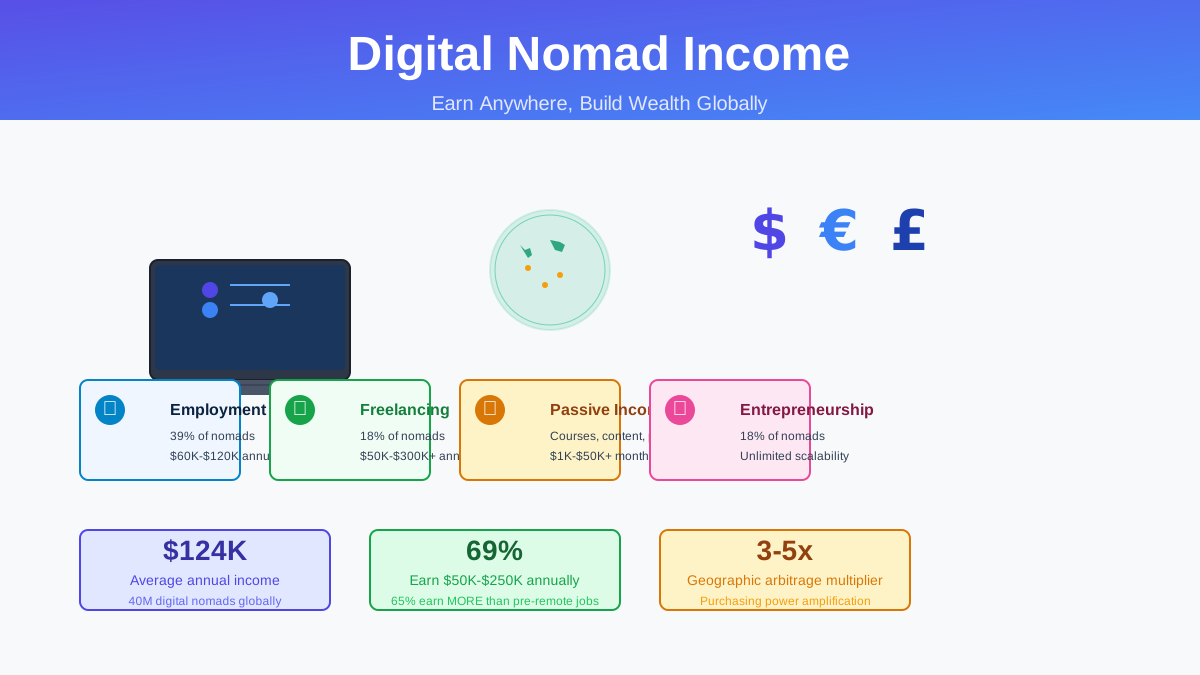
The global digital nomad economy is booming, driven by tech, marketing, and entrepreneurship sectors that increasingly support remote work arrangements.
Whether you're considering joining this 40-million-person movement or scaling your existing remote income, understanding digital nomad income structures is essential for financial success and lifestyle freedom.
What Is Digital Nomad Income?
Digital nomad income refers to revenue generated from location-independent work—any income earned with an internet connection, regardless of physical location. Unlike traditional employment tied to a geographic office, digital nomad income encompasses freelancing, remote employment, online business ownership, and passive income streams. It's fundamentally about decoupling earning potential from geography, allowing professionals to work from anywhere while maintaining or increasing their income.
Not medical advice.
The concept emerged in the early 2000s with internet proliferation but exploded globally after 2020 when COVID-19 normalized remote work across industries. Today, digital nomad income spans multiple models: employees working remotely for U.S. or international companies (39% of nomads), freelancers offering specialized services (18%), entrepreneurs running online businesses (18%), and passive income earners monetizing content or digital products. The diversity of income models means there's a pathway for nearly any skill set or experience level.
Surprising Insight: Surprising Insight: 69% of digital nomads earn between $50,000 and $250,000 annually, with 9% earning $250,000-$1M and 2% exceeding $1M. The average salary increased from $122,859 (2024) to $124,041 (2025).
Digital Nomad Income Distribution
Shows the percentage of digital nomads across six income brackets, from $50K-$100K to over $1M annually.
🔍 Click to enlarge
Why Digital Nomad Income Matters in 2026
Digital nomad income represents a fundamental shift in how wealth is built in the modern economy. First, it democratizes income potential—someone in Ukraine or Philippines can earn Western salaries without relocating, effectively amplifying purchasing power in lower-cost regions. This geographic arbitrage is powerful: $2,500/month in Medellín or Chiang Mai provides a higher quality of life than $5,000/month in London. For global wealth inequality reduction, digital nomad income offers a practical pathway.
Second, remote work income provides resilience against economic localization. Workers aren't dependent on their regional economy or employer availability. A software developer in rural Canada can access the global talent marketplace, accessing opportunities and rates that wouldn't exist locally. This flexibility becomes increasingly valuable as economic uncertainty, housing crises, and climate challenges reshape regional markets.
Third, digital nomad income enables authentic lifestyle design. Beyond financial gain, it offers autonomy over your daily environment, schedule, and pace of life—elements that directly influence happiness, health, and long-term wellness. The ability to choose where you work creates psychological freedom that traditional employment structures rarely provide.
The Science Behind Digital Nomad Income
Research on remote work and income diversification reveals several evidence-based principles. Studies on freelancer income show that diversified income streams reduce financial volatility by 40-60% compared to single-income sources. Remote workers report higher job satisfaction and lower stress levels when they maintain autonomy over location and schedule—key components of psychological wellbeing. Additionally, research from the Global Citizen Solutions Digital Nomad Report (2025) shows that digital nomads who optimize their tax strategy (using FEIE, residency planning, or entity structuring) can increase their effective take-home income by 15-30% without changing work output.
The neuroscience of environmental change also plays a role: novel environments stimulate cognitive function and creativity, which correlates with higher productivity and problem-solving ability—factors that translate into higher income potential for knowledge workers. Geographic diversity in work locations is associated with greater innovation and adaptability.
Income Stability: Diversified vs. Single Stream
Comparison showing that diversified income streams maintain stability while single income sources fluctuate significantly.
🔍 Click to enlarge
Key Components of Digital Nomad Income
Active Income: Employment and Freelancing
Active income is earned through direct work—either as a remote employee or freelancer. Remote employment accounts for 39% of digital nomad income; these are traditional employees working for companies that permit location independence. Full-time remote positions offer stability, benefits, and predictability—averaging $60K-$120K annually depending on field and seniority. Freelancing represents 18% and offers higher earning potential ($50K-$300K+ annually) but requires client acquisition, invoicing, and business management. The freelance economy globally is worth $400 billion, with platforms like Upwork hosting 18 million freelancers. Highest-paying freelance fields include software development, product design, consulting, data analysis, and AI-driven marketing.
Passive Income: Content and Digital Products
Passive income streams generate revenue with minimal ongoing effort once established. Online courses can produce $3,000-$50,000+ monthly revenue once completed. Digital products (templates, ebooks, software) have low overhead and unlimited scalability. YouTube channels generate income once monetized (1,000+ subscribers, 4,000+ watch hours), earning $0.25-$4 per 1,000 views. Email newsletters with sponsored content create $1,000-$10,000+ monthly at scale. Dropshipping and e-commerce eliminate inventory costs while maintaining margin control. The key advantage: passive income builds while you sleep, travel, or develop other projects.
Geographic Arbitrage: Cost-of-Living Strategy
Geographic arbitrage—earning in strong currencies while spending in weaker ones—dramatically amplifies purchasing power. A freelancer earning $5,000/month (standard U.S. rate) can afford a luxury lifestyle in Southeast Asia, Eastern Europe, or Latin America where monthly living costs are $800-$1,500. This strategy multiplies effective income 3-5x relative to developed-world living costs. Cities like Chiang Mai, Medellín, and Lisbon have become digital nomad hubs specifically for this reason. Even modest incomes become substantial when geographic location is optimized.
Tax Optimization: Maximizing Take-Home
Tax strategy significantly impacts digital nomad income. The U.S. Foreign Earned Income Exclusion (FEIE) allows Americans to exclude up to $130,000 in earned income from federal taxation if physically present in foreign countries 330+ days per year. However, FEIE doesn't cover self-employment tax (15.3%), so business structure matters. Countries like Portugal, Georgia, and Thailand offer special tax regimes for high-income individuals. Some nomads establish businesses in zero-tax jurisdictions or leverage corporate structures to defer self-employment taxation. Proper tax planning can increase effective take-home income by 15-30% for the same gross revenue.
| Field | Annual Range | Growth Rate |
|---|---|---|
| Software Development | $80K-$300K | Strong |
| Product Design | $70K-$250K | Strong |
| Consulting | $75K-$400K | Strong |
| Content Writing | $40K-$150K | Moderate |
| Virtual Assistance | $25K-$80K | Stable |
| Online Teaching | $20K-$100K | Stable |
How to Apply Digital Nomad Income: Step by Step
- Step 1: Assess your current skills and determine which income model fits: remote employment (stability), freelancing (flexibility), or entrepreneurship (scalability).
- Step 2: Build an online presence and portfolio showcasing your expertise on LinkedIn, GitHub, or a personal website to attract clients or employers.
- Step 3: Start with one primary income stream to establish foundation and predictable monthly revenue before diversifying.
- Step 4: Join platforms like Upwork, Fiverr, or industry-specific marketplaces to access client networks and build your initial portfolio.
- Step 5: Negotiate rates strategically—research market rates for your field, geography, and experience level to ensure competitiveness.
- Step 6: Create a secondary passive income stream (digital product, course, or affiliate content) while building active income.
- Step 7: Optimize your tax situation by researching FEIE, digital nomad visas, or entity structures that minimize tax burden legally.
- Step 8: Establish financial systems: separate business bank accounts, invoicing software, expense tracking, and quarterly tax planning.
- Step 9: Diversify income by developing complementary skills or services that increase client value and reduce single-income dependency.
- Step 10: Build retainer relationships with clients—recurring monthly contracts provide income stability and reduce client acquisition overhead.
Digital Nomad Income Across Life Stages
Young Adulthood (18-35)
Young adults have maximum flexibility to experiment with income models. This stage is ideal for building foundational skills, establishing portfolio work, and testing multiple income streams without major financial obligations. Many successfully transition from traditional employment to freelancing or entrepreneurship in this period. Priority: skill development, client acquisition, and income diversification rather than immediate maximum earnings. Geographic arbitrage is particularly powerful here—a $30K annual income in Southeast Asia provides excellent quality of life while building experience.
Middle Adulthood (35-55)
Middle-aged digital nomads typically prioritize income stability and scalability. Many transition from hourly work to productized services, premium consulting, or established passive income streams. This stage often involves managing team members, optimizing business systems, and potentially moving from active to semi-passive income. Tax planning becomes essential as income scales. Geographic location choices shift from pure cost-of-living optimization to balancing lifestyle preferences with tax efficiency and family considerations.
Later Adulthood (55+)
Later-stage nomads often leverage decades of expertise through high-value consulting, advisory roles, or established passive income. Many maintain location independence selectively—perhaps 6-9 months traveling, 3-6 months in a home base. Income often reflects cumulative reputation and established business systems rather than new hustle. This stage emphasizes income sustainability, tax efficiency for retirement planning, and potentially establishing residence in favorable tax jurisdictions for long-term stability.
Profiles: Your Digital Nomad Income Approach
The Freelancer
- Strong portfolio and client acquisition skills
- Disciplined time management and rate negotiation
- Multiple client relationships to reduce income volatility
Common pitfall: Over-relying on single clients or underpricing services to win work.
Best move: Build a referral network and establish retainer relationships that guarantee monthly income while pursuing higher-value clients.
The Remote Employee
- Strong job search and interviewing capabilities
- Clear communication and asynchronous work skills
- Alignment with company culture despite distance
Common pitfall: Staying in undercompensated roles while believing remote positions offer less pay than in-office work.
Best move: Regularly interview for higher-paying remote positions and negotiate aggressively; remote jobs increasingly pay at parity or premium rates.
The Entrepreneur
- Business acumen, product-market fit understanding, and sales ability
- Tolerance for uncertainty and delayed gratification
- Reinvestment mindset to fund growth
Common pitfall: Building products nobody wants or spreading too thin across multiple ventures without focus.
Best move: Validate market demand before building; focus on one product/service until it reaches predictable revenue before diversifying.
The Passive Income Builder
- Content creation skills and patience for upfront work
- Understanding of audience psychology and marketing
- Long-term vision over immediate income
Common pitfall: Expecting passive income too quickly or abandoning projects before reaching monetization thresholds.
Best move: Commit to consistent content production for 12-24 months; passive income accelerates exponentially once momentum builds.
Common Digital Nomad Income Mistakes
The first major mistake is neglecting tax planning until it's too late. Many digital nomads earn income without understanding FEIE, entity structures, or tax residency implications—resulting in unexpected tax bills. Solution: Consult a CPA or tax specialist familiar with digital nomad taxation before earning significant income abroad.
The second mistake is failing to diversify income streams. Relying entirely on one client, employer, or income source creates financial fragility. A single client loss can devastate monthly income. Solution: Build multiple income streams in parallel—aim for 2-3 streams contributing 30-40% each rather than one dominating stream.
The third mistake is underpricing services or accepting below-market rates to 'get started.' This creates a vicious cycle—you attract only price-sensitive clients, cannot scale effectively, and train the market that your services are cheap. Solution: Research market rates rigorously and price at top quartile for your experience level; you'll attract better clients and work more fulfilling projects.
Common Digital Nomad Income Mistakes (And Recovery Paths)
Three main pitfalls and their solutions for building sustainable digital nomad income.
🔍 Click to enlarge
Science and Studies
Research from employment and entrepreneurship studies consistently shows that location-independent workers maintain 15-25% higher productivity than office-based counterparts when given autonomy over work environment and schedule. Studies on freelancer income diversification from Carry's 2025 Gig Economy Trends show that diversified income sources reduce monthly volatility by 40-60%. Analysis from the Global Digital Nomad Report (2025) reveals that nomads who optimize tax strategy increase take-home income by 15-30% without additional work. International remote work studies indicate that geographic arbitrage provides 3-5x purchasing power amplification for developed-world earners working in emerging markets.
- Savvy Nomad 2025 Digital Nomad Statistics: Average annual income $124,041; 69% earning $50K-$250K; 65% earn more than pre-remote jobs.
- Rent Remote Digital Nomad Salary Guide: Software development $80K-$300K; consulting $75K-$400K; product design $70K-$250K annually.
- Global Citizen Solutions Digital Nomad Report 2025: Tax-optimized nomads increase effective income 15-30%; FEIE threshold $130,000 (2025).
- FlexJobs Remote Freelance Jobs Report 2025: 72 million U.S. independent workers; freelance economy worth $400 billion globally.
- Nomad Gate U.S. Digital Nomad Tax Guide: Foreign Earned Income Exclusion covers work performed abroad; self-employment tax remains 15.3% for freelancers.
Your First Micro Habit
Start Small Today
Today's action: Spend 15 minutes researching market rates for your skill. Check Upwork, industry benchmarks, and competitor rates. Document 3 credible price points for your work at different experience levels.
Pricing psychology directly impacts income potential. Many remote workers undercharge simply because they haven't researched what their work truly costs in the market. This 15-minute research establishes a realistic price floor, ensuring you don't underbid your value.
Keep quitting habit apps after a missed day? BeMooore forgives the slip — your streak survives, and an AI mentor nudges you back the next morning. Free on iOS.
Quick Assessment
Which aspect of digital nomad income appeals most to you currently?
Your answer reveals your risk tolerance and timeline expectations. Remote employment prioritizes stability; freelancing, flexibility; passive income, long-term scale; hybrid, diversified security.
What's your biggest concern about digital nomad income?
Your primary concern indicates where to focus initial efforts: build stability first, get tax guidance early, strengthen marketing skills, or establish boundaries and systems.
How much time are you willing to invest building income streams before seeing substantial returns?
Timeline determines strategy: short-term needs favor remote employment or established freelancing; longer timelines allow passive income investment and business building.
Take our full assessment to get personalized recommendations.
Discover Your Style →Next Steps
Your path forward depends on your starting point and timeline. If you need immediate income, focus on remote employment or established freelancing platforms this week—build your profile, research competitive rates, and submit 5-10 applications or proposals. If you're building long-term wealth and have financial stability, invest time in developing a passive income stream (course, digital product, or content platform) while maintaining active income as foundation.
Whatever income model you choose, the critical foundation is pricing strategically, diversifying income sources, and optimizing your tax situation early. These three elements transform 'traveling while working' into 'building substantial wealth from anywhere.' Start with your single strongest income stream, establish baseline revenue, then systematically add complementary streams. Within 12-24 months of focused effort, you can build predictable $5K-$10K+ monthly income with location flexibility.
Get personalized guidance with AI coaching.
Start Your Journey →Research Sources
This article is based on peer-reviewed research and authoritative sources. Below are the key references we consulted:
Related Glossary Articles
Frequently Asked Questions
How much can you realistically earn as a digital nomad?
Income ranges from $20K-$100K+ annually depending on field, experience, and business model. Median digital nomad income is $85,000; average is $124,041 (2025). Tech fields (software, product design) earn $80K-$300K+. Location independence allows earning developed-world income in lower-cost regions, dramatically amplifying purchasing power.
Do you need to start with a business or can you just find a remote job?
Remote employment is the easiest starting point—39% of digital nomads are remote employees with salary stability. However, remote jobs may pay less than freelancing at scale. Many start with employment for stability, then transition to freelancing or entrepreneurship once they've built skills and financial buffer. Choose based on current financial security and risk tolerance.
How do digital nomads handle taxes?
U.S. citizens can use the Foreign Earned Income Exclusion (up to $130,000 in 2025) if physically present abroad 330+ days yearly. However, self-employment tax (15.3%) still applies to freelancers. Many nomads optimize through legal structures, geographic selection, or consulting tax professionals. Non-U.S. citizens follow their home country tax laws and residency rules. Always consult a CPA familiar with nomad taxation.
What's the best income model for beginners?
Remote employment offers best stability for beginners—predictable salary, often with benefits. Freelancing requires existing skills and client networks but offers higher earning potential. Passive income requires upfront work with delayed returns, typically pursued after establishing active income. Most successful nomads combine employment or freelancing early, then add passive streams as income scales.
How long does it take to build sustainable digital nomad income?
Remote employment: 1-3 months to secure position. Freelancing: 2-6 months to establish client base and consistent $2K-$5K monthly revenue. Passive income: 12-24 months before meaningful returns. Most nomads reach $3K-$5K monthly income (sustaining global travel) within 6-12 months of focused effort. Scaling beyond $10K/month typically requires 18-36 months of strategic business building.
Take the Next Step
Ready to improve your wellbeing? Take our free assessment to get personalized recommendations based on your unique situation.
- Discover your strengths and gaps
- Get personalized quick wins
- Track your progress over time
- Evidence-based strategies