Lean FIRE
Imagine retiring in your 30s or 40s, not through luck or inheritance, but through intentional choices and disciplined strategies. Lean FIRE (Financial Independence, Retire Early) makes this possible by showing you how to build substantial wealth while living on significantly less than average. This approach combines aggressive savings rates, minimalist living, and smart investing into a powerful framework for breaking free from traditional employment cycles and designing a life around your authentic values.
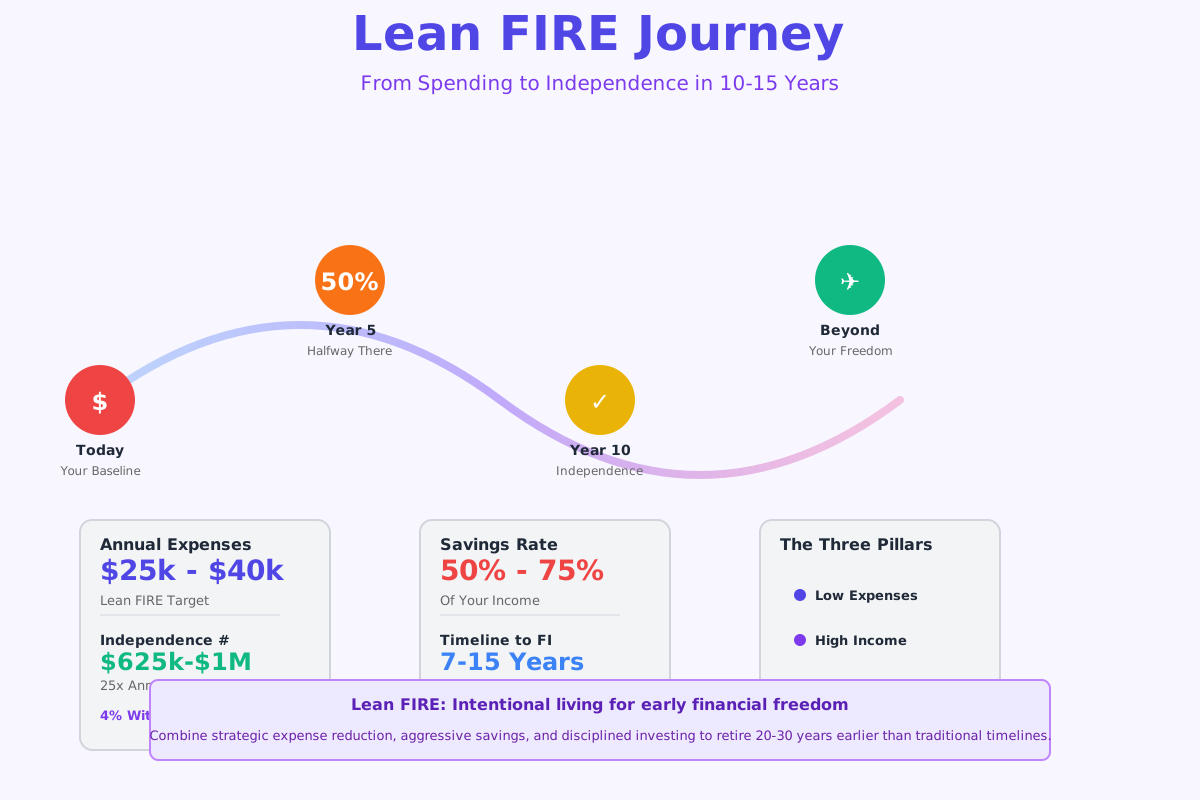
Lean FIRE isn't about deprivation—it's about intentional allocation, where every dollar serves your long-term freedom rather than funding habits that don't truly satisfy you.
Thousands of people worldwide have successfully reached financial independence 20-30 years earlier than traditional retirement timelines by embracing Lean FIRE principles and remaining consistent with their wealth-building strategies.
What Is Lean FIRE?
Lean FIRE is a subset of the broader FIRE (Financial Independence, Retire Early) movement that emphasizes achieving early retirement through extreme frugality and minimalist living. The core principle is straightforward: the lower your annual expenses, the less wealth you need accumulated to retire safely using the 4% withdrawal rule. Someone targeting $25,000-40,000 yearly expenses needs only $625,000 to $1 million saved, compared to $1-3 million for traditional retirement planning.
Not financial advice.
Lean FIRE operates on the math principle that financial independence equals 25 times your annual expenses (the inverse of the 4% withdrawal rate). By consciously reducing expenses through structural changes—housing choices, transportation decisions, subscription elimination—rather than daily willpower struggles, Lean FIRE practitioners create a foundation for permanent financial freedom. This approach particularly appeals to individuals seeking location independence, younger professionals with high earning potential, and anyone who values freedom over consumption.
Surprising Insight: Surprising Insight: Studies on minimalism and simple living consistently show higher life satisfaction scores than traditional consumers earn—even with 50-60% lower annual spending.
Lean FIRE Financial Independence Formula
Visual representation of the 4% rule and expense-to-independence calculation showing how reducing annual expenses dramatically shortens the timeline to financial freedom.
🔍 Click to enlarge
Why Lean FIRE Matters in 2026
Economic uncertainty, inflation concerns, and changing workforce dynamics make Lean FIRE increasingly relevant. Traditional pension systems have largely disappeared, and many individuals question whether standard retirement timelines align with their life goals or health timelines. Lean FIRE offers a concrete alternative: a pathway to financial security that doesn't depend on employer loyalty or government programs.
In 2026, healthcare cost changes—particularly the expiration of enhanced ACA subsidies—make geographic flexibility critical. Lean FIRE practitioners in low-cost states or countries can maintain significantly lower healthcare expenses, making early retirement more feasible. This has driven increased interest in location independence strategies among FIRE adherents.
For younger professionals entering high-income fields, Lean FIRE demonstrates that aggressive savings rates (50-75% of income) create compounding wealth that generates freedom 15-25 years earlier than peer groups following traditional consumption patterns. The psychological benefit—knowing you're building toward autonomy rather than permanent employment—significantly enhances motivation and financial discipline.
The Science Behind Lean FIRE
Lean FIRE's mathematical foundation rests on William Bengen's 1994 research on sustainable withdrawal rates. His analysis of historical market performance demonstrated that a 4% annual withdrawal from a diversified portfolio has an exceptionally high success rate across various market conditions. This principle means that whatever amount you can safely withdraw annually (4%), simply multiply by 25 to determine your independence number. The math is elegant and proven across decades of market cycles.
Psychologically, Lean FIRE works because structural expense reduction—choosing less expensive housing, lower-cost transportation, eliminating recurring subscriptions—creates permanent changes unlike daily willpower-dependent decisions. Research on behavioral economics shows that removing decision points entirely (structural changes) produces more sustainable results than relying on repeated choices (willpower). Additionally, the act of conscious expense tracking—even handwritten methods like the traditional Japanese kakeibo system—creates powerful awareness that leads to 25-30% savings increases simply through visibility.
Lean FIRE Savings Rate Impact Timeline
Comparison showing how different savings rates (50%, 60%, 70%) affect years to financial independence, demonstrating the exponential impact of aggressive saving strategies.
🔍 Click to enlarge
Key Components of Lean FIRE
Strategic Expense Reduction
The foundation of Lean FIRE rests on identifying and eliminating or minimizing major expense categories through deliberate choice architecture. Rather than nibbling at dozens of small expenses (daily coffee, subscription services), successful practitioners focus on the 'big three': housing, transportation, and food. Moving to a lower-cost region, choosing modest housing, biking or public transit, and cooking at home create sustainable 30-40% expense reductions without constant willpower demands.
Aggressive Savings Rate
Lean FIRE practitioners typically save 50-75% of their income, compared to the average person's 5-10% savings rate. This isn't achieved through salary reduction or deprivation, but through intentional expense restructuring combined with income optimization. Many pursue high-income careers (tech, professional services, skilled trades) specifically to enable aggressive saving, understanding that doubling income while maintaining lean expenses dramatically accelerates the timeline to independence.
Passive Index Investing
The investing component emphasizes simplicity and low costs. Rather than individual stock picking or active fund management, Lean FIRE followers typically invest accumulated savings in low-cost index funds or exchange-traded funds (ETFs) tracking broad market indices. This approach minimizes fees (often under 0.1% annually), reduces emotional decision-making, and historically delivers 7-10% average annual returns across market cycles, enabling wealth compound over time.
Lifestyle Design and Values Alignment
Perhaps most importantly, Lean FIRE works when lifestyle choices align with personal values rather than feeling like punishment. Successful practitioners report that intentional living—choosing community connections over consumption, experiences over possessions, autonomy over status—creates higher life satisfaction than traditional consumption patterns, even with dramatically lower spending. This alignment prevents the common burnout that occurs when people attempt deprivation-based saving.
| Dimension | Lean FIRE | Traditional Retirement |
|---|---|---|
| Target Annual Expenses | $25,000 - $40,000 | $60,000 - $100,000+ |
| Independence Number | $625,000 - $1,000,000 | $1,500,000 - $3,000,000+ |
| Typical Savings Rate | 50-75% of income | 10-20% of income |
| Years to Retirement | 7-15 years (high earners) | 35-45 years |
| Lifestyle Approach | Intentional minimalism | Consumption-focused |
| Location Flexibility | High (geo-arbitrage) | Often location-locked |
How to Apply Lean FIRE: Step by Step
- Step 1: Calculate your ideal annual spending by analyzing your core needs (housing, food, utilities, insurance) without discretionary expenses, targeting $25,000-40,000 as a reasonable Lean FIRE budget.
- Step 2: Multiply your target annual expenses by 25 to determine your independence number—the total wealth needed to retire safely using the 4% withdrawal rule.
- Step 3: Analyze your current income and typical expenses to calculate your potential savings rate; aim for 50-60% minimum to make aggressive savings possible.
- Step 4: Identify your largest expense categories (housing typically 30-40%, transportation 15-25%, food 10-15%) and explore structural reductions in each area.
- Step 5: Create a deliberate housing strategy: downsize, relocate to lower-cost area, house-hack (rent rooms), or choose minimal accommodations that reduce this largest expense.
- Step 6: Solve transportation through bike commuting, public transit, or single modest vehicle; eliminate expensive car payments and insurance that many spend $8,000-12,000 yearly on.
- Step 7: Establish baseline investment approach using low-cost index funds in tax-advantaged accounts (401k, IRA, HSA) with asset allocation matching your risk tolerance.
- Step 8: Set up automatic transfers of saved amounts to investment accounts each payday, removing decision friction and enabling consistent wealth accumulation.
- Step 9: Track expenses monthly using manual methods (kakeibo journaling) or apps to maintain awareness and identify subtle spending drift before it derails your plan.
- Step 10: Develop geographic flexibility strategy: research lower-cost locations domestically or internationally, understanding healthcare, visa, and quality-of-life implications for potential future moves.
Lean FIRE Across Life Stages
Young Adulthood (18-35)
This is the optimal window for aggressive Lean FIRE implementation. Without major dependents, mortgages, or established consumption patterns, young adults can establish minimalist habits and high savings rates from the beginning, compounding wealth over 25+ years. Entry into high-income careers during this stage dramatically accelerates the timeline—someone earning $80,000 and saving 60% ($48,000 yearly) reaches a $1 million independence number in approximately 12-15 years of consistent investing, enabling retirement by age 30-35.
Middle Adulthood (35-55)
Mid-career professionals often have children, mortgages, or established lifestyle expenses, making classic Lean FIRE more challenging but still achievable through strategic adjustments. This stage frequently involves 'Fat FIRE' considerations—maintaining higher expenses for family needs while still pursuing financial independence earlier than traditional retirement. Many mid-career professionals with peak earning years can execute modified Lean FIRE approaches: maintaining moderate lifestyle expenses while saving aggressively for 10-15 years, enabling semi-retirement or location independence by age 50-55.
Later Adulthood (55+)
Individuals entering later adulthood can apply Lean FIRE principles to extend traditional retirement longevity or enhance lifestyle within existing retirement frameworks. A person with $500,000 saved at 55 targeting $30,000 annual expenses achieves 100% independence immediately. Additionally, age 55+ individuals accessing 401(k)s through the 'Rule of 55' exception and accessing Social Security strategically create additional income layers, reducing portfolio withdrawal pressure and enabling higher sustainable spending than pure Lean FIRE calculations suggest.
Profiles: Your Lean FIRE Approach
The Ambitious Accumulator
- Clear income-to-expenses math and timeline projections
- Structured expense tracking and accountability systems
- Motivational milestones (savings targets, percentage-to-goal progress)
Common pitfall: Becoming obsessed with optimization, spending hours perfecting budgets while missing the bigger picture; lifestyle creep when income increases without corresponding expense discipline.
Best move: Focus on the 'big three' expenses (housing, transportation, food) and automate savings; celebrate reaching 10%, 25%, 50% of independence number rather than micro-optimizing every category.
The Lifestyle Designer
- Emphasis on values alignment over numbers maximization
- Geographic and lifestyle flexibility exploration
- Connection with community and purpose beyond consumption
Common pitfall: Pursuing minimalism as identity or status symbol rather than practical tool; romantic notions of frugality without realistic execution; expecting lifestyle changes to instantly create happiness.
Best move: Ground Lean FIRE philosophy in genuine values: choose cheaper activities you actually enjoy (hiking, reading, socializing) rather than restricting all discretionary spending; experiment with different locations and expense levels.
The Skeptical Pragmatist
- Evidence and historical data backing the 4% rule and market assumptions
- Recognition of risks: market downturns, healthcare costs, unexpected expenses
- Flexibility to adjust spending levels or return to income if needed
Common pitfall: Analysis paralysis, spending years perfecting the plan without starting; requiring certainty in an inherently uncertain future; overlooking sequence-of-returns risk and its impact on early retirement.
Best move: Accept 'good enough' planning and begin investing now; target slightly higher expenses ($50,000) if that improves peace of mind; include side income or skill development as safety net options.
The Family Provider
- Realistic family budget including children's needs and education
- Integration of spousal financial goals and risk tolerance
- Emphasis on household income optimization across partners
Common pitfall: Underestimating children's impact on expenses and timeline; sacrificing family wellbeing for aggressive savings targets; spousal misalignment causing relationship tension.
Best move: Shift toward 'Fat FIRE' framework ($50,000-60,000 expenses) accounting for family realities; focus household savings rate on dual-income optimization rather than individual deprivation; emphasize shared values around time freedom.
Common Lean FIRE Mistakes
Many aspiring Lean FIRE followers fail not from poor math but from implementation errors. The most common mistake is underestimating healthcare costs. Retiring before Medicare eligibility (65) requires health insurance, and 2026 ACA changes mean substantial premiums in many states without children subsidies—potentially $100-300 monthly per person. Location becomes critical; knowing which states maintain subsidies dramatically impacts expense projections.
A second critical error is sequence-of-returns risk: retiring into a major bear market can devastate a carefully calculated plan. Someone retiring with $1 million in 2007 experienced 50%+ portfolio decline exactly when portfolio withdrawals began. This concentration risk is why many Lean FIRE practitioners maintain part-time income capacity, side businesses, or higher safety margins than pure 4% rule suggests.
The third mistake involves lifestyle inflation: increased income without corresponding expense discipline. A professional earning $50,000 can maintain $25,000 expenses and save 50%. But when income rises to $100,000, many unconsciously increase expenses to $70,000+, reducing savings rate to just 30% and extending independence timeline by 5-10 years. Automating savings (paying yourself first) prevents this drift more effectively than willpower-based approaches.
Common Lean FIRE Implementation Pitfalls and Solutions
Matrix showing the three main mistakes (healthcare underestimation, market timing risk, lifestyle inflation) with triggers and preventive strategies for each.
🔍 Click to enlarge
Science and Studies
Lean FIRE's credibility rests on decades of financial research and real-world practitioner success. The foundational math—the 4% rule and its sustainability—has been extensively studied and validated across historical market conditions. Research on minimalism, simple living, and geo-arbitrage strategies provides psychological and practical support for the approach.
- William Bengen's 1994 Trinity Study establishing the 4% withdrawal rate success rate across various market cycles and asset allocations
- Behavioral economics research on structural expense reduction showing 25-30% increased savings from implementing constraints versus relying on willpower alone
- Japanese kakeibo (budgeting) studies demonstrating that manual expense tracking creates psychological awareness increasing savings by 25-35% compared to automated systems
- Geographic arbitrage research showing $30,000-40,000 annual US expenses equivalent to $12,000-15,000 in Southeast Asia or Latin America, expanding Lean FIRE feasibility
- Life satisfaction research consistently showing minimalist/simple living practitioners report higher wellbeing than consumption-focused counterparts, contradicting deprivation narratives
Your First Micro Habit
Start Small Today
Today's action: Calculate your Lean FIRE independence number: estimate monthly expenses, multiply by 12 for annual spending, then multiply by 25. Example: $2,500/month = $30,000/year = $750,000 independence number. Write this single number down today.
One concrete number—your independence target—creates psychological activation and forward momentum. It transforms abstract 'early retirement' into a specific, achievable target. Knowing you need $750,000 rather than an imaginary $3 million enables real planning and reveals that aggressive saving can achieve it in 10-15 years of disciplined investing.
Keep quitting habit apps after a missed day? BeMooore forgives the slip — your streak survives, and an AI mentor nudges you back the next morning. Free on iOS.
Quick Assessment
How confident are you in your current financial trajectory toward retirement?
If you selected 'uncertain' or 'somewhat confident,' Lean FIRE calculations could provide the clarity you're missing. Simply calculating your independence number reveals whether you're on track and what timeline adjustments might help.
What aspect of financial independence matters most to you personally?
Your primary motivation determines whether Lean FIRE, Fat FIRE, or another approach suits you best. Time-freedom seekers thrive with Lean FIRE discipline. Comfort-focused people might target higher expense numbers. Understanding your true driver enables sustainable planning.
Which represents your biggest barrier to aggressive saving?
Each barrier has different solutions. Income barriers suggest career development strategy. Expense barriers point to geographic strategy or different FIRE approach. Habit barriers require implementation systems. Uncertainty barriers benefit from evidence and real-world examples of successful practitioners.
Take our full assessment to get personalized recommendations.
Discover Your Style →Next Steps
Your Lean FIRE journey begins with one calculation: your target annual expenses times 25. Don't aim for perfection—estimate conservatively (slightly higher than your calculated minimum) and update as you gather more data. Once you understand your independence number, the path becomes clear: implement structural expense reductions in your top 2-3 categories, automate savings, invest in low-cost index funds, and track progress monthly.
The most successful Lean FIRE practitioners emphasize that this isn't about deprivation or suffering. It's about intentionality: conscious choice around how you spend time and money, with clear alignment to your authentic values. If you value freedom, experiences, and autonomy more than consumption status, Lean FIRE can deliver that alignment while simultaneously accelerating financial independence by 15-25 years compared to traditional approaches.
Get personalized guidance with AI coaching.
Start Your Journey →Research Sources
This article is based on peer-reviewed research and authoritative sources. Below are the key references we consulted:
Related Glossary Articles
Frequently Asked Questions
Is the 4% withdrawal rule still valid in 2026?
The 4% rule remains supported by historical research and continues to be validated across market cycles. However, early retirees often apply slightly more conservative approaches (3.5%) or maintain portfolio flexibility (spending less during downturns, more during gains) to accommodate sequence-of-returns risk and longer retirement horizons. Your personal circumstances determine the appropriate withdrawal rate.
What if healthcare costs explode after I retire?
Healthcare is Lean FIRE's biggest variable cost. Research your state's ACA subsidies before retiring—some states maintain subsidies even above 400% federal poverty line, while others don't. At 55, access to 401(k) via 'Rule of 55' exception helps. Many practitioners maintain side income capacity specifically for healthcare expense insurance. Geographic flexibility (relocating to lower-cost states or countries) provides additional options.
Can I do Lean FIRE with a family and children?
Traditional Lean FIRE targets $25,000-40,000 annually, making family support challenging. However, 'Fat FIRE' or modified approaches targeting $50,000-70,000 annually are very achievable with dual household income and disciplined saving. The timeline extends (15-20 years vs. 10-12 years), but the freedom gain remains dramatic compared to working until 65.
What if the stock market crashes after I retire?
Sequence-of-returns risk is real: retiring into a bear market reduces portfolio sustainability. Mitigation strategies include: maintaining higher safety margins (targeting 50x expenses rather than 25x), keeping 1-2 years expenses in bonds/cash, developing part-time income capacity, or planning flexibility to reduce spending during market downturns. Many early retirees maintain modestly paid work they enjoy, reducing pressure on portfolio withdrawals.
Is Lean FIRE just for young people or high earners?
Lean FIRE benefits anyone wanting to accelerate financial independence regardless of age or income. A 50-year-old earning $60,000 and spending $25,000 yearly needs only 5-7 years to reach $625,000 independence number. High income accelerates the timeline, but even modest earners achieve independence faster than traditional retirement timelines. Mid-career professionals and later-adulthood individuals represent growing FIRE practitioner communities.
Take the Next Step
Ready to improve your wellbeing? Take our free assessment to get personalized recommendations based on your unique situation.
- Discover your strengths and gaps
- Get personalized quick wins
- Track your progress over time
- Evidence-based strategies