Enmeshment
You can't tell where you end and your loved one begins. Your emotions feel fused with theirs. Your decisions get questioned because they're treated as collective choices. You feel responsible for their happiness, and they feel entitled to your thoughts, feelings, and space. Welcome to enmeshment—a relationship pattern where boundaries dissolve so completely that individuality becomes almost impossible. If you've ever felt suffocated by closeness disguised as love, this article will help you understand what's happening and why it matters for your wellbeing.
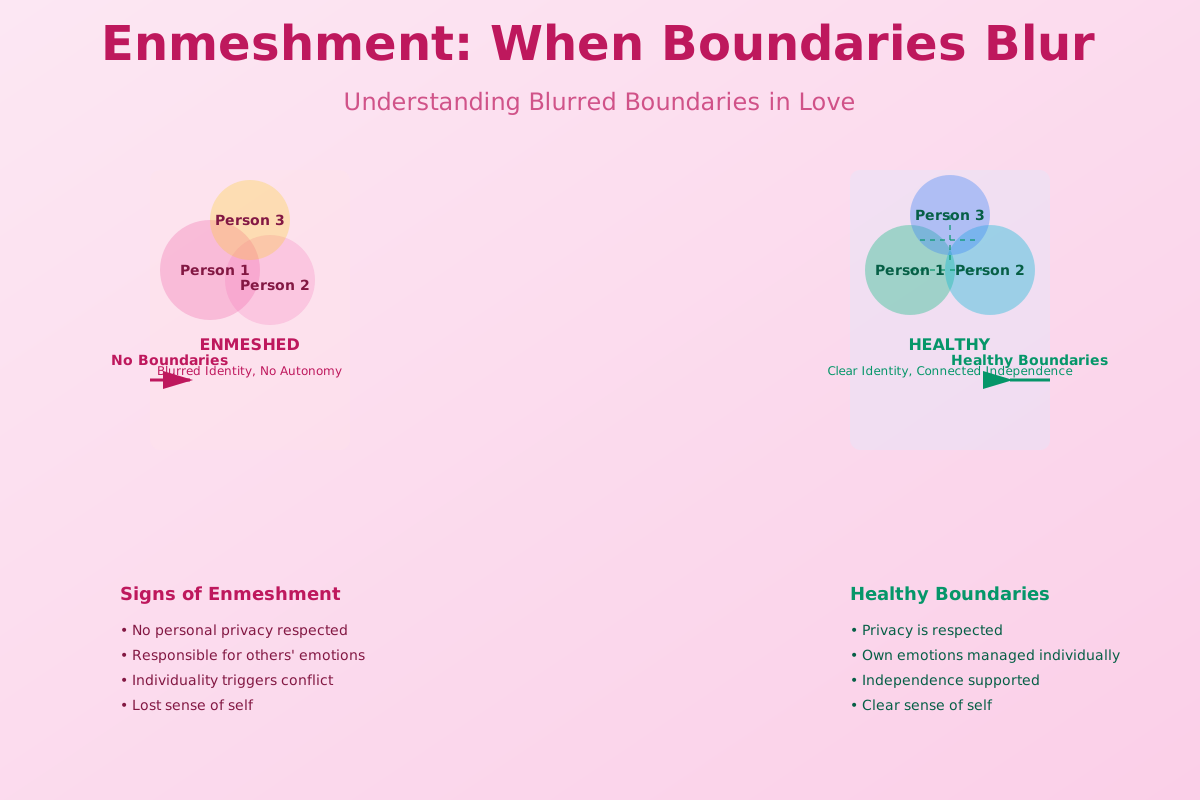
Enmeshment isn't just about being close to someone. It's a specific family or relationship dynamic where personal boundaries have become so blurred that people lose their individual identities. You might find yourself unable to have private thoughts, make autonomous decisions, or maintain separate friendships without triggering conflict or guilt.
The challenge with enmeshment is that it often feels normal to those living it. It masquerades as deep love, loyalty, and family closeness. But underneath, it prevents emotional growth, reinforces anxiety, and damages your ability to build healthy partnerships outside the enmeshed system.
What Is Enmeshment?
Enmeshment is a family systems concept describing relationships where emotional and physical boundaries have become so permeable that family members lack clear separation. Instead of functioning as distinct individuals with separate identities, thoughts, and feelings, people in enmeshed relationships experience a fusion where each person's emotional state directly triggers or influences the others. In enmeshed families, loyalty to the family unit is valued above personal autonomy, privacy is often viewed as a form of rejection or betrayal, and individual preferences are subordinated to family needs or desires.
Not medical advice.
The term originates from family systems theory, developed by Salvador Minuchin in the 1970s. He observed that healthy families maintain a balance between cohesion (togetherness) and differentiation (individuality). Enmeshment represents an extreme on the cohesion spectrum—maximum togetherness at the expense of individual development. Unlike codependency, where one person takes a caretaking role, enmeshment involves mutual boundary dissolution where everyone is overinvolved in everyone else's lives.
Surprising Insight: Surprising Insight: Enmeshed families often appear closer than healthy families from the outside. High communication, shared activities, and emotional expressiveness mask the absence of genuine autonomy beneath.
Healthy vs. Enmeshed Family Systems
Comparison of boundary patterns in healthy families versus enmeshed families, showing how emotional separation enables individual development.
🔍 Click to enlarge
Why Enmeshment Matters in 2026
In 2026, enmeshment has become increasingly relevant due to several cultural shifts. Digital connectivity keeps families hyperconnected, making it harder to establish physical and emotional distance. Parents often blur boundaries with adult children through constant texting, social media monitoring, and financial enmeshment (shared accounts, unclear payment responsibilities). Additionally, mental health awareness has revealed how enmeshment perpetuates anxiety, depression, and attachment insecurity across generations. Understanding enmeshment is crucial for breaking intergenerational trauma patterns.
Research shows that individuals from enmeshed families struggle disproportionately with anxiety, depression, and relationship dysfunction as adults. They often find themselves either repeating enmeshment patterns in their own relationships or swinging to the opposite extreme—complete emotional isolation and avoidance of intimacy. Recognizing enmeshment early allows you to make conscious choices about your relationships rather than defaulting to familiar patterns.
For those in romantic partnerships, enmeshment can mask itself as closeness while actually preventing genuine intimacy, mutual respect, and authentic connection. The ability to maintain healthy boundaries while staying emotionally available is a cornerstone of thriving relationships in adulthood.
The Science Behind Enmeshment
Attachment theory provides the neurobiological foundation for understanding enmeshment. When children experience inconsistent or emotionally suffocating parenting, their nervous system learns to maintain hypervigilance about the caregiver's emotional state. Mirror neurons (cells that fire both when we act and when we observe others acting) may contribute to emotional fusion in enmeshed families, where family members literally synchronize their emotional and physiological responses. A 2024 meta-analysis published in peer-reviewed journals found that parent-child boundary dissolution is associated with significantly higher rates of anxiety, depression, and externalizing behavior problems in children.
The neuroscience also reveals why breaking enmeshment is difficult: the brain has been wired since childhood to prioritize family emotional states. The ventromedial prefrontal cortex, which manages self-referential thinking and decision-making, becomes over-connected to threat-detection circuits (amygdala) when someone grows up in enmeshed environments. This explains why setting boundaries feels dangerous—your nervous system treats autonomy as a threat to connection and safety.
How Enmeshment Develops: Attachment Pathway
Three-stage model showing how inconsistent or intrusive parenting leads to enmeshed attachment and boundary confusion.
🔍 Click to enlarge
Key Components of Enmeshment
Boundary Dissolution
In enmeshed relationships, physical, emotional, and psychological boundaries become unclear or non-existent. Family members may read each other's diaries, go through personal belongings, or have unrestricted access to phone messages and social media. More subtly, emotional boundaries blur when one person's mood dominates the entire household or when individual preferences are overridden by family consensus. Psychological boundaries dissolve when family members are expected to share thoughts, feelings, and decisions collectively, with privacy interpreted as betrayal or coldness.
Loss of Individual Identity
People in enmeshed systems often struggle to answer basic questions: "What do I like?" "What do I want?" "Who am I separate from my family?" This identity diffusion occurs because individuation—the healthy developmental process of becoming a separate person—never fully takes place. Instead of developing autonomous preferences and values, enmeshed individuals internalize family desires as their own. They may excel at mirroring others' emotions and meeting others' needs while remaining blind to their own.
Emotional Responsibility & Enmeshment
Enmeshed family members feel responsible for managing each other's emotions. A parent might depend on a child to regulate their own sadness or anxiety. Adult siblings might feel obligated to manage a parent's mood. In romantic partnerships, enmeshment manifests as walking on eggshells, constantly adjusting your behavior to keep your partner emotionally stable. This emotional caretaking is exhausting and creates a false sense of power ("I can control their emotions") alongside helplessness ("Their emotional state controls my actions").
Difficulty with Autonomy & Separation
Simple acts of independence trigger disproportionate conflict in enmeshed systems. Attending a friend's event without a family member, declining a family request, choosing a different career path, or ending a family call can activate guilt, anger, or accusations of betrayal. The enmeshed family perceives individuation as rejection. This keeps members psychologically tethered, unable to develop separate lives, friendships, or identities without guilt and anxiety.
| Dimension | Enmeshed Families | Healthy Families |
|---|---|---|
| Boundaries | Blurred, permeable, disrespected | Clear, flexible, mutually respected |
| Decision-Making | Collective, consensus-driven, individual choice suppressed | Individual autonomy with family input valued |
| Identity | Merged, dependent on family role, unclear sense of self | Differentiated, secure sense of individual identity |
| Privacy | Viewed as betrayal or coldness, minimal privacy respected | Respected as healthy and normal |
| Conflict | Separation or individuation triggers severe conflict | Healthy disagreements coexist with connection |
| Emotional Regulation | Family members responsible for each other's emotions | Each person manages their own emotional state |
How to Apply Enmeshment: Step by Step
- Step 1: Recognize enmeshment patterns: Observe when you feel responsible for others' emotions, when privacy is questioned, or when independence triggers guilt. Notice whether you struggle to distinguish your feelings from family members' feelings.
- Step 2: Name your experience: Acknowledge that what you lived through was enmeshment, not normal closeness. This cognitive reframing is the first step toward healing.
- Step 3: Track emotional fusion moments: For one week, write down times when you absorbed someone else's emotional state or felt obligated to manage their feelings. This data reveals the pattern.
- Step 4: Set micro-boundaries: Start with small, low-stakes boundaries. Practice saying 'no' to minor requests, spending time alone without explaining, or keeping one area of your life private.
- Step 5: Practice the 'pause response': Before responding to requests or sharing information, pause for 10 seconds. Ask yourself: 'Does this serve my values and wellbeing, or am I doing it from guilt?'
- Step 6: Build your separate identity: Deliberately cultivate interests, friendships, and values that are yours alone, not family-derived. This may feel uncomfortable but is essential for differentiation.
- Step 7: Communicate changes calmly: When you begin setting boundaries, expect resistance. Use calm, consistent language: 'I love you and I'm choosing to [boundary behavior] for my wellbeing.'
- Step 8: Find professional support: A therapist trained in family systems theory or attachment-based therapy can help you navigate the complex emotions that arise when changing patterns.
- Step 9: Join a community: Connect with others recovering from enmeshment through support groups, online communities, or therapy groups. Shared experience reduces isolation.
- Step 10: Practice self-compassion: Breaking enmeshment patterns triggers guilt, anxiety, and fear of rejection. Remind yourself that building healthy boundaries is an act of love toward yourself and, paradoxically, toward your family.
Enmeshment Across Life Stages
Young Adulthood (18-35)
In young adulthood, enmeshment manifests as difficulty leaving home (either physically or psychologically), constant parental input on relationships and career choices, and anxiety about independence. Young adults from enmeshed families may struggle with romantic relationships, either seeking partners who continue the enmeshed pattern or rejecting intimacy entirely. You might find yourself calling parents multiple times daily, seeking approval before decisions, or feeling obligated to prioritize family events over personal goals. The task of this stage—building an independent identity—becomes complicated when you've never developed one separate from family.
Middle Adulthood (35-55)
By middle adulthood, unhealed enmeshment often surfaces as relationship dissatisfaction, anxiety, or difficulty setting boundaries with aging parents. If you haven't differentiated, you may replay enmeshment patterns with your own children, partners, or colleagues. Alternatively, you might experience burnout from over-responsibility (always managing others' emotions and crises). Middle-aged adults from enmeshed families often report feeling trapped between parents' increasing dependency needs and their own desire for autonomy. This is a critical period for therapy and intentional boundary-setting before these patterns calcify further.
Later Adulthood (55+)
In later adulthood, enmeshment affects how older adults relate to adult children and how they navigate aging. Parents may struggle to allow adult children independence and respect, continuing to micromanage their lives. Conversely, adult children may remain unable to set boundaries as parents age, leading to caretaking exhaustion and resentment. Unresolved enmeshment in later life often leaves regrets about missed autonomy, unfulfilled personal dreams, and incomplete individuation. This stage offers opportunities for late-life differentiation and healing, though it requires conscious effort and often professional support.
Profiles: Your Enmeshment Approach
The Loyalist
- Reassurance that setting boundaries is not betrayal
- Permission to prioritize personal wellbeing without guilt
- Gradual, incremental boundary-setting to build confidence
Common pitfall: Feeling intense guilt whenever you step outside family expectations; swinging between complete compliance and explosive rebellion.
Best move: Start with affirming your love for family while being clear that autonomy strengthens, not weakens, connection. Set one specific boundary monthly.
The Emotional Absorber
- Clear distinction between their emotions and others' emotions
- Tools to process and release absorbed emotional states
- Support in recognizing emotional responsibility is not their role
Common pitfall: Carrying family members' emotional burdens as your own; feeling responsible for others' happiness and suffering.
Best move: Practice grounding techniques to differentiate your emotional state from others'. Journal: 'This feeling belongs to [person], not to me.'
The Boundary Setter
- Strategies for maintaining boundaries when family escalates
- Support navigating guilt and conflict that follows boundary-setting
- Ways to stay compassionate while remaining firm
Common pitfall: Over-correcting by becoming defensive or cold; cutting off contact entirely rather than finding middle ground.
Best move: Maintain boundaries with warmth. You can love someone and not accept their boundary violations. Practice: 'I love you and I'm not discussing this.'
The Unaware
- Education about what healthy boundaries look like
- Validation that their discomfort with independence is understandable
- Gentle exposure to differentiated functioning without judgment
Common pitfall: Normalizing enmeshment as 'just how close families are'; resisting the idea that boundaries are healthy.
Best move: Observe how other families function. Talk to people from healthy systems. Expand your reference point of what's possible.
Common Enmeshment Mistakes
The most common mistake people make when addressing enmeshment is attempting complete separation or 'no contact.' While this might feel necessary in extreme cases, it often perpetuates the all-or-nothing thinking that characterizes enmeshed systems. Healthy boundaries don't require cutting people off; they require maintaining connection while protecting your autonomy.
Another mistake is blaming family members entirely. While enmeshment is dysfunctional, it usually develops from intergenerational trauma, insecurity, or mental health struggles. Your parents likely repeated patterns they experienced. Recognizing this doesn't excuse boundary violations, but it helps you respond with compassion rather than rage—which actually enables healthier change.
A third mistake is expecting immediate transformation. Breaking enmeshment takes years, not weeks. Your nervous system learned these patterns over decades. When you set boundaries, family members will typically escalate (more conflict, more guilt-tripping, more emotional manipulation) before accepting the new reality. If you interpret this escalation as proof that boundaries don't work, you'll likely revert. Persistence through the discomfort is essential.
The Enmeshment Trap: Common Patterns
Cycle showing how attempted escape from enmeshment often leads back to enmeshment through guilt, fear, or misguided strategies.
🔍 Click to enlarge
Science and Studies
Recent peer-reviewed research has established clear links between enmeshment and psychological difficulties. A 2024 meta-analysis found that parent-child boundary dissolution significantly predicts both internalizing symptoms (anxiety, depression) and externalizing symptoms (aggression, behavioral problems) in children. A 2025 study published in the International Social Science Journal introduced the Financial Enmeshment Scale, revealing that blurred financial boundaries in families correlate with anxiety, poor financial decision-making, and relationship dysfunction. Research on attachment theory shows that children of enmeshed parents often develop anxious attachment styles, characterized by hypervigilance to relationship threats and difficulty trusting others' consistency.
- Family Cohesion and Enmeshment in Child Development (PMC/NIH): Demonstrates enmeshment's role in moderating the relationship between maternal instability and children's behavioral problems.
- Parent-Child Boundary Dissolution Meta-Analysis (2024): Comprehensive review showing enmeshment predicts anxiety, depression, and behavioral issues with larger effect sizes than other family factors.
- Financial Enmeshment Scale Study (Wiley, 2025): First standardized measure of financial boundary-blurring, revealing psychological impacts of financial fusion.
- Attachment Theory and Enmeshment Research: Shows anxious attachment develops in response to intrusive or inconsistently available parenting.
- Attachment Project Studies: Clinical findings linking enmeshment trauma to attachment difficulties, self-concept clarity issues, and treatment outcomes.
Your First Micro Habit
Start Small Today
Today's action: Identify one small boundary to set this week. It could be: not answering a phone call immediately and returning it later, declining one family request without over-explaining, or spending one hour doing something for yourself without family involvement. Do this once, then notice the guilt without acting on it.
Small wins build confidence and prove that boundaries don't destroy relationships. Your nervous system learns that independence is safe. The guilt decreases each time you don't give in to it.
Keep quitting habit apps after a missed day? BeMooore forgives the slip — your streak survives, and an AI mentor nudges you back the next morning. Free on iOS.
Quick Assessment
How often do you find yourself responsible for managing family members' emotions or moods?
If you answered 'Constantly' or 'Frequently,' you likely carry significant emotional enmeshment patterns. This is common for people raised in families where emotional boundaries were blurred. Therapy can help you recognize when you're absorbing others' emotions versus managing your own.
When you make a decision independent of your family's input, what typically happens?
Your family's reaction to your autonomy reveals your enmeshment level. Healthy families support independence; enmeshed families punish it. If you experience guilt, resistance, or accusations, you've been conditioned to fear differentiation. This can change with intentional boundary-setting.
Do you have private thoughts, preferences, or friendships that your family doesn't closely monitor?
Privacy and trust are foundations of autonomy. If you feel guilty about having a private life or if your family punishes or questions privacy, you're in an enmeshed system. Reclaiming privacy is a form of self-respect.
Take our full assessment to get personalized recommendations.
Discover Your Style →Next Steps
Start by identifying one area where enmeshment affects you most: emotional boundaries, privacy, decision-making autonomy, or identity development. Journal about this area for one week. Notice the guilt, fear, or anxiety that arises. This is data—not truth. Your nervous system is protecting you from what it perceives as danger, but separating from enmeshment is not actually dangerous, just unfamiliar.
Consider seeking therapy with a clinician trained in family systems therapy or attachment-based approaches. Individual therapy combined with family therapy (if family members are willing) can accelerate healing and create lasting change. Whether or not you access formal therapy, remember this: breaking enmeshment is an act of courage and self-love. It requires persistence, compassion for yourself, and commitment to your own wellbeing. Your family may resist, guilt may surge, and the discomfort will be real. But on the other side of enmeshment is a life of genuine autonomy, authentic relationships, and freedom to become fully yourself.
Get personalized guidance with AI coaching.
Start Your Journey →Research Sources
This article is based on peer-reviewed research and authoritative sources. Below are the key references we consulted:
Related Glossary Articles
Frequently Asked Questions
Is enmeshment the same as codependency?
No, though they're related. Enmeshment refers to blurred boundaries where all family members lack separation. Codependency typically involves one person taking a caretaking role while the other becomes dependent. You can have enmeshment without codependency, or codependency without enmeshment. However, enmeshed families often develop codependent patterns within the broader boundary-diffusion.
Can parents set healthy boundaries with enmeshed adult children?
Absolutely. If you're a parent realizing you've created enmeshment with adult children, you can change this pattern. Start by recognizing their autonomy, respecting their privacy, and backing away from emotional responsibility for their choices. Your changes may trigger guilt or resistance initially, but you're modeling healthy differentiation.
Does setting boundaries mean I don't love my family?
No. Boundaries and love coexist. In fact, healthy boundaries are a form of respect and honesty. Enmeshed families confuse boundaries with rejection, but this is a learned distortion, not reality. You can love your family deeply while maintaining clear boundaries about what you will and won't accept.
Will my family ever accept my boundaries?
Eventually, usually yes—but not immediately. When you change the dynamic, family members typically escalate (more conflict, guilt, anger) before they adjust. This escalation is temporary; if you stay consistent, most family members eventually accept the new equilibrium. Some family members may not accept it, which is painful but not a reason to abandon healthy boundaries.
Can I heal from enmeshment without cutting off contact?
Yes, and this is often the healthier option. Complete estrangement sometimes feels necessary but can perpetuate trauma and leave important relational work unfinished. Middle-ground approaches—reduced contact, structured communication, therapy work alongside contact—often lead to deeper healing and the possibility of eventual improved relationships based on clearer boundaries.
Take the Next Step
Ready to improve your wellbeing? Take our free assessment to get personalized recommendations based on your unique situation.
- Discover your strengths and gaps
- Get personalized quick wins
- Track your progress over time
- Evidence-based strategies