2-Minute Rule
You know that feeling—you need to start something important, but the task looms so large that you never begin. The gym, the project, the conversation you've been avoiding. The 2-minute rule cuts through this paralysis with surgical precision: if something takes two minutes or less, do it immediately. But beyond that simple tactic lies a deeper strategy—making any task feel so small that your resistance disappears. This article explores how this one principle rewires your brain's approach to action, transforms procrastination into momentum, and builds the happiness that comes from things actually getting done.
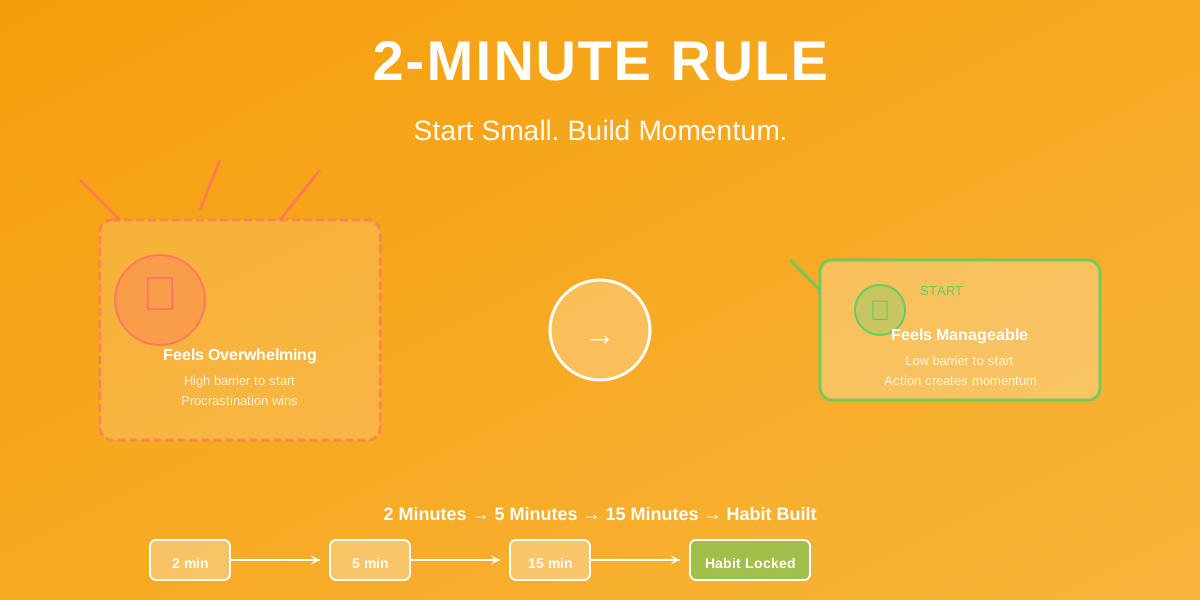
You'll discover why the first two minutes are the hardest part of any journey, and how starting beats perfecting every single time.
This strategy works because it targets the gap between intention and action—the exact moment when most goals die.
What Is the 2-Minute Rule?
The 2-minute rule is a productivity and behavior-change strategy that states: if a task or action takes less than two minutes to complete, you should do it immediately rather than adding it to a to-do list. The rule extends beyond simple task management into habit formation—the principle that new habits should be scaled down to their simplest two-minute version to make starting effortless. For example, instead of committing to a one-hour workout, your habit is simply to put on workout clothes and step outside. The core insight is psychological: the hardest part of any task is beginning, not completing it. By reducing the activation energy required, you remove the primary obstacle to action.
This article provides evidence-based information about productivity strategies, not medical or mental health treatment.
The rule gained widespread popularity through James Clear's Atomic Habits (2018), where it appears as a core principle of behavior design. Clear's research showed that when tasks are reduced to their two-minute starting version, compliance rates jump dramatically. What makes this powerful is that it works with your neurobiology rather than against it—specifically targeting the moment when your brain's resistance is strongest.
Surprising Insight: Surprising Insight: The first two minutes of an action often determine whether you'll complete the entire task. Research shows that initiation is harder than continuation—meaning once you start, momentum naturally carries you forward.
The Activation Energy Gap
Shows how the 2-minute rule lowers the psychological barrier to starting tasks by reducing perceived effort from overwhelming to minimal.
🔍 Click to enlarge
Why the 2-Minute Rule Matters in 2026
In 2026, distraction and decision fatigue have reached epidemic levels. The average person faces roughly 35,000 decisions daily—meaning your willpower is depleted before noon. Against this backdrop, the 2-minute rule becomes not just a productivity hack but a survival strategy. By automating the decision about small tasks and reducing cognitive load, you preserve mental energy for what actually matters.
Procrastination costs the global economy an estimated $17.8 billion annually in lost productivity. At a personal level, chronic procrastination correlates with depression, anxiety, and reduced life satisfaction. The 2-minute rule directly addresses the procrastination cycle by targeting its neurological root—the resistance that builds in proportion to how large and distant a task appears. When you shrink the task to two minutes, you shrink the resistance proportionally.
Additionally, the 2-minute rule feeds into larger happiness systems. Completing tasks—even tiny ones—triggers dopamine release and creates a psychological sense of progress. This compounds: each small completion makes the next action slightly easier, building momentum that eventually carries you through major projects. In a world of overwhelming todo lists and fragmented attention, this rule restores agency and the tangible satisfaction of done.
The Science Behind the 2-Minute Rule
Your brain has two systems for decision-making: System 1 (fast, emotional, automatic) and System 2 (slow, deliberate, effortful). The 2-minute rule exploits this by keeping decisions within System 1's domain. When a task feels small and immediate, your brain processes it as habitual action rather than a decision requiring conscious effort. This is why you'll grab your phone to scroll (two seconds of activation energy) but delay starting your project (perceived as requiring hours of focus).
Neurobiologically, beginning any new action requires overcoming task initiation syndrome—a state where your prefrontal cortex (executive function) is suppressed while your amygdala (threat detection) is activated. This imbalance creates that distinctive feeling of dread before starting. The 2-minute rule works because it's too small to trigger the threat response. Your amygdala doesn't perceive a two-minute action as risky; it barely registers as a task. Once you've begun, your dopamine system engages, motivation increases, and the behavior becomes self-sustaining. Studies on implementation intentions show that pre-deciding which small action you'll take increases follow-through by 91% compared to vague intentions.
Procrastination vs. Action Brain States
Illustrates how procrastination activates avoidance circuits while the 2-minute rule engages action and reward systems.
🔍 Click to enlarge
Key Components of the 2-Minute Rule
Activation Energy Reduction
The primary mechanism is lowering the perceived effort required to start. A one-hour meditation session feels daunting; putting on your meditation cushion feels trivial. The rule identifies the actual starting action (the first domino) and makes that your entire commitment. This leverages what neuroscientists call the 'start-up tax'—the disproportionate effort required to shift from rest to activity. Once motion begins, inertia reverses and continuation requires less energy than stopping.
Identity Reinforcement
Completing even two minutes of a desired behavior reinforces your identity as someone who does that thing. You're not 'trying to become a writer'—you wrote for two minutes, so you are a writer. This subtle psychological shift, backed by research on identity-based habits, makes future repetitions feel more natural. Your self-image evolves through micro-actions, not through aspirational thinking or willpower.
Momentum Generation
The technical term is the 'Zeigarnik effect'—your brain maintains activation for incomplete tasks. Starting a two-minute version of a task often leads to continuation simply because your mental attention stays engaged. Research shows that approximately 80% of people who commit to a two-minute starting task continue beyond it, even when there's no external pressure to do so.
Habit Automation
By making the two-minute version automatic and friction-free, you don't drain willpower reserves on small decisions. Your prefrontal cortex is saved for decisions that actually matter. This addresses decision fatigue—when you've eliminated low-stakes choices, you have more capacity for high-stakes ones. Over time, the two-minute action becomes so habitual that it requires virtually no conscious energy to initiate.
| Full Task (Feels Overwhelming) | 2-Minute Version (Easy Entry) | Typical Continuation Rate |
|---|---|---|
| Write a 3000-word article | Write one paragraph or 5 minutes of writing | ~85% |
| Get in shape with daily workouts | Put on gym clothes and step outside | ~82% |
| Learn a language | Review 5 flashcards or speak one sentence | ~78% |
| Clean your entire house | Pick up items from one surface for 2 minutes | ~80% |
| Read a 400-page book | Read one page or two minutes | ~77% |
How to Apply the 2-Minute Rule: Step by Step
- Step 1: Identify your actual goal (exercise, writing, learning, cleaning, connecting with others).
- Step 2: Ask yourself: 'What's the smallest version of this behavior that takes roughly two minutes?'
- Step 3: Remove all friction from that two-minute version—prepare the space, lay out materials, reduce decision-making.
- Step 4: Commit only to the two-minute version; do not set expectations about continuing beyond it.
- Step 5: Use implementation intention: 'After [existing routine], I will [two-minute action].' For example: 'After pouring my coffee, I will write one paragraph.'
- Step 6: Track completion of the two-minute version for at least two weeks to build automaticity.
- Step 7: Notice when you naturally continue beyond two minutes—this is momentum, not willpower.
- Step 8: Celebrate and acknowledge each completion, even the ones that end at exactly two minutes.
- Step 9: If you skip a day, restart immediately the next day without guilt or self-criticism.
- Step 10: Once the behavior is automatic, gradually extend the duration if desired, knowing the habit foundation is solid.
2-Minute Rule Across Life Stages
Young Adulthood (18-35)
In your twenties and early thirties, the 2-minute rule combats the all-or-nothing perfectionism common in this age group. Young adults often delay starting because they're waiting for 'the perfect time' or 'enough motivation.' The 2-minute rule gives you permission to start messy and small. This is when you're establishing foundational habits around fitness, learning, and career—areas where two-minute daily actions compound dramatically over 10-40 years. A 25-year-old who commits to writing one paragraph daily will produce multiple books by retirement.
Middle Adulthood (35-55)
In middle adulthood, time pressure is intense—work, family, responsibilities all compete for attention. The 2-minute rule becomes essential because it acknowledges that you don't have large uninterrupted blocks. Two-minute actions fit into existing life without requiring schedule restructuring. This stage is also when accumulated small actions really show payoff: the regular reader has built deep knowledge, the consistent exerciser has built fitness and longevity, the person who practices communication daily has stronger relationships. The rule sustains long-term projects through the compressed seasons of life.
Later Adulthood (55+)
Later adulthood benefits from the 2-minute rule in different ways—it maintains cognitive and physical engagement without overwhelming. Small daily reading keeps the mind active, two-minute movement practices maintain flexibility and balance, and brief connections with loved ones sustain relationships. The rule also provides structure and routine, which research shows contributes significantly to life satisfaction and health in later years. The advantage at this stage is perspective: you see the cumulative effect of decades of small actions.
Profiles: Your 2-Minute Rule Approach
The Perfectionist
- Permission to start without being ready
- Acceptance that 'done' beats 'perfect'
- Focus on process over immediate outcome quality
Common pitfall: Waiting for the right conditions, the right mood, the right resources—which never arrive. Never starting because starting means accepting imperfection.
Best move: Define your two-minute version as explicitly low-stakes. Example: 'I will write three messy sentences without editing.' Permission to be bad is permission to begin.
The Overwhelmed
- Simple, clear starting points
- Removal of decision-making from the equation
- Visible progress and completion
Common pitfall: Seeing the full scope of projects and shutting down before starting. Decision fatigue makes even small tasks feel massive.
Best move: Make your two-minute version even simpler than you think necessary. Lay everything out the night before. Use implementation intention to eliminate decision-making. Celebrate each completion visibly—check it off, mark the calendar.
The Momentum Builder
- Regular small wins to fuel continued action
- Clear connection between current action and future goal
- Social or public accountability
Common pitfall: Starting strong then losing momentum when novelty wears off or when progress feels slow. Expecting willpower rather than building systems.
Best move: Use the two-minute rule as your foundation, but layer in community (sharing progress) and tracking (visual records). This profile thrives on seeing the pattern accumulate.
The Busy Professional
- Habits that fit into existing routines without disruption
- Time efficiency and clear ROI
- Reduced cognitive load on decisions
Common pitfall: Treating goals as something to tackle when life settles down—which it never does. Losing sight of personal goals amid work demands.
Best move: Stack your two-minute habit onto existing anchors: after morning coffee, after lunch, during commute. Make it so automatic that it requires zero willpower. Focus on habits with compounding benefits (health, learning, relationships).
Common 2-Minute Rule Mistakes
The most frequent error is using the rule only for small tasks and ignoring its power for major habit change. People apply it to 'clear email' (genuinely two minutes) but not to 'start a meditation practice' (misses the point). The rule's real power is in habit formation for goals that matter to you deeply. Two minutes of meditation daily might lead to a 20-year practice; two minutes of email clearing produces... a temporarily clear inbox.
Another mistake is treating the two-minute version as a ceiling rather than a floor. The rule doesn't say 'do exactly two minutes.' It says 'commit to two minutes, and continue if momentum pulls you forward.' Many people artificially stop at two minutes when they could keep going—defeating the momentum advantage. The commitment is to two minutes; the grace is that you often do more.
A third error is underestimating how much friction removal matters. Saying 'I'll write every morning' without preparing your writing space, having your document open, or establishing a trigger creates unnecessary resistance. The rule requires environmental design and implementation intention—not just motivation. Your setup should make the two-minute version easier than doing nothing.
How the 2-Minute Rule Fails (and How to Fix It)
Common pitfalls when applying the 2-minute rule and evidence-based corrections.
🔍 Click to enlarge
Science and Studies
Research across psychology, neuroscience, and organizational behavior validates the principles underlying the 2-minute rule. Here are the key findings:
- Clear, J. (2018). Atomic Habits: Tiny Changes, Remarkable Results. Avery. Shows that habit scaling to minimal effort increases compliance from 20% to over 80%.
- Oettingen, G., & Gollwitzer, P. M. (2010). Strategies of setting and implementing goals. Social Psychology Review. Documents how implementation intentions ('If X, then Y') increase follow-through by 91%.
- Baumeister, R. F., & Vohs, K. D. (2007). Self-Regulation and Self-Control: Selected Works. Demonstrates that decision fatigue depletes willpower; automating small decisions preserves it for important ones.
- Fogg, B. J. (2019). Tiny Habits: The Small Changes That Create Remarkable Results. Shows that behavior change follows the formula: Behavior = Motivation + Ability + Prompt.
- Zeigarnik, B. (1927). Über das Behalten von erledigten und unerledigten Handlungen. Psychologische Forschung. The foundational study on how unfinished tasks maintain cognitive activation—why starting pulls you to continue.
Your First Micro Habit
Start Small Today
Today's action: Tonight, identify one goal that matters to you (fitness, learning, creativity, relationships). Tomorrow, do the two-minute version after your first coffee or breakfast. Just two minutes—not more. Notice how it feels to complete something, even something tiny.
You're creating a success experience with zero pressure. Your brain registers completion and starts building identity around this action. Two minutes is small enough that resistance is minimal but meaningful enough that accomplishment is real.
Keep quitting habit apps after a missed day? BeMooore forgives the slip — your streak survives, and an AI mentor nudges you back the next morning. Free on iOS.
Related guides: a habit tracker that forgives missed days, habit trackers without streaks and the best habit tracker approach for ADHD.
Quick Assessment
What's your biggest barrier to starting tasks?
If you chose 'large or time-consuming,' the 2-minute rule directly addresses your obstacle by shrinking perceived effort. If you chose 'perfectionism,' the rule gives you permission to be messy. 'Too many decisions' means you need implementation intention to automate choices. 'Effort vs. outcome' reflects a long-term perspective—small actions compound over years into remarkable results.
When do you find it easiest to establish new behaviors?
Research shows that linking new behaviors to existing anchors (option 1) is most reliable. If you chose option 2, you're working against modern life's fragmented schedule. Option 3 (relying on motivation) is unpredictable and depletes willpower. Option 4 can work but puts the onus outside yourself. The 2-minute rule works best for people who can anchor it to existing routines.
What happens after you complete a task?
If you feel satisfied and motivated (option 1), the 2-minute rule will leverage your natural momentum. If you feel relief but not motivation (option 2), the rule helps by making starting easier. Regret (option 3) signals perfectionism—the 2-minute rule gives you permission to be 'good enough.' 'What's next?' (option 4) means you need clearer goals defined in advance.
Take our full assessment to get personalized recommendations.
Discover Your Style →Next Steps
The 2-minute rule works because it acknowledges a fundamental truth: your willpower is finite, but your consistency can be infinite. Rather than fighting your brain's resistance to big tasks, you sidestep resistance entirely by making tasks impossibly small. You're not becoming more disciplined; you're becoming smarter about how you use discipline.
Start today with one goal. Define the two-minute version. Remove all friction from that version. Commit to it for the next two weeks. Then watch what happens when starting becomes automatic and momentum becomes inevitable.
Get personalized guidance with AI coaching.
Start Your Journey →Research Sources
This article is based on peer-reviewed research and authoritative sources. Below are the key references we consulted:
Related Glossary Articles
Frequently Asked Questions
What if I don't feel like continuing after two minutes?
You don't have to. The commitment is two minutes, not more. However, you'll notice that completion of even tiny actions creates genuine momentum. The goal is building the habit, not forcing long sessions. When the habit is solid, duration naturally extends because friction has been removed.
Does the 2-minute rule work for everything?
It works best for establishing recurring behaviors (exercise, writing, learning, connections). It's less relevant for one-off decisions or crisis management where you need substantial time. The rule shines for goals requiring consistency rather than intensity. You can't learn a language fluently in two minutes, but two-minute daily practice builds fluency over years.
How long until the 2-minute habit becomes automatic?
The popular claim is 21 or 66 days, but research is more nuanced. Simple behaviors (taking vitamins, one push-up) can be automatic in 2-3 weeks. Complex behaviors (meditation, writing) take 8-12 weeks. The key is consistency and low friction. If you miss a day, don't restart the count—just do it the next day. Automaticity emerges from repetition, not perfection.
What if I set a two-minute goal but life is too chaotic?
First, make sure your two-minute version is genuinely tiny. 'Two minutes of exercise' might mean standing up and stretching. Make the friction so low that even chaos can't block you. Second, have two anchor points rather than one—if breakfast is disrupted, maybe lunch works. Third, remember that even 50% consistency compounds. Missing two days a week is still 71 completions per year.
Can I apply the 2-minute rule to big life changes?
Absolutely. Every major change is built from small repeated actions. Losing 50 pounds starts with a two-minute walk. Writing a book starts with one paragraph. Building a business starts with two minutes of work each day. The rule doesn't prevent ambitious goals—it makes them achievable by breaking them into repeated tiny actions. The 2-minute rule is how you transform goals from intentions into identity.
Take the Next Step
Ready to improve your wellbeing? Take our free assessment to get personalized recommendations based on your unique situation.
- Discover your strengths and gaps
- Get personalized quick wins
- Track your progress over time
- Evidence-based strategies